TXB0104: TXB0104 Operation Issue

Part Number: TXB0104
Other Parts Discussed in Thread: TXU0304, TXU0104, TXU0204, SN74AXC4T774

Hello.

I have a question regarding the use of the TXB0104.

Side A is connected to a component, while Side B is open. (Figure 1)

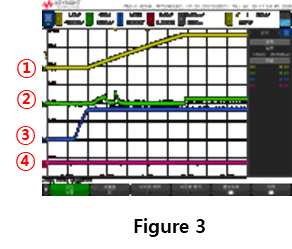
When power is applied, as shown in Figure 2, the pull-up resistor connected to pin 2 operates and goes high. This causes pin 9 of the B side to go high, allowing the component connected to Side A to operate normally. However, occasionally, as shown in Figure 3, pin 2 outputs a low signal before the pull-up resistor connected to pin 2 operates, causing pin 2 to go low and the component connected to Side A to stop functioning.

Is there any reason why pin 2 of Side A outputs a low signal when Side B is open?

Please let me know if there is a replacement part available to resolve this issue. (Pin 2 of Side A must go high when power is applied, and it only needs to operate once upon power application.)
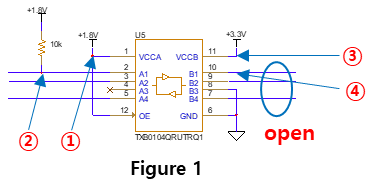
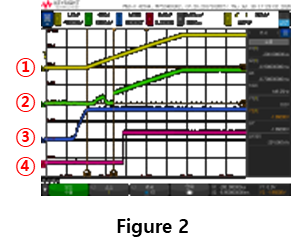
 

image.png

image.png

image.png


  • Hi Suyoung,

    I need more time on this one. 
    Regards,

    Jack

  • The TXB is bidirectional; all I/O pins are both inputs and outputs. The TXB should not be used with pull-up/-down resistors.

    Use the TXU0104/TXU0204/TXU0304 instead.

  • Thank you for your review.

    I am contacting you again because there are still some things I do not understand.

    1) I understand that the TXB's one-short circuit operates only when the input level changes, sending the output to the opposite side. (If the input (A side) is open, the external pull-up resistor on the output (B side) operates first to output to the A side.)

    Should I understand that if the input is open, it is affected by the order of power applied to A and B?

    2) The TXU you recommended is a unidirectional buffer. Although our circuit is open on the board, it needs to be able to operate bidirectionally by connecting an external cable. (The input and output are mixed.) Please check if there are any alternative products available.

  • 1) The TXB is completely disabled when at least one power supply is down. So when the A/B pins are floating or have different voltages during power up, there is no guarantee whether the resulting state is high or low. To ensure that a line is high or low, you have to add pull-up or pull-down resistors on both sides. Also note that 10 kΩ is an invalid value that violates the restriction described in section 7.3.5 of the datasheet.

    2) The TXU devices can have different directions on different channels. If the directions must be selectable at runtime, consider the SN74AXC4T774. The TXB does not need an explicit direction selection, but has many other restrictions (see sections 7.3.2…7.3.5 of the datasheet).

  • We appreciate your suggestion for a replacement, but there are a few restrictions.

    We would be grateful if you could suggest a replacement that satisfies the following conditions:

    1) Currently, changing the PCB is not possible. (Changes are only possible to the same package as the TXB.)

    2) When power is first applied, the A side must always be high.

    3) It must operate bidirectionally.

  • Then the TXB is the only solution. Use 100 kΩ pull-ups on both sides.

    Please review the restrictions in sections 7.3.2…7.3.5.

  • Unfortunately, the PCB cannot be changed. (We are unable to make any modifications to the current PCB.)

    On page 13 of the TXB datasheet, TXS is listed. Is it prohibited to use TXS? (Are there any specific issues with using it?)

    Our board only requires the A side to turn high unconditionally when power is applied.

    Please confirm whether TXS can be used.

  • We have received your inquiry and will follow up shortly.

  • Hello Suyoung, 

    Unlike TXB, TXS is a switch-based level translator that requires pull-up resistors to operate.

    Regards,

    Josh