This thread has been locked.

If you have a related question, please click the "Ask a related question" button in the top right corner. The newly created question will be automatically linked to this question.

TXS0104E: input rise/fall time

Part Number: TXS0104E

Hi Team,

My customer has few questions about TXS0104E input rise/fall time:

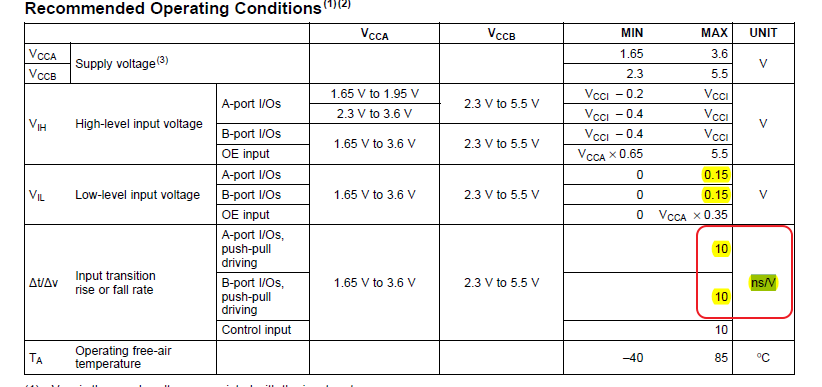
1. Why there is only transition rate requirement of push pull driving?   If my customer use OD driving, what's the transition rate requirement?  
       

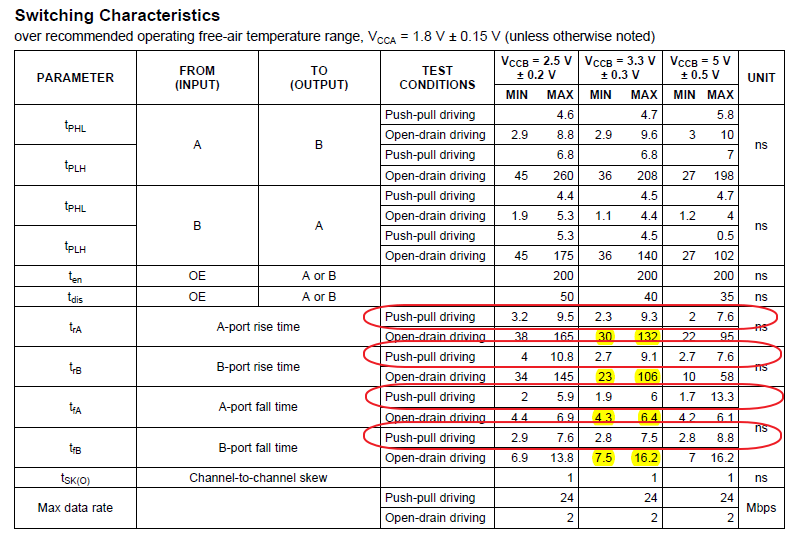
2. How to understand SWITCHING CHARACTERISTICS?  Is this testing data?

    Why Tra different with push-pull and OD driving?

   Tra is output signal rise time at A port  when input signal to B port ?
  • 1) The transition rate should satisfy 10ns/V max at the input of the device. For open drain device, it depends on the strength of the external pull-up resistor(if in case they exist) to achieve that transition rate.
    2)The one-shot will be driving the initial level up to the Vccx supply and then the 10k will take over.
    unless the input signal of the open drain was slow rising (during which the output follows the input which will affect the rise time of the output), the output should not be an order of magnitude apart.

  • 2)Looking at the parameter measurement page in the datasheet, the open drain driver case doesn't have external pull-up resistor and will depend on the internal 10k pull-up resistor. Since the pull-up is not strong enough, the rise time will be slower which will affect the output rise time as well.
  • Hi Shreyas,

    For 1), that is to say, OD driving also needs to meet the Max 10ns/V rate, right?
    For 2), How to define *input signal slow rising*? If input signal of OD driving transition rate <10ns/V, the output rise/fall time still will *be the same as* push pull driving? like 5~6 ns?
  • 1) Yes, it would apply for OD as well.
    2) I would expect both to be similar if the input rise/fall rate is similiar.