


Part Number: AM2634
Application
I’m in the process of evaluating the AM2634 for the control of a 16-phase buck used as a very high current PoL regulator. As such, the phase stability and accuracy of each PWM channel is critical in my application. Also, HRPWM will be needed.
Observations
Using the AM263x Control Card, I’ve tested a few different methods of synchronizing multiple PWM channels.
- Daisy-chaining sync pulses of multiple PWM channels.
- Referencing all but one of the PWM channels’ sync inputs from a single “master” channel.
In either case, the sync pulse is sent every cycle. The performance of these two approaches does vary. However, I do notice significantly more jitter and phase inaccuracy when daisy-chaining. This seems like a reasonable result, as there are more dependencies and greater propagation delay with the daisy-chained approach.

Figure 1 - Daisy-Chaining Sync Pulses: The green persistence plot shows the rising edge of a PWM signal when daisy-chaining sync pulses.
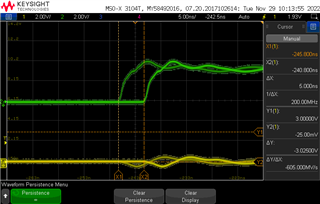
Figure 2 - Common Sync Pulse Reference: The green persistence plot shows the rising edge of a PWM signal when using a common sync input reference.
Question
Is there a better approach I could take than either of the two methods mentioned above? Perhaps a known best practice with this chip which minimizes jitter and maximizes phase offset accuracy?


