This thread has been locked.

If you have a related question, please click the "Ask a related question" button in the top right corner. The newly created question will be automatically linked to this question.

MCU-PLUS-SDK-AM263X: Serial port with timeout not working?

Part Number: MCU-PLUS-SDK-AM263X


Tool/software:

Hi

I have issues with timeout UART_read.

Example is uart_echo:

Added the code at the end between DebugP_log and driversClose like this:

DebugP_log("All tests have passed!!\r\n");

for (int i=0;i<30;i++)
{
trans.buf = &gUartReceiveBuffer[0U];
trans.count = APP_UART_RECEIVE_BUFSIZE;
trans.timeout = 1000;
transferOK = UART_read(gUartHandle[CONFIG_UART_CONSOLE], &trans);

DebugP_log("Read %d -> ok = %d\r\n",i,transferOK);
}


Board_driversClose();

It's a ~1sec timeout read, the serial does not have anything here (using a simple text console to send the 8 characters needed by the example for echo).

The console looks like this:

12345678
All tests have passed!!
Read 0 -> ok = -1
Read 1 -> ok = 0
Read 2 -> ok = 0
Read 3 -> ok = 0

Basically what I get is a FAIL for 1st try and than I get SystemP_SUCCESS no matter how much I try and it is visible that only the 1st try waits the 1 second, after that it returns almost instant.

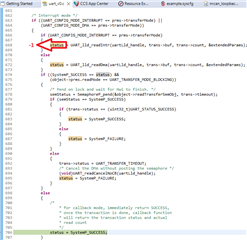
The culprit seems to be this part of uart_v0.c:
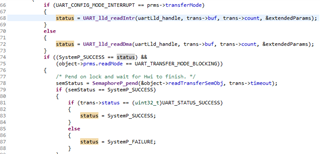
The status seems to be -1 on UART_lld_readIntr which is correct (it must be timeout) by the return of the function is 0. 

Am I doing something wrong? Timeout is not supposed to work with blocking/interrupt?

Best regards,

  • I did more debugging and there is probably a bug in uart_v0.c:

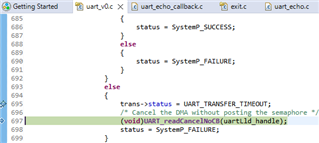
    The status at the red arrow is clearly -1 so UART_lld_readIntr it is still returning timeout (which is correct) however the code will "fix" this Success at line 706 stating:
    /*
    * for callback mode, immediately return SUCCESS,
    * once the transaction is done, callback function
    * will return the transaction status and actual
    * read count
    */

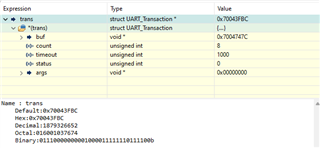
    However the transaction is already altered here, the count is what was requested, not what was read.

    I do not think that SUCCESS is ok here if there were no bytes read and timeout was the reason of exit. Or at least there would need some update of the read count to 0.

    Otherwise no upper level code will know about the failure.

    A good example is XMODEM 1 char receive function from the SDK - if we try to do flush like that will lock himself forever in the flush loop since UART_Read will return SUCCESS all the time regardless of there was real data or not.

    My wild guess is that the if structures are wrongly structured:
    if ((SystemP_SUCCESS == status) &&
    (object->prms.readMode == UART_TRANSFER_MODE_BLOCKING))

    This case is still blocking (no callback): 

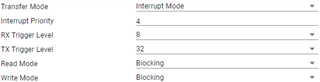
    Also checked that prms.readMode and it is indeed 0 which is UART_TRANSFER_MODE_BLOCKING.

    I would say that the if should be without SystemP_SUCCESS == status and treat the BLOCKING and the CALLBACK modes completely separate.

    Or differentiate at line 706 between the two modes and not return success for BLOCKING?

    Am I missing something or this is really a bug?

  • Hi Barna,

    Thanks for sharing your insights. I can confirm it is a valid bug and the logic handling needs to be changed.

    I have filed the bug (MCUSDK-13380). I will shortly share a patch addressing the issue. 

    Regards,
    Shaunak

  • /*
     * Copyright (C) 2021-2023 Texas Instruments Incorporated
     *
     * Redistribution and use in source and binary forms, with or without
     * modification, are permitted provided that the following conditions
     * are met:
     *
     *   Redistributions of source code must retain the above copyright
     *   notice, this list of conditions and the following disclaimer.
     *
     *   Redistributions in binary form must reproduce the above copyright
     *   notice, this list of conditions and the following disclaimer in the
     *   documentation and/or other materials provided with the
     *   distribution.
     *
     *   Neither the name of Texas Instruments Incorporated nor the names of
     *   its contributors may be used to endorse or promote products derived
     *   from this software without specific prior written permission.
     *
     * THIS SOFTWARE IS PROVIDED BY THE COPYRIGHT HOLDERS AND CONTRIBUTORS
     * "AS IS" AND ANY EXPRESS OR IMPLIED WARRANTIES, INCLUDING, BUT NOT
     * LIMITED TO, THE IMPLIED WARRANTIES OF MERCHANTABILITY AND FITNESS FOR
     * A PARTICULAR PURPOSE ARE DISCLAIMED. IN NO EVENT SHALL THE COPYRIGHT
     * OWNER OR CONTRIBUTORS BE LIABLE FOR ANY DIRECT, INDIRECT, INCIDENTAL,
     * SPECIAL, EXEMPLARY, OR CONSEQUENTIAL DAMAGES (INCLUDING, BUT NOT
     * LIMITED TO, PROCUREMENT OF SUBSTITUTE GOODS OR SERVICES; LOSS OF USE,
     * DATA, OR PROFITS; OR BUSINESS INTERRUPTION) HOWEVER CAUSED AND ON ANY
     * THEORY OF LIABILITY, WHETHER IN CONTRACT, STRICT LIABILITY, OR TORT
     * (INCLUDING NEGLIGENCE OR OTHERWISE) ARISING IN ANY WAY OUT OF THE USE
     * OF THIS SOFTWARE, EVEN IF ADVISED OF THE POSSIBILITY OF SUCH DAMAGE.
     */
    
    /**
     *  \file   UART.c
     *
     *  \brief  This file contains the implementation of UART driver
     */
    
    /* ========================================================================== */
    /*                             Include Files                                  */
    /* ========================================================================== */
    
    /* This is needed for memset/memcpy */
    #include <string.h>
    #include <stdint.h>
    #include <drivers/hw_include/hw_types.h>
    #include <drivers/hw_include/csl_types.h>
    #include <kernel/dpl/AddrTranslateP.h>
    #include <kernel/dpl/ClockP.h>
    #include <kernel/dpl/TaskP.h>
    #include <drivers/uart/v0/lld/uart_lld.h>
    #include <drivers/uart/v0/lld/dma/uart_dma.h>
    
    /* UART Config,DMA structure handles */
    extern UART_DmaHandle       gUartDmaHandle[];
    extern UART_DmaChConfig     gUartDmaChConfig[];
    
    /**
     *  \brief  This API is the callback that gets after UART write completion.
     *
     *  \param  hUart           Handle to the UART instance used
     *  \param  transaction      Structure pointing to the current transaction
     *
     */
    static void UART_lld_writeCompleteCallback(void *args);
    
    /**
     *  \brief  This API is the callback that gets after UART read completion.
     *
     *  \param  hUart           Handle to the UART instance used
     *  \param  transaction     Structure pointing to the current transaction
     *
     */
    static void UART_lld_readCompleteCallback(void *args);
    
    
    /**
     *  \brief  This API is the callback that gets called when a UART error occurs.
     *
     *  \param  hUart           Handle to the UART instance used
     *  \param  transaction     Structure pointing to the current transaction. The transaction
     *                          status holds the error flag.
     *
     */
    static void UART_lld_errorCallback(void *args);
    
    /**
     *  \brief  This function checks the openParameters for UART
     *
     *  \param  prms        Pointer to open parameters. If NULL is passed, then
     *                      default values will be used
     *
     *  \return #SystemP_SUCCESS if started successfully; else error on failure
     */
    static int32_t UART_checkOpenParams(const UART_Params *prms);
    
    /* ========================================================================== */
    /*                           Macros & Typedefs                                */
    /* ========================================================================== */
    
    #define UART_FIFO_CONFIG(txGra, rxGra, txTrig, rxTrig, txClr, rxClr, dmaEnPath, \
                             dmaMode)                                               \
        (((uint32_t) (txGra & 0xFU) << (uint32_t)26U)    |                       \
         ((uint32_t) (rxGra & 0xFU) << (uint32_t)22U)    |                       \
         ((uint32_t) (txTrig & 0xFFU) << (uint32_t)14U)  |                       \
         ((uint32_t) (rxTrig & 0xFFU) << (uint32_t)6U)   |                       \
         ((uint32_t) (txClr & 0x1U) << (uint32_t)5U)     |                       \
         ((uint32_t) (rxClr & 0x1U) << (uint32_t)4U)     |                       \
         ((uint32_t) (dmaEnPath & 0x1U) << (uint32_t)3U) |                       \
         (uint32_t) (dmaMode & 0x7U))
    
    #define UART_FIFO_CONFIG_TXGRA          ((uint32_t) 0xFU << 26)
    #define UART_FIFO_CONFIG_RXGRA          ((uint32_t) 0xFU << 22)
    #define UART_FIFO_CONFIG_TXTRIG         ((uint32_t) 0xFFU << 14)
    #define UART_FIFO_CONFIG_RXTRIG         ((uint32_t) 0xFFU << 6)
    #define UART_FIFO_CONFIG_TXCLR          ((uint32_t) 0x1U << 5)
    #define UART_FIFO_CONFIG_RXCLR          ((uint32_t) 0x1U << 4)
    #define UART_FIFO_CONFIG_DMAENPATH      ((uint32_t) 0x1U << 3)
    #define UART_FIFO_CONFIG_DMAMODE        ((uint32_t) 0x7U << 0)
    
    #define UART_TRIG_LVL_GRANULARITY_4     ((uint32_t) 0x0000U)
    #define UART_TRIG_LVL_GRANULARITY_1     ((uint32_t) 0x0001U)
    
    #define UART_DMA_EN_PATH_FCR            (UART_SCR_DMA_MODE_CTL_DMA_MODE_CTL_VALUE_0)
    #define UART_DMA_EN_PATH_SCR            (UART_SCR_DMA_MODE_CTL_DMA_MODE_CTL_VALUE_1)
    
    #define UART_INT2_RX_EMPTY              (UART_IER2_EN_RXFIFO_EMPTY_MASK)
    #define UART_INT2_TX_EMPTY              (UART_IER2_EN_TXFIFO_EMPTY_MASK)
    
    #define UART_DMA_MODE_0_ENABLE          (UART_SCR_DMA_MODE_2_DMA_MODE_2_VALUE_0)
    #define UART_DMA_MODE_1_ENABLE          (UART_SCR_DMA_MODE_2_DMA_MODE_2_VALUE_1)
    #define UART_DMA_MODE_2_ENABLE          (UART_SCR_DMA_MODE_2_DMA_MODE_2_VALUE_2)
    #define UART_DMA_MODE_3_ENABLE          (UART_SCR_DMA_MODE_2_DMA_MODE_2_VALUE_3)
    
    #define UART_MIR_OVERSAMPLING_RATE_41   ((uint32_t) 41U)
    #define UART_MIR_OVERSAMPLING_RATE_42   ((uint32_t) 42U)
    
    #define UART_BREAK_COND_DISABLE         (UART_LCR_BREAK_EN_BREAK_EN_VALUE_0 \
                                                << UART_LCR_BREAK_EN_SHIFT)
    #define UART_BREAK_COND_ENABLE          (UART_LCR_BREAK_EN_BREAK_EN_VALUE_1 \
                                                << UART_LCR_BREAK_EN_SHIFT)
    #define UART_NO_HARDWARE_FLOW_CONTROL    (UART_EFR_HW_NO_FLOW_CONTROL_VALUE)
    #define UART_RTS_ENABLE                  (UART_EFR_HW_ENABLE_RTS_VALUE)
    #define UART_CTS_ENABLE                  (UART_EFR_HW_ENALE_CTS_VALUE)
    #define UART_RTS_CTS_ENABLE              (UART_EFR_HW_ENABLE_RTS_CTS_FLOW_CONTROL_VALUE)
    
    #define UART_TIMEOUTL                       (0x98U)
    #define UART_TIMEOUTH                       (0x9CU)
    
    #define UART_EFR2                             (0x8CU)
    #define UART_EFR2_TIMEOUT_BEHAVE_SHIFT        (0x6U)
    #define UART_EFR2_TIMEOUT_BEHAVE_MASK         (0x6U)
    
    /* ========================================================================== */
    /*                         Structures and Enums                               */
    /* ========================================================================== */
    
    typedef struct
    {
        void                   *lock;
        /**< Driver lock - to protect across open/close */
        SemaphoreP_Object       lockObj;
        /**< Driver lock object */
    } UART_DrvObj;
    
    /* ========================================================================== */
    /*                            Global Variables                                */
    /* ========================================================================== */
    
    /** \brief Driver object */
    static UART_DrvObj     gUartDrvObj =
    {
        .lock           = NULL,
    };
    
    /* ========================================================================== */
    /*                          Function Definitions                              */
    /* ========================================================================== */
    
    void UART_init(void)
    {
        int32_t         status;
        uint32_t        cnt;
        UART_Object    *object;
    
        /* Init each driver instance object */
        for (cnt = 0U; cnt < gUartConfigNum; cnt++)
        {
            /* initialize object varibles */
            object = gUartConfig[cnt].object;
            DebugP_assert(NULL_PTR != object);
            (void)memset(object, 0, sizeof(UART_Object));
            gUartConfig[cnt].attrs->baseAddr = (uint32_t) AddrTranslateP_getLocalAddr((uint64_t)gUartConfig[cnt].attrs->baseAddr);
        }
    
        /* Create driver lock */
        status = SemaphoreP_constructMutex(&gUartDrvObj.lockObj);
        if(SystemP_SUCCESS == status)
        {
            gUartDrvObj.lock = &gUartDrvObj.lockObj;
        }
    
        return;
    }
    
    void UART_deinit(void)
    {
        /* Delete driver lock */
        if(NULL != gUartDrvObj.lock)
        {
            SemaphoreP_destruct(&gUartDrvObj.lockObj);
            gUartDrvObj.lock = NULL;
        }
    
        return;
    }
    
    static int32_t UART_checkOpenParams(const UART_Params *prms)
    {
        int32_t     status = SystemP_SUCCESS;
    
        if((UART_TRANSFER_MODE_CALLBACK == prms->readMode) &&
           (NULL_PTR == prms->readCallbackFxn))
        {
            status = SystemP_FAILURE;
        }
        if((UART_TRANSFER_MODE_CALLBACK == prms->writeMode) &&
           (NULL_PTR == prms->writeCallbackFxn))
        {
            status = SystemP_FAILURE;
        }
    
        return (status);
    }
    
    UART_Handle UART_open(uint32_t index, const UART_Params *prms)
    {
        int32_t             status = SystemP_SUCCESS;
        UART_Handle         handle = NULL;
        UART_Config        *config = NULL;
        UART_Object        *object    = NULL;
        const UART_Attrs   *attrs;
        HwiP_Params         hwiPrms;
        UARTLLD_Handle      uartLld_handle;
        UARTLLD_InitHandle  uartLldInit_handle;
    
        /* Check index */
        if(index >= gUartConfigNum)
        {
            status = SystemP_FAILURE;
        }
        else
        {
            config = &gUartConfig[index];
        }
    
        DebugP_assert(NULL_PTR != gUartDrvObj.lock);
        (void)SemaphoreP_pend(&gUartDrvObj.lockObj, SystemP_WAIT_FOREVER);
    
        if(SystemP_SUCCESS  == status)
        {
            object = config->object;
            attrs  = config->attrs;
            DebugP_assert(NULL_PTR != object);
            if(TRUE == object->isOpen)
            {
                /* Handle is already opened */
                status = SystemP_FAILURE;
            }
        }
    
        if(SystemP_SUCCESS == status)
        {
            /* Init state */
            object->handle = (UART_Handle) config;
            if(NULL != prms)
            {
                ( void )memcpy(&object->prms, prms, sizeof(UART_Params));
            }
            else
            {
                /* Init with default if NULL is passed */
                UART_Params_init(&object->prms);
    
            }
    
             /*  Mapping HLD parameter with LLD. */
            object->uartLld_handle             = &object->uartLld_object;
            uartLld_handle                     = object->uartLld_handle;
    
            object->uartLld_initHandle         = &object->uartLld_initObject;
            uartLldInit_handle                 = object->uartLld_initHandle;
    
            uartLld_handle->hUartInit          = uartLldInit_handle;
            uartLld_handle->baseAddr           = attrs->baseAddr;
            uartLld_handle->args               = (void *)object->handle;
            uartLld_handle->writeBuf           = object->writeBuf;
            uartLld_handle->writeCount         = object->writeCount;
            uartLld_handle->writeSizeRemaining = object->writeSizeRemaining;
            uartLld_handle->readBuf            = object->readBuf;
            uartLld_handle->readCount          = object->readCount;
            uartLld_handle->readSizeRemaining  = object->readSizeRemaining;
            uartLld_handle->rxTimeoutCnt       = object->rxTimeoutCnt;
            uartLld_handle->readErrorCnt       = object->readErrorCnt;
            uartLld_handle->state              = UART_STATE_RESET;
    
            uartLldInit_handle->inputClkFreq      = attrs->inputClkFreq;
            uartLldInit_handle->baudRate          = object->prms.baudRate;
            uartLldInit_handle->baudRate          = object->prms.baudRate;
            uartLldInit_handle->dataLength        = object->prms.dataLength;
            uartLldInit_handle->stopBits          = object->prms.stopBits;
            uartLldInit_handle->parityType        = object->prms.parityType;
            uartLldInit_handle->readReturnMode    = object->prms.readReturnMode;
            uartLldInit_handle->hwFlowControl     = object->prms.hwFlowControl;
            uartLldInit_handle->hwFlowControlThr  = object->prms.hwFlowControlThr;
            uartLldInit_handle->intrNum           = object->prms.intrNum;
            uartLldInit_handle->transferMode      = object->prms.transferMode;
            uartLldInit_handle->intrPriority      = object->prms.intrPriority;
            uartLldInit_handle->operMode          = object->prms.operMode;
            uartLldInit_handle->rxTrigLvl         = object->prms.rxTrigLvl;
            uartLldInit_handle->txTrigLvl         = object->prms.txTrigLvl;
            uartLldInit_handle->uartDmaHandle     = NULL;
            uartLldInit_handle->dmaChCfg          = NULL;
            uartLldInit_handle->rxEvtNum          = object->prms.rxEvtNum;
            uartLldInit_handle->txEvtNum          = object->prms.txEvtNum;
            uartLldInit_handle->writeMode         = object->prms.writeMode;
            uartLldInit_handle->readMode          = object->prms.readMode;
            uartLldInit_handle->timeGuardVal      = object->prms.timeGuardVal;
            uartLldInit_handle->clockP_get        = ClockP_getTicks;
            uartLldInit_handle->clockP_usecToTick = ClockP_usecToTicks;
            /* Read, Write & Error callback Functions */
            uartLldInit_handle->readCompleteCallbackFxn =  UART_lld_readCompleteCallback;
            uartLldInit_handle->writeCompleteCallbackFxn = UART_lld_writeCompleteCallback;
            uartLldInit_handle->errorCallbackFxn =         UART_lld_errorCallback;
    
            /* Check open parameters */
            status = UART_checkOpenParams(&object->prms);
        }
    
        if(SystemP_SUCCESS == status)
        {
            uartLld_handle->state = UART_STATE_RESET;
    
            /* If DMA is enabled, program DMA */
            if(UART_CONFIG_MODE_DMA == object->prms.transferMode)
            {
                uartLldInit_handle->uartDmaHandle = (UART_DmaHandle) gUartDmaHandle[index];
                uartLldInit_handle->dmaChCfg      = gUartDmaChConfig[index];
                status = UART_lld_initDma(uartLld_handle);
            }
            else
            {
                status = UART_lld_init(uartLld_handle);
                object->uartDmaHandle = NULL;
            }
    
            if(SystemP_SUCCESS == status)
            {
                /* Create instance lock */
                status = SemaphoreP_constructMutex(&object->lockObj);
                if(SystemP_SUCCESS == status)
                {
                    object->lock = &object->lockObj;
                }
                /* Create transfer sync semaphore */
                status += SemaphoreP_constructBinary(&object->readTransferSemObj, 0U);
                if(SystemP_SUCCESS == status)
                {
                    object->readTransferSem = &object->readTransferSemObj;
                    uartLld_handle->readTransferMutex = object->readTransferSem;
                }
                status += SemaphoreP_constructBinary(&object->writeTransferSemObj, 0U);
                if(SystemP_SUCCESS == status)
                {
                    object->writeTransferSem = &object->writeTransferSemObj;
                    uartLld_handle->writeTransferMutex = object->writeTransferSem;
                }
    
                /* Register interrupt */
                if((UART_CONFIG_MODE_INTERRUPT == object->prms.transferMode) && (TRUE != object->prms.skipIntrReg))
                {
                    DebugP_assert(object->prms.intrNum != 0xFFFFU);
                    HwiP_Params_init(&hwiPrms);
                    hwiPrms.intNum      = object->prms.intrNum;
                    hwiPrms.callback    = &UART_lld_controllerIsr;
                    hwiPrms.priority    = object->prms.intrPriority;
                    hwiPrms.args        = (void *) uartLld_handle;
                    status += HwiP_construct(&object->hwiObj, &hwiPrms);
                    if(SystemP_SUCCESS == status)
                    {
                        object->hwiHandle = &object->hwiObj;
                    }
                }
            }
        }
    
        if(SystemP_SUCCESS == status)
        {
            object->isOpen = TRUE;
            handle = (UART_Handle) config;
        }
    
        SemaphoreP_post(&gUartDrvObj.lockObj);
    
        /* Free-up resources in case of error */
        if(SystemP_SUCCESS != status)
        {
            if(NULL != config)
            {
                UART_close((UART_Handle) config);
            }
        }
    
        return (handle);
    }
    
    UART_Handle UART_getHandle(uint32_t index)
    {
        UART_Handle         handle = NULL;
    
        /* Check index */
        if(index < gUartConfigNum)
        {
            UART_Object *object;
    
            object = gUartConfig[index].object;
    
            if(object && (TRUE == object->isOpen))
            {
                /* valid handle */
                handle = object->handle;
            }
        }
    
        return handle;
    }
    
    void UART_close(UART_Handle handle)
    {
        UART_Config        *config;
        UART_Object        *object;
        const UART_Attrs   *attrs;
    
        config = (UART_Config *) handle;
        UARTLLD_Handle      uartLld_handle;
    
        if ((NULL != config) && (config->object != NULL) && (config->object->isOpen != FALSE))
        {
            object = config->object;
            attrs = config->attrs;
            object->uartLld_handle = &object->uartLld_object;
            uartLld_handle = object->uartLld_handle;
            DebugP_assert(NULL_PTR != object);
            DebugP_assert(NULL_PTR != attrs);
    
            DebugP_assert(NULL_PTR != gUartDrvObj.lock);
            (void)SemaphoreP_pend(&gUartDrvObj.lockObj, SystemP_WAIT_FOREVER);
    
            /* Flush TX FIFO */
            UART_flushTxFifo(handle);
    
            /* Disable UART and interrupts. */
            UART_intrDisable(attrs->baseAddr,
                           UART_INTR_RHR_CTI | UART_INTR_THR | UART_INTR_LINE_STAT);
            UART_intr2Disable(attrs->baseAddr, UART_INT2_TX_EMPTY);
            (void)UART_operatingModeSelect(attrs->baseAddr, UART_OPER_MODE_DISABLED);
    
            if(UART_CONFIG_MODE_DMA == object->prms.transferMode)
            {
                (void)UART_lld_deInitDma(uartLld_handle);
            }
            else
            {
                (void)UART_lld_deInit(uartLld_handle);
            }
            if(NULL != object->lock)
            {
                SemaphoreP_destruct(&object->lockObj);
                object->lock = NULL;
            }
            if(NULL != object->readTransferSem)
            {
                SemaphoreP_destruct(&object->readTransferSemObj);
                object->readTransferSem = NULL;
                uartLld_handle->readTransferMutex = NULL;
            }
            if(NULL != object->writeTransferSem)
            {
                SemaphoreP_destruct(&object->writeTransferSemObj);
                object->writeTransferSem = NULL;
                uartLld_handle->writeTransferMutex = NULL;
            }
            if(NULL != object->hwiHandle)
            {
                HwiP_destruct(&object->hwiObj);
                object->hwiHandle = NULL;
            }
    
            object->isOpen = FALSE;
            SemaphoreP_post(&gUartDrvObj.lockObj);
        }
    
        return;
    }
    
    int32_t UART_write(UART_Handle handle, UART_Transaction *trans)
    {
        int32_t             status = SystemP_SUCCESS, semStatus = SystemP_SUCCESS;
        UART_Config        *config;
        UART_Object        *object;
        const UART_Attrs   *attrs;
        UART_Params        *prms;
        uintptr_t           key;
        UARTLLD_Handle      uartLld_handle;
        UART_ExtendedParams extendedParams;
    
        /* Check parameters */
        if ((NULL_PTR == handle) || (NULL_PTR == trans))
        {
            status = SystemP_FAILURE;
        }
    
        if(SystemP_SUCCESS == status)
        {
            config  = (UART_Config *) handle;
            object  = config->object;
            attrs   = config->attrs;
            prms    = &config->object->prms;
            uartLld_handle = object->uartLld_handle;
            object->writeTrans = trans;
    
            DebugP_assert(NULL_PTR != object);
            DebugP_assert(NULL_PTR != attrs);
    
            /* Assinging the Extended Parameters */
            extendedParams.args = trans->args;
    
        }
    
        if(SystemP_SUCCESS == status)
        {
            /* When User Managed Interrupt is set, user need to manage the read/write operation */
            if (TRUE == prms->skipIntrReg)
            {
                status = SystemP_FAILURE;
            }
        }
    
        if(SystemP_SUCCESS == status)
        {
            key = HwiP_disable();
    
            HwiP_restore(key);
    
            uartLld_handle->state = UART_STATE_READY;
    
            /* Interrupt mode */
            if ((UART_CONFIG_MODE_INTERRUPT == prms->transferMode) ||
                (UART_CONFIG_MODE_DMA == prms->transferMode))
            {
                if (UART_CONFIG_MODE_INTERRUPT == prms->transferMode)
                {
                    status = UART_lld_writeIntr(uartLld_handle, trans->buf, trans->count, &extendedParams);
                }
                else
                {
                    status = UART_lld_writeDma(uartLld_handle, trans->buf, trans->count, &extendedParams);
                }
                if (SystemP_SUCCESS == status)
                {
                    if(object->prms.writeMode == UART_TRANSFER_MODE_BLOCKING)
                    {
                        /* Pend on lock and wait for Hwi to finish. */
                        semStatus = SemaphoreP_pend(&object->writeTransferSemObj, trans->timeout);
                        if (semStatus == SystemP_SUCCESS)
                        {
                            if (trans->status == (uint32_t)UART_STATUS_SUCCESS)
                            {
                                status = SystemP_SUCCESS;
                            }
                            else
                            {
                                status = SystemP_FAILURE;
                            }
                        }
                        else
                        {
                            trans->status = UART_TRANSFER_TIMEOUT;
                            /* Cancel the DMA without posting the semaphore */
                            (void)UART_writeCancelNoCB(uartLld_handle);
                            status = SystemP_FAILURE;
                        }
                    }
                    else
                    {
                        /*
                            * for callback mode, immediately return SUCCESS,
                            * once the transaction is done, callback function
                            * will return the transaction status and actual
                            * write count
                            */
                        status = SystemP_SUCCESS;
                    }
                }
            }
            else
            {
                /* Polled mode */
                status = UART_lld_write(uartLld_handle, trans->buf, trans->count, trans->timeout, &extendedParams);
            }
        }
    
        return (status);
    }
    
    int32_t UART_read(UART_Handle handle, UART_Transaction *trans)
    {
        int32_t             status = SystemP_SUCCESS, semStatus = SystemP_SUCCESS;
        UART_Config        *config;
        UART_Object        *object;
        const UART_Attrs   *attrs;
        UART_Params        *prms;
        uintptr_t           key;
        UARTLLD_Handle      uartLld_handle;
        UART_ExtendedParams extendedParams;
    
        /* Check parameters */
        if ((NULL_PTR == handle) || (NULL_PTR == trans))
        {
            status = SystemP_FAILURE;
        }
    
        if(SystemP_SUCCESS == status)
        {
            config  = (UART_Config *) handle;
            object  = config->object;
            attrs   = config->attrs;
            prms    = &config->object->prms;
            uartLld_handle = object->uartLld_handle;
            object->readTrans = trans;
    
            DebugP_assert(NULL_PTR != object);
            DebugP_assert(NULL_PTR != attrs);
    
            /* Assinging the Extended Parameters */
            extendedParams.args = trans->args;
        }
    
        if(SystemP_SUCCESS == status)
        {
            /* When User Managed Interrupt is set, user need to manage the read/write operation */
            if (TRUE == prms->skipIntrReg)
            {
                status = SystemP_FAILURE;
            }
        }
    
        if(SystemP_SUCCESS == status)
        {
            key = HwiP_disable();
    
            HwiP_restore(key);
    
            /* Interrupt mode */
            if ((UART_CONFIG_MODE_INTERRUPT == prms->transferMode) ||
                (UART_CONFIG_MODE_DMA == prms->transferMode))
            {
                if (UART_CONFIG_MODE_INTERRUPT == prms->transferMode)
                {
                    status = UART_lld_readIntr(uartLld_handle, trans->buf, trans->count, &extendedParams);
                }
                else
                {
                    status = UART_lld_readDma(uartLld_handle, trans->buf, trans->count, &extendedParams);
                }
                if(SystemP_SUCCESS == status)
                {
                    if(object->prms.readMode == UART_TRANSFER_MODE_BLOCKING)
                    {
                        /* Pend on lock and wait for Hwi to finish. */
                        semStatus = SemaphoreP_pend(&object->readTransferSemObj, trans->timeout);
                        if (semStatus == SystemP_SUCCESS)
                        {
                            if (trans->status == (uint32_t)UART_STATUS_SUCCESS)
                            {
                                status = SystemP_SUCCESS;
                            }
                            else
                            {
                                status = SystemP_FAILURE;
                            }
                        }
                        else
                        {
                            trans->status = UART_TRANSFER_TIMEOUT;
                            /* Cancel the DMA without posting the semaphore */
                            (void)UART_readCancelNoCB(uartLld_handle);
                            status = SystemP_FAILURE;
                        }
                    }
                    else
                    {
                        /*
                            * for callback mode, immediately return SUCCESS,
                            * once the transaction is done, callback function
                            * will return the transaction status and actual
                            * read count
                            */
                        status = SystemP_SUCCESS;
                    }
                }
            }
            else
            {
                /* Polled mode */
                status = UART_lld_read(uartLld_handle, trans->buf, trans->count, trans->timeout, &extendedParams);
            }
        }
    
        return (status);
    }
    
    int32_t UART_writeCancel(UART_Handle handle, UART_Transaction *trans)
    {
        int32_t             status = SystemP_SUCCESS;
        UART_Config        *config;
        UART_Object        *object;
        UART_Params        *prms;
        UARTLLD_Handle      uartLld_handle;
    
        /* Check parameters */
        if((NULL == handle) || (NULL == trans))
        {
            status = SystemP_FAILURE;
        }
    
        if(SystemP_SUCCESS == status)
        {
            config = (UART_Config *) handle;
            object = config->object;
            prms    = &config->object->prms;
            DebugP_assert(NULL != object);
            uartLld_handle = object->uartLld_handle;
    
            /* When User Managed Interrupt is set, user need to manage the read/write operation */
            if (TRUE == prms->skipIntrReg)
            {
                status = SystemP_FAILURE;
            }
        }
    
        if(SystemP_SUCCESS == status)
        {
            status = UART_lld_writeCancel(uartLld_handle, trans);
            if(SystemP_SUCCESS == status)
            {
                object->writeTrans->status = UART_TRANSFER_STATUS_CANCELLED;
                /*
                * Post transfer Sem in case of bloacking transfer.
                * Call the callback function in case of Callback mode.
                */
                if (object->prms.writeMode == UART_TRANSFER_MODE_CALLBACK)
                {
                     object->prms.writeCallbackFxn((UART_Handle) config, object->writeTrans);
                }
                else
                {
                    (void)SemaphoreP_post(&object->writeTransferSemObj);
                }
                object->writeTrans = NULL;
            }
            else
            {
                trans->status = UART_TRANSFER_STATUS_ERROR_OTH;
                status = SystemP_FAILURE;
            }
        }
    
        return (status);
    }
    
    int32_t UART_readCancel(UART_Handle handle, UART_Transaction *trans)
    {
        int32_t             status = SystemP_SUCCESS;
        UART_Config        *config;
        UART_Object        *object;
        UART_Params        *prms;
        UARTLLD_Handle      uartLld_handle;
    
        /* Check parameters */
        if((NULL == handle) || (NULL == trans))
        {
            status = SystemP_FAILURE;
        }
    
        if(SystemP_SUCCESS == status)
        {
            config = (UART_Config *) handle;
            object = config->object;
            prms    = &config->object->prms;
            uartLld_handle = object->uartLld_handle;
            DebugP_assert(NULL != object);
    
            /* When User Managed Interrupt is set, user need to manage the read/write operation */
            if (TRUE == prms->skipIntrReg)
            {
                status = SystemP_FAILURE;
            }
        }
    
        if(SystemP_SUCCESS == status)
        {
            status = UART_lld_readCancel(uartLld_handle, trans);
            if (status == SystemP_SUCCESS)
            {
                object->readTrans->status = UART_TRANSFER_STATUS_CANCELLED;
                if (object->prms.readMode == UART_TRANSFER_MODE_CALLBACK)
                {
                    object->prms.readCallbackFxn((UART_Handle) config, object->readTrans);
                }
                else
                {
                    (void)SemaphoreP_post(&object->readTransferSemObj);
                }
                object->readTrans = NULL;
            }
            else
            {
                trans->status = UART_TRANSFER_STATUS_ERROR_OTH;
                status = SystemP_FAILURE;
            }
        }
    
        return (status);
    }
    
    void UART_flushTxFifo(UART_Handle handle)
    {
        UART_Config        *config;
        const UART_Attrs   *attrs;
        uint32_t            isTxFifoEmpty, startTicks, elapsedTicks;
        uint32_t            timeout = UART_TRANSMITEMPTY_TRIALCOUNT;
        uint32_t            timeoutElapsed  = FALSE;
    
        config = (UART_Config *) handle;
    
        if (NULL != config)
        {
            attrs = config->attrs;
            DebugP_assert(NULL_PTR != attrs);
    
            /* Update current tick value to perform timeout operation */
            startTicks = ClockP_getTicks();
            while (FALSE == timeoutElapsed)
            {
                /* Get TX FIFO status */
                isTxFifoEmpty = UART_spaceAvail(attrs->baseAddr);
                if (TRUE == isTxFifoEmpty)
                {
                    /* FIFO and Shift register is empty */
                    break;
                }
    
                /* Check whether timeout happened or not */
                elapsedTicks = ClockP_getTicks() - startTicks;
                if (elapsedTicks >= timeout)
                {
                    /* timeout occured */
                    timeoutElapsed = TRUE;
                }
                else
                {
                    TaskP_yield();
                }
            }
            DebugP_assert(FALSE == timeoutElapsed);
        }
    
        return;
    }
    
    static void UART_lld_writeCompleteCallback(void *args)
    {
        UART_Config   *config;
        UART_Object   *obj;
    
        UARTLLD_Handle hUart = (UARTLLD_Handle)args;
    
        if(NULL_PTR != hUart)
        {
            UART_Handle handle = (UART_Handle)hUart->args;
            if(NULL_PTR != handle)
            {
                config = (UART_Config *) handle;
                obj = config->object;
                obj->writeTrans->count = hUart->writeTrans.count;
                if (obj->prms.writeMode == UART_TRANSFER_MODE_CALLBACK)
                {
                    obj->prms.writeCallbackFxn(hUart, &hUart->writeTrans);
                }
                else
                {
                    SemaphoreP_post((SemaphoreP_Object *)hUart->writeTransferMutex);
                }
            }
        }
    
    }
    
    static void UART_lld_readCompleteCallback(void *args)
    {
        UART_Config   *config;
        UART_Object   *obj;
    
        UARTLLD_Handle hUart = (UARTLLD_Handle)args;
    
        if(NULL_PTR != hUart)
        {
            UART_Handle handle = (UART_Handle)hUart->args;
            if(NULL_PTR != handle)
            {
                config = (UART_Config *) handle;
                obj = config->object;
                obj->readTrans->count = hUart->readTrans.count;
                if (obj->prms.readMode == UART_TRANSFER_MODE_CALLBACK)
                {
                    obj->prms.readCallbackFxn(hUart, &hUart->readTrans);
                }
                else
                {
                    SemaphoreP_post((SemaphoreP_Object *)hUart->readTransferMutex);
                }
            }
        }
    }
    
    static void UART_lld_errorCallback(void *args)
    {
        UART_NOT_IN_USE(args);
    }
    
    /**
     *  \brief  Function to initialize the #UART_Params struct to its defaults
     *
     *  \param  trans       Pointer to #UART_Params structure for
     *                      initialization
     */
    void UART_Params_init(UART_Params *prms)
    {
        if(prms != NULL)
        {
            prms->baudRate           = 115200U;
            prms->dataLength         = UART_LEN_8;
            prms->stopBits           = UART_STOPBITS_1;
            prms->parityType         = UART_PARITY_NONE;
            prms->readMode           = UART_TRANSFER_MODE_BLOCKING;
            prms->readReturnMode     = UART_READ_RETURN_MODE_FULL;
            prms->writeMode          = UART_TRANSFER_MODE_BLOCKING;
            prms->readCallbackFxn    = NULL;
            prms->writeCallbackFxn   = NULL;
            prms->hwFlowControl      = FALSE;
            prms->hwFlowControlThr   = UART_RXTRIGLVL_16;
            prms->intrNum            = 0xFFFF;
            prms->transferMode       = UART_CONFIG_MODE_INTERRUPT;
            prms->intrPriority       = 4U;
            prms->skipIntrReg        = FALSE;
            prms->uartDmaIndex       = -1;
            prms->operMode           = UART_OPER_MODE_16X;
            prms->rxTrigLvl          = UART_RXTRIGLVL_8;
            prms->txTrigLvl          = UART_TXTRIGLVL_32;
        }
    }
    
    /**
     *  \brief  Function to initialize the #UART_Transaction struct to its defaults
     *
     *  \param  trans       Pointer to #UART_Transaction structure for
     *                      initialization
     */
    void UART_Transaction_init(UART_Transaction *trans)
    {
        if(trans != NULL)
        {
            trans->buf              = NULL;
            trans->count            = 0U;
            trans->timeout          = SystemP_WAIT_FOREVER;
            trans->status           = UART_STATUS_SUCCESS;
            trans->args             = NULL;
        }
    }
    
    /* ========================================================================== */
    /*                       Advanced Function Definitions                        */
    /* ========================================================================== */
    
    uint32_t UART_getBaseAddr(UART_Handle handle)
    {
        UART_Config       *config;
        UART_Attrs        *attrs;
        uint32_t           baseAddr;
    
        /* Check parameters */
        if (NULL_PTR == handle)
        {
            baseAddr = 0U;
        }
        else
        {
            config = (UART_Config *) handle;
            attrs = config->attrs;
            baseAddr = attrs->baseAddr;
        }
    
        return baseAddr;
    }
    

    Hi Barna,

    I am attaching the updated uart_v0.c driver file. The file has changes in UART_read() and UART_write() APIs to handle the error situations.

    Please replace your uart_v0.c file with the new version I have attached and rebuild your drivers lib using the following command:

    #TO CLEAN EXISTING LIB
    gmake -sj -f makefile.am263x drivers_r5f.ti-arm-clang_clean
    
    #TO BUILD A RELEASE VERSION OF DRIVERS LIB
    gmake -sj -f makefile.am263x drivers_r5f.ti-arm-clang
    
    #To build/clean a DEBUG lib, pass the following flag to the above commands PROFILE=debug

    Then rebuild your application so the new drivers.lib gets linked correctly.

    Regards,
    Shaunak

  • The fix works, more importantly managed to convert the existing sdk XMODEM to work under Freertos with this fix.

    TY for the quick fix

  • There is still something - if I start to use this timeout variant after a while I get "in_USE" errors here:

    It should be timeout, not inuse ... Somewhere the read transaction is not freed up in timeout case.

  • Hi Barna Csenteri,

    I will look into it and get back with my findings,

    Regards,
    Shaunak

  • Hi Barna,

    Are you getting the in_use errors when some transaction is in progress?

    Regards,
    Shaunak

  • Hi

    No - the first read returns timeout and the rest is going in this way.

    Steps to reproduce:

    - take the same example (uart echo freertos)

    - use the uart_v0,c sent by you with recompiled kernel

    - Modify my testcode to display the transaction status:

    DebugP_log("All tests have passed!!\r\n");

    for (int i=0;i<30;i++)
    {
    UART_Transaction_init(&trans);
    trans.buf = &gUartReceiveBuffer[0U];
    trans.count = APP_UART_RECEIVE_BUFSIZE;
    trans.timeout = 1000;
    transferOK = UART_read(gUartHandle[CONFIG_UART_CONSOLE], &trans);
    DebugP_log("Read %d -> ok = %d %d\r\n",i,transferOK, trans.status);
    }

    Board_driversClose();
    Drivers_close();

    Result on console will be:
    [Cortex_R5_0] [UART] Echo example started ...
    All tests have passed!!
    Read 0 -> ok = -1 -2
    Read 1 -> ok = -1 0
    Read 2 -> ok = -1 0
    Read 3 -> ok = -1 0

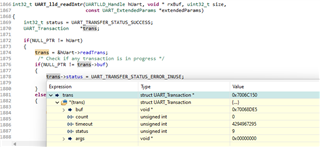
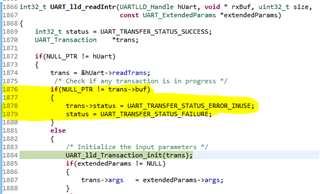
    As you can see only the 1st call returns TIMEOUT (-2), the rest returns 0 there. The LLD code enters the green line (line 1884) only at 1st time, all of the rest of the cases goes to the yellow one:

    My guess is that the buffer is not cleared for timeout case:


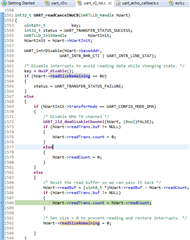
    While this section of the code is called, what happens inside is:

    remainingsize is set to 0 but the buf itself is not freed up (UART_lld_Transaction_deInit is not called anywhere for this case).

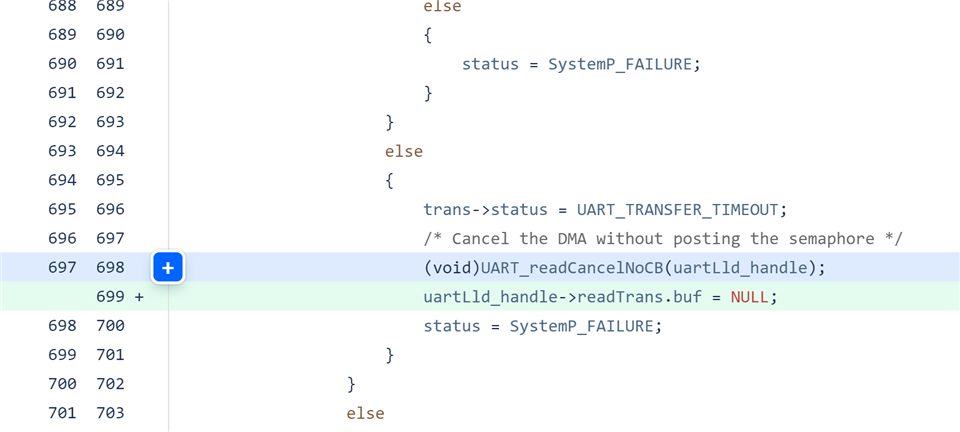
    And the result is sort of a deadlock - UART_lld_readIntr does not reads because the buffer is not cleared,   UART_readCancelNoCB is not working because it checks if (hUart->readSizeRemaining == 0U) and returns fail.

    I would say there is a missing UART_lld_Transaction_deInit for the timeout case but I am not sure where and how should be added.

    Best Regards

  • Hi Barna,

    My guess is that the buffer is not cleared for timeout case:

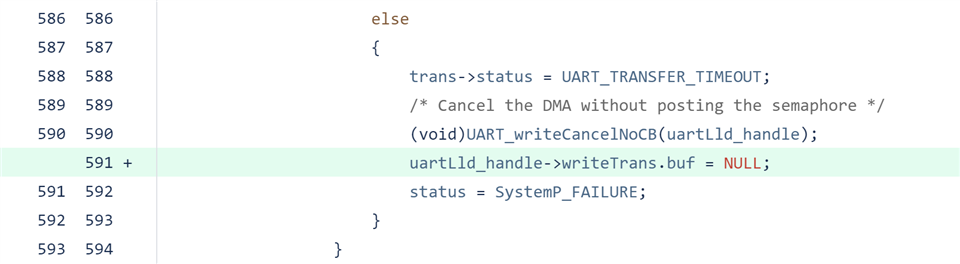
    Yes this is an issue. I tried clearing the buffers and setting the buffer to null in case of the timeout scenarios.

    The output for all the 30 iterations of the for loop is then "-1 -2".

    Sharing what we did (pretty straightforward):

    Please add the following code snippets to the previously shared uart_v0.c file

    Then please rebuild your drivers lib and the application and test again

    Regards,
    Shaunak

  • Hi

    I think it works ok - now I can receive 1 byte, have timeouts, than receive again.

    Will this fixes make into next SDK version?

    TY

  • Hi Barna

    Apologies for a delayed response, I was out of office for a couple of days.

    Yes this will make it into the official MCU+SDK 10.00 Version driver.

    Thanks for pointing out the bugs and helping us improve the driver.

    Regards,
    Shaunak