This thread has been locked.

If you have a related question, please click the "Ask a related question" button in the top right corner. The newly created question will be automatically linked to this question.

MSPM0G3507: LP-MSPM0G3507: Issues with Using the PMBus API

Part Number: MSPM0G3507


Tool/software:

1. When using the LP-MSPM0G3507 PMBus, I found that transactions encounter issues when the API uses PMB_BLOCK_WRITE or PMB_BLOCK_READ for read/write operations. How should this be resolved?

2. Even when I hardcoded the underlying API transaction to use the PMB_MFR_REVISION command for testing, errors still occur with this command. How should this be addressed?

  • Hi Oe J,

    • Can you describe the issue?
      • When you stop the code are you hanging in a wait somewhere?
      • When you scope the lines are you seeing any clock signal?
    • Are we the controller or target in this PMBus interaction?
      • What is the other device on the other end?
    • Are the appropriate pull-ups provided?

    Regards,
    Luke

  • Hi Luke,

    When you stop the code are you hanging in a wait somewhere?
    There is an issue with `uint8_t transaction = (PMBus_Commands[commandId] & 0x0F);`, so we hardcoded it to `0x40`, and the following situation occurred.

    When using the code PMB_MFR_REVISION (9B), the state obtained is SMBus_State_Controller_NACK, which then returns -1, resulting in a read failure.

    When you scope the lines are you seeing any clock signal?
    We are currently only printing messages and have not yet connected the oscilloscope. We also don't believe it's a signal issue, especially since using the above method with command 9C works successfully.

    What is the other device on the other end?
    We connected I2C0 and I2C1 on the same board.

    Are the appropriate pull-ups provided?
    Because the I2C is directly connected, we only use one set of pull-up resistors.

    Regards,
  • Hi Oe J,

    Can you scope the communication lines?

    There might be some clock stretching happening that is keeping the line when it shouldn't.

    Regards,
    Luke

  • Hi Luke,
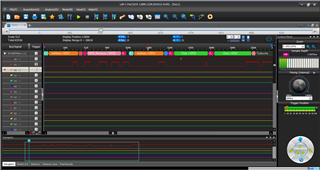
    Do you want the waveform diagram?
    There is an issue with `uint8_t transaction = (PMBus_Commands[commandId] & 0x0F);`, so we hardcoded it to `0x40`,
    Executing the 0x9B command with a PMBus block read results in an error, and the signal indeed is not sent out.
    FC can be used normally.
     

  • Hi Oe J,

    I am going to attempt to replicate this on my side and get back to you.

    On the uint8_t transaction = (PMBus_Commands[commandId] & 0x0F);. The & bit-wise operation will only allow the lower nibble to pass whereas you're attempting to send 0x40, which only has data in the upper nibble.

    Regards,
    Luke

  • Hi Luke,

    If this is not done, 9B, PMB_BLOCK_READ, after the transaction, will not match with PMB_BLOCK_READ in the switch case.
    How can this be fixed?
    Or am I using it incorrectly?

    When we use this method to test, 9C(command) is able to function.

  • Hi oe j,

    Looking at the pmbus.c file, the PMB_BLOCK_READ is getting defined as 0x40 (line 48), I think this is a typo and the block read should be set to 0x04.

    If you look at the library all the read commands are on the lower nibble and the write commands are in the upper nibble. This way when doing the bit operations it will mask the appropriate command.

    So the MFR_REVISION command will end up with an OR operation between 0x50 and 0x40 which results in 0x90 when this later gets masked you end with a PMB_RESERVED for the read which goes into the PMBUS return error.

    I'll push to get this fixed in the next SDK release.

    Regards,
    Luke

  • Hi Luke,
    So the issue with 0x9B is still not resolved. Even after adjusting the transaction, it still doesn't work.
    Does it need to perform an initialization step?
    Regards,
    Joe

  • Hi oe J,

    Can you confirm that the change for the BLOCK_READ is taking place? You can set a break point to where the transaction is getting called and check the return value from the PMBus_Commands[commandId]. The value should be 0x54 (Block write + block read).

    Your Oscilloscope portion looks to be sending the command 0x9B, so the issue may be on the target portion rather than the target once we've resolved the 0x40 typo.

    Regards,
    Luke


  • Hi Luke,
    Here is the English translation of your text:

    "After correcting the 0x40 error, it can operate. I would like to ask, what is the relationship between `sSMBusTarget.nwk.txBuffPtr[0] = 0x08;` and `sSMBusTarget.nwk.txLen = 9;`?"

    case 0x9C://mfr version
    sSMBusTarget.nwk.txBuffPtr[0] = 0x08;
    sSMBusTarget.nwk.txBuffPtr[1] = 0x02;
    sSMBusTarget.nwk.txBuffPtr[2] = 0x03;
    sSMBusTarget.nwk.txBuffPtr[3] = 0x04;
    sSMBusTarget.nwk.txBuffPtr[4] = 0x05;
    sSMBusTarget.nwk.txBuffPtr[5] = 0x06;
    sSMBusTarget.nwk.txBuffPtr[6] = 0x07;
    sSMBusTarget.nwk.txBuffPtr[7] = 0x08;
    sSMBusTarget.nwk.txBuffPtr[8] = 0x09;
    sSMBusTarget.nwk.txLen = 9;
    break;

    This is what I entered during testing,

  • Hi oe J,

    The SMBus has a specific packet structure (SMBus Protocol)


    The first data given from the target will be the Block Count, which is number of data sent. So the sSMBusTarget.nwk.txBuffPtr[0] = 0x08; relates to having 8 data bytes coming up. The sSMBusTarget.nwk.txLen = 9,, is because the whole transmission will have the Byte count + data, so the length should equal the Byte Count + 1 for the whole transaction.

    If you had the sSMBusTarget.nwk.txBuffPtr[0] = 0x0A; then the sSMBusTarget.nwk.txLen = 11.

    Regards,
    Luke

  • If you have one of the commands that has block read working, then the issue will be on the command implementation on the target (slave) side.