Part Number: MSPM0L1304
Other Parts Discussed in Thread: LP-MSPM0L1306, , SYSCONFIG, MSPM0L1306
Tool/software:
Hello,
For our project, we would like to run our program with the CPU at 32kHz, corresponding to RUN1 or RUN2 modes. However, when we call the function DL_SYSCTL_switchMCLKfromSYSOSCtoLFCLK(false), the program awaits the MCU's confirmation that we have made the transition in perpetuity. The error appears on both an LP-MSPM0L1306 and a custom PCB mounting an MSPM0L1304. This error has appeared using MSPM0 SDK versions 1.30 and 2.2.
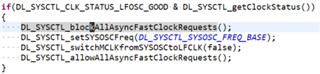
This is the code block that called in different circumstances, including right after initialization. Included are extra interrupt disabling and systick disabling, hoping that might resolve our issue.
if(DL_SYSCTL_CLK_STATUS_LFOSC_GOOD & DL_SYSCTL_getClockStatus())
{
    __disable_irq();
    DL_SYSTICK_disable();
    DL_SYSCTL_setSYSOSCFreq(DL_SYSCTL_SYSOSC_FREQ_BASE);

    DL_SYSCTL_switchMCLKfromSYSOSCtoLFCLK(false);
    __enable_irq();
}
Relevant registers at time of error:


I've browsed example projects and all the educational material I can. Shockingly, I've not seen one reference to people actually trying to change the MCLK source.
Sysconfig initialization code. This is all that is called before the code I posted above:
/*
 * Copyright (c) 2023, Texas Instruments Incorporated
 * All rights reserved.
 *
 * Redistribution and use in source and binary forms, with or without
 * modification, are permitted provided that the following conditions
 * are met:
 *
 * *  Redistributions of source code must retain the above copyright
 *    notice, this list of conditions and the following disclaimer.
 *
 * *  Redistributions in binary form must reproduce the above copyright
 *    notice, this list of conditions and the following disclaimer in the
 *    documentation and/or other materials provided with the distribution.
 *
 * *  Neither the name of Texas Instruments Incorporated nor the names of
 *    its contributors may be used to endorse or promote products derived
 *    from this software without specific prior written permission.
 *
 * THIS SOFTWARE IS PROVIDED BY THE COPYRIGHT HOLDERS AND CONTRIBUTORS "AS IS"
 * AND ANY EXPRESS OR IMPLIED WARRANTIES, INCLUDING, BUT NOT LIMITED TO,
 * THE IMPLIED WARRANTIES OF MERCHANTABILITY AND FITNESS FOR A PARTICULAR
 * PURPOSE ARE DISCLAIMED. IN NO EVENT SHALL THE COPYRIGHT OWNER OR
 * CONTRIBUTORS BE LIABLE FOR ANY DIRECT, INDIRECT, INCIDENTAL, SPECIAL,
 * EXEMPLARY, OR CONSEQUENTIAL DAMAGES (INCLUDING, BUT NOT LIMITED TO,
 * PROCUREMENT OF SUBSTITUTE GOODS OR SERVICES; LOSS OF USE, DATA, OR PROFITS;
 * OR BUSINESS INTERRUPTION) HOWEVER CAUSED AND ON ANY THEORY OF LIABILITY,
 * WHETHER IN CONTRACT, STRICT LIABILITY, OR TORT (INCLUDING NEGLIGENCE OR
 * OTHERWISE) ARISING IN ANY WAY OUT OF THE USE OF THIS SOFTWARE,
 * EVEN IF ADVISED OF THE POSSIBILITY OF SUCH DAMAGE.
 */

/*
 *  ============ ti_msp_dl_config.c =============
 *  Configured MSPM0 DriverLib module definitions
 *
 *  DO NOT EDIT - This file is generated for the LP_MSPM0L1306
 *  by the SysConfig tool.
 */

#include "ti_msp_dl_config.h"

/*
 *  ======== SYSCFG_DL_init ========
 *  Perform any initialization needed before using any board APIs
 */
SYSCONFIG_WEAK void SYSCFG_DL_init(void)
{
    SYSCFG_DL_initPower();
    SYSCFG_DL_GPIO_init();
    /* Module-Specific Initializations*/
    SYSCFG_DL_SYSCTL_init();
    SYSCFG_DL_TIMER_0_init();
    SYSCFG_DL_TIMER_1_init();
    SYSCFG_DL_I2C_0_init();
    SYSCFG_DL_UART_HOST_USB_init();
    SYSCFG_DL_ADC12_0_init();
    SYSCFG_DL_COMP_0_init();
    SYSCFG_DL_DMA_init();
    SYSCFG_DL_SYSTICK_init();
}

SYSCONFIG_WEAK void SYSCFG_DL_initPower(void)
{
    DL_GPIO_reset(GPIOA);
    DL_TimerG_reset(TIMER_0_INST);
    DL_TimerG_reset(TIMER_1_INST);
    DL_I2C_reset(I2C_0_INST);
    DL_UART_Main_reset(UART_HOST_USB_INST);
    DL_ADC12_reset(ADC12_0_INST);
    DL_COMP_reset(COMP_0_INST);


    DL_GPIO_enablePower(GPIOA);
    DL_TimerG_enablePower(TIMER_0_INST);
    DL_TimerG_enablePower(TIMER_1_INST);
    DL_I2C_enablePower(I2C_0_INST);
    DL_UART_Main_enablePower(UART_HOST_USB_INST);
    DL_ADC12_enablePower(ADC12_0_INST);
    DL_COMP_enablePower(COMP_0_INST);


    delay_cycles(POWER_STARTUP_DELAY);
}

SYSCONFIG_WEAK void SYSCFG_DL_GPIO_init(void)
{


	DL_GPIO_initPeripheralInputFunction(
		 GPIO_I2C_0_IOMUX_SDA, GPIO_I2C_0_IOMUX_SDA_FUNC);
	DL_GPIO_initPeripheralInputFunction(
		 GPIO_I2C_0_IOMUX_SCL, GPIO_I2C_0_IOMUX_SCL_FUNC);
    DL_GPIO_enableHiZ(GPIO_I2C_0_IOMUX_SDA);
    DL_GPIO_enableHiZ(GPIO_I2C_0_IOMUX_SCL);

    DL_GPIO_initPeripheralOutputFunction(
        GPIO_UART_HOST_USB_IOMUX_TX, GPIO_UART_HOST_USB_IOMUX_TX_FUNC);

	DL_GPIO_initPeripheralInputFunction(
		 GPIO_UART_HOST_USB_IOMUX_RX, GPIO_UART_HOST_USB_IOMUX_RX_FUNC);

    DL_GPIO_initDigitalOutput(GPIO_PA_FG_RESETB_IOMUX);

    DL_GPIO_initDigitalOutputFeatures(GPIO_PA_LED_EN_IOMUX,
		 DL_GPIO_INVERSION_ENABLE, DL_GPIO_RESISTOR_NONE,
		 DL_GPIO_DRIVE_STRENGTH_LOW, DL_GPIO_HIZ_DISABLE);

    DL_GPIO_initDigitalOutput(GPIO_PA_TRIGGER_EN_IOMUX);

    DL_GPIO_initDigitalOutput(GPIO_PA_MCU_AUTOKILL_IOMUX);

    DL_GPIO_initDigitalInput(GPIO_PA_SAFETY_IOMUX);

    DL_GPIO_initDigitalOutput(GPIO_PA_CHRG_DISABLE_IOMUX);

    DL_GPIO_initDigitalOutput(GPIO_PA_ACCS_3V3_EN_IOMUX);

    DL_GPIO_initDigitalInput(GPIO_PA_ACCEL_INT_IOMUX);

    DL_GPIO_clearPins(GPIO_PA_PORT, GPIO_PA_LED_EN_PIN |
		GPIO_PA_TRIGGER_EN_PIN |
		GPIO_PA_MCU_AUTOKILL_PIN |
		GPIO_PA_CHRG_DISABLE_PIN);
    DL_GPIO_setPins(GPIO_PA_PORT, GPIO_PA_FG_RESETB_PIN |
		GPIO_PA_ACCS_3V3_EN_PIN);
    DL_GPIO_enableOutput(GPIO_PA_PORT, GPIO_PA_FG_RESETB_PIN |
		GPIO_PA_LED_EN_PIN |
		GPIO_PA_TRIGGER_EN_PIN |
		GPIO_PA_MCU_AUTOKILL_PIN |
		GPIO_PA_CHRG_DISABLE_PIN |
		GPIO_PA_ACCS_3V3_EN_PIN);

}


SYSCONFIG_WEAK void SYSCFG_DL_SYSCTL_init(void)
{

	//Low Power Mode is configured to be SLEEP0
    DL_SYSCTL_setBORThreshold(DL_SYSCTL_BOR_THRESHOLD_LEVEL_0);

    DL_SYSCTL_setSYSOSCFreq(DL_SYSCTL_SYSOSC_FREQ_BASE);

}


/*
 * Timer clock configuration to be sourced by BUSCLK /  (32000000 Hz)
 * timerClkFreq = (timerClkSrc / (timerClkDivRatio * (timerClkPrescale + 1)))
 *   1000000 Hz = 32000000 Hz / (1 * (31 + 1))
 */
static const DL_TimerG_ClockConfig gTIMER_0ClockConfig = {
    .clockSel    = DL_TIMER_CLOCK_BUSCLK,
    .divideRatio = DL_TIMER_CLOCK_DIVIDE_1,
    .prescale    = 31U,
};

/*
 * Timer load value (where the counter starts from) is calculated as (timerPeriod * timerClockFreq) - 1
 * TIMER_0_INST_LOAD_VALUE = (65.536ms * 1000000 Hz) - 1
 */
static const DL_TimerG_TimerConfig gTIMER_0TimerConfig = {
    .period     = TIMER_0_INST_LOAD_VALUE,
    .timerMode  = DL_TIMER_TIMER_MODE_ONE_SHOT_UP,
    .startTimer = DL_TIMER_STOP,
};

SYSCONFIG_WEAK void SYSCFG_DL_TIMER_0_init(void) {

    DL_TimerG_setClockConfig(TIMER_0_INST,
        (DL_TimerG_ClockConfig *) &gTIMER_0ClockConfig);

    DL_TimerG_initTimerMode(TIMER_0_INST,
        (DL_TimerG_TimerConfig *) &gTIMER_0TimerConfig);
    DL_TimerG_enableClock(TIMER_0_INST);


}

/*
 * Timer clock configuration to be sourced by BUSCLK /  (32000000 Hz)
 * timerClkFreq = (timerClkSrc / (timerClkDivRatio * (timerClkPrescale + 1)))
 *   1000000 Hz = 32000000 Hz / (1 * (31 + 1))
 */
static const DL_TimerG_ClockConfig gTIMER_1ClockConfig = {
    .clockSel    = DL_TIMER_CLOCK_BUSCLK,
    .divideRatio = DL_TIMER_CLOCK_DIVIDE_1,
    .prescale    = 31U,
};

/*
 * Timer load value (where the counter starts from) is calculated as (timerPeriod * timerClockFreq) - 1
 * TIMER_1_INST_LOAD_VALUE = (65.536ms * 1000000 Hz) - 1
 */
static const DL_TimerG_TimerConfig gTIMER_1TimerConfig = {
    .period     = TIMER_1_INST_LOAD_VALUE,
    .timerMode  = DL_TIMER_TIMER_MODE_ONE_SHOT_UP,
    .startTimer = DL_TIMER_STOP,
};

SYSCONFIG_WEAK void SYSCFG_DL_TIMER_1_init(void) {

    DL_TimerG_setClockConfig(TIMER_1_INST,
        (DL_TimerG_ClockConfig *) &gTIMER_1ClockConfig);

    DL_TimerG_initTimerMode(TIMER_1_INST,
        (DL_TimerG_TimerConfig *) &gTIMER_1TimerConfig);
    DL_TimerG_enableClock(TIMER_1_INST);


}


static const DL_I2C_ClockConfig gI2C_0ClockConfig = {
    .clockSel = DL_I2C_CLOCK_BUSCLK,
    .divideRatio = DL_I2C_CLOCK_DIVIDE_1,
};

SYSCONFIG_WEAK void SYSCFG_DL_I2C_0_init(void) {

    DL_I2C_setClockConfig(I2C_0_INST,
        (DL_I2C_ClockConfig *) &gI2C_0ClockConfig);
    DL_I2C_setAnalogGlitchFilterPulseWidth(I2C_0_INST,
        DL_I2C_ANALOG_GLITCH_FILTER_WIDTH_50NS);
    DL_I2C_enableAnalogGlitchFilter(I2C_0_INST);

    /* Configure Controller Mode */
    DL_I2C_resetControllerTransfer(I2C_0_INST);
    /* Set frequency to 400000 Hz*/
    DL_I2C_setTimerPeriod(I2C_0_INST, 7);
    DL_I2C_setControllerTXFIFOThreshold(I2C_0_INST, DL_I2C_TX_FIFO_LEVEL_EMPTY);
    DL_I2C_setControllerRXFIFOThreshold(I2C_0_INST, DL_I2C_RX_FIFO_LEVEL_BYTES_1);
    DL_I2C_enableControllerClockStretching(I2C_0_INST);


    /* Enable module */
    DL_I2C_enableController(I2C_0_INST);


}


static const DL_UART_Main_ClockConfig gUART_HOST_USBClockConfig = {
    .clockSel    = DL_UART_MAIN_CLOCK_BUSCLK,
    .divideRatio = DL_UART_MAIN_CLOCK_DIVIDE_RATIO_1
};

static const DL_UART_Main_Config gUART_HOST_USBConfig = {
    .mode        = DL_UART_MAIN_MODE_NORMAL,
    .direction   = DL_UART_MAIN_DIRECTION_TX_RX,
    .flowControl = DL_UART_MAIN_FLOW_CONTROL_NONE,
    .parity      = DL_UART_MAIN_PARITY_NONE,
    .wordLength  = DL_UART_MAIN_WORD_LENGTH_8_BITS,
    .stopBits    = DL_UART_MAIN_STOP_BITS_ONE
};

SYSCONFIG_WEAK void SYSCFG_DL_UART_HOST_USB_init(void)
{
    DL_UART_Main_setClockConfig(UART_HOST_USB_INST, (DL_UART_Main_ClockConfig *) &gUART_HOST_USBClockConfig);

    DL_UART_Main_init(UART_HOST_USB_INST, (DL_UART_Main_Config *) &gUART_HOST_USBConfig);
    /*
     * Configure baud rate by setting oversampling and baud rate divisors.
     *  Target baud rate: 115200
     *  Actual baud rate: 115211.52
     */
    DL_UART_Main_setOversampling(UART_HOST_USB_INST, DL_UART_OVERSAMPLING_RATE_16X);
    DL_UART_Main_setBaudRateDivisor(UART_HOST_USB_INST, UART_HOST_USB_IBRD_32_MHZ_115200_BAUD, UART_HOST_USB_FBRD_32_MHZ_115200_BAUD);


    /* Configure Interrupts */
    DL_UART_Main_enableInterrupt(UART_HOST_USB_INST,
                                 DL_UART_MAIN_INTERRUPT_DMA_DONE_TX |
                                 DL_UART_MAIN_INTERRUPT_RX);
    /* Setting the Interrupt Priority */
    NVIC_SetPriority(UART_HOST_USB_INST_INT_IRQN, 1);

    /* Configure DMA Transmit Event */
    DL_UART_Main_enableDMATransmitEvent(UART_HOST_USB_INST);
    /* Configure FIFOs */
    DL_UART_Main_enableFIFOs(UART_HOST_USB_INST);
    DL_UART_Main_setRXFIFOThreshold(UART_HOST_USB_INST, DL_UART_RX_FIFO_LEVEL_ONE_ENTRY);
    DL_UART_Main_setTXFIFOThreshold(UART_HOST_USB_INST, DL_UART_TX_FIFO_LEVEL_1_2_EMPTY);

    DL_UART_Main_enable(UART_HOST_USB_INST);
}

/* ADC12_0 Initialization */
static const DL_ADC12_ClockConfig gADC12_0ClockConfig = {
    .clockSel       = DL_ADC12_CLOCK_ULPCLK,
    .divideRatio    = DL_ADC12_CLOCK_DIVIDE_1,
    .freqRange      = DL_ADC12_CLOCK_FREQ_RANGE_24_TO_32,
};
SYSCONFIG_WEAK void SYSCFG_DL_ADC12_0_init(void)
{
    DL_ADC12_setClockConfig(ADC12_0_INST, (DL_ADC12_ClockConfig *) &gADC12_0ClockConfig);

    DL_ADC12_initSeqSample(ADC12_0_INST,
        DL_ADC12_REPEAT_MODE_ENABLED, DL_ADC12_SAMPLING_SOURCE_AUTO, DL_ADC12_TRIG_SRC_SOFTWARE,
        DL_ADC12_SEQ_START_ADDR_00, DL_ADC12_SEQ_END_ADDR_02, DL_ADC12_SAMP_CONV_RES_12_BIT,
        DL_ADC12_SAMP_CONV_DATA_FORMAT_UNSIGNED);
    DL_ADC12_configConversionMem(ADC12_0_INST, ADC12_0_ADCMEM_ADC_FOUT,
        DL_ADC12_INPUT_CHAN_1, DL_ADC12_REFERENCE_VOLTAGE_VDDA, DL_ADC12_SAMPLE_TIMER_SOURCE_SCOMP0, DL_ADC12_AVERAGING_MODE_DISABLED,
        DL_ADC12_BURN_OUT_SOURCE_DISABLED, DL_ADC12_TRIGGER_MODE_AUTO_NEXT, DL_ADC12_WINDOWS_COMP_MODE_DISABLED);
    DL_ADC12_configConversionMem(ADC12_0_INST, ADC12_0_ADCMEM_ADC_SHUNT,
        DL_ADC12_INPUT_CHAN_2, DL_ADC12_REFERENCE_VOLTAGE_VDDA, DL_ADC12_SAMPLE_TIMER_SOURCE_SCOMP0, DL_ADC12_AVERAGING_MODE_DISABLED,
        DL_ADC12_BURN_OUT_SOURCE_DISABLED, DL_ADC12_TRIGGER_MODE_AUTO_NEXT, DL_ADC12_WINDOWS_COMP_MODE_DISABLED);
    DL_ADC12_configConversionMem(ADC12_0_INST, ADC12_0_ADCMEM_ADC_FORCE,
        DL_ADC12_INPUT_CHAN_3, DL_ADC12_REFERENCE_VOLTAGE_VDDA, DL_ADC12_SAMPLE_TIMER_SOURCE_SCOMP0, DL_ADC12_AVERAGING_MODE_DISABLED,
        DL_ADC12_BURN_OUT_SOURCE_DISABLED, DL_ADC12_TRIGGER_MODE_AUTO_NEXT, DL_ADC12_WINDOWS_COMP_MODE_DISABLED);
    DL_ADC12_setSampleTime0(ADC12_0_INST,160);
    /* Enable ADC12 interrupt */
    DL_ADC12_clearInterruptStatus(ADC12_0_INST,(DL_ADC12_INTERRUPT_MEM0_RESULT_LOADED));
    DL_ADC12_enableInterrupt(ADC12_0_INST,(DL_ADC12_INTERRUPT_MEM0_RESULT_LOADED));
    NVIC_SetPriority(ADC12_0_INST_INT_IRQN, 0);
    DL_ADC12_enableConversions(ADC12_0_INST);
}

/* COMP_0 Initialization */
static const DL_COMP_Config gCOMP_0Config = {
    .channelEnable = DL_COMP_ENABLE_CHANNEL_NONE,
    .mode          = DL_COMP_MODE_FAST,
    .negChannel    = DL_COMP_IMSEL_CHANNEL_0,
    .posChannel    = DL_COMP_IPSEL_CHANNEL_0,
    .hysteresis    = DL_COMP_HYSTERESIS_NONE,
    .polarity      = DL_COMP_POLARITY_NON_INV
};
static const DL_COMP_RefVoltageConfig gCOMP_0VRefConfig = {
    .mode           = DL_COMP_REF_MODE_STATIC,
    .source         = DL_COMP_REF_SOURCE_NONE,
    .terminalSelect = DL_COMP_REF_TERMINAL_SELECT_POS,
    .controlSelect  = DL_COMP_DAC_CONTROL_COMP_OUT,
    .inputSelect    = DL_COMP_DAC_INPUT_DACCODE0
};

SYSCONFIG_WEAK void SYSCFG_DL_COMP_0_init(void)
{
    DL_COMP_init(COMP_0_INST, (DL_COMP_Config *) &gCOMP_0Config);
    DL_COMP_refVoltageInit(COMP_0_INST, (DL_COMP_RefVoltageConfig *) &gCOMP_0VRefConfig);

    DL_COMP_enable(COMP_0_INST);

}


static const DL_DMA_Config gDMA_HOST_TXConfig = {
    .transferMode   = DL_DMA_SINGLE_TRANSFER_MODE,
    .extendedMode   = DL_DMA_NORMAL_MODE,
    .destIncrement  = DL_DMA_ADDR_UNCHANGED,
    .srcIncrement   = DL_DMA_ADDR_INCREMENT,
    .destWidth      = DL_DMA_WIDTH_BYTE,
    .srcWidth       = DL_DMA_WIDTH_BYTE,
    .trigger        = UART_HOST_USB_INST_DMA_TRIGGER,
    .triggerType    = DL_DMA_TRIGGER_TYPE_EXTERNAL,
};

SYSCONFIG_WEAK void SYSCFG_DL_DMA_HOST_TX_init(void)
{
    DL_DMA_clearInterruptStatus(DMA, DL_DMA_INTERRUPT_CHANNEL0);
    DL_DMA_enableInterrupt(DMA, DL_DMA_INTERRUPT_CHANNEL0);
    DL_DMA_setSrcIncrement(DMA, DMA_HOST_TX_CHAN_ID, DL_DMA_ADDR_INCREMENT);
    DL_DMA_initChannel(DMA, DMA_HOST_TX_CHAN_ID , (DL_DMA_Config *) &gDMA_HOST_TXConfig);
}
SYSCONFIG_WEAK void SYSCFG_DL_DMA_init(void){
    SYSCFG_DL_DMA_HOST_TX_init();
}


SYSCONFIG_WEAK void SYSCFG_DL_SYSTICK_init(void)
{
    /*
     * Initializes the SysTick period to 1.00 ms,
     * enables the interrupt, and starts the SysTick Timer
     */
    DL_SYSTICK_config(32000);
}
Thanks in advance for any help.