This thread has been locked.

If you have a related question, please click the "Ask a related question" button in the top right corner. The newly created question will be automatically linked to this question.

AM2432: OSPI CLK configuration

Part Number: AM2432


Tool/software:

Hi 

Customer are developing AM243 for years. 

They uses the datasheet Revsion B, which does not constrain the OSPI clock, so they configured 250MHz (Tap) at the time.
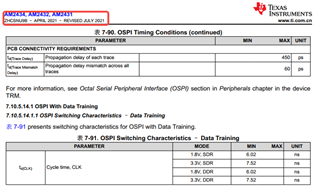
However, the latest version G has constraints, requiring the clock cycle to be > 20ns in Tap mode. If they keep the 250MHz configuration and do not modify it, what will be the impact?
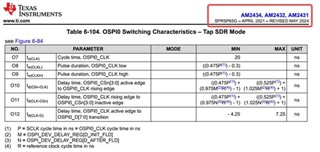
Any reason add this constraints?

Regards

Zekun

  • Hi

    Any updates here? 

    Thanks

    Zekun

  • Hi Zekun,

    I will ask documentation team for more details. Changes similar to these are typically coming after chip validation conducted between the two datasheet releases.

    Regards,

    Stan

  • Hi Stan

    Thanks for reply. This question is from Top customer in China, so please prioritize this and give feedback soon, 

    Regards

    Zekun

  • Zekun,

    I will do my best.

  • The OSPI Tap mode timing was added to revision D of the AM243x datasheet. The first Release to Production (RTP) datasheet was revision E. Any information found in a pre-RTP datasheet is subject to change until the RTP datasheet is released, since TI is still characterizing device performance until the device is released to production. The customer should never design a product based on any pre-RTP datasheet. The customer should have designed their product based on datasheet revision E or newer. Note: Any pre-RTP datasheets will be marked with either "Product Preview" or "Advance Information" on the side of every page. Revision B of the AM243x datasheet was marked "Advance Information".

    The OSPI peripheral was not designed to operate at 250MHz. The AM243x devices were only validated for OSPI operating at up to 200MHz. Therefore, your customer should reduce the operating frequency of their OSPI peripheral to ensure proper operation across all Process, Voltage, and Temperature operating conditions.

    Regards,
    Paul