This thread has been locked.

If you have a related question, please click the "Ask a related question" button in the top right corner. The newly created question will be automatically linked to this question.

TM4C1290NCPDT: design review

Part Number: TM4C1290NCPDT
Other Parts Discussed in Thread: TPS62932,

Tool/software:

Hello team, 

i am asking for a design review,

i designed this board wich has a huge problem, the 3V3 is shorted to the GND. I can t figure out where the problem is. It seems that removing the processor also make the short disappear, i can't really understand.

Please help me understand why the 3v3 node is shorted to GND.

Kind Regards

Emanuele Peruzzi

gerbers_rf_test_board_b.zip

rf_test_board_b.pdf

  • Hi,

    i designed this board wich has a huge problem, the 3V3 is shorted to the GND.

    How do you know it is shorted to ground? Your description is too brief. Are you seeing high current when you power up?  For a normal device, I will expect the reset current in the single digit mA range. What is the reset current you measure?

    Are you able to load any firmware? Is the observed short happening after you run your firmware or the observed short is happening when the flash is empty? If you have loaded a firmware and if the firmware configures a I/O that is in conflict with another device then you can potentially create a short. For example, both the MCU and an external device are driving a signal with one driving a LOW while another is driving a HIGH. 

    Have you done a resistance check on the I/O pins? I/Os are in high impedance after reset. If there is a short then you will measure small resistance. 

    Looking at your schematic, I find one major issue and some minor ones. The major issue is that you left the RBIAS pin NC. Although you don't use Ethernet, the RBIAS pin must still be ground through a 4.7kOhm resistor due to an known errata. Without connection to ground, it is possible the debugger cannot connect to the device. 

    The minor issue is on your VDDC filter cap. You have a 3.0uF of cap on VDDC. While it is ok, the recommendation is between 3.3uF to 3.4uF Refer to the TM4C129 System Design Guideline for details. 

    3.4.2 LDO Filter Capacitor (VDDC) All TivaTm C Series microcontrollers have an on-chip voltage regulator to provide power to the core. The voltage regulator requires a filter capacitor to operate properly (see the CLDO parameter in the corresponding microcontroller data sheet for acceptable capacitor value range). The CLDO capacitance is the sum of the capacitor values on the VDDC pins. The recommended VDDC capacitor solution, taking tolerance into account, consists of two or more 10%-tolerance ceramic chip capacitors totaling 3.3μF to 3.4μF (examples are, one each of 3.3μF and 0.1μF capacitors or one each 2.2μF, 1.0μF and 0.1μF). Z5U dielectric capacitors are not recommended due to wide tolerance over temperature. 

  • Hello Charles,

    i will add some details just to clarify: 

    - i am absolutely not able to connect with debugger

    - my problem comes also with the board unpowered. If the board is without power, i already have a short between the nets 3V3 and GND. This short disappear if i remove (desolder) the processor. 

    - When i connected power for the very first time, +24V on J1, immediately U1 exploded. Then i removed the burned TPS62932, and tryied to test the connection between 3V3 and GND with multimeter and i noted that they were shorted. Then i removed (desoldering) the processor, and the short was gone, the 3V3 and GND were no longer tied. Then i tought that having fried my U1 regulator could have damaged the processor too, so i toke a brand new board, and before powering it up, i noticed that also in the new board the 3V3 node is already shorted with GND. 

    - It sounds strange to me that 2 boards have both a short between 3V3 and GND. I think there is something wrong in my design or layout that generate this short, but i can t understand why, what it could be. I have many unused pins onto the processor, that are connected to GND. May one of these pins be the source of the problem?

    - meanwhile i will surely try to add a resistor at RBIAS, and change the capacitor value, but i doubt that adding a resistor will solve this issue.

    If you have any hint please tell me.

    Kind Regards

    emazed

  • HI,

    - my problem comes also with the board unpowered. If the board is without power, i already have a short between the nets 3V3 and GND. This short disappear if i remove (desolder) the processor. 

    Looking at your schematic I can't spot anything that could have caused the shorts. It may be your layout but I don't know. What if you cut

     Can you just cut off the 3V3 to the MCU without desoldering MCU? Does U1 produce correct 3.3V and U1 is still functional? After you cut the 3V3 from the MCU, can you separately supply an external 3.3V to the 3.3V net for the MCU. Will you be able to isolate the short this way?

    Just one additional comment on your JTAG connector. Below is the recommended pullup on the JTAG connectors although what you currently should not contribute to the short issue.   


    - It sounds strange to me that 2 boards have both a short between 3V3 and GND. I think there is something wrong in my design or layout that generate this short, but i can t understand why, what it could be. I have many unused pins onto the processor, that are connected to GND. May one of these pins be the source of the problem?

    There is no issue to connect unused I/Os to ground. Actually it is the preferred approach. 

    - meanwhile i will surely try to add a resistor at RBIAS, and change the capacitor value, but i doubt that adding a resistor will solve this issue.

    Yes, you must have the 4.7kohm resistor despite the current shorting issue. Once you resolve the shorting issue, your next issue will be debugging unable to connect to the device due to the errata. 

  • Hello Charles,

    thank you for fast reply, and for suggestion about how to correct debugging.

    I followed your suggestion and tryied disconnect 3V3. I removed U1 and L1 but the short is still there, on the U2 side. I also removed U3 and the JTAG connector just to see if short disappear, but with no luck. Attaching another 3V3 power to the MCU, makes the external voltage to drop to 0.15V, because of the same short. I will go on desoldering things until i get the problem, thank you for your kind support. 

    Kind Regards

    emazed

  • Hi Emazed,

      Please let me know once you identify the short. I'm also curious where the short can be. 

  • Hi Emazed,

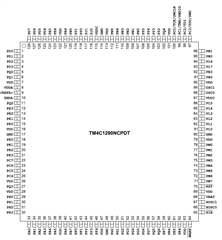
      Can you confirm you are using the correct part number? Your schematic shows that you are using TM4C1290NCPDT but the pinouts do not match. Refer to the datasheet pin diagram. There is no Ethernet for TM4C1290NCPDT while your symbol for the same on the schematic has Ethernet. I think the pinout difference cause the shorts. 

  • I took the dtasheet of TM4C1294 to make the component.

    I wanna cry now.

    Next days i will make the proper correction to the schematic and make a new board, i will send the revised schematic to you for a rapid check, before manufacturing. 

    Thank you, saved me a lot of headcaches

    Kind Regards

    emazed