This thread has been locked.

If you have a related question, please click the "Ask a related question" button in the top right corner. The newly created question will be automatically linked to this question.

MSPM0G1519: BSL Password Protection

Part Number: MSPM0G1519
Other Parts Discussed in Thread: SYSCONFIG, MSPM0G3507, MSPM0G3519

Tool/software:

Regarding the BSL password for unlocking most BSL commands for MSPM0G the 

  • Technical Reference Manual
  • AN: MSPM0 Bootloader Implementation
  • MSPM0 Bootloader User Guide 
  • MSPM0G1519 Datasheet

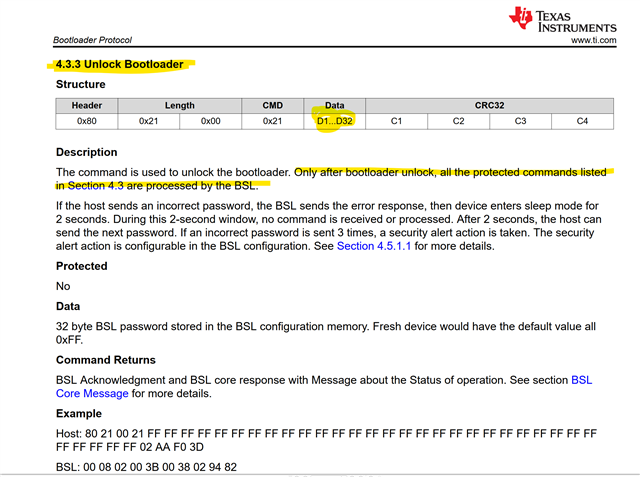
all mention a 256bit password that need to be presented to unlock those BSL commands.

From this I figured that there will be a plain

presented pwd (256bit) == configured value in BSLPW[y] register (in NONMAIN) 

check only.

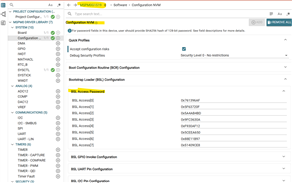
Yet when looking at the description in TI IDE below


I get the impression that there is a hash calculation involved. Meaning

sha256(presented pwd 128bit) ==  configured value in BSLPW[y] register (in NONMAIN) 

Can you please explain which BSL PWD comparison scheme is really used?

  • Actually, we use these two types of passwords for different devices. You can check the NONMAIN register in the corresponding device's  TRM. If it mentioned SHA2 Digest of the password as shown below, then it means it requires hash, and please refer to the Sysconfig guide to generate the hash password.

    Best Regards,
    Peter

  • Hello Peter,

    thx you for your reply .. but I don't mean the passwords you marked. I am talking about the password needed to unlock the bootloader as indicated below in the BSL user guide:

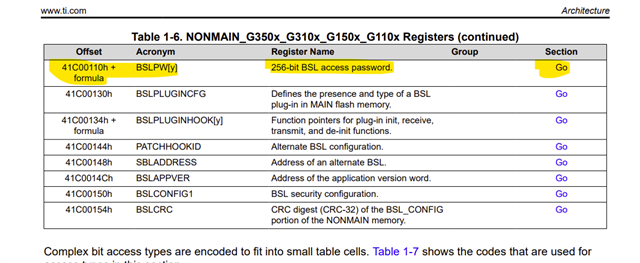
    As I read the TRM the corresponding NONMAIN register is BSLPW[y]

    so for this password is there a hash involved or not?

    Marco

  • Hi Marco,

    so for this password is there a hash involved or not?

    If you use MSPM0G1519, then the answer is yes, it is involved hash.

    The figure I showed before is not the register you care about, but it's a method to indicate that whether this device need hash operation of BSL password. If you also take a look at the device like MSPM0G3507 within this TRM, then you can find that it is not hash required, and so does the BSL password.

    And another quick method to determine whether need hash or not is: just take a look at the Sysconfig as you did, if it's required, then it will have the explanation of this hash code generate process, below is the difference of this part between two device MSPM03507 and MSPM0G3519 in Sysconfig.

    Best Regards,
    Peter

  • Hello Peter,

    ok I get it. Yet you write regarding BSL access password

    so for this password is there a hash involved or not?

    If you use MSPM0G1519, then the answer is yes, it is involved hash.


    But this doesn't seem to be correct or? Because:

    1. MSPM0G1519 TRM does not say anything about hash for BSLPW[y]

    2. SYSCONFIG for MSPM0G1519 does not say anything about hash either

    So I conclude: No hash involvement for MSPM0G1519 BSL access password right?

  • Hi Marco, 

    1. MSPM0G1519 TRM does not say anything about hash for BSLPW[y]

    Our TRM does not describe whether hash is required on this register, so that I recommend other methods as above for you to distinguish this spec between different devices.

    2. SYSCONFIG for MSPM0G1519 does not say anything about hash either

    If you hover your mouse over "BSL Access Password", I believe a question mark icon will appear, click it will bring up the steps to generate the hash. And also, because hash is required, you can see that the default passwords are irregular, and for those device that do not require hash, the default should be all 0xFFFFFFFF.

    Best Regards,
    Peter