This thread has been locked.

If you have a related question, please click the "Ask a related question" button in the top right corner. The newly created question will be automatically linked to this question.

AM2634: Issue running boundary scan test

Part Number: AM2634
Other Parts Discussed in Thread: AM263P4

Tool/software:

I have the same issues that were referenced but not resolved on another thread on this forum ( AM2632: ARM-Based MCU Can't Enter Boundary Scan Mode Using The AM263.bsdl ).

The supplied BSDL file for this device (AM2634CODFHAZCZR) specifies an 8 bit instruction register but when we capture the value of that register it only returns four bits.

We have also seen that the IDCode returned from the device has both a different version and part number value when compared to the value specified in the BSDL file.

As suggested in the previous thread we have tried different boot modes, and seen different behaviours.  The behaviour described above was seen with bootmode 0110.  When we tried with 1001, suggested in the other thread, we got no data returned from the chain.  Neither of these boot modes is referenced in the TRM for the device.

Many thanks

Stuart

  • Hi Stuart,

    Apologies for the long delay!! The bsdl present in ti.com has some errors. 

    Please find the updated AM263.bsdl - 

    -------------------------------------------------------------------------------
    -------------------------------------------------------------------------------
    --          Created by    : Texas Instruments Incorporated                   --
    -------------------------------------------------------------------------------
    -------------------------------------------------------------------------------
    --          The power up sequence for BSDL mode is                            --
    --          BSDL MODE: SPI0_D0,SPI0_CLK,QSPI0_D1,QSPI0_D0: 1001              --
    --                                                                           --
    -------------------------------------------------------------------------------
    
    
    entity AM263 is
    	generic (PHYSICAL_PIN_MAP : string := "nFBGA");
    
    port (
    	TCK: in bit;
    	TMS: in bit;
    	TDO: out bit;
    	TDI: in bit;
    	QSPI0_CSn0: inout bit;
    	QSPI0_CSn1: inout bit;
    	QSPI0_CLK: inout bit;
    	QSPI0_D0: inout bit;
    	QSPI0_D1: inout bit;
    	QSPI0_D2: inout bit;
    	QSPI0_D3: inout bit;
    	MCAN0_RX: inout bit;
    	MCAN0_TX: inout bit;
    	MCAN1_RX: inout bit;
    	MCAN1_TX: inout bit;
    	SPI0_CS0: inout bit;
    	SPI0_CLK: inout bit;
    	SPI0_D0: inout bit;
    	SPI0_D1: inout bit;
    	SPI1_CS0: inout bit;
    	SPI1_CLK: inout bit;
    	SPI1_D0: inout bit;
    	SPI1_D1: inout bit;
    	LIN1_RXD: inout bit;
    	LIN1_TXD: inout bit;
    	LIN2_RXD: inout bit;
    	LIN2_TXD: inout bit;
    	I2C1_SCL: inout bit;
    	I2C1_SDA: inout bit;
    	UART0_RTSn: inout bit;
    	UART0_CTSn: inout bit;
    	UART0_RXD: inout bit;
    	UART0_TXD: inout bit;
    	RGMII1_RXC: inout bit;
    	RGMII1_RX_CTL: inout bit;
    	RGMII1_RD0: inout bit;
    	RGMII1_RD1: inout bit;
    	RGMII1_RD2: inout bit;
    	RGMII1_RD3: inout bit;
    	RGMII1_TXC: inout bit;
    	RGMII1_TX_CTL: inout bit;
    	RGMII1_TD0: inout bit;
    	RGMII1_TD1: inout bit;
    	RGMII1_TD2: inout bit;
    	RGMII1_TD3: inout bit;
    	MDIO0_MDIO: inout bit;
    	MDIO0_MDC: inout bit;
    	EPWM0_A: inout bit;
    	EPWM0_B: inout bit;
    	EPWM1_A: inout bit;
    	EPWM1_B: inout bit;
    	EPWM2_A: inout bit;
    	EPWM2_B: inout bit;
    	EPWM3_A: inout bit;
    	EPWM3_B: inout bit;
    	EPWM4_A: inout bit;
    	EPWM4_B: inout bit;
    	EPWM5_A: inout bit;
    	EPWM5_B: inout bit;
    	EPWM6_A: inout bit;
    	EPWM6_B: inout bit;
    	EPWM7_A: inout bit;
    	EPWM7_B: inout bit;
    	EPWM8_A: inout bit;
    	EPWM8_B: inout bit;
    	EPWM9_A: inout bit;
    	EPWM9_B: inout bit;
    	EPWM10_A: inout bit;
    	EPWM10_B: inout bit;
    	EPWM11_A: inout bit;
    	EPWM11_B: inout bit;
    	EPWM12_A: inout bit;
    	EPWM12_B: inout bit;
    	EPWM13_A: inout bit;
    	EPWM13_B: inout bit;
    	EPWM14_A: inout bit;
    	EPWM14_B: inout bit;
    	EPWM15_A: inout bit;
    	EPWM15_B: inout bit;
    	UART1_RXD: inout bit;
    	UART1_TXD: inout bit;
    	MMC0_CLK: inout bit;
    	MMC0_CMD: inout bit;
    	MMC0_D0: inout bit;
    	MMC0_D1: inout bit;
    	MMC0_D2: inout bit;
    	MMC0_D3: inout bit;
    	MMC0_WP: inout bit;
    	MMC0_CD: inout bit;
    	PR0_MDIO0_MDIO: inout bit;
    	PR0_MDIO0_MDC: inout bit;
    	PR0_PRU0_GPO5: inout bit;
    	PR0_PRU0_GPO9: inout bit;
    	PR0_PRU0_GPO10: inout bit;
    	PR0_PRU0_GPO8: inout bit;
    	PR0_PRU0_GPO6: inout bit;
    	PR0_PRU0_GPO4: inout bit;
    	PR0_PRU0_GPO0: inout bit;
    	PR0_PRU0_GPO1: inout bit;
    	PR0_PRU0_GPO2: inout bit;
    	PR0_PRU0_GPO3: inout bit;
    	PR0_PRU0_GPO16: inout bit;
    	PR0_PRU0_GPO15: inout bit;
    	PR0_PRU0_GPO11: inout bit;
    	PR0_PRU0_GPO12: inout bit;
    	PR0_PRU0_GPO13: inout bit;
    	PR0_PRU0_GPO14: inout bit;
    	PR0_PRU1_GPO5: inout bit;
    	PR0_PRU1_GPO9: inout bit;
    	PR0_PRU1_GPO10: inout bit;
    	PR0_PRU1_GPO8: inout bit;
    	PR0_PRU1_GPO6: inout bit;
    	PR0_PRU1_GPO4: inout bit;
    	PR0_PRU1_GPO0: inout bit;
    	PR0_PRU1_GPO1: inout bit;
    	PR0_PRU1_GPO2: inout bit;
    	PR0_PRU1_GPO3: inout bit;
    	PR0_PRU1_GPO16: inout bit;
    	PR0_PRU1_GPO15: inout bit;
    	PR0_PRU1_GPO11: inout bit;
    	PR0_PRU1_GPO12: inout bit;
    	PR0_PRU1_GPO13: inout bit;
    	PR0_PRU1_GPO14: inout bit;
    	PR0_PRU1_GPO19: inout bit;
    	PR0_PRU1_GPO18: inout bit;
    	EXT_REFCLK0: inout bit;
    	SDFM0_CLK0: inout bit;
    	SDFM0_D0: inout bit;
    	SDFM0_CLK1: inout bit;
    	SDFM0_D1: inout bit;
    	SDFM0_CLK2: inout bit;
    	SDFM0_D2: inout bit;
    	SDFM0_CLK3: inout bit;
    	SDFM0_D3: inout bit;
    	EQEP0_A: inout bit;
    	EQEP0_B: inout bit;
    	EQEP0_STROBE: inout bit;
    	EQEP0_INDEX: inout bit;
    	I2C0_SDA: inout bit;
    	I2C0_SCL: inout bit;
    	MCAN2_TX: inout bit;
    	MCAN2_RX: inout bit;
    	CLKOUT0: inout bit;
    	WARMRSTn: inout bit;
    	SAFETY_ERRORn: inout bit);
    
    use STD_1149_1_2001.all;
    
    attribute COMPONENT_CONFORMANCE of AM263 : entity is "STD_1149_1_2001";
    
    attribute PIN_MAP of AM263 : entity is PHYSICAL_PIN_MAP;
    
    constant nFBGA :   PIN_MAP_STRING :=
    
    	"TCK: B3, "&
    	"TMS: D5, "&
    	"TDO: C4, "&
    	"TDI: C5, "&
    	"QSPI0_CSn0: P1, "&
    	"QSPI0_CSn1: R3, "&
    	"QSPI0_CLK: N2, "&
    	"QSPI0_D0: N1, "&
    	"QSPI0_D1: N4, "&
    	"QSPI0_D2: M4, "&
    	"QSPI0_D3: P3, "&
    	"MCAN0_RX: M1, "&
    	"MCAN0_TX: L1, "&
    	"MCAN1_RX: L2, "&
    	"MCAN1_TX: K1, "&
    	"SPI0_CS0: C11, "&
    	"SPI0_CLK: A11, "&
    	"SPI0_D0: C10, "&
    	"SPI0_D1: B11, "&
    	"SPI1_CS0: C9, "&
    	"SPI1_CLK: A10, "&
    	"SPI1_D0: B10, "&
    	"SPI1_D1: D9, "&
    	"LIN1_RXD: A9, "&
    	"LIN1_TXD: B9, "&
    	"LIN2_RXD: B8, "&
    	"LIN2_TXD: A8, "&
    	"I2C1_SCL: D7, "&
    	"I2C1_SDA: C8, "&
    	"UART0_RTSn: C7, "&
    	"UART0_CTSn: B7, "&
    	"UART0_RXD: A7, "&
    	"UART0_TXD: A6, "&
    	"RGMII1_RXC: R17, "&
    	"RGMII1_RX_CTL: R18, "&
    	"RGMII1_RD0: U17, "&
    	"RGMII1_RD1: T17, "&
    	"RGMII1_RD2: U18, "&
    	"RGMII1_RD3: T18, "&
    	"RGMII1_TXC: N18, "&
    	"RGMII1_TX_CTL: M18, "&
    	"RGMII1_TD0: P16, "&
    	"RGMII1_TD1: P17, "&
    	"RGMII1_TD2: P18, "&
    	"RGMII1_TD3: N17, "&
    	"MDIO0_MDIO: N16, "&
    	"MDIO0_MDC: M17, "&
    	"EPWM0_A: B2, "&
    	"EPWM0_B: B1, "&
    	"EPWM1_A: D3, "&
    	"EPWM1_B: D2, "&
    	"EPWM2_A: C2, "&
    	"EPWM2_B: C1, "&
    	"EPWM3_A: E2, "&
    	"EPWM3_B: E3, "&
    	"EPWM4_A: D1, "&
    	"EPWM4_B: E4, "&
    	"EPWM5_A: F2, "&
    	"EPWM5_B: G2, "&
    	"EPWM6_A: E1, "&
    	"EPWM6_B: F3, "&
    	"EPWM7_A: F4, "&
    	"EPWM7_B: F1, "&
    	"EPWM8_A: G3, "&
    	"EPWM8_B: H2, "&
    	"EPWM9_A: G1, "&
    	"EPWM9_B: J2, "&
    	"EPWM10_A: G4, "&
    	"EPWM10_B: J3, "&
    	"EPWM11_A: H1, "&
    	"EPWM11_B: J1, "&
    	"EPWM12_A: K2, "&
    	"EPWM12_B: J4, "&
    	"EPWM13_A: K4, "&
    	"EPWM13_B: K3, "&
    	"EPWM14_A: V17, "&
    	"EPWM14_B: T16, "&
    	"EPWM15_A: P15, "&
    	"EPWM15_B: R16, "&
    	"UART1_RXD: L3, "&
    	"UART1_TXD: M3, "&
    	"MMC0_CLK: B6, "&
    	"MMC0_CMD: A4, "&
    	"MMC0_D0: B5, "&
    	"MMC0_D1: B4, "&
    	"MMC0_D2: A3, "&
    	"MMC0_D3: A2, "&
    	"MMC0_WP: C6, "&
    	"MMC0_CD: A5, "&
    	"PR0_MDIO0_MDIO: L17, "&
    	"PR0_MDIO0_MDC: L18, "&
    	"PR0_PRU0_GPO5: G17, "&
    	"PR0_PRU0_GPO9: F17, "&
    	"PR0_PRU0_GPO10: G18, "&
    	"PR0_PRU0_GPO8: G15, "&
    	"PR0_PRU0_GPO6: K15, "&
    	"PR0_PRU0_GPO4: K16, "&
    	"PR0_PRU0_GPO0: K17, "&
    	"PR0_PRU0_GPO1: K18, "&
    	"PR0_PRU0_GPO2: J18, "&
    	"PR0_PRU0_GPO3: J17, "&
    	"PR0_PRU0_GPO16: H18, "&
    	"PR0_PRU0_GPO15: L16, "&
    	"PR0_PRU0_GPO11: M16, "&
    	"PR0_PRU0_GPO12: M15, "&
    	"PR0_PRU0_GPO13: H17, "&
    	"PR0_PRU0_GPO14: H16, "&
    	"PR0_PRU1_GPO5: F15, "&
    	"PR0_PRU1_GPO9: C18, "&
    	"PR0_PRU1_GPO10: D17, "&
    	"PR0_PRU1_GPO8: D18, "&
    	"PR0_PRU1_GPO6: E16, "&
    	"PR0_PRU1_GPO4: F16, "&
    	"PR0_PRU1_GPO0: F18, "&
    	"PR0_PRU1_GPO1: G16, "&
    	"PR0_PRU1_GPO2: E17, "&
    	"PR0_PRU1_GPO3: E18, "&
    	"PR0_PRU1_GPO16: C16, "&
    	"PR0_PRU1_GPO15: A17, "&
    	"PR0_PRU1_GPO11: B18, "&
    	"PR0_PRU1_GPO12: B17, "&
    	"PR0_PRU1_GPO13: D16, "&
    	"PR0_PRU1_GPO14: C17, "&
    	"PR0_PRU1_GPO19: D15, "&
    	"PR0_PRU1_GPO18: C15, "&
    	"EXT_REFCLK0: P2, "&
    	"SDFM0_CLK0: B16, "&
    	"SDFM0_D0: D14, "&
    	"SDFM0_CLK1: A16, "&
    	"SDFM0_D1: D13, "&
    	"SDFM0_CLK2: B15, "&
    	"SDFM0_D2: C13, "&
    	"SDFM0_CLK3: A15, "&
    	"SDFM0_D3: C14, "&
    	"EQEP0_A: B14, "&
    	"EQEP0_B: A14, "&
    	"EQEP0_STROBE: C12, "&
    	"EQEP0_INDEX: D11, "&
    	"I2C0_SDA: B13, "&
    	"I2C0_SCL: A13, "&
    	"MCAN2_TX: B12, "&
    	"MCAN2_RX: A12, "&
    	"CLKOUT0: M2, "&
    	"WARMRSTn: C3, "&
    	"SAFETY_ERRORn: D4";
    
    attribute TAP_SCAN_IN  of TDI   : signal is true;
    attribute TAP_SCAN_MODE  of TMS   : signal is true;
    attribute TAP_SCAN_OUT   of TDO   : signal is true;
    attribute TAP_SCAN_CLOCK of TCK   : signal is (30.0e6, BOTH);
    
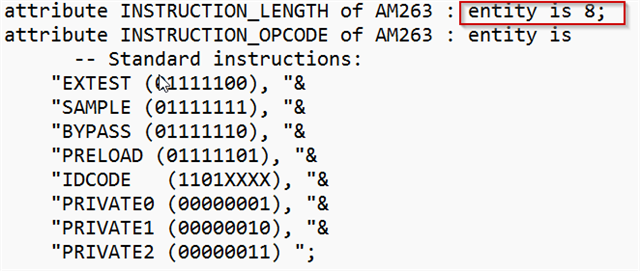
    attribute INSTRUCTION_LENGTH of AM263 : entity is 8;
    attribute INSTRUCTION_OPCODE of AM263 : entity is
          -- Standard instructions:
        "EXTEST (01111100), "&
        "SAMPLE (01111111), "&
        "BYPASS (01111110), "&
        "PRELOAD (01111101), "&
        "IDCODE   (1101XXXX), "&
        "PRIVATE0 (00000001), "&
        "PRIVATE1 (00000010), "&
        "PRIVATE2 (00000011) ";
    
    
    attribute INSTRUCTION_CAPTURE of AM263 : entity is "00000001";
    
    attribute INSTRUCTION_PRIVATE of AM263 : entity is
    "PRIVATE0," &
    "PRIVATE1," &
    "PRIVATE2";
    
    
    attribute REGISTER_ACCESS of AM263 : entity is
            "BOUNDARY (EXTEST,SAMPLE, PRELOAD), " & 
          "BYPASS(BYPASS)   ";
    attribute BOUNDARY_LENGTH of AM263 : entity is 438;
    attribute BOUNDARY_REGISTER of AM263 : entity is
    "0   (BC_1, *, control, 1), "&
    "1   (BC_1, SAFETY_ERRORn, input, X), "&
    "2   (BC_1, SAFETY_ERRORn, output3, X, 0, 1, Z), "&
    "3   (BC_1, *, control, 1), "&
    "4   (BC_1, WARMRSTn, input, X), "&
    "5   (BC_1, WARMRSTn, output3, X, 3, 1, Z), "&
    "6   (BC_1, *, control, 1), "&
    "7   (BC_1, EPWM0_A, input, X), "&
    "8   (BC_1, EPWM0_A, output3, X, 6, 1, Z), "&
    "9   (BC_1, *, control, 1), "&
    "10   (BC_1, EPWM0_B, input, X), "&
    "11   (BC_1, EPWM0_B, output3, X, 9, 1, Z), "&
    "12   (BC_1, *, control, 1), "&
    "13   (BC_1, EPWM1_A, input, X), "&
    "14   (BC_1, EPWM1_A, output3, X, 12, 1, Z), "&
    "15   (BC_1, *, control, 1), "&
    "16   (BC_1, EPWM1_B, input, X), "&
    "17   (BC_1, EPWM1_B, output3, X, 15, 1, Z), "&
    "18   (BC_1, *, control, 1), "&
    "19   (BC_1, EPWM2_A, input, X), "&
    "20   (BC_1, EPWM2_A, output3, X, 18, 1, Z), "&
    "21   (BC_1, *, control, 1), "&
    "22   (BC_1, EPWM2_B, input, X), "&
    "23   (BC_1, EPWM2_B, output3, X, 21, 1, Z), "&
    "24   (BC_1, *, control, 1), "&
    "25   (BC_1, EPWM3_A, input, X), "&
    "26   (BC_1, EPWM3_A, output3, X, 24, 1, Z), "&
    "27   (BC_1, *, control, 1), "&
    "28   (BC_1, EPWM3_B, input, X), "&
    "29   (BC_1, EPWM3_B, output3, X, 27, 1, Z), "&
    "30   (BC_1, *, control, 1), "&
    "31   (BC_1, EPWM4_A, input, X), "&
    "32   (BC_1, EPWM4_A, output3, X, 30, 1, Z), "&
    "33   (BC_1, *, control, 1), "&
    "34   (BC_1, EPWM4_B, input, X), "&
    "35   (BC_1, EPWM4_B, output3, X, 33, 1, Z), "&
    "36   (BC_1, *, control, 1), "&
    "37   (BC_1, EPWM5_A, input, X), "&
    "38   (BC_1, EPWM5_A, output3, X, 36, 1, Z), "&
    "39   (BC_1, *, control, 1), "&
    "40   (BC_1, EPWM5_B, input, X), "&
    "41   (BC_1, EPWM5_B, output3, X, 39, 1, Z), "&
    "42   (BC_1, *, control, 1), "&
    "43   (BC_1, EPWM6_A, input, X), "&
    "44   (BC_1, EPWM6_A, output3, X, 42, 1, Z), "&
    "45   (BC_1, *, control, 1), "&
    "46   (BC_1, EPWM6_B, input, X), "&
    "47   (BC_1, EPWM6_B, output3, X, 45, 1, Z), "&
    "48   (BC_1, *, control, 1), "&
    "49   (BC_1, EPWM7_A, input, X), "&
    "50   (BC_1, EPWM7_A, output3, X, 48, 1, Z), "&
    "51   (BC_1, *, control, 1), "&
    "52   (BC_1, EPWM7_B, input, X), "&
    "53   (BC_1, EPWM7_B, output3, X, 51, 1, Z), "&
    "54   (BC_1, *, control, 1), "&
    "55   (BC_1, EPWM8_A, input, X), "&
    "56   (BC_1, EPWM8_A, output3, X, 54, 1, Z), "&
    "57   (BC_1, *, control, 1), "&
    "58   (BC_1, EPWM8_B, input, X), "&
    "59   (BC_1, EPWM8_B, output3, X, 57, 1, Z), "&
    "60   (BC_1, *, control, 1), "&
    "61   (BC_1, EPWM9_A, input, X), "&
    "62   (BC_1, EPWM9_A, output3, X, 60, 1, Z), "&
    "63   (BC_1, *, control, 1), "&
    "64   (BC_1, EPWM9_B, input, X), "&
    "65   (BC_1, EPWM9_B, output3, X, 63, 1, Z), "&
    "66   (BC_1, *, control, 1), "&
    "67   (BC_1, EPWM10_A, input, X), "&
    "68   (BC_1, EPWM10_A, output3, X, 66, 1, Z), "&
    "69   (BC_1, *, control, 1), "&
    "70   (BC_1, EPWM10_B, input, X), "&
    "71   (BC_1, EPWM10_B, output3, X, 69, 1, Z), "&
    "72   (BC_1, *, control, 1), "&
    "73   (BC_1, EPWM11_A, input, X), "&
    "74   (BC_1, EPWM11_A, output3, X, 72, 1, Z), "&
    "75   (BC_1, *, control, 1), "&
    "76   (BC_1, EPWM11_B, input, X), "&
    "77   (BC_1, EPWM11_B, output3, X, 75, 1, Z), "&
    "78   (BC_1, *, control, 1), "&
    "79   (BC_1, EPWM12_A, input, X), "&
    "80   (BC_1, EPWM12_A, output3, X, 78, 1, Z), "&
    "81   (BC_1, *, control, 1), "&
    "82   (BC_1, EPWM12_B, input, X), "&
    "83   (BC_1, EPWM12_B, output3, X, 81, 1, Z), "&
    "84   (BC_1, *, control, 1), "&
    "85   (BC_1, EPWM13_A, input, X), "&
    "86   (BC_1, EPWM13_A, output3, X, 84, 1, Z), "&
    "87   (BC_1, *, control, 1), "&
    "88   (BC_1, EPWM13_B, input, X), "&
    "89   (BC_1, EPWM13_B, output3, X, 87, 1, Z), "&
    "90   (BC_1, *, control, 1), "&
    "91   (BC_1, MCAN1_TX, input, X), "&
    "92   (BC_1, MCAN1_TX, output3, X, 90, 1, Z), "&
    "93   (BC_1, *, control, 1), "&
    "94   (BC_1, MCAN1_RX, input, X), "&
    "95   (BC_1, MCAN1_RX, output3, X, 93, 1, Z), "&
    "96   (BC_1, *, control, 1), "&
    "97   (BC_1, MCAN0_RX, input, X), "&
    "98   (BC_1, MCAN0_RX, output3, X, 96, 1, Z), "&
    "99   (BC_1, *, control, 1), "&
    "100   (BC_1, MCAN0_TX, input, X), "&
    "101   (BC_1, MCAN0_TX, output3, X, 99, 1, Z), "&
    "102   (BC_1, *, control, 1), "&
    "103   (BC_1, UART1_RXD, input, X), "&
    "104   (BC_1, UART1_RXD, output3, X, 102, 1, Z), "&
    "105   (BC_1, *, control, 1), "&
    "106   (BC_1, UART1_TXD, input, X), "&
    "107   (BC_1, UART1_TXD, output3, X, 105, 1, Z), "&
    "108   (BC_1, *, control, 1), "&
    "109   (BC_1, CLKOUT0, input, X), "&
    "110   (BC_1, CLKOUT0, output3, X, 108, 1, Z), "&
    "111   (BC_1, *, control, 1), "&
    "112   (BC_1, QSPI0_D0, input, X), "&
    "113   (BC_1, QSPI0_D0, output3, X, 111, 1, Z), "&
    "114   (BC_1, *, internal, 1), "&
    "115   (BC_1, *, internal, 1), "&
    "116   (BC_1, *, internal, 1), "&
    "117   (BC_1, *, control, 1), "&
    "118   (BC_1, QSPI0_CLK, input, X), "&
    "119   (BC_1, QSPI0_CLK, output3, X, 117, 1, Z), "&
    "120   (BC_1, *, control, 1), "&
    "121   (BC_1, QSPI0_D1, input, X), "&
    "122   (BC_1, QSPI0_D1, output3, X, 120, 1, Z), "&
    "123   (BC_1, *, control, 1), "&
    "124   (BC_1, QSPI0_D2, input, X), "&
    "125   (BC_1, QSPI0_D2, output3, X, 123, 1, Z), "&
    "126   (BC_1, *, control, 1), "&
    "127   (BC_1, QSPI0_D3, input, X), "&
    "128   (BC_1, QSPI0_D3, output3, X, 126, 1, Z), "&
    "129   (BC_1, *, control, 1), "&
    "130   (BC_1, QSPI0_CSn0, input, X), "&
    "131   (BC_1, QSPI0_CSn0, output3, X, 129, 1, Z), "&
    "132   (BC_1, *, control, 1), "&
    "133   (BC_1, QSPI0_CSn1, input, X), "&
    "134   (BC_1, QSPI0_CSn1, output3, X, 132, 1, Z), "&
    "135   (BC_1, *, control, 1), "&
    "136   (BC_1, EXT_REFCLK0, input, X), "&
    "137   (BC_1, EXT_REFCLK0, output3, X, 135, 1, Z), "&
    "138   (BC_1, *, control, 1), "&
    "139   (BC_1, EPWM14_A, input, X), "&
    "140   (BC_1, EPWM14_A, output3, X, 138, 1, Z), "&
    "141   (BC_1, *, control, 1), "&
    "142   (BC_1, EPWM14_B, input, X), "&
    "143   (BC_1, EPWM14_B, output3, X, 141, 1, Z), "&
    "144   (BC_1, *, control, 1), "&
    "145   (BC_1, EPWM15_A, input, X), "&
    "146   (BC_1, EPWM15_A, output3, X, 144, 1, Z), "&
    "147   (BC_1, *, control, 1), "&
    "148   (BC_1, EPWM15_B, input, X), "&
    "149   (BC_1, EPWM15_B, output3, X, 147, 1, Z), "&
    "150   (BC_1, *, control, 1), "&
    "151   (BC_1, RGMII1_RD0, input, X), "&
    "152   (BC_1, RGMII1_RD0, output3, X, 150, 1, Z), "&
    "153   (BC_1, *, control, 1), "&
    "154   (BC_1, RGMII1_RD1, input, X), "&
    "155   (BC_1, RGMII1_RD1, output3, X, 153, 1, Z), "&
    "156   (BC_1, *, control, 1), "&
    "157   (BC_1, RGMII1_RD2, input, X), "&
    "158   (BC_1, RGMII1_RD2, output3, X, 156, 1, Z), "&
    "159   (BC_1, *, control, 1), "&
    "160   (BC_1, RGMII1_RD3, input, X), "&
    "161   (BC_1, RGMII1_RD3, output3, X, 159, 1, Z), "&
    "162   (BC_1, *, control, 1), "&
    "163   (BC_1, RGMII1_RXC, input, X), "&
    "164   (BC_1, RGMII1_RXC, output3, X, 162, 1, Z), "&
    "165   (BC_1, *, control, 1), "&
    "166   (BC_1, RGMII1_RX_CTL, input, X), "&
    "167   (BC_1, RGMII1_RX_CTL, output3, X, 165, 1, Z), "&
    "168   (BC_1, *, control, 1), "&
    "169   (BC_1, RGMII1_TD0, input, X), "&
    "170   (BC_1, RGMII1_TD0, output3, X, 168, 1, Z), "&
    "171   (BC_1, *, control, 1), "&
    "172   (BC_1, RGMII1_TD1, input, X), "&
    "173   (BC_1, RGMII1_TD1, output3, X, 171, 1, Z), "&
    "174   (BC_1, *, control, 1), "&
    "175   (BC_1, RGMII1_TD2, input, X), "&
    "176   (BC_1, RGMII1_TD2, output3, X, 174, 1, Z), "&
    "177   (BC_1, *, control, 1), "&
    "178   (BC_1, RGMII1_TD3, input, X), "&
    "179   (BC_1, RGMII1_TD3, output3, X, 177, 1, Z), "&
    "180   (BC_1, *, control, 1), "&
    "181   (BC_1, RGMII1_TXC, input, X), "&
    "182   (BC_1, RGMII1_TXC, output3, X, 180, 1, Z), "&
    "183   (BC_1, *, control, 1), "&
    "184   (BC_1, RGMII1_TX_CTL, input, X), "&
    "185   (BC_1, RGMII1_TX_CTL, output3, X, 183, 1, Z), "&
    "186   (BC_1, *, control, 1), "&
    "187   (BC_1, MDIO0_MDC, input, X), "&
    "188   (BC_1, MDIO0_MDC, output3, X, 186, 1, Z), "&
    "189   (BC_1, *, control, 1), "&
    "190   (BC_1, MDIO0_MDIO, input, X), "&
    "191   (BC_1, MDIO0_MDIO, output3, X, 189, 1, Z), "&
    "192   (BC_1, *, control, 1), "&
    "193   (BC_1, PR0_MDIO0_MDC, input, X), "&
    "194   (BC_1, PR0_MDIO0_MDC, output3, X, 192, 1, Z), "&
    "195   (BC_1, *, control, 1), "&
    "196   (BC_1, PR0_MDIO0_MDIO, input, X), "&
    "197   (BC_1, PR0_MDIO0_MDIO, output3, X, 195, 1, Z), "&
    "198   (BC_1, *, control, 1), "&
    "199   (BC_1, PR0_PRU0_GPO11, input, X), "&
    "200   (BC_1, PR0_PRU0_GPO11, output3, X, 198, 1, Z), "&
    "201   (BC_1, *, control, 1), "&
    "202   (BC_1, PR0_PRU0_GPO12, input, X), "&
    "203   (BC_1, PR0_PRU0_GPO12, output3, X, 201, 1, Z), "&
    "204   (BC_1, *, control, 1), "&
    "205   (BC_1, PR0_PRU0_GPO15, input, X), "&
    "206   (BC_1, PR0_PRU0_GPO15, output3, X, 204, 1, Z), "&
    "207   (BC_1, *, control, 1), "&
    "208   (BC_1, PR0_PRU0_GPO0, input, X), "&
    "209   (BC_1, PR0_PRU0_GPO0, output3, X, 207, 1, Z), "&
    "210   (BC_1, *, control, 1), "&
    "211   (BC_1, PR0_PRU0_GPO1, input, X), "&
    "212   (BC_1, PR0_PRU0_GPO1, output3, X, 210, 1, Z), "&
    "213   (BC_1, *, control, 1), "&
    "214   (BC_1, PR0_PRU0_GPO6, input, X), "&
    "215   (BC_1, PR0_PRU0_GPO6, output3, X, 213, 1, Z), "&
    "216   (BC_1, *, control, 1), "&
    "217   (BC_1, PR0_PRU0_GPO2, input, X), "&
    "218   (BC_1, PR0_PRU0_GPO2, output3, X, 216, 1, Z), "&
    "219   (BC_1, *, control, 1), "&
    "220   (BC_1, PR0_PRU0_GPO3, input, X), "&
    "221   (BC_1, PR0_PRU0_GPO3, output3, X, 219, 1, Z), "&
    "222   (BC_1, *, control, 1), "&
    "223   (BC_1, PR0_PRU0_GPO4, input, X), "&
    "224   (BC_1, PR0_PRU0_GPO4, output3, X, 222, 1, Z), "&
    "225   (BC_1, *, control, 1), "&
    "226   (BC_1, PR0_PRU0_GPO16, input, X), "&
    "227   (BC_1, PR0_PRU0_GPO16, output3, X, 225, 1, Z), "&
    "228   (BC_1, *, control, 1), "&
    "229   (BC_1, PR0_PRU0_GPO13, input, X), "&
    "230   (BC_1, PR0_PRU0_GPO13, output3, X, 228, 1, Z), "&
    "231   (BC_1, *, control, 1), "&
    "232   (BC_1, PR0_PRU0_GPO14, input, X), "&
    "233   (BC_1, PR0_PRU0_GPO14, output3, X, 231, 1, Z), "&
    "234   (BC_1, *, control, 1), "&
    "235   (BC_1, PR0_PRU0_GPO5, input, X), "&
    "236   (BC_1, PR0_PRU0_GPO5, output3, X, 234, 1, Z), "&
    "237   (BC_1, *, control, 1), "&
    "238   (BC_1, PR0_PRU0_GPO10, input, X), "&
    "239   (BC_1, PR0_PRU0_GPO10, output3, X, 237, 1, Z), "&
    "240   (BC_1, *, control, 1), "&
    "241   (BC_1, PR0_PRU0_GPO9, input, X), "&
    "242   (BC_1, PR0_PRU0_GPO9, output3, X, 240, 1, Z), "&
    "243   (BC_1, *, control, 1), "&
    "244   (BC_1, PR0_PRU0_GPO8, input, X), "&
    "245   (BC_1, PR0_PRU0_GPO8, output3, X, 243, 1, Z), "&
    "246   (BC_1, *, control, 1), "&
    "247   (BC_1, PR0_PRU1_GPO0, input, X), "&
    "248   (BC_1, PR0_PRU1_GPO0, output3, X, 246, 1, Z), "&
    "249   (BC_1, *, control, 1), "&
    "250   (BC_1, PR0_PRU1_GPO1, input, X), "&
    "251   (BC_1, PR0_PRU1_GPO1, output3, X, 249, 1, Z), "&
    "252   (BC_1, *, control, 1), "&
    "253   (BC_1, PR0_PRU1_GPO2, input, X), "&
    "254   (BC_1, PR0_PRU1_GPO2, output3, X, 252, 1, Z), "&
    "255   (BC_1, *, control, 1), "&
    "256   (BC_1, PR0_PRU1_GPO3, input, X), "&
    "257   (BC_1, PR0_PRU1_GPO3, output3, X, 255, 1, Z), "&
    "258   (BC_1, *, control, 1), "&
    "259   (BC_1, PR0_PRU1_GPO4, input, X), "&
    "260   (BC_1, PR0_PRU1_GPO4, output3, X, 258, 1, Z), "&
    "261   (BC_1, *, control, 1), "&
    "262   (BC_1, PR0_PRU1_GPO5, input, X), "&
    "263   (BC_1, PR0_PRU1_GPO5, output3, X, 261, 1, Z), "&
    "264   (BC_1, *, control, 1), "&
    "265   (BC_1, PR0_PRU1_GPO6, input, X), "&
    "266   (BC_1, PR0_PRU1_GPO6, output3, X, 264, 1, Z), "&
    "267   (BC_1, *, control, 1), "&
    "268   (BC_1, PR0_PRU1_GPO8, input, X), "&
    "269   (BC_1, PR0_PRU1_GPO8, output3, X, 267, 1, Z), "&
    "270   (BC_1, *, control, 1), "&
    "271   (BC_1, PR0_PRU1_GPO9, input, X), "&
    "272   (BC_1, PR0_PRU1_GPO9, output3, X, 270, 1, Z), "&
    "273   (BC_1, *, control, 1), "&
    "274   (BC_1, PR0_PRU1_GPO10, input, X), "&
    "275   (BC_1, PR0_PRU1_GPO10, output3, X, 273, 1, Z), "&
    "276   (BC_1, *, control, 1), "&
    "277   (BC_1, PR0_PRU1_GPO11, input, X), "&
    "278   (BC_1, PR0_PRU1_GPO11, output3, X, 276, 1, Z), "&
    "279   (BC_1, *, control, 1), "&
    "280   (BC_1, PR0_PRU1_GPO12, input, X), "&
    "281   (BC_1, PR0_PRU1_GPO12, output3, X, 279, 1, Z), "&
    "282   (BC_1, *, control, 1), "&
    "283   (BC_1, PR0_PRU1_GPO13, input, X), "&
    "284   (BC_1, PR0_PRU1_GPO13, output3, X, 282, 1, Z), "&
    "285   (BC_1, *, control, 1), "&
    "286   (BC_1, PR0_PRU1_GPO14, input, X), "&
    "287   (BC_1, PR0_PRU1_GPO14, output3, X, 285, 1, Z), "&
    "288   (BC_1, *, control, 1), "&
    "289   (BC_1, PR0_PRU1_GPO15, input, X), "&
    "290   (BC_1, PR0_PRU1_GPO15, output3, X, 288, 1, Z), "&
    "291   (BC_1, *, control, 1), "&
    "292   (BC_1, PR0_PRU1_GPO16, input, X), "&
    "293   (BC_1, PR0_PRU1_GPO16, output3, X, 291, 1, Z), "&
    "294   (BC_1, *, control, 1), "&
    "295   (BC_1, PR0_PRU1_GPO18, input, X), "&
    "296   (BC_1, PR0_PRU1_GPO18, output3, X, 294, 1, Z), "&
    "297   (BC_1, *, control, 1), "&
    "298   (BC_1, PR0_PRU1_GPO19, input, X), "&
    "299   (BC_1, PR0_PRU1_GPO19, output3, X, 297, 1, Z), "&
    "300   (BC_1, *, control, 1), "&
    "301   (BC_1, SDFM0_CLK0, input, X), "&
    "302   (BC_1, SDFM0_CLK0, output3, X, 300, 1, Z), "&
    "303   (BC_1, *, control, 1), "&
    "304   (BC_1, SDFM0_CLK1, input, X), "&
    "305   (BC_1, SDFM0_CLK1, output3, X, 303, 1, Z), "&
    "306   (BC_1, *, control, 1), "&
    "307   (BC_1, SDFM0_CLK2, input, X), "&
    "308   (BC_1, SDFM0_CLK2, output3, X, 306, 1, Z), "&
    "309   (BC_1, *, control, 1), "&
    "310   (BC_1, SDFM0_CLK3, input, X), "&
    "311   (BC_1, SDFM0_CLK3, output3, X, 309, 1, Z), "&
    "312   (BC_1, *, control, 1), "&
    "313   (BC_1, SDFM0_D0, input, X), "&
    "314   (BC_1, SDFM0_D0, output3, X, 312, 1, Z), "&
    "315   (BC_1, *, control, 1), "&
    "316   (BC_1, SDFM0_D1, input, X), "&
    "317   (BC_1, SDFM0_D1, output3, X, 315, 1, Z), "&
    "318   (BC_1, *, control, 1), "&
    "319   (BC_1, SDFM0_D2, input, X), "&
    "320   (BC_1, SDFM0_D2, output3, X, 318, 1, Z), "&
    "321   (BC_1, *, control, 1), "&
    "322   (BC_1, SDFM0_D3, input, X), "&
    "323   (BC_1, SDFM0_D3, output3, X, 321, 1, Z), "&
    "324   (BC_1, *, control, 1), "&
    "325   (BC_1, EQEP0_A, input, X), "&
    "326   (BC_1, EQEP0_A, output3, X, 324, 1, Z), "&
    "327   (BC_1, *, control, 1), "&
    "328   (BC_1, EQEP0_B, input, X), "&
    "329   (BC_1, EQEP0_B, output3, X, 327, 1, Z), "&
    "330   (BC_1, *, control, 1), "&
    "331   (BC_1, EQEP0_INDEX, input, X), "&
    "332   (BC_1, EQEP0_INDEX, output3, X, 330, 1, Z), "&
    "333   (BC_1, *, control, 1), "&
    "334   (BC_1, EQEP0_STROBE, input, X), "&
    "335   (BC_1, EQEP0_STROBE, output3, X, 333, 1, Z), "&
    "336   (BC_1, *, control, 1), "&
    "337   (BC_1, I2C0_SCL, input, X), "&
    "338   (BC_1, I2C0_SCL, output3, X, 336, 1, Z), "&
    "339   (BC_1, *, control, 1), "&
    "340   (BC_1, I2C0_SDA, input, X), "&
    "341   (BC_1, I2C0_SDA, output3, X, 339, 1, Z), "&
    "342   (BC_1, *, control, 1), "&
    "343   (BC_1, MCAN2_TX, input, X), "&
    "344   (BC_1, MCAN2_TX, output3, X, 342, 1, Z), "&
    "345   (BC_1, *, control, 1), "&
    "346   (BC_1, MCAN2_RX, input, X), "&
    "347   (BC_1, MCAN2_RX, output3, X, 345, 1, Z), "&
    "348   (BC_1, *, control, 1), "&
    "349   (BC_1, SPI0_CLK, input, X), "&
    "350   (BC_1, SPI0_CLK, output3, X, 348, 1, Z), "&
    "351   (BC_1, *, control, 1), "&
    "352   (BC_1, SPI0_CS0, input, X), "&
    "353   (BC_1, SPI0_CS0, output3, X, 351, 1, Z), "&
    "354   (BC_1, *, control, 1), "&
    "355   (BC_1, SPI0_D0, input, X), "&
    "356   (BC_1, SPI0_D0, output3, X, 354, 1, Z), "&
    "357   (BC_1, *, control, 1), "&
    "358   (BC_1, SPI0_D1, input, X), "&
    "359   (BC_1, SPI0_D1, output3, X, 357, 1, Z), "&
    "360   (BC_1, *, control, 1), "&
    "361   (BC_1, SPI1_CLK, input, X), "&
    "362   (BC_1, SPI1_CLK, output3, X, 360, 1, Z), "&
    "363   (BC_1, *, control, 1), "&
    "364   (BC_1, SPI1_CS0, input, X), "&
    "365   (BC_1, SPI1_CS0, output3, X, 363, 1, Z), "&
    "366   (BC_1, *, control, 1), "&
    "367   (BC_1, SPI1_D0, input, X), "&
    "368   (BC_1, SPI1_D0, output3, X, 366, 1, Z), "&
    "369   (BC_1, *, control, 1), "&
    "370   (BC_1, SPI1_D1, input, X), "&
    "371   (BC_1, SPI1_D1, output3, X, 369, 1, Z), "&
    "372   (BC_1, *, control, 1), "&
    "373   (BC_1, LIN1_RXD, input, X), "&
    "374   (BC_1, LIN1_RXD, output3, X, 372, 1, Z), "&
    "375   (BC_1, *, control, 1), "&
    "376   (BC_1, LIN1_TXD, input, X), "&
    "377   (BC_1, LIN1_TXD, output3, X, 375, 1, Z), "&
    "378   (BC_1, *, control, 1), "&
    "379   (BC_1, LIN2_RXD, input, X), "&
    "380   (BC_1, LIN2_RXD, output3, X, 378, 1, Z), "&
    "381   (BC_1, *, control, 1), "&
    "382   (BC_1, LIN2_TXD, input, X), "&
    "383   (BC_1, LIN2_TXD, output3, X, 381, 1, Z), "&
    "384   (BC_1, *, control, 1), "&
    "385   (BC_1, I2C1_SDA, input, X), "&
    "386   (BC_1, I2C1_SDA, output3, X, 384, 1, Z), "&
    "387   (BC_1, *, control, 1), "&
    "388   (BC_1, I2C1_SCL, input, X), "&
    "389   (BC_1, I2C1_SCL, output3, X, 387, 1, Z), "&
    "390   (BC_1, *, control, 1), "&
    "391   (BC_1, UART0_CTSn, input, X), "&
    "392   (BC_1, UART0_CTSn, output3, X, 390, 1, Z), "&
    "393   (BC_1, *, control, 1), "&
    "394   (BC_1, UART0_RTSn, input, X), "&
    "395   (BC_1, UART0_RTSn, output3, X, 393, 1, Z), "&
    "396   (BC_1, *, control, 1), "&
    "397   (BC_1, UART0_RXD, input, X), "&
    "398   (BC_1, UART0_RXD, output3, X, 396, 1, Z), "&
    "399   (BC_1, *, control, 1), "&
    "400   (BC_1, UART0_TXD, input, X), "&
    "401   (BC_1, UART0_TXD, output3, X, 399, 1, Z), "&
    "402   (BC_1, *, control, 1), "&
    "403   (BC_1, MMC0_CD, input, X), "&
    "404   (BC_1, MMC0_CD, output3, X, 402, 1, Z), "&
    "405   (BC_1, *, control, 1), "&
    "406   (BC_1, MMC0_CLK, input, X), "&
    "407   (BC_1, MMC0_CLK, output3, X, 405, 1, Z), "&
    "408   (BC_1, *, control, 1), "&
    "409   (BC_1, MMC0_CMD, input, X), "&
    "410   (BC_1, MMC0_CMD, output3, X, 408, 1, Z), "&
    "411   (BC_1, *, control, 1), "&
    "412   (BC_1, MMC0_D0, input, X), "&
    "413   (BC_1, MMC0_D0, output3, X, 411, 1, Z), "&
    "414   (BC_1, *, control, 1), "&
    "415   (BC_1, MMC0_D1, input, X), "&
    "416   (BC_1, MMC0_D1, output3, X, 414, 1, Z), "&
    "417   (BC_1, *, control, 1), "&
    "418   (BC_1, MMC0_D2, input, X), "&
    "419   (BC_1, MMC0_D2, output3, X, 417, 1, Z), "&
    "420   (BC_1, *, control, 1), "&
    "421   (BC_1, MMC0_D3, input, X), "&
    "422   (BC_1, MMC0_D3, output3, X, 420, 1, Z), "&
    "423   (BC_1, *, control, 1), "&
    "424   (BC_1, MMC0_WP, input, X), "&
    "425   (BC_1, MMC0_WP, output3, X, 423, 1, Z), "&
    "426   (BC_1, *, internal, 1), "&
    "427   (BC_1, *, internal, 1), "&
    "428   (BC_1, *, internal, 1), "&
    "429   (BC_1, *, internal, 1), "&
    "430   (BC_1, *, internal, 1), "&
    "431   (BC_1, *, internal, 1), "&
    "432   (BC_1, *, internal, 1), "&
    "433   (BC_1, *, internal, 1), "&
    "434   (BC_1, *, internal, 1), "&
    "435   (BC_1, *, internal, 1), "&
    "436   (BC_1, *, internal, 1), "&
    "437   (BC_1, *, internal, 1)";
    
    end AM263;


    These are the inputs I received from the design team.

    The supplied BSDL file for this device (AM2634CODFHAZCZR) specifies an 8 bit instruction register but when we capture the value of that register it only returns four bits.

    Can you please help us understand the testcase how this instruction register value is being read. Can you share the test or the steps used to read instruction reg value.

    We have also seen that the IDCode returned from the device has both a different version and part number value when compared to the value specified in the BSDL file.

    ID code register is an optional register which was removed in the latest version I have attached.

    As suggested in the previous thread we have tried different boot modes, and seen different behaviours.  The behaviour described above was seen with bootmode 0110.  When we tried with 1001, suggested in the other thread, we got no data returned from the chain.  Neither of these boot modes is referenced in the TRM for the device.

    The bsdl with bootmode configuration is already updated. There are comments at the top to tell the boot mode. Can you tell which pin is and 1 and 0 and is it similar to what mentioned in the updated bsdl file

    Thanks & Regards,
    Rijohn

  • Hello Rijohn,

    Thank you for posting the new BSDL file with the power up sequence for BSDL mode.  It would be normal to put this as a COMPLIANCE section in the file, but it good that it is in there somewhere.


  • Hello Rijohn,

    Thank you for posting the new BSDL file with the power up sequence for BSDL mode.  It would be normal to put this in a COMPLIANCE section in the file, but it is good to have it in there.

    We read the instruction register by moving through the JTAG state machine to IR Capture and then IR Shift.  We clock a marker into TDI and monitor TDO to see when that marker is clocked out.  We see that there are 8 TCKs required to read out the marker which is how we know that the IR is 8 bits wide, rather than the four bits listed in the file.

    While the IDCode is optional, it is still selected by default when the JTAG state machine enters test logic reset.  If a device does not implement an IDCode BYPASS mode should be selected when in test logic reset.  I can work around the IDCode not being correct but I do need the correct instruction register lenght in the file.

    We have tried with different boot mode configurations. Fortunately the board I am working on has DIP switches to configure the values of these pins.  We have tried the suggested values but see the behaviour previously described.

    Any further help greatfully received.

  • Hi Stuart,

    The COMPLIANCE was not working because the global checkers were fail as those pins are having boundary scan registers.

    We see that there are 8 TCKs required to read out the marker which is how we know that the IR is 8 bits wide, rather than the four bits listed in the file

    In the file as well it is listed as 8 right?


    Fortunately the board I am working on has DIP switches to configure the values of these pins.  We have tried the suggested values but see the behaviour previously described.

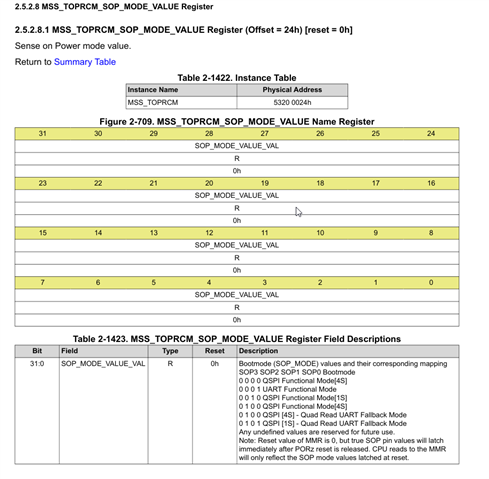
    Can you please put set the DIP switches in 1001 states and confirm it by connecting to R5F Core0 and reading the value of MSS_TOPRCM_SOP_MODE_VALUE register.


    Best Reagrds,
    Rijohn


  • Hello Rijohn,

    The IR length in the file is not what we are seeing on the board.

    As you have highlighted the BSDL file specifies an 8 bit register; however we are seeing only four bits between TDI and TDO when we are running our tests.

    I don't have the tools to read the register but I have asked my customer if they the tools needed to do this.

    I will come back to you as soon as I have their answer but if you can check under what circumstance there would be a four bir IR register that would be very helpful.

    Many thanks

    Stuart

  • I have just reread my previous post and see that I have the four and eight bits the wrong way around.  I confirm that we see four bits, not the 8 listed in the file.

    Apologies for the confusion.

  • Hi Stuart,

    Can you please share us the test case? we will replicate the simulation
     - Testcase of how tck, tms and tdi is changing.

    Thanks & Regards
    Rijohn

  • Hello Rijohn,

    We are applying a TMS reset (TMS high for 5 TCKs) to enter test logic reset.  We are then moving through the JTAG state machine to IR capture and on to IR shift.

    In IR shift we apply a marker to the TDI pin, you can choose your marker but I think we are using 0x96 across 8 TCKs.  All the time in IR shift we are monitoring TDO to see the values reported.  We look to see our marker coming out from TDO and then we know that everything that came before that is from the IR register of the device.

    We then check the value retured from the IR register and compare that to the IR CAPTURE value defined in the BSDL file.

    I hope that this is clear but please let me know if you need more details.

    Stuart

  • The register MSS_TOPRCM_SOP_MODE_VALUE value for setting the DIP switches in 1001 states is 0110 (0x06) as shown in the below figure.


  • Hi Stuart,

    Apologies for the late response.

    Our DFT engineer is working on to recreate this setup and here is status I got from them:
    "They are powering up in SOP1 mode followed by reaching the shift IR state and then shifting from tdi."
    I will try to get results and share that before 30th Sept.

    Thanks,
    Rijohn

  • Hi Stuart,

    DFT engineer measured the Instruction Register (IR) length using the JTAG TAP controller.

    • Device is powered up in sop1 mode
    • The TAP was reset and taken through the states:

    Test-Logic-Reset → Run-Test/Idle → Select-DR-Scan → Select-IR-Scan → Capture-IR → Shift-IR.

    • In Shift-IR, we applied a known bit sequence (1010…) on TDI.
    • The same sequence appeared on TDO after 8 TCK cycles.

    This confirms that the IR length of the device is 8 bits and the same is mentioned in the bsdl file as well

    Please see the attached simulation diagram and number of rising edge to get the output at tdo

    Simulation Diagram


    Thanks & Regards,
    Rijohn

  • Hello Rijohn,

    Thank you for sending this - please do not close this case. We need to understand why you are seeing different 

  • Sorry - realised I wasn't logged in and that completed my comment!

    We need to understand why you are seeing different behavour to that being seen by our customer.

    Can you ask your colleagues what IDCode they see the device returning?  As they are seeing an 8 bit IR register, it could be that they will also see the IDCode that is specified in the original BSDL file.

    To read the IDCode go to Test Logic Reset, transition to DR Shift then apply 32 TCKs monitoring TDO.

    I will look to do more investigations on our side.

  • Hi Stuart,

    Can you ask your colleagues what IDCode they see the device returning?  As they are seeing an 8 bit IR register, it could be that they will also see the IDCode that is specified in the original BSDL file.

    To read the IDCode go to Test Logic Reset, transition to DR Shift then apply 32 TCKs monitoring TDO.

    Sure, I will check with DFT engineer and get back by mid next week (delay as it is Navarathri Festival + Gandhi Jayanthi holidays in India).

    Thanks & Regards,
    Rijohn

  • Hello Rohit,

    We have been doing some more investigation and we have been able to access an 8 bit instruction register, which is consistent with the signal capture shared by your colleagues.

    We don't know why this wasn't working on a different customer's design but for now we are happy to move on.  Unfortunately we have been blocked at the next step.

    Having been able to load instructions into the device to select different data registers we have not then been able to move data through those selected registers.

    We have tried shifting data through the boundary scan register with the device in SAMPLE and we have tried moving data through the bypass register with the device in BYPASS.  In both of these cases we have not been able to shift the marker that I mentioned before through the device and back out of TDO.

    The easiest case for your colleagues to investigate will be the BYPASS register as that is only one bit wide.  That said, we have noticed that the BYPASS instruction given in the BSDL file (0b01111110) is not compliant with the JTAG standard.  The standard defines that the BYPASS instruction should be all 1s.

    Could you please ask your colleagues to comment on the amomoly around this instruction but also on the device not passing data thought the bypass register when this instruction is loaded.

    Many thanks

    Stuart

  • Hello Rijohn,

    Firstly appologies for getting your name wrong on my last post - most embarassing!

    The main reason for this post is to highlight that our latest tests have been done on a AM263P4.  I believe the similaritiy in behaviour that we are seeing mean that the issues are across the family but I wanted to be sure you had all the information that we have when looking to resolve this issue.

    I would like to highlight that this is now an urgent issue as we have a joint customer who is waiting to be able to test a production run of boards.

    Many thanks.

    Stuart

  • Hi Stuart,
    Apology for the delay, I was out last week. 
    I am simulating on AM261, the test tap architecture of AM263/AM263P and AM261 is exactly the same.

    I performed a JTAG scan to validate the BYPASS register functionality.
    • The BYPASS instruction (0x7E → binary 01111110) was shifted into the Instruction Register (IR).
    • The attached waveform snapshot shows the transition into the Shift-IR state, followed by the device moving into the BYPASS instruction state after the Update-IR phase.
    • Next, I entered the Shift-DR state. In this phase, the data shifted into TDI appears at TDO exactly one clock cycle later, confirming the expected 1-bit behavior of the BYPASS register.

    This verifies that the device correctly interprets the 0x7E instruction as BYPASS and that the JTAG chain behaves as expected.

    Please find the waveform attached for your reference.

    Thanks,

    Arshad

  • Hello Arshad,

    Thank you for doing that test and sending the screenshot.  My colleague who reported this problem has done more testing and confirmed your findings.

    My colleague has reported that the device does not overscan in SAMPLE mode; however we are working around this issue.

    I think that it would be good to update the BSDL file to highlight the issues that have been seen (device not selecting the correct state on passing through test logic reset (possibly a broken IDCode register rather than BYPASS), data not scanning through the BSR when in SAMPLE and the fact that there are compliance values - I know these have been added as a comment on the latest BSDL file but it should be specified in the syntax of the file).

    I do appreciate your help with this device, especially as I have to accept that some of the information we have given has not been correct.