This thread has been locked.

If you have a related question, please click the "Ask a related question" button in the top right corner. The newly created question will be automatically linked to this question.

MSPM0G1506:About Errata VREF_ERR_03

Part Number: MSPM0G1506
Other Parts Discussed in Thread: SYSCONFIG

Tool/software:

Hello,

Please tell me about VREF_ERR_03.

>If there are frequent power cycling of the VREF then damage cam occur.
Specifically, how frequent is "frequently"?


>Pre-charge the VREF+ capacitor by using the GPIO before enabling VREF. This provides the capacitor is charged more than required. Then enable the VREF module and disable the GPIO pull-up.
Is there no inrush current caused by the GPIO when it is pre-charged?

  • Specifically, how frequent is "frequently"?

    Doesn't recommend to use Vref itself to charge the 1uF. Please use GPIO with pullup to charge.

    Is there no inrush current caused by the GPIO when it is pre-charged?

    There is 40kOhm pullup when you enable GPIO(IOMUx)'s pullup, the current is limited.

    And This charge current is coming from IOMUx pullup, not from Vref, so there is no damage to Vref module.

  • Thank you,

    I am configuring VREF in sysconfig; is it possible to apply a workaround for this erratum?

  • Yes, init the Vref manually.

    Output high to Vref+ pin by GPIO.

    Then reset IOMUX and init Vref module.

  • OK,

    I understand that the SYSCFG_DL_VREF_init(void) function automatically generated by SYSCONFIG should not be used. Is that correct?

  • You need to charge Vref+ using GPIO, then reset IOMUX and call 

    SYSCFG_DL_VREF_init

    to enable vref+ module.

    Since Vref is analog function, IOMUX need to keep in reset status.

  • A response has not been received.
    Is it correct to understand that enabling the VREF+ module after using the GPIO cannot be achieved through SYSCONFIG?


    I will implement the countermeasure in my program, but how many seconds should the precharge via GPIO be performed?

  • Is it correct to understand that enabling the VREF+ module after using the GPIO cannot be achieved through SYSCONFIG?

    Yes~ syscfg only support simple peripherals init code generation.

  • Hello,

    I would like you to answer this question.

    >I will implement the countermeasure in my program, but how many seconds should the precharge via GPIO be performed?

    Thank you.

  • >I will implement the countermeasure in my program, but how many seconds should the precharge via GPIO be performed?

    From the test on Launchpad, 200us is enough.

    But you need to consider your own PCB design.

    https://e2e.ti.com/cfs-file/__key/communityserver-discussions-components-files/908/VrefpCharge.sal

  • Hello,

    >From the test on Launchpad, 200us is enough.

    OK, thank you.


    >But you need to consider your own PCB design.
    This was unexpected.
    Precharging cannot be done within the internal circuit. Does this mean that it is necessary to precharge through an external circuit?

  • This was unexpected.
    Precharging cannot be done within the internal circuit. Does this mean that it is necessary to precharge through an external circuit?

    No.

    1. If you add a larger capacitor to Vref+, it will need more time.

    2. If your power supply can output limited current(maybe < 2~5mA), maybe need more time to charge or causing M0 powering down,

    Plese try to monitor the Vref+ charging voltage waveform to make sure your hardware design is OK to support a little bit large charging current.

  • Hmm. I'm starting to get confused.


    Is "VREF_ERR_03" related to "VREF_ERR_02"?
    If "VREF_ERR_02" is addressed, is it unnecessary to handle "VREF_ERR_03"?

  • Is "VREF_ERR_03" related to "VREF_ERR_02"?

    No. this is about VREF module discharge speed is low.

    Err_03 is about can not support fast charge current.

    This is two different thing.

    Vref_Err_02's workaround is about how to use GPIO to discharge the Vref capacitor if Vref C = 1uF.

    Vref_Err_03 is about the Vref charge method.

    By referring to Err_02, you can consider to control the charge voltage to 2.5V by testing and controlling the charge time.

  • Hello.


    Thank you for your support.
    I will take measures against VREF_ERR_02 and VREF_ERR_03 using the following methods.


    ①VREF DISABLE
    ② Connect a GPIO pull-up to VREF+
    ③ Wait for 200 microseconds
    ④ Disconnect the GPIO
    ⑤VREF ENABLE
    ⑥ Wait for 200 microseconds

  • Yes.

    To make sure Vref+ charged correctly with software controlled GPIO.

    Please try to monitor the voltage of Vref+ and compare it with your software timepoint(Try to use GPIO toggle between functions)

  • Thank you.
    I was just creating and testing the software when my team asked me a question.
    The question is whether the errata fixes seem to be ineffective.
    Please confirm this and respond.

    If a capacitor is pre-charged with a 3V power supply voltage and Vref is connected, a potential difference of 1.6V will be created between Vref (1.4V) and the capacitor's 3V charge voltage.
    In this case, I think there is a possibility that reverse current will occur at the output terminal of the op amp generating Vref. Would pre-charging the capacitor as a countermeasure be appropriate?

  • If a capacitor is pre-charged with a 3V power supply voltage and Vref is connected, a potential difference of 1.6V will be created between Vref (1.4V) and the capacitor's 3V charge voltage.
    In this case, I think there is a possibility that reverse current will occur at the output terminal of the op amp generating Vref. Would pre-charging the capacitor as a countermeasure be appropriate?

    There are.

    But this reverse current won't damage to Vref.

    Only issue is discharge from 3.3V to 1.4V is slow.

    If you want a faster application, please control your charge time to control the charge voltage around 1.4V. (Maybe 1.5 ~ 1.8 is better)

  • Thank you for your valuable feedback.

    I will try to proceed with the evaluation based on this.

    First, I will estimate the charging/discharging time to see roughly how long it will take, and then I will check it by actual measurement and optimize accordingly.

  • Hello.
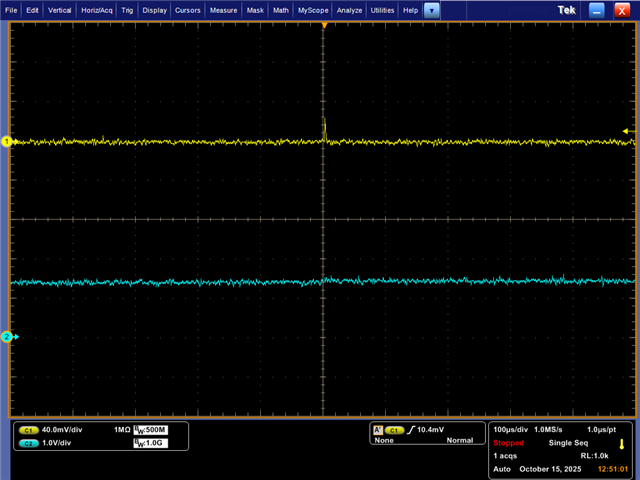
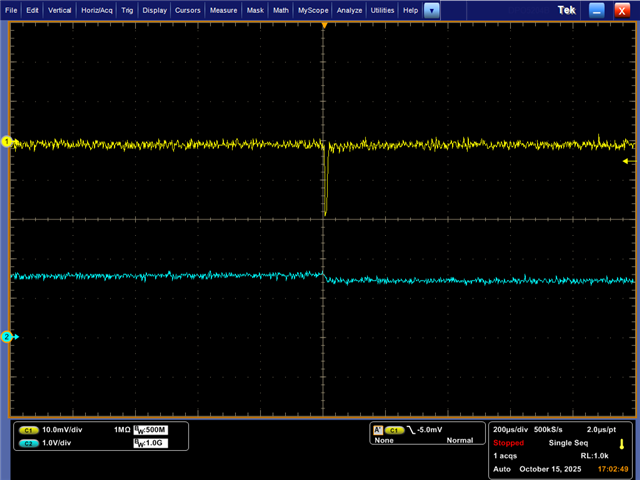
    As per your advice, I performed pre-charging of the capacitor using GPIO and checked the current and voltage. In Image 1, channel 1 shows current at 20mA/div and channel 2 shows voltage at 1V/div, with a 30ms charge. In Image 2, channel 1 shows current at 5mA/div and channel 2 shows voltage at 1V/div, with a 35ms charge. With 30ms of charging, the voltage is less than 1.4V and a current of about 12mA is flowing; however, with 35ms of charging, a reverse current of 10mA occurred.

    • According to your explanation, you mentioned that there is no problem even if reverse current flows, so is it safe to precharge for 35ms without causing any damage?
    • I think that bringing the voltage closer to Vref will further reduce the current, but to what level (in mA) should the current be lowered to ensure that no damage will occur?
  • According to your explanation, you mentioned that there is no problem even if reverse current flows, so is it safe to precharge for 35ms without causing any damage?

    Since ERR_03 is talked about Vref module charge external circuit will cause damage.

    And ERR_02 means discharge to Vref module is slow.

    There is no mention that discharge will damage vref.

    35 ms is OK.

    I think that bringing the voltage closer to Vref will further reduce the current, but to what level (in mA) should the current be lowered to ensure that no damage will occur

    Based on ERR_03, don't try to charge external capacitor with Vref is OK.

    a little bit discharge to vref is OK.

  • Thank you for your response.
    I had overlooked the fact that changes in the supply voltage would also cause changes in the precharge voltage.
    We are assuming a coin cell battery with a supply voltage of 2.2V to 3.3V.
    With a minimum supply voltage of 2.2V and a precharge time of 65 ms, a small reverse current of about 3.5 mA is expected.
    However, with a maximum supply voltage of 3.3V and a precharge time of 65 ms, a large reverse current of about 40 mA is expected to flow towards Vref.

    • Down to how many mA of reverse current is acceptable?
    • Why is that amount of reverse current acceptable?
  • Down to how many mA of reverse current is acceptable?
    Why is that amount of reverse current acceptable?

    Based on ERR_02, only concern is the slow discharge rate, there is no damage to Vref when discharge.

    No need to consider discharge damage.

  • Hello Helic,
    We understood your answer and have a question.
    (Question)
    How many current is the expected discharge current?

    Regards,
    Tao_2199

  • Let me check.

  • Hello,

    Would you let us know current status?

    Regards,
    Tao_2199

  • Hi, I have send the feedback to Isao-san.