AM2434: ODVA Conformance test - EDS test fail

Part Number: AM2434

Hi 

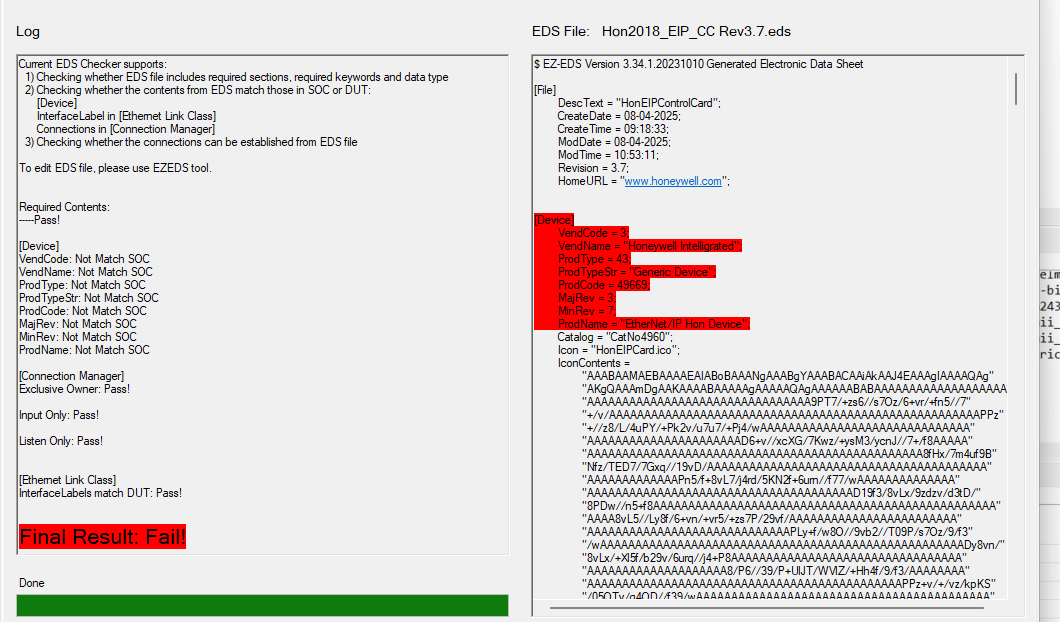
we are doing a conformance test on our custom board with am2434  ind_comms_sdk_am243x_09_02_00_24 SDK and I have attached the error, as per the previous suggestions we had updated the code with product_code, Product name, Device revision, vendor ID)

Is there any other things we have to take care or change in the code.

Screenshot 2025-12-08 111837.png Screenshot 2025-12-08 111641.png


  • Hi Yashaswini,

    The error likely indicates that you haven't loaded your .SOC file. You'll need to adapt your .SOC file just as you did for the .EDS file. To do this, simply open your .SOC/.STC file via "STC Editor" panel -> Add -> (select your SOC file) -> OK (Add menu) -> OK ("STC Editor" menu)

    If you don't have a .SOC file, you can start from an EIP example as a template. For instance, the SOC file for a Generic Device can be found at: "ind_comms_sdk_am243x_09_02_00_24\examples\industrial_comms\ethernetip_adapter_demo\device_profiles\generic_device\soc\am243x-lp_tiEtherNetIP_freeRTOS.soc"

    Please ensure that your EDS file and SOC file are consistent with each other to avoid any mismatches.


    Best regards,
    Pourya

  • Hi Pourya

    Thanks for your quick response 

    While running conformance test I got errors

    On seeing the log I see device is unable to bind to the given address. Any idea why is this

  • Hi Yashaswini,

    The primary issue that I see, is that you're conducting tests against CT22, whereas according to the EIP Datasheet for SDK 09.02.00.24, you should be using CT21.
    CT22 is built on a newer version of the CIP specification, which will be incorporated in our next release.
    Please switch to using CT21 for your testing, and let me know if you encounter any problem.

    Best regards,
    Pourya

  • Hi  , 

    I hope you are doing well. We have received a request from ODVA to evaluate using CT22, and we have successfully obtained the license for that version. With customer evaluations already underway, we are eager to proceed with the new version of the SDK to adapt to CT22 as soon as possible. Could you kindly provide an estimate on how soon you can release this new version? In the meantime, if there is any workaround that we can implement to keep things moving, we would greatly appreciate it. Thank you for your assistance with this matter.

    Best regards,
    Yash Mehta

  • Hi Yash,

    We are currently implementing new specification updates to ensure compatibility with CT22. These changes will be incorporated in our next release, which is scheduled for the first quarter of 2026.
    This release timeline aligns with the dates specified in the ODVA Specification Mandatory Change List

    Best regards,
    Pourya

  • Hi Pourya 

    We have received the ODVA CT21 software and completed the test. However, we encountered several errors, as shown in the attached images. The card is responding in over 300 ms, and we are seeing errors. The log file is also attached for reference

      CT21_Hon2018_EIP_CC.log


  • Hi Pourya 

    any update on this?

  • Hi Yashaswini,

    I apologize for the delayed response; I was out of the office.

    Could you please provide the Wireshark capture from the test you ran? Ideally, repeat the test and upload both the CT log and the Wireshark trace as a ZIP file.

    From the CT log, it appears that the command to change the IP address did not succeed. To investigate the List-Identity issue further, I’ll need to review the Wireshark log to determine whether the request is being processed correctly.
    Could you also please confirm if the reset request is being handled correctly?

    Best regards,
    Pourya

  • Hi Pourya 

    I have attached the zip file of related files

    Thank you

    odva.zip

  • Hi Pourya 

    I have retested below are the files attached 

    ODVA CC10 (2).zip

  • Hi Yashaswini,

    here are my observations:

    1) In your STC (.SOC) file, the MAC address doesn't match the device being tested, which will cause errors in the LLDP and TCP/IP object tests.

    2) Regarding my previous inquiry about reset requests, I notice that both Type2 and Type1 Reset requests are skipped. Could you please explain why this is happening and confirm whether the reset request is being handled correctly?

    Could you also please confirm if the reset request is being handled correctly?


    3) Your .SOC file appears to be incorrectly configured for IO connections, as any attempt to open an IO connection (ForwardOpen) is rejected by the device with an "invalid O->T size" error (extended status code 0x127). Please update your SOC file with the correct IO stream sizes for O->T and T->O to match the device.

    The root cause of the remaining errors seems to be misconfiguration on the PC running the CT21 test. Please follow the instructions in the CT21 User Manual (accessible via Help > Reference > User Manual) for proper PC network configuration.

    You need to configure two IP addresses (preferably use 192.168.1.5 and 192.168.1.6 instead of 192.168.1.1) and ensure the netmask for both is set to 255.255.255.0. Also, please pay special attention to the LLDP configuration requirements.


    Best regards,
    Pourya

  • Hi Pourya,

    Thanks for your suggestions — they helped us significantly reduce the errors. However, we still have a few issues that we’d like to clarify:

    1. Type 1 and Type 2 Reset Tests:
      We are not skipping these tests intentionally, but the tool is still reporting them as skipped. We’re unsure why this is happening.

    2. DUT Response Time Errors:
      We are seeing multiple errors stating that the DUT takes more than 300 ms to respond. Could you help us understand what might be causing this?

    3. TCP/IP Test Issue:
      In our application, the last octet of the IP address is set using rotary switches. We suspect this might be preventing the IP address from changing during the test. Is this likely the root cause?

    4. Connection Manager Test:
      We tried multiple combinations of data sizes, but we continue to get errors. Is there a way to identify the exact O→T and T→O sizes expected by the test?

  • Hi Yashaswini,

    1) Reset Issue: do you observe that the device restarts? can you capture the UART log during the test?
    If not, do you have any observable method (LED, etc.) to see that the device actually restarts?
    If that also not feasible, you need to debug your application and put a breakpoint to see if CMN_OS_reset is called or not.

    2) DUT Response time: Are you connecting your DUT directly to your Test-PC LAN port, or is there any USB-Ethernet adapter involved? If you are using any USB-Ethernet adapter that might cause unexpected delay.
    Other than that, the other suspect is what you mentioned in another E2E ticket, namely the delay that you have added to main task.

    3)TCP/IP Test Issue: yes, indeed when there is another part of your code which overwrites the IP address setting that can be the root cause.

    4) Connection Manager Test: The O->T and T->O payload sizes must be known to you already, how else can PLC communicate with your device and establish IO connection? Just use exactly the same payload size that you are using in your EDS file. It is the size of Producing and Consuming assemblies.

    Best regards,
    Pourya

  • Hi Pourya

    1) Reset Issue
    I have verified that CMN_OS_reset is being called within our application. I’ve attached the UART log for your reference.

    2) DUT Response Time
    The DUT is connected directly to the Test PC.

    Currently, I’m unable to access the CT21 software log file. For now, I’ve attached the complete UART log (from the start to the end of the test), the Wireshark capture, and a few screenshots.

    ODVA Ct21.zip

  • Hi Yashaswini,

    have you checked the check-box during test-setup to run Reset Type1 and Type2?

    Regards,
    Pourya

  • Hi Pourya 

    Thank you for your suggestion. We were able to resolve the two errors related to the List Identity object. However, we are still seeing errors in the TCP/IP object, Connection Manager, and Ethernet Link object.

    For the TCP/IP and Ethernet Link issues, I understand they may be related to our application, but could you provide any insight into how the conformance test body typically evaluates or interprets these kinds of errors?

  • Hi Yashaswini,

    For a more comprehensive understanding of what each Object test evaluates, please refer to the EtherNet/IP_PCTS.pdf and CIP_PCTS.pdf documents located in the CT21 installation directory.

    Best regards,
    Pourya

  • hI  , 

    Here are the logs that   was able to provide me from her testing last time. This has both the Conformance test logs and the wireshark data. Please let me know if you need anything else. 

    odva cc112.zip

    Thanks, 

    Yash Mehta

  • Hi Yash,

    Based on the logs analysis:

    1) Incorrect Timing for List-Identity: This appears to be caused by delays in the Main task, as we previously discussed.

    2)TCP/IP Object Failures: These occur because your application is overwriting IP configurations received from the network. For example, when the test tool attempts to change the IP address to 192.168.1.11, the setting fails to apply.

    Recommended Improvements in your application:

    1) Task Independence: Ensure your DAC task operates independently from the Main task. If data exchange between these tasks is necessary, implement proper inter-task communication mechanisms such as signals or queues to manage safe data transfer. What is the task priority for DAC task? 

    2) Resolve IP Configuration Conflicts: Address the conflicting behavior regarding TCP/IP attribute changes. When a change request comes from the network, it should be able to override the default rotary switch configuration enforced by your application.

    To monitor network-initiated change requests, refer to EI_APP_CFG_callback function in appCfg.c. When EI_APP_CFG_isChanged_s is set to true, your application should stop overwriting the received network configuration. 

    Implement a proper state-machine, when and how the rotary switch setting should be applied and when the request from the network.

    If you prefer that your device's TCP/IP attributes be exclusively controlled by the rotary switch and not be modifiable from the network, this is technically feasible. However, this functionality would require a customized patch for the EtherNet/IP stack, as it's not included in the standard EIP implementation delivered with the Standard SDK.

    For this custom solution, please contact your local TI sales office for more details.

    Best regards,
    Pourya

  • Hi pourya

    Apologies for the delay as I was on vacation for last few days, Thank you for your suggestions 

    We are running the DAC task independently from the main task but still we are getting delayed response from DUT, what might be the reason?ODVATCP.zip

    I have attached error log for your reference  

  • Hi Yashaswini,

    No Wireshark log was uploaded in your attached file, based on the log itself, I cannot offer a conclusive diagnosis of the issue. To better assist you, I would need:

    1) Wireshark capture: If available, please share the Wireshark log from this test. If not, please consider re-running the test while capturing network traffic with Wireshark.

    2)Task scheduling information: The issue may be related to FreeRTOS task scheduling. Specifically, the EtherNet/IP internal tasks might not be receiving adequate processing time.
    One possibility worth investigating is task priority configuration. If your DAC task is assigned a very high priority and doesn't yield control (via TaskP_yield , waiting on Signals to run or similar calls), it could monopolize CPU time. This would prevent lower-priority tasks, including critical EtherNet/IP tasks, from executing properly.
    Please let me know:

    1) What priority level is assigned to your DAC task?
    2) Does your DAC implementation include appropriate yield points or do you implement some sort of signal mechanism to wait for an event and then execute?
    3) Have you monitored task execution times,? If your project is based on TI example, then the simplest way is to enable WebServer and monitor execution time. Please provide a screenshot of the WebServer when the conformance test is running.

    This scheduling imbalance could explain the symptoms you're experiencing. Additional diagnostic information would help confirm this hypothesis or identify alternative causes.


    Best regards,
    Pourya