Part Number: TM4C1294NCPDT
This is a multi-faceted issue.
Most important: We have devices, based arount the TM4C1294NCPDT (the recent version is TM4C1294NCPDTI3) MCU.
We have them permanently connected to HP desktops as USB devices. They are being plugged into their USB3 ports, using regular USB2 A-to-B cables.
The device's USB circuitry is configured as "Self-powered Device". We use full size USB-B connector to communicate.
Once in a while (5 units out of 120 at the facility YTD) a unit's USB comms die. Post-mortem reveals the USB port no longer communicates, while the rest of the MCU operates fine and even can be re-programmed via JTAG. Sometimes one of the Data pins (we are seeing the DP) is shorted to GND.
The device is powered from an Earth-Grounded tabletop 12VDC power adapter (device's Case and Digital GND are both tied to Earth) and the HP computer is also Earthed. Both the device and the computer are powered from the same power strip (to answer the potential GND shift etc).
Also: we have passed the immunity compliance to 6kV contact/ 6kV air ESD, and also 2kV EFT/SURGE with no damage to USB whatsoever.
An observation: while looking at the comms, the Device seems to default to Full-Speed mode. The Data frequency seems to be 6MHz, the DP is held at +3.1V and the DM is held at 0V while idling.
Additional question: TM4C is advertised as USB2 Hi-speed USB device; is there a way to force it to advertise itself and communicate as USB2? So far it defaults to USB1 speed; we use TI-provided library driver with no mods to it.
The pictures: below you could see the way USB is connected between the connector and the respective USB pins of the TM4C. The PB1 is used as the USB0VBUS, and the VBUS is conditioned through the 1K resistor, 4.7V Zener and filtering 0.1uF caps.
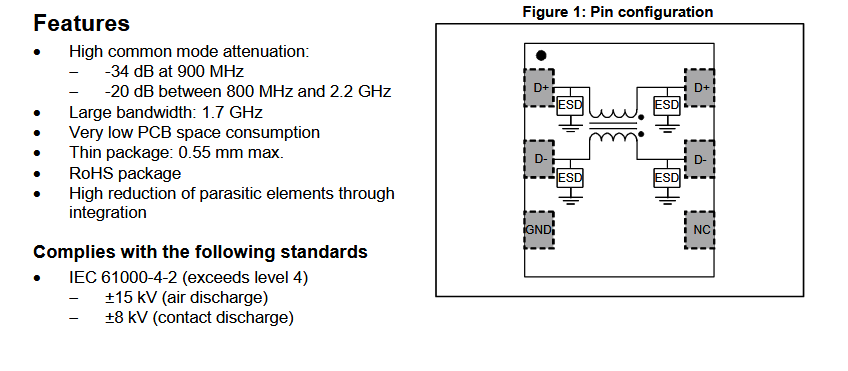
The DM/DP pins are put through the CM choke that actually has ESD protection on both ends of each winding. The choke's picture is also below.
Best
Mike