MSPM0C1104: PA24 - No injection current allowed

Part Number: MSPM0C1104


Hi, 

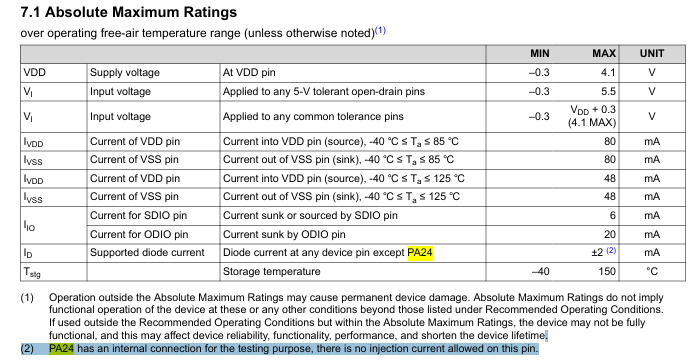
My customer is planning to use PA24 (GPIO) however they had query on the the note on PA24 where no injection current allowed. 

May we have clarification what does this means and imply in terms of design?

#1 : What's the exact difference between PA24 and other GPIO pin?

#2 : What is the expected behavior if customer accidentally injected current? Would the device halt operation or damaged? Bascially customer wants to access the worst case scenario.

#3 : What may triggers the error? Is it high voltage or current?

#4 : Would using an ESD diode alone be sufficient to protect the pin?

#5 : Would using an ESD diode plus a BAT54SW be sufficicent?
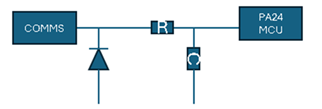
image.png

image.png

image.png

Thanks,

Christina 

  • Hi Christina,

    1. What's the exact difference between PA24 and other GPIO pin?

    The difference between PA24 and the other GPIO pins is that there's an internal connection for testing purposes.

    • What is the expected behavior if customer accidentally injected current? Would the device halt operation or damaged? Bascially customer wants to access the worst case scenario.

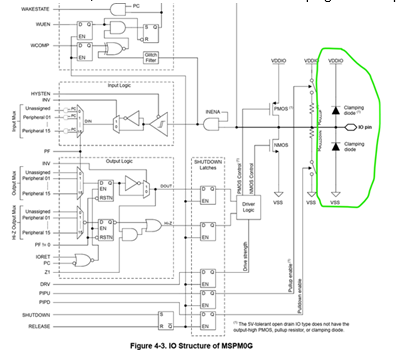
    Injecting current on PA24 can lead to many different outcomes. It can result in unpredictable logic states, degrade performance, increase power consumption, permanently damage the input protection diodes, reset the device, or even eventually result in device failure if repeatedly violated.

    Injection current can be caused from an input voltage exceeding VDD + 0.3. Any violation to these specs will result in injection current. The GPIO pins can tolerate up to +/- 2mA of current, with the exception of PA24.

    No, this would likely not help, since there are already internal ESD diodes. The VDD + 0.3 spec ensures that the applied voltage does not result in the ESD diode turning on. Any voltage that exceeds VDD + 0.3V will forward-bias the internal protection diode and cause injection current to flow into the device.

    This might work. Another potential protection could be a Zener diode. The important thing here is that you prevent any injection current from flowing into the device by not violating the input voltage specification.

    Best,

    Owen