Part Number: MSPM0G1507
Other Parts Discussed in Thread: SYSCONFIG,
Hi,
I’m using MSPM0G1507 in a new design and configuring the LF clock via SysConfig.
-
Device: MSPM0G1507 ([package], [silicon revision if known])
-
SDK / SysConfig: [MSPM0 SDK version], [SysConfig version], IDE: [CCS version]
-
Pins: PA3 (pin 9) = LFXIN, PA4 (pin 10) = LFXOUT
-
LFCLK source: LFXT
-
LFXT input: external 32.768 kHz connected from outside
-
Source type: [crystal / oscillator module / MCU clock output]
-
Signal level: [e.g., CMOS 3.3 V / 1.8 V], connection: [to LFXIN / both pins], LFXOUT: [connected/open]
-
(If crystal) load caps: [value], ESR: [value if known]
-
SysConfig generates SYSCFG_DL_init() and it calls:
-
DL_SYSCTL_setLFCLKSourceLFXT();
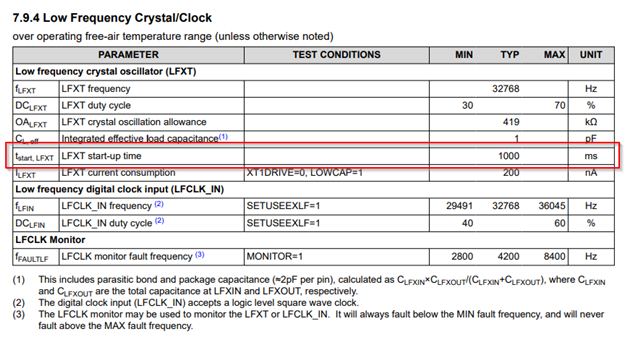
This function seems to configure LFXT and wait until LFXT is stable/ready.
From a cold power-on (VDD completely off → on), I measured the wait time by toggling a GPIO before/after this call, and it takes about ~1 second.
My questions are:
-
Is ~1 second LFXT “stable wait” time expected/normal for MSPM0G1507, especially when using an external 32.768 kHz source?
-
Is there any way to reduce this startup time?
For example, recommended configuration for external clock (bypass mode), different DriverLib APIs, or starting with an internal LF oscillator and switching to LFXT later. -
If I remove/skip the waiting part of
DL_SYSCTL_setLFCLKSourceLFXT()(or avoid calling it at boot), what issues could occur?
Would it be safe to start with an internal LF clock, then later check LFXT ready and enable RTC afterwards?
Any guidance on the recommended approach to minimize boot time while still using LFXT for RTC accuracy would be appreciated.
Best regards,
Conor