This thread has been locked.

If you have a related question, please click the "Ask a related question" button in the top right corner. The newly created question will be automatically linked to this question.

F29H85X-SOM-EVM: the issue about power on and crystal oscillators

Part Number: F29H85X-SOM-EVM

Hi all,

  1. Regarding the power-on slope, our test focuses on the fastest section of the power-up slope. I’d like to ask if the datasheet specification for the rising slope is also based on the fastest segment?

  1. During power-down, when XRSN drops, VDD3V3 drops to 2.73V but then recovers. Will the repeated assertion/de-assertion of XRSN caused by such power supply jitter during power down cause any problems?

  1. What is the required ripple for each power rail? I couldn’t find this specification in the datasheet.
  2. For external active crystal oscillators, I didn't find any requirements for the peak-to-peak amplitude in the datasheet.
  3. Is it necessary to add a capacitor to XTAL1? Your datasheet mentions it as a recommendation, but there is no such capacitor in the development board schematic.

Regard,

Jenney

  • Hi Jenny 

    Let me find the right person to address the issue. Please expect response in 1-2 days.

    Thank you 

    Amir Hussain

  • Hi Amir,

    The customer has an urgent case, so pls give higher priority to these questions. 

  • Hi Jenney,

    Regarding the power-on slope, our test focuses on the fastest section of the power-up slope. I’d like to ask if the datasheet specification for the rising slope is also based on the fastest segment?

    This is correct, you will see a linear region in the power-up waveform. The datasheet specs are based on this linear region 

    During power-down, when XRSN drops, VDD3V3 drops to 2.73V but then recovers. Will the repeated assertion/de-assertion of XRSN caused by such power supply jitter during power down cause any problems?

    Can you reupload the image? It seems it's not displaying in your message

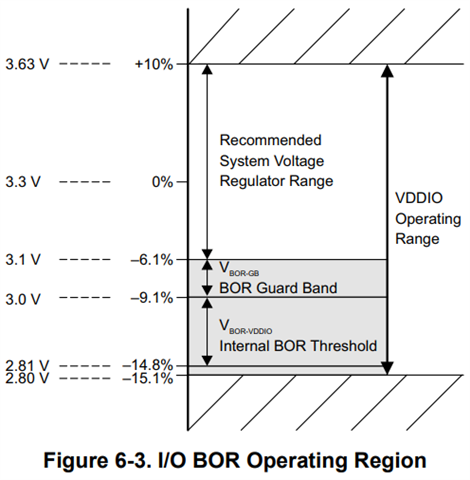
    What is the required ripple for each power rail? I couldn’t find this specification in the datasheet.

    Voltage ripple is typically not a concern as long as the voltage remains within the recommended operating voltage. See below diagram for reference values. Proper decoupling of voltage rails should be sufficient, please refer to datasheet recommendations accordingly for each voltage rail

    For external active crystal oscillators, I didn't find any requirements for the peak-to-peak amplitude in the datasheet.

    We primarily use passive, such as 830108207209 which does not specify voltage and leverages internal MCU clocking circuitry for deriving the clock. For active oscillators, as long as it does not exceed 3.3V, it is fine

    Is it necessary to add a capacitor to XTAL1? Your datasheet mentions it as a recommendation, but there is no such capacitor in the development board

    Some clocking configuration requires external capacitor, others do not, please see below for examples

    Regards,

    Peter

  • Hi Peter,

    add the picture:

    During power-down, when XRSN drops, VDD3V3 drops to 2.73V but then recovers. Will the repeated assertion/de-assertion of XRSN caused by such power supply jitter during power down cause any problems?

    Regards,

    Jenney

  • Hi Jenney,

    What is the method of power-down the device? I see there is also some oscillation of the power rail further in the graph. Typically the internal power management module will be responsible for ensuring proper power-on and power-off of the device to protect from long-term damage

    Regards,

    Peter

  • Hi Peter,

    You mean 'power-on and power-off of the device abnormally will cause the long-term damage',right? The internal power management module needs the software development, right? Where i can get the docments about this?

    Regards,

    Jenney

  • Hi Jenney,

    The PMM is internal module, but it doesn't need any software intervention. It acts automatically to detect any improper power supplied to device and puts MCU in reset if applicable. This and decoupling caps is why we do not specify the voltage ripple requirements for power. You can see more information on this in the PMM section of the datasheet, but there is no registers associated with this PMM module

    Regards,

    Peter