This thread has been locked.

If you have a related question, please click the "Ask a related question" button in the top right corner. The newly created question will be automatically linked to this question.

AM6442: AM6442 : USB 3.0 Usage in AM6442 from the Main Domain(R5 Core)

Part Number: AM6442

Hello TI Team,

We are currently using the AM6442 EVM for interface development, and based on our product requirements, we need to bring up the USB 3.0 (USB 3.1 Gen 1, SuperSpeed) interface on this platform.

Query:

We are working with the SDK mcu_plus_sdk_am64x_11_02_00_24. Within this SDK, we are able to find reference examples and documentation for the USB 2.0 controller, including support for            (device mode) operation . However, we are unable to locate any example applications, drivers, or reference designs specifically targeting the USB 3.0 (SuperSpeed) interface.

Additionally, as mentioned in the MCU+ SDK v11.02.00 release notes, it is stated that the USB 3.0 feature has not yet been fully validated/tested by TI.

Could you please confirm the following:

  1. Whether it is technically possible to bring up and use the USB 3.0 interface on the AM6442 using the current SDK.
  2. If USB 3.0 bring-up is supported (even if experimental), are there any available reference examples, patches, or internal drivers that can be used as a starting point?
  3. If no examples are available, what configuration changes, driver integrations, or additional steps would be required at the SDK, bootloader, or device-tree level to enable USB 3.0 operation?

Any guidance, limitations, or recommended roadmap regarding USB 3.0 support on the AM6442 would be greatly appreciated.
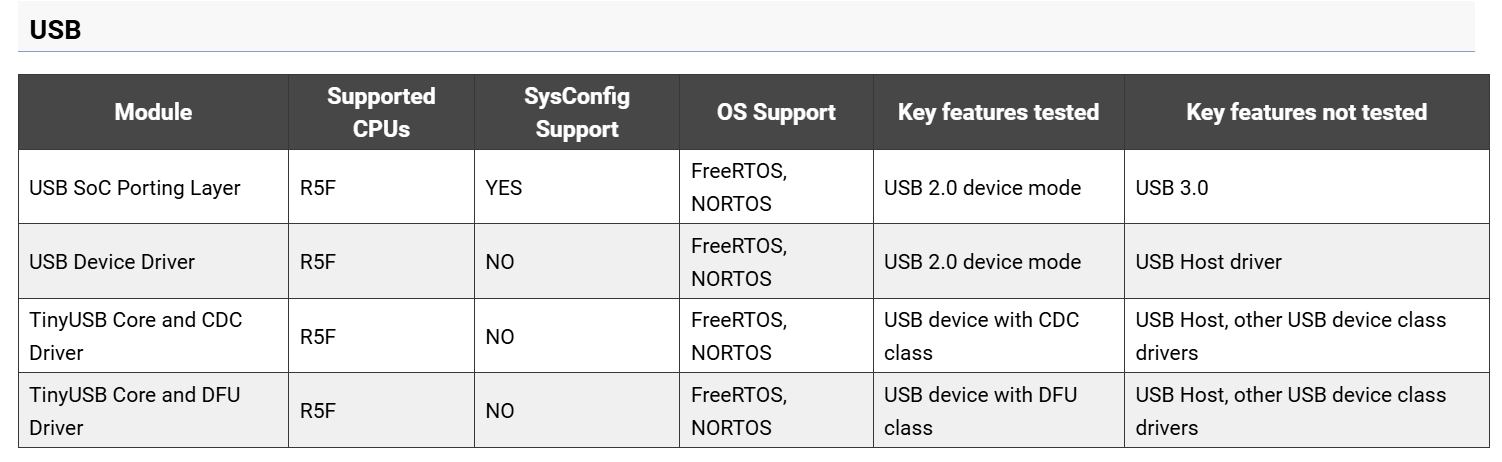
 image.png 


  • Hi,

    Whether it is technically possible to bring up and use the USB 3.0 interface on the AM6442 using the current SDK.

    The USB IP in the AM64x device do support USB 3.0. The USB 3.0 superspeed device mode is not supported.

    To see all the feature supported or not supported, please refer section 12.2.4.1.1 USB Features in TRM.

    If USB 3.0 bring-up is supported (even if experimental), are there any available reference examples, patches, or internal drivers that can be used as a starting point?

    There are no reference example for USB 3.0 mode.

    If no examples are available, what configuration changes, driver integrations, or additional steps would be required at the SDK, bootloader, or device-tree level to enable USB 3.0 operation?

    SERDES needs to be enabled while using USB 3.0 protocol. Also SERDES is shared between both PCIE and USB but only once can use it at a time.

    In our current SDK offering we do not support USB 3.0 and there is no future plan for the same.

    Please refer USB feature not supported for details.

    Regards,

    Tushar

  • Hi Tushar,

    Thank you for the detailed responses. I would like to seek further clarification, as some of the statements appear to be inconsistent, and we want to ensure correct understanding before proceeding with our design.

    From your initial response, you mentioned that

    The USB IP in the AM64x device does support USB 3.0, however USB 3.0 SuperSpeed device mode is not supported.


    Based on my understanding of the TRM and datasheet, the USB subsystem supports multiple data rates. To clarify:

    • If USB 3.0 SuperSpeed device mode is not supported, does this imply that the USB 3.0 controller can still operate at lower speeds (for example, USB 2.0 High-Speed or lower) for bring-up and functional validation?

    You also mentioned that:

    • SERDES is required for USB 3.0 operation.
    • SERDES is shared between PCIe and USB, and only one interface can be active at a time.
    • There are no reference examples or documented procedures available for configuring SERDES for USB 3.0.

    Given the above, could you please provide guidance or documentation on:

    • The required SERDES configuration steps (if applicable) to enable USB operation.
    • Whether USB functionality can be validated without SERDES when operating at non-SuperSpeed data rates.

    Additionally, your statement In our current SDK offering we do not support USB 3.0 and there is no future plan for the same seems to contradict the earlier statement that the USB IP supports USB 3.0 (with limitations). It would be helpful if you could clarify the scope of this statement—specifically whether it refers to:

    • SuperSpeed support only, or
    • Any USB 3.0-related functionality within the SDK.

    To consolidate our understanding, could you please clarify the following questions:

    a) What is the distinction between USB 3.0 and USB 3.0 SuperSpeed device mode in the context of the AM64x USB IP?

    b) If USB 3.0 SuperSpeed is not supported, can the controller still be configured to operate at lower data rates for both host and device modes, and is it acceptable to proceed with interface bring-up under these conditions?

    c) In the current SDK, I see reference examples only for USB 2.0 device mode. Could you please provide inputs or pointers to reference examples, documentation, or guidelines for using USB 2.0 in host mode?

    Your clarification on these points will help us align our implementation approach with the device and SDK capabilities.

    Regards

    Ganesh

  • If USB 3.0 SuperSpeed device mode is not supported, does this imply that the USB 3.0 controller can still operate at lower speeds (for example, USB 2.0 High-Speed or lower) for bring-up and functional validation?

    Yes, the USB controller can operate at lower speed. As per the TRM, the USB controller on the SoC supports data rates at SuperSpeed (5 Gbps), high speed (480 Mbps), full speed (12Mbps), and low speed (1.5 Mbps).

    The required SERDES configuration steps (if applicable) to enable USB operation.

    Serdes is only required for USB Superspeed operation. The High speed, Full speed and Low speed operation can be performed without serdes initialization.

    Whether USB functionality can be validated without SERDES when operating at non-SuperSpeed data rates
    If USB 3.0 SuperSpeed is not supported, can the controller still be configured to operate at lower data rates for both host and device modes, and is it acceptable to proceed with interface bring-up under these conditions?

    Yes, this is possible. Please refer EXAMPLES_USB_CDC_ECHO for details.

    a) What is the distinction between USB 3.0 and USB 3.0 SuperSpeed device mode in the context of the AM64x USB IP?

    There is no difference. The USB 3.0 protocol itself supports superspeed transfers. The device mode indicates that the USB controller can not be configured as USB device mode in superspeed, as it only supports USB superspeed host mode.

    In the current SDK, I see reference examples only for USB 2.0 device mode. Could you please provide inputs or pointers to reference examples, documentation, or guidelines for using USB 2.0 in host mode?

    As already mention in my previous reply, this functionality is not tested and we don't have any documentation around it. The USB host mode is not implemented in the SDK and is not supported on E2E forum.

    Regards,

    Tushar