This thread has been locked.

If you have a related question, please click the "Ask a related question" button in the top right corner. The newly created question will be automatically linked to this question.

AM263PX-MCAL-SDK: PBIST Negative Test Need and PBIST Register Info

Part Number: AM263PX-MCAL-SDK
Other Parts Discussed in Thread: AM263P4

Hi Team,

According to SDK 11.0.19 you are performing negative and positive test for pbist. For development of pbist code at boot level for AM263P4, is positive test alone enough or negative test is required as well?

Also we noticed that for starting PBIST negative test you are writing 0x1 to STR register which has address 0x5330016C when looked through variables view while debugging(as shown below), but in AM263P register addendum we don't see that reg. In AM263x reg addendum it says that reg(PBIST_PC) is internal TI register reserved for hw testing purpose.
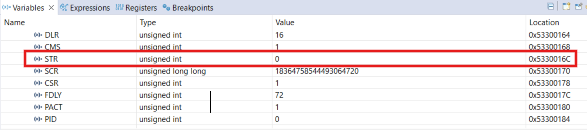
image.png

Could you please look into above issue. 

PS: I am using AM263P CC board for development and testing. 


Thanks & Regards,

Vandana Chintala 

  • Hello Vandana,

    Thank you for your questions regarding PBIST testing and register documentation for the AM263PX-MCAL-SDK.

    PBIST Negative Test Requirement

    For boot-level PBIST implementation on AM263P4, the general industry practice for safety-critical and high-reliability applications is to run both positive and negative PBIST tests. The positive test verifies normal memory operation, while the negative test confirms that the PBIST logic can properly detect and report faults such as stuck-at bits or address-line errors.

    However, I recommend reviewing the following documentation to confirm the specific requirements for your application:

    The exact requirement may depend on your functional safety goals and whether you need compliance with standards like ISO 26262.

    PBIST_PC Register at 0x5330016C

    Regarding the PBIST_PC/STR register at address 0x5330016C that you observed during debugging: since the SDK uses this register for negative testing, it should be safe for you to use it in your boot-level code as well. The SDK serves as the reference implementation, registers utilized by the SDK are usually appropriate for customer applications.

    While this register may not appear in the public AM263P register addendum (https://www.ti.com/lit/pdf/spruj52), its usage in the SDK generally indicates it is intended for customer use. The discrepancy you noted between AM263x and AM263P Register Addendums is likely due to a documentation miss. I will file a bug to make sure this is reviewed.

    For detailed register bit-field information and usage examples, I recommend referencing the SDK source code directly, as it provides an accurate implementation for your device.

    Please let me know if you need additional clarification or assistance with your PBIST implementation.

    Best Regards,
    Zackary Fleenor

  • Hi Fleenor, 

    Thank you for the clarification regarding the PBIST registers and providing updated documentation. 

    I appreciate you filing a bug to address the documentation discrepancy in the AM263P Register Addendum; that will certainly help avoid confusion for others in the future. Thanks again for the support. 

    Best regards,
    Vandana Chintala