AM263P4: Question about Action-Qualifier event priority in up-down-count mode

Part Number: AM263P4

Hi,

I have a question regarding the ePWM module in the following TRM.

Document number: SPRUJ55D
Document title: AM263Px Technical Reference Manual
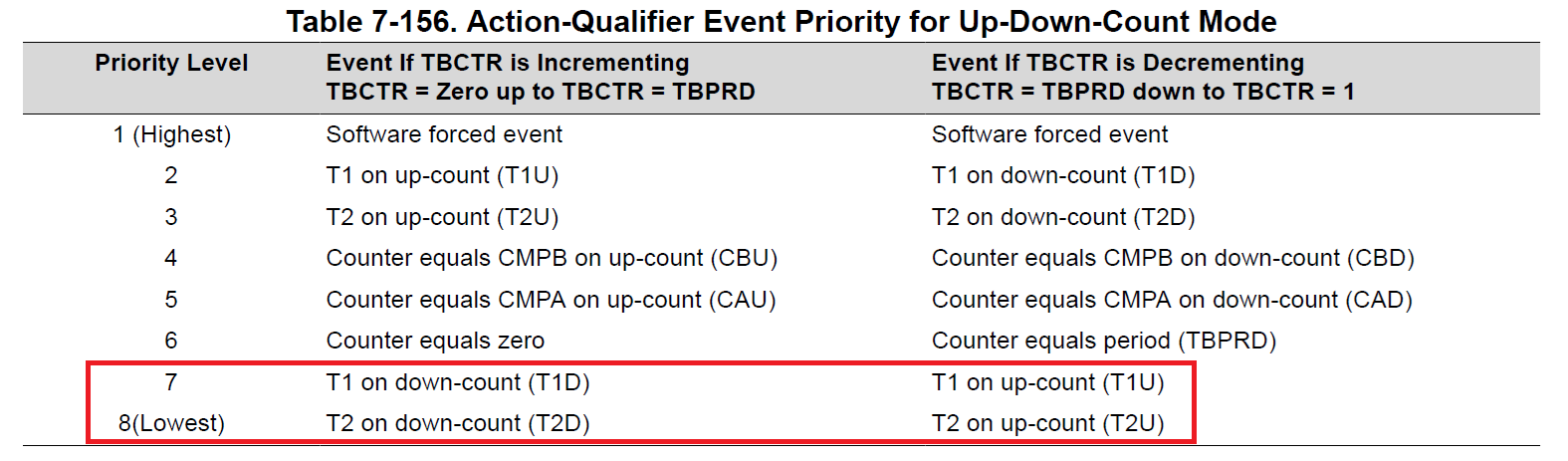
Table 7-156.png

Table 7-156 shows the Action-Qualifier event priority for up-down-count mode.

In the "Event If TBCTR is Incrementing" column, priority levels 7 and 8 are:
- T1 on down-count (T1D)
- T2 on down-count (T2D)

However, if TBCTR is incrementing, I do not understand why down-count events (T1D/T2D) appear in the "TBCTR is Incrementing" column.

Similarly, in the "Event If TBCTR is Decrementing" column, priority levels 7 and 8 are:
- T1 on up-count (T1U)
- T2 on up-count (T2U)

If TBCTR is decrementing, I do not understand why up-count events (T1U/T2U) appear in the "TBCTR is Decrementing" column.

My understanding is:
- "Incrementing TBCTR" means TBCTR is currently counting up
- "Decrementing TBCTR" means TBCTR is currently counting down

Are the "up-count" and "down-count" conditions of T1/T2 events different from the actual TBCTR counting direction?

Tetsuo Amano

  • Hi Tetsuo,

    Thank you for your question. Your observation is correct, and I can explain why the table is structured this way.

    Key Concept:

    T1 and T2 events can be independently configured to trigger actions on both up-count (T1U/T2U) and down-count (T1D/T2D), regardless of the current TBCTR direction. The priority table accounts for all possible event configurations, not just events matching the current counter direction.

    Why "Opposite Direction" Events Appear:

    When TBCTR is incrementing:

    • Priority 2-3: T1U and T2U are the primary events for this direction
    • Priority 7-8: T1D and T2D are included as lower-priority fallback events

    When TBCTR is decrementing:

    • Priority 2-3: T1D and T2D are the primary events for this direction
    • Priority 7-8: T1U and T2U are included as lower-priority fallback events

    Purpose:

    This structure provides flexibility for:

    1. Configuring different actions for the same event source depending on counter direction
    2. Handling asynchronous Trip Zone events that may occur regardless of counter direction
    3. Resolving priority when multiple events occur simultaneously

    The hardware evaluates all configured events and uses the priority table to determine which action takes precedence. The lower priority assigned to "opposite direction" events ensures they do not interfere with the primary events for the current counter direction.

    Reference: See Section 7.5.6.6.3 and Figure 7-207 in the AM263Px Technical Reference Manual (SPRUJ55D), which illustrates independent T1 event actions during up-count and down-count phases.

    Please let me know if you need any additional clarification.

    Best Regards,
    Zackary Fleenor

  • Hi Zackary,

    Thank you very much for your quick response.

    I understand that the priority structure is designed so that T1U/T2U and T1D/T2D do not interfere with each other.
    I also checked Figure 7-207 in the TRM.

    Thank you for explaining the purpose of the priority structure.
    Your explanation was very helpful and easy to understand.

    Best regards,
    Tetsuo Amano