A related question is a question created from another question. When the related question is created, it will be automatically linked to the original question.
If you have a related question, please click the "Ask a related question" button in the top right corner. The newly created question will be automatically linked to this question.
AM2632: Can we reduce system startup time when using HSM
You cannot disable the HSMRT verification as this is done by ROM.
You can either not load the HSMRT if you are not using the M4 core.
You can disable the verification of App image. If you are using Bootloader_parseAndLoadMultiCoreELF to load the image then you would have to modify the below struct member .isAppimageSigned to False to not authenticate the image.
Once you unlock the JTAG, possibly using a signed sbl_null with debug open flag enabled via UART, then flashing and debugging can be performed normally similar to HS_FS device.
Post unlocking JTAG, you can flash a debug opened SBL into flash, so that you need not open JTAG manually upon every power cycle.
Hi Nikhil, Thank you for reply, I got your points.
Why am I asking the questions above? We are considering the workflow for transitioning from HS_FS to HS_SE and how to flash the production HEX during the SOP phase (SBL+APP).
As you know, downloading the Keywriter SBL via UART boot mode during production takes a long time. Therefore, we plan to use QSPI mode to download the Keywriter SBL to trigger device to SE mode. But after switching the device to HS_SE mode, how can we reflash the Keywriter SBL back to the normal operational SBL?
Hi Nikhil, Thank you for reply, I got your points.
Why am I asking the questions above? We are considering the workflow for transitioning from HS_FS to HS_SE and how to flash the production HEX during the SOP phase (SBL+APP).
As you know, downloading the Keywriter SBL via UART boot mode during production takes a long time. Therefore, we plan to use QSPI mode to download the Keywriter SBL to trigger device to SE mode. But after switching the device to HS_SE mode, how can we reflash the Keywriter SBL back to the normal operational SBL?
============================================================================================================> Hi Nikhil,
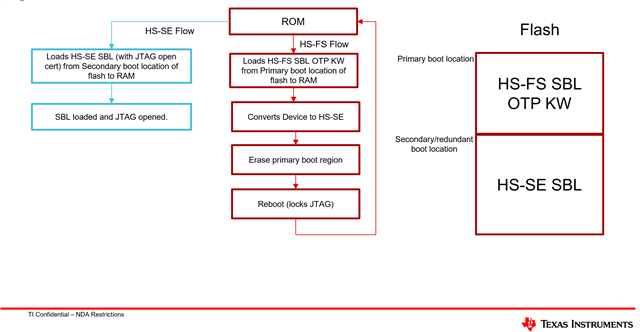
Yes, in this case, one option would be to place the HS-SE SBL into the redundant boot location (which has debug enable). Flash SBL OTP KW to primary location and HS-SE SBL into the redundant boot location together, so that when the device is HS-FS, the SBL OTP KW is executed and when it coverts to HS-SE, the secondary location HS-SE SBL is executed as the primary location has HS-FS firmware.
Could you please share detailed steps or links regarding this process? I believe the process of transitioning from 'HS-FS → boot SBL OTP KW → HS-SE → boot HS-SE SBL' is handled automatically by the BOOTROM, is that correct?
I believe the process of transitioning from 'HS-FS → boot SBL OTP KW → HS-SE → boot HS-SE SBL' is handled automatically by the BOOTROM, is that correct?
That is correct. All you have to do is to place the binaries in the respective locations.
I've created a flow diagram for your reference.
For more on redundant boot, please refer to 5.5 Redundant boot support chapter in TRM
I believe the "Erase primary boot region" step is performed within the OTP Keywriter SBL, correct? We are currently using otp_keywriter_am263x_SR_11_10_01_00_00, and it appears that this version does not include the primary boot region erasure function. Could you help give more details how to add "Erase primary boot region" feature?
Yes, it does not include the erase part. This can integrated at your end or you can later use uniflash to flash your updated HS-SE binary later, as you already have JTAG unlock HS-SE binary in the redundant location. So even after conversion, upon every reboot, the JTAG will be unlocked because of this.
We prefer to integrate the erase function into the OTP Keywriter SBL, but we are encountering a compilation issue when adding the erase feature in SysConfig based on otp_keywriter_am263x_SR_11_10_01_00_00. Do you know how to resolve this?
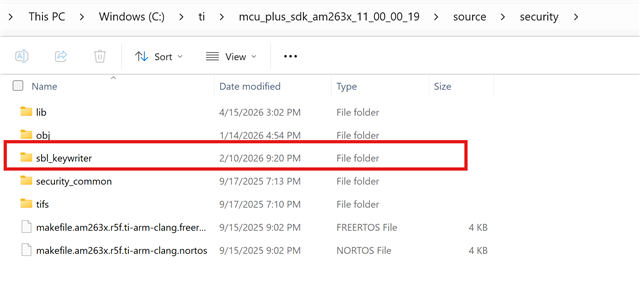
Did you copy the OTP KW package into the latest MCU_PLUS_SDK folder?
i.e. please copy the sbl_keywriter as shown below.
If you have already done this, then please modify the example.syscfg file (--product) by referring to the "hello world" example of the sdk you are using.
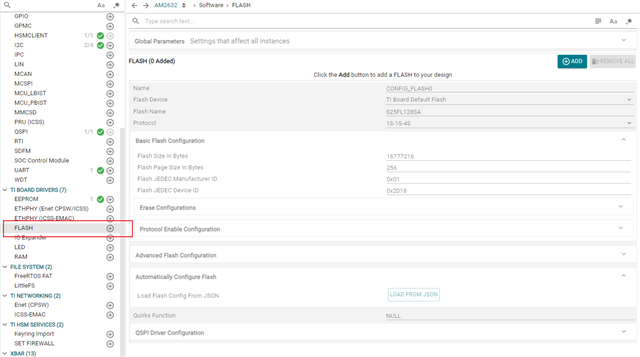
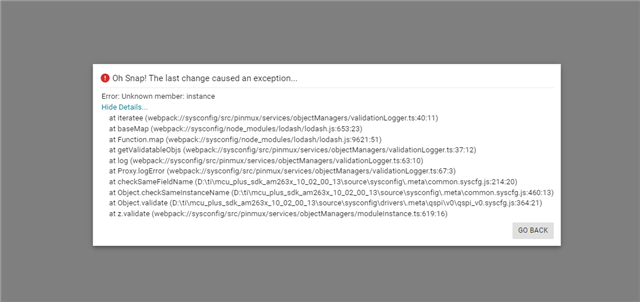
Hi Nikhil, We have been able to import the sbl_keywriter project into SysConfig. However, there was an issue when editing the FLASH module. Is there any way to solve this?
I'm able to configure flash in SDK 10.1 and OTP KW 10.1 environment. May I know when you are seeing the issue and what is the environment that you are using?