TIDM-02009: Battery Manage and ESS

Part Number: TIDM-02009
Other Parts Discussed in Thread: UCC28950, LM5176, BQ76952, BQ79616, TMS320F28379D, TMS320F280049C, TCAN4550, TIDA-010210, TIDM-02010,

I am considering to make ESS like system with 7S LiFePO4 20Ah battery pack.

First, 14 piece of the battery back which vary from 20V to 30V should connect to one DC to AC inverter for supply AC votage through power outlet. In this case, each battery pack has a little different voltage which could make some stress to each other. I wonder, TI has solution for this. Each battery pack has charging circuit their own.

Second, first scheme has done and then I would like to collect all of the 14 AC source to use larger power outlet. In this case like green arrow, AC synchronization and peak to peak should be matched to use AC power. Is there any solution too?
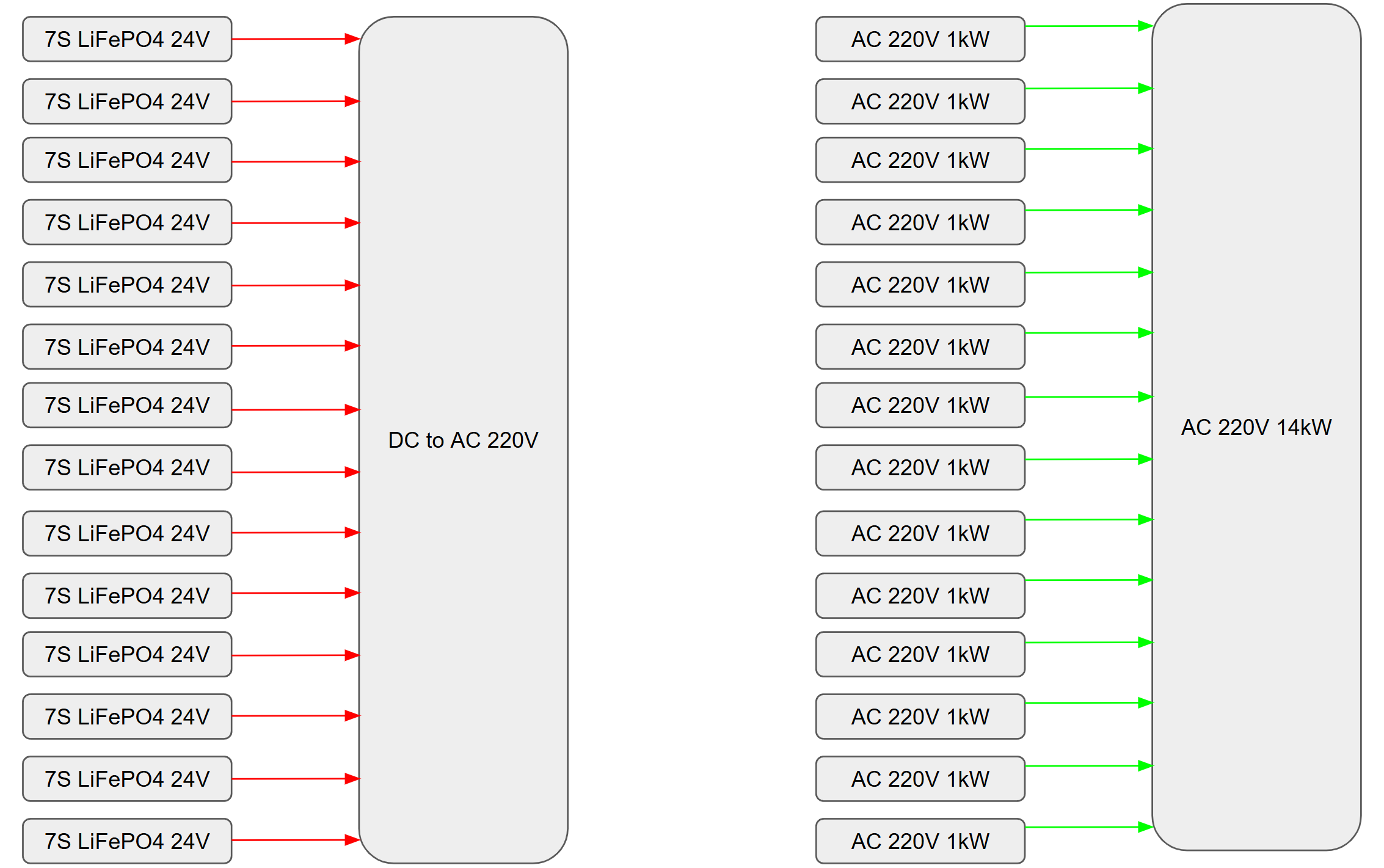
Q1.png

  • Hello Andrea,

    Thank you for your detailed question about designing an ESS with multiple 7S LiFePO4 battery packs. I'll address both of your architectural concerns.


    Issue 1: Connecting 14 Battery Packs with Different Voltages to One Inverter

    You are correct to be concerned about voltage mismatches. When multiple battery packs with different voltages (20V-30V range) are directly connected to a single inverter, you will experience:

    • Cross-current flow between packs (higher voltage packs charging lower voltage packs)
    • Uneven discharge rates
    • Circulating currents that reduce efficiency and can damage batteries

    Recommended Solutions:

    1. DC-DC Converter per Pack Architecture

      • Place an isolated DC-DC converter on each battery pack output
      • Regulate all packs to a common DC bus voltage before feeding the inverter
      • Implement current-sharing control for balanced power contribution
      • Consider: UCC28950 (Phase-Shifted Full-Bridge Controller) or LM5176 (Wide VIN Buck-Boost Controller)
    2. Battery Management System with Active Balancing

      • Use BQ76952 or BQ79616 multi-cell battery monitors
      • Provides cell-level balancing within each 7S pack
      • Enables communication and monitoring of pack health
    3. Power Path Control

      • Implement ideal diode controllers (LM74670, LM74720) to prevent reverse current
      • Combine with DC-DC regulation for voltage normalization


    Issue 2: AC Synchronization for Combining 14 Inverter Outputs

    Paralleling AC inverters requires precise synchronization of phase, frequency, and voltage magnitude. This is complex and presents significant safety risks if not implemented correctly.

    TI Solutions for AC Synchronization:

    1. C2000 Real-Time Microcontrollers

      • TMS320F28379D or TMS320F280049C
      • Built-in PWM synchronization and phase-locked loop (PLL) capabilities
      • Support for droop control and load sharing algorithms
    2. Master-Slave Communication Architecture

      • One inverter acts as master, generating reference signals
      • Remaining 13 inverters synchronize via CAN bus or RS-485
      • Use TCAN1042 or TCAN4550 for communication
      • Requires synchronization check relays and protection circuits
    3. Reference Designs

      • Review TIDA-010210 (Parallel UPS reference design) for AC synchronization methods
      • TIDM-02010 (Grid-Connected PV Inverter) for inverter control architecture

    Critical Safety Considerations:

    • Out-of-phase AC sources can create extremely high fault currents
    • You must implement synchronization check relays, overcurrent protection, and overvoltage protection
    • Isolation transformers are recommended


    Alternative Simplified Architecture Recommendation:

    Given the complexity and safety concerns of your proposed approach, I recommend considering a centralized architecture:

    [14 x 7S Battery Packs] → [Centralized BMS] → [Common DC Bus] → [Single 14kW Inverter] → AC 220V Output

    Advantages:

    • Eliminates DC voltage mismatch issues
    • No AC synchronization complexity required
    • Single point of control and monitoring
    • Higher efficiency and lower overall cost
    • Simplified protection and safety design

    Implementation:

    • Use BQ76952 battery monitors (supports up to 16 cells per device)
    • Configure batteries in series-parallel arrangement for stable DC bus
    • Single high-power inverter with C2000 MCU control
    • Centralized battery management reduces wiring complexity


    Additional TI Resources:

    • TIDM-02009: Battery Management and Energy Storage System
    • TIDM-02010: Grid-Connected PV Inverter
    • TIDA-010210: Parallel UPS System
    • Battery Management Studio: Software tool for BQ76 series configuration

    I would be happy to discuss your specific requirements in more detail and help you select the optimal architecture for your application. Please let me know if you would like component recommendations, reference schematics, or further clarification on any of these approaches.

    Best Regards,
    Zackary Fleenor