


Part Number: AM263P4
Other Parts Discussed in Thread: AM2634,
Question 1:
According to the Keywriter introduction in `README_FIRST_AM263PX.html`, the Keywriter injects fields such as MSV, SMPK/SMEK, BMPK/BMEK, EXT OTP, KEY COUNT, SWREV–HSM, SWREV–APP, SWREV-SBL, and KEY REV. I understand that these fields are programmed into the OTP region. However, the table below indicates that for SMPK and BMPK, only their corresponding hashes (SMPKH and BMPKH) are injected, rather than the keys themselves, whereas the other fields are programmed with their raw data values.
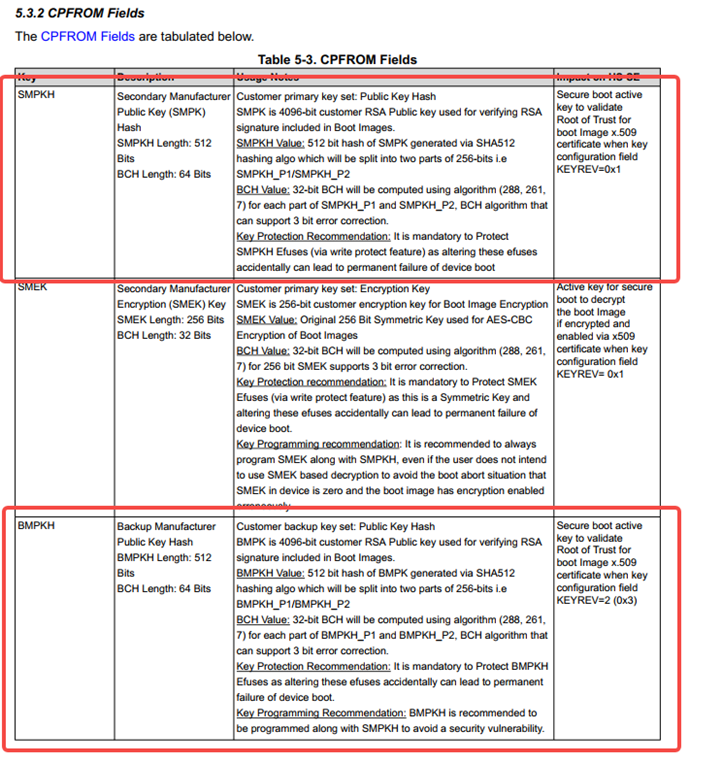
My question is: are SMPK and BMPK actually programmed into the OTP region (though not accessible to developers) with the table simply listing the OTP data that we are allowed to read? Or is it true that what gets programmed into the OTP region for SMPK and BMPK is indeed just SMPKH and BMPKH? If the latter is true, how can this serve the purpose of signature verification, given that a hash cannot be reversed to derive the original key data?
Question 2:
Version `otp_keywriter_am263px_SR_10_11_01_01_00` adds the following fixes:
1. Displays logs to the user when a field is just protected, without programming it.
2. Single-bit error correction in the OTP Region using Column Repair Address (CRA).
3. Row Replacement method for multi-bit error correction in the OTP Region.
Regarding item 1, I noticed that `otp_keywriter_am263px_SR_10_10_01_00_00` already has a corresponding feature.
For items 2 and 3, under what specific circumstances do the single-bit and multi-bit error correction mechanisms actually take effect? For example, can they repair a hardware OTP bad block where a bit cannot be programmed from 0 to 1 under any condition? Or can they mitigate issues caused by extremely brief instability in the 1.7V VPP supply during programming?
Previously, when using the Keywriter built from `otp_keywriter_am263x_SR1.1_v08_06_00` for AM2634 and `otp_keywriter_am263px_SR_10_10_01_00_00` for AM263P4, we sporadically encountered the following logs even with the 1.7V supply properly connected:
**AM263P4:**
```
MSV is Protected, can't program
[HSM CLIENT] OTP-KW Error encountered in OTP Keywriter
```
**AM2634:**
```
* MSV and MSV_BCH:
MSV is Protected, can't program
MSV_BCH is Protected, can't program
* BMPKH, BMEK:
BMPKH is Protected, can't program
BMEK is Protected, can't program
* SMPKH, SMEK:
SMPKH is Protected, can't program
SMEK is Protected, can't program
Error in programming SMEK
debug_response: 0x8000
```
Will upgrading to `otp_keywriter_am263px_SR_10_11_01_01_00` reduce the probability of encountering such failures? Will these two newly added features (CRA and Row Replacement) improve the programming success rate for OTP fields such as MSV, SMPK/SMEK, BMPK/BMEK, EXT OTP, and KEY COUNT?
Since we currently attribute these failures to 1.7V instability, but are unable to verify the Keywriter's inherent reliability across a large number of chips, we would like to know: is it possible for OTP field programming failures to occur even when the 1.7V input is stable, potentially due to inherent defects in the Keywriter software itself?
