This thread has been locked.

If you have a related question, please click the "Ask a related question" button in the top right corner. The newly created question will be automatically linked to this question.

TIDM-1000: Input Current Zero-Crossing Distortion Causing Low-Frequency CE102 Noise Issue

Part Number: TIDM-1000

Dear Team,

I am facing a CE102 noise issue at 10 kHz under the Build 4 test condition.

Filter Details:

  • Dual-stage Pi filter 169uH, 1uF

  • Input Voltage Vin: 95Vac Vout: 320Vdc

Waveform Channels:

  • Yellow: R-phase Boost Current

  • Green: Vout

  • Orange: R-phase Input Current

We are observing input current distortion in the 2 A to 4 A load region. Kindly suggest potential solutions to resolve this issue.
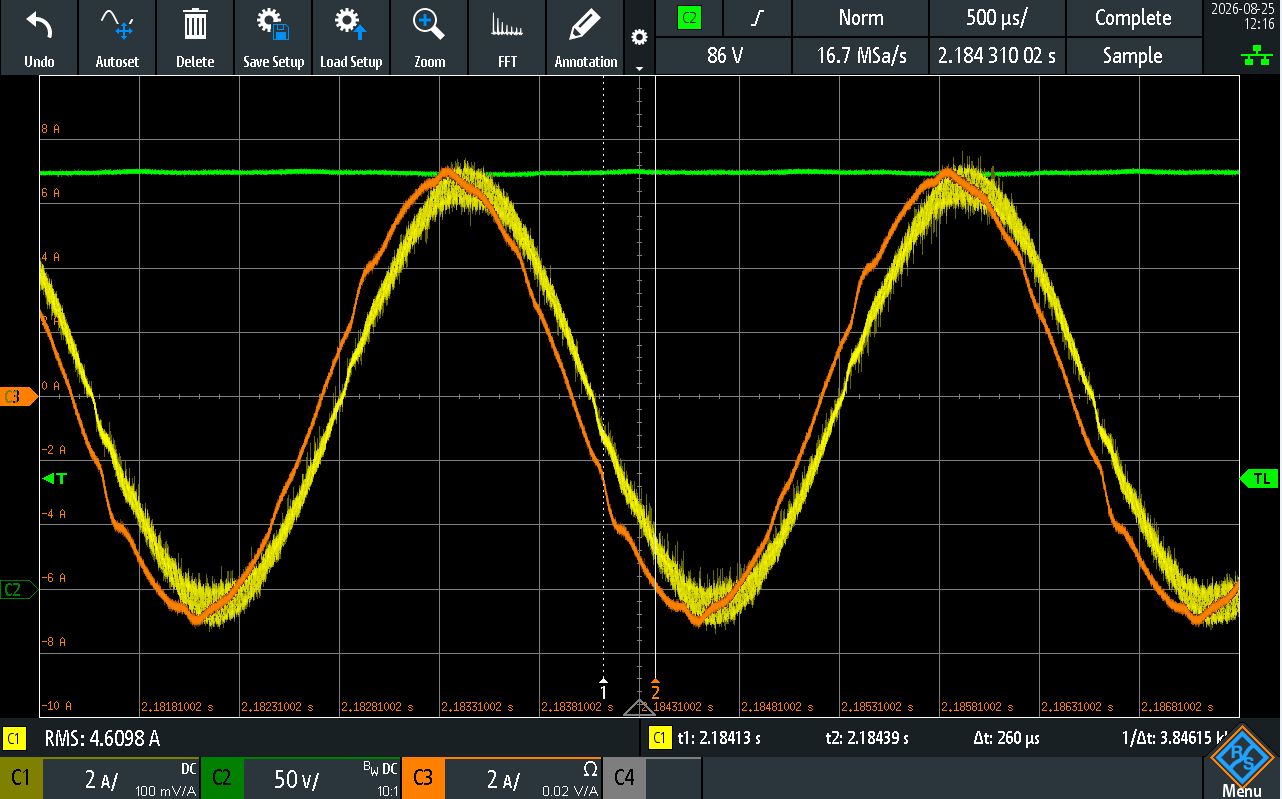
image.png

Best regards,

Vignesh


  • Vignesh, Can you give few more details on the SDK SW used and the board setup you have. Also the expectation? 

  • Dear Venkata Pavan Mahankali, 
             I am expecting the input current to be a pure sine wave, but it starts to distort near the zero-crossing point. According to some research papers I referred to, this distortion is caused by reactive current. This current distortion is causing us to fail the MIL-STD-461 CE102 test at 10 kHz. 
    Our board setup details are: 
    • Input Voltage: 95 Vac at 400 Hz 
    • Vout: 320 Vdc
    I am seeking your guidance on how to overcome this problem. Could you kindly provide sample firmware or code for reactive power compensation if you have it available?
    Regards,
    Vignesh 
  • Hi Vignesh,

    The reference code for Vienna rectifier is available in the latest version of digital power SDK: C2000WARE-DIGITALPOWER-SDK Software development kit (SDK) | TI.com.

    Please note that the Vienna rectifier cannot support reactive power and is intended to operate at UPF with unidirectional power flow capability. Only mode of operation is when boost current is in phase with the inverter terminal voltage due to the presence of diodes.

    The phase difference in the current waveforms above is most likely due to the current flowing through the AC side filter capacitor.

    You need to design the common mode filter to meet the requirements of the conducted emission standard (MIL-STD-461 CE102).

    Regards,
    Harisyam