AM2612: Multiple technical questions regarding EtherNet/IP development, SDK, WWDT1, and hardware design

Part Number: AM2612
Other Parts Discussed in Thread: LP-AM261,

Hi TI Team,

We are developing an EtherNet/IP adapter using the LP-AM261 EVM and have encountered several technical questions. We would appreciate your clarification and guidance on the following items:

1. Industrial Comms SDK & Pinmux

  • SDK Version Alignment: When will the Industrial Communications SDK (Ind-Comms SDK) be released to support MCU+ SDK 26.01?

  • Pinmux Generation Bug: In version 26.01, unlock/lock sequences were added to pinmux_config.c.xdt, but DRV_PRUICSS_init() still performs raw writes to locked registers. Has this been fixed in the corresponding release, and are there any other similar paths?

2. WWDT1 Access on Core 1

  • When Core 1 accesses WWDT1 (0x52101000), a precise data abort occurs (even with direct JTAG loading).

  • What are the prerequisites or conditions for Core 1 to access its own WWDT1? What is the default firewall configuration for it?

3. EtherNet/IP Stack Capacity

  • We found that the total CIP connections are limited to 29 (34 slots minus 5 reserved for startup), and the TCP connection limit is 9 (compile-time constants in the pre-compiled library).

  • Is this the expected design? Are there higher-capacity versions, configuration options, source code licensing options, or official guidelines to reserve Class 1 capacity?

4. tiarmclang Compiler Behavior

  • With tiarmclang 4.0.4.LTS, we suspect a code generation issue where strcmp is compiled into a memcmp referencing an incorrect location. We can provide a 20-line minimal reproducible example if needed.

5. PORz RC Circuit Design

  • In both Rev A and Rev E2 schematics, R40 is $49.9\,\Omega$ and C40 is ~0.01 µF (yielding a time constant of ~0.5 µs), which differs by three orders of magnitude from the "1 ms delay" recommended in the User Guide.

  • What is the engineering design intent behind this circuit?

6. Additional Technical Clarifications

  • VIM (Vectored Interrupt Manager): If an interrupt pulse is re-triggered while it is already in the pending state, are the pulses combined/merged?

  • Memory Attributes: Do you support cross-core exclusive memory attributes?

  • Debugger/CIO Stalling: When a debugger is connected, why does CIO cause the core to stall for 100 ms to 1 s?

Thanks for your support!

Best regards,

Daniel

  • Hi Daniel,

    Please find my responses to your questions #1 and #3 below. Regarding your remaining questions, I am routing them to the appropriate internal teams.

    1) Industrial Comms SDK & Pinmux
    • SDK Version Alignment: The next release is scheduled for November. This release will utilize the new MCU+SDK 26.01.
    • Pinmux Generation Bug: I can confirm that the pinmux generation issue has been resolved and will be addressed in the upcoming release.
    3) EtherNet/IP Stack Capacity:
    In the upcoming release, the maximum number of parallel TCP connections and active UDP connections will be application-configurable.
    Please note that this feature is exclusive to the Premium SDK. If you are using the Standard SDK, these configuration settings will be disregarded, and the default limits will apply (10 maximum parallel TCP connections and 6 maximum active UDP connections).

    Please let me know if you require any further clarification.

    Best regards,
    Pourya
  • Hi Pourya

    It confirmed that the next EtherNet/IP release (Industrial Comms SDK, November, paired with MCU+ SDK 26.01) will make the maximum TCP and UDP connections configurable in the Premium SDK only, and that the Standard SDK stays at TCP 10 / UDP 6.

    We are evaluating both options for a gateway product on AM2612. Our target requirement is up to 16 concurrent connections in total. Could you please help with the following?

    1. Licensing and fees: What is the licensing model and cost for Premium (one-time fee, per-unit royalty, or annual)? The same question for Standard in production, since we currently use the evaluation SDK (ind_comms_sdk_am261x_2026_00_00_06_eval).
    2. Upgrade path: Can we move from Standard to Premium later without re-porting our application? Are the APIs and example projects identical?
    3. Connection limits: With Premium, what are the maximum values for TCP and UDP connections? Can they reach 16 or more?
    4. Premium features: Please confirm which features are Premium-only (we understand: Asynchronous Connections, CIP Safety integration, DLR Supervisor, Application Triggered).
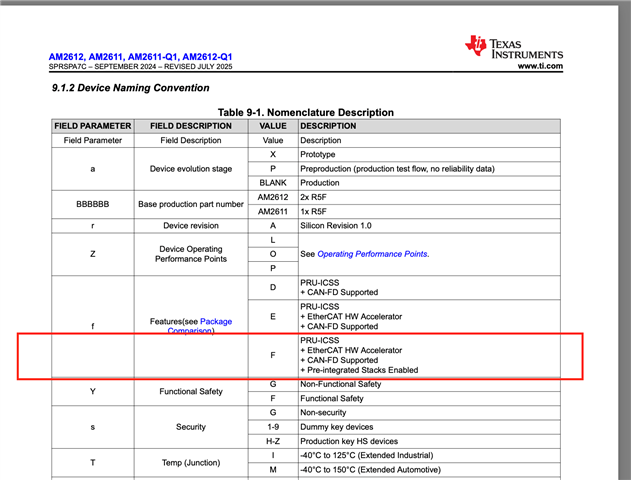
    5. “F” feature code: The AM2612 datasheet (SPRSPA7C, Table 9-1) lists feature code F as “PRU-ICSS + EtherCAT HW Accelerator + CAN-FD + Pre-integrated Stacks Enabled”. If we order a device with code F, are the royalty and software licence fees for the pre-integrated stacks already included in the device price, with nothing further to pay? Does this apply to EtherNet/IP as well? And does code F correspond to the Standard or the Premium SDK?

    Thank you very much for your support.

    Daniel

  • Hi Daniel,

    Please find my responses to your questions below:
    1 & 5) SDK Variants and "F" Variant Hardware The Standard SDK is free to use. When purchasing an "F" variant device, the costs for the pre-integrated stacks are already included in the chip price (no additional fees are required).
    For more details on the different SDK package variants, please refer to this documentation: AM261x INDUSTRIAL COMMUNICATIONS SDK: Introduction.

    Please note that the "F" hardware variant is independent of the choice between Standard and Premium SDKs. To use Industrial protocols, you must use an "F" variant chip as specified in [SPRSPA7C, Table 9-1.2], regardless of which SDK version you select.

    The Premium SDK is distinguished by its additional features and enhanced support levels. If you are interested in evaluating these features before a full purchase, we also offer a "Premium-Time-Limited" SDK on demand (which includes all premium features but limits stack runtime to 1 hour). Please contact your local TI Sales Representative for more details.
    2) Upgrade Path There is no migration required. Applications developed using the Standard SDK are fully compatible with the Premium SDK, as the APIs are identical. The Premium SDK simply grants access to a broader range of APIs and advanced features.

    3) Premium EtherNet/IP Features The Premium SDK includes the following advanced features:
    • Asynchronous Connections
    • CIP Safety integration APIs
    • DLR Supervisor
    • Application-triggered I/O connections
    • Configurable number for maximum parallel TCP and active UDP connections

    Regarding your requirement for 16 concurrent connections: Are you referring to UDP connections or TCP? As a rule of thumb, increasing TCP connections has more memory footprint impact than UDP connections, in theory, as long as you have enough memory available on your device, you can increase the the maximum active UPD or TCP connections.

    Please let me know if you have any further questions.
    Best regards,
    Pourya