This thread has been locked.

If you have a related question, please click the "Ask a related question" button in the top right corner. The newly created question will be automatically linked to this question.

lockstep


Hi,

I want to confirm if my understanding about lockstep is correct.

see the following screenshot.

There are two sets of registers in each core? what about the ALU, Decode, components, also each core has a seperate one?

what about the cache and RAM? do they share the same one cache?

I also don't understand the "the CPU pushed the internal registers on to the stack on a function call, which could lead to the detection of the core comparision error", why this happens?

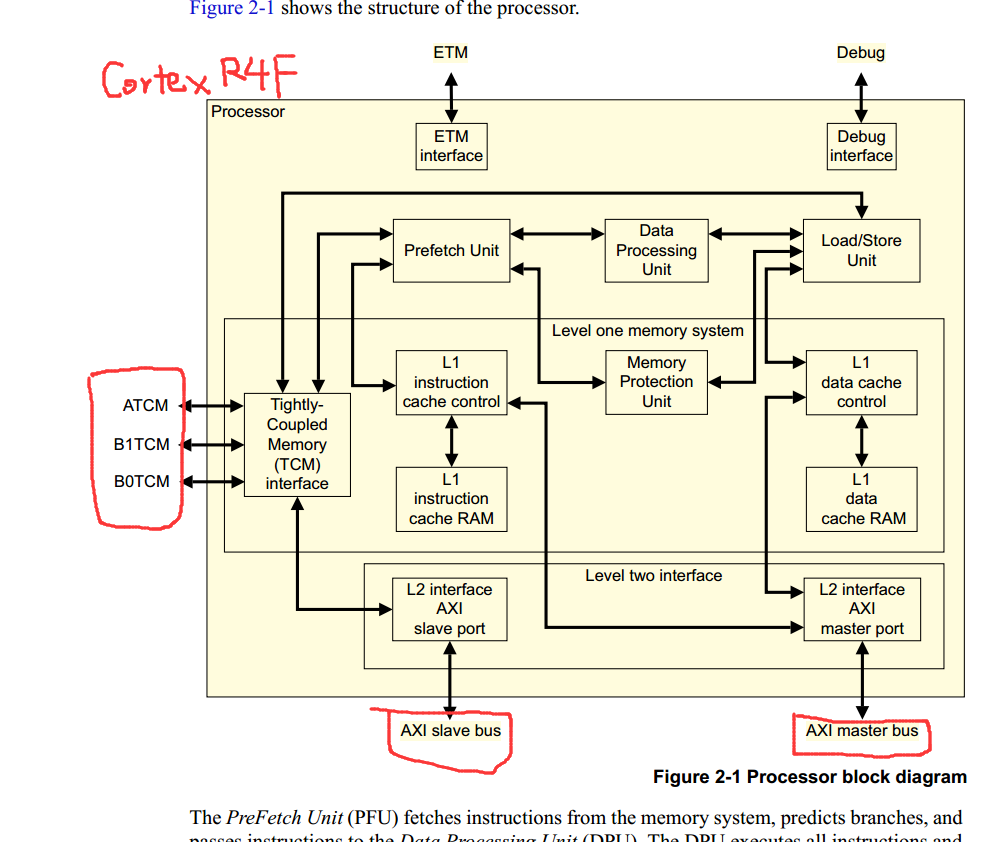
  • Eric, would you please tell me which Hercules device you are asking about. The devices that use the Cortex R4F are not cache based. The Flash is attached to the ATCM and static RAMS are attached to the BTCMs. The blocks labeled CPU1 and CPU2 in the first diagram are complete Cortex R4F CPUs.
  • Hi Bob,

    RM57L(cortexR5F) and RM48L(cortexR4F).

    For RM48L the two core have seperate registers? Can I think that the CCM will compare the ATCM, BTCM, AXI bus signals? (according the processor block diagram these signals are output of the core)

    For RM57L a I-Cache and D-Cache exist. Do the two cores share the cache or each core has a cache?

    Best regard,
    Eric
  • Yes, on the RM48L, the CCMR4 is constantly checking the ATCM, BTCM and AXI signals between the two CPUs. Each CPU has its own registers.

    On the RM57L both CPUs see the same I-cache and D-cache. The CCMR5 is checking the signals between the CPUs and the caches.