Part Number: TM4C123GH6PM
Other Parts Discussed in Thread: SW-DRL
Tool/software: Code Composer Studio
Hi All,
Currently I am facing a problem with ADC input where I am trying to get the input through PE3 which is triggered with timer.
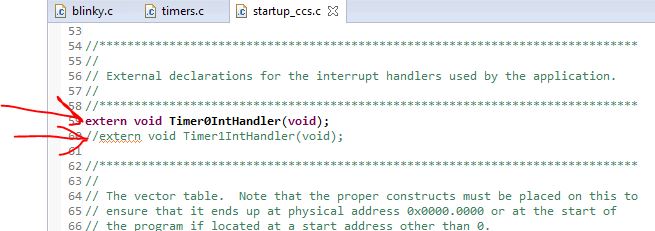
I have built the code without any error though I am not able to trigger the interrupt. and some more problems are pointed in the attached image.
Any suggestion is appriciated.
#include <stdint.h>
#include <stdbool.h>
#include "inc/hw_ints.h"
#include "driverlib/adc.h"
#include "inc/hw_memmap.h"
#include "inc/hw_types.h"
#include "driverlib/debug.h"
//#include "driverlib/fpu.h"
#include "driverlib/gpio.h"
#include "driverlib/interrupt.h"
#include "driverlib/pin_map.h"
//#include "driverlib/rom.h"
#include "driverlib/sysctl.h"
#include "driverlib/timer.h"
#include "driverlib/uart.h"
#include "utils/uartstdio.h"


float Aquire[1000];
uint32_t ResultIndex = 0;
uint32_t stat;
double fRadians;
float prev = 0;
float strt = 2000;
uint32_t toggler = GPIO_PIN_2;

uint32_t ADC0Value[1];


#ifndef M_PI
#define M_PI 3.14159265358979323846264
#endif


void
InitConsole(void)
{
    //UARTprintf("Console start");
    //
    // Enable GPIO port A which is used for UART0 pins.
    //
    SysCtlPeripheralEnable(SYSCTL_PERIPH_GPIOA);

    //
    // Configure the pin muxing for UART0 functions on port A0 and A1.
    // This step is not necessary if your part does not support pin muxing.
    //
    GPIOPinConfigure(GPIO_PA0_U0RX);
    GPIOPinConfigure(GPIO_PA1_U0TX);

    //
    // Enable UART0 so that we can configure the clock.
    //
    SysCtlPeripheralEnable(SYSCTL_PERIPH_UART0);

    //
    // Use the internal 16MHz oscillator as the UART clock source.
    //
    UARTClockSourceSet(UART0_BASE, UART_CLOCK_PIOSC);

    //
    // Select the alternate (UART) function for these pins.
    //
    GPIOPinTypeUART(GPIO_PORTA_BASE, GPIO_PIN_0 | GPIO_PIN_1);

    //
    // Initialize the UART for console I/O.
    //
    UARTStdioConfig(0,115200,16000000);

    UARTprintf("Console end\n");
}

void
InitADC0(void)
{
    //
    // The ADC0 peripheral must be enabled for use.
    //
    SysCtlPeripheralEnable(SYSCTL_PERIPH_ADC0);

    //
    // For this example ADC0 is used with AIN0 on port E7.
    // The actual port and pins used may be different on your part, consult
    // the data sheet for more information.  GPIO port E needs to be enabled
    // so these pins can be used.
    // TODO: change this to whichever GPIO port you are using.
    //
    SysCtlPeripheralEnable(SYSCTL_PERIPH_GPIOE);

    //
    // Select the analog ADC function for these pins.
    // Consult the data sheet to see which functions are allocated per pin.
    // TODO: change this to select the port/pin you are using.
    //
    GPIOPinTypeADC(GPIO_PORTE_BASE, GPIO_PIN_3);

    //
    // Enable sample sequence 3 with a processor signal trigger.  Sequence 3
    // will do a single sample when the processor sends a signal to start the
    // conversion.  Each ADC module has 4 programmable sequences, sequence 0
    // to sequence 3.  This example is arbitrarily using sequence 3.
    //
    ADCSequenceConfigure(ADC0_BASE, 3, ADC_TRIGGER_PROCESSOR, 0);

    //
    // Configure step 0 on sequence 3.  Sample channel 0 (ADC_CTL_CH0) in
    // single-ended mode (default) and configure the interrupt flag
    // (ADC_CTL_IE) to be set when the sample is done.  Tell the ADC logic
    // that this is the last conversion on sequence 3 (ADC_CTL_END).  Sequence
    // 3 has only one programmable step.  Sequence 1 and 2 have 4 steps, and
    // sequence 0 has 8 programmable steps.  Since we are only doing a single
    // conversion using sequence 3 we will only configure step 0.  For more
    // information on the ADC sequences and steps, reference the datasheet.
    //
    ADCSequenceStepConfigure(ADC0_BASE, 3, 0, ADC_CTL_CH0 | ADC_CTL_IE |
                                 ADC_CTL_END);

    //
    // Since sample sequence 3 is now configured, it must be enabled.
    //
    ADCSequenceEnable(ADC0_BASE, 3);

    //
    // Clear the interrupt status flag.  This is done to make sure the
    // interrupt flag is cleared before we sample.
    //
    ADCIntClear(ADC0_BASE, 3);
    UARTprintf("ADC0 end\n");

}

void
InitGPIO_F(void)
{
    //
    // Enable the GPIO port that is used for the on-board LED.
    //
    SysCtlPeripheralEnable(SYSCTL_PERIPH_GPIOF);
    //
    // Enable the GPIO pins for the LED (PF1 & PF2).
    //
    GPIOPinTypeGPIOOutput(GPIO_PORTF_BASE, GPIO_PIN_2);

    UARTprintf("GPIOEnabled\n");

}
void
InitTimer(void)
{
    // Enable the peripherals used by this example.
    //
    SysCtlPeripheralEnable(SYSCTL_PERIPH_TIMER0);
    //SysCtlPeripheralEnable(SYSCTL_PERIPH_TIMER1);

    //
    // Enable processor interrupts.
    //
    IntMasterEnable();

    //tickk = SysCtlClockGet();
    //
    // Configure the two 32-bit periodic timers.
    //
    TimerConfigure(TIMER0_BASE, TIMER_CFG_PERIODIC);
    //ROM_TimerConfigure(TIMER1_BASE, TIMER_CFG_PERIODIC);
    TimerLoadSet(TIMER0_BASE, TIMER_A, SysCtlClockGet());
    //ROM_TimerLoadSet(TIMER1_BASE, TIMER_A, ROM_SysCtlClockGet() / 2);

    //
    // Setup the interrupts for the timer timeouts.
    //
    IntEnable(INT_TIMER0A);
    //ROM_IntEnable(INT_TIMER1A);
    TimerIntEnable(TIMER0_BASE, TIMER_TIMA_TIMEOUT);
    //ROM_TimerIntEnable(TIMER1_BASE, TIMER_TIMA_TIMEOUT);

    //
    // Enable the timers.
    //
    TimerEnable(TIMER0_BASE, TIMER_A);
    //ROM_TimerEnable(TIMER1_BASE, TIMER_A);

    UARTprintf("TimerEnabled\n");
}
//*****************************************************************************
//
// The interrupt handler for the first timer interrupt.
//
//*****************************************************************************
void
Timer0IntHandler(void)
{
    UARTprintf("Timer start\n");

    TimerIntClear(TIMER0_BASE, TIMER_TIMA_TIMEOUT);

    toggler ^= GPIO_PIN_2;

    UARTprintf("Toggler = %3d\n",toggler);

    GPIOPinWrite(GPIO_PORTF_BASE, GPIO_PIN_2,toggler);

    UARTprintf("bulb\n");


    ADCIntClear(ADC0_BASE, 3);
    UARTprintf("ADCClear\n");

    ADCProcessorTrigger(ADC0_BASE, 3);
    UARTprintf("ProTrig\n");

    while(!ADCIntStatus(ADC0_BASE, 3, false))
    {
        UARTprintf("G\r");
    }

    ADCIntClear(ADC0_BASE, 3);
    UARTprintf("ADCClear\n");

    ADCSequenceDataGet(ADC0_BASE, 3, ADC0Value);
    UARTprintf("GetData\n");
    //UARTprintf("%3d\n",ADC0Value[0]);

    UARTprintf("%3d\n",ADC0Value[0]);
    if (prev-ADC0Value[0]>strt)
    {
        if(stat==0)
            {
                if(ResultIndex<900)
                {
                    Aquire[ResultIndex] = ADC0Value[0];
                    ResultIndex+=1;
                }
                else
                {
                    stat = 1;
                }
            }
    }
    else
    {
        prev = ADC0Value[0];
    }


    IntMasterDisable();

    IntMasterEnable();
}


int main(void)
{

    //FPULazyStackingEnable();
    //FPUEnable();

    //SysCtlClockSet(SYSCTL_SYSDIV_1 | SYSCTL_USE_PLL | SYSCTL_XTAL_16MHZ | SYSCTL_OSC_MAIN);
    //SysCtlClockSet(SYSCTL_SYSDIV_1 | SYSCTL_USE_OSC | SYSCTL_OSC_MAIN | SYSCTL_XTAL_16MHZ);
    SysCtlClockSet(SYSCTL_SYSDIV_2_5|SYSCTL_USE_PLL|SYSCTL_OSC_MAIN|SYSCTL_XTAL_16MHZ);

    //
    // Initialize the UART and write status.
    //
    InitConsole();

    //
    // Initialize the ADC0.
    //
    InitADC0();

    InitGPIO_F();

    //
    // Initialize the Timer for triggering.
    //
    InitTimer();


    while(1)
    {

    }
}