This thread has been locked.

If you have a related question, please click the "Ask a related question" button in the top right corner. The newly created question will be automatically linked to this question.

CCS/EK-TM4C1294XL: UniFlash "Program Load completed succesfully", but Debug Port error?

Part Number: EK-TM4C1294XL
Other Parts Discussed in Thread: UNIFLASH, TM4C1294NCPDT,

Tool/software: Code Composer Studio

Dear TI community,

I am trying to flash an assembly program with the UniFlash standalone flash tool. The source code is given below.

    .thumb                                                                                                                            
    .cpu cortex-m4
    .syntax unified

#define GPIO_PORT_CGC_R     0x400FE608

#define GPIO_PORTN0_DATA_R  0x40064004
#define GPIO_PORTN_DIR_R    0x40064400
#define GPIO_PORTN_DEN_R    0x4006451C


    .section .text
    .global main

main:
        
    ldr R11, =GPIO_PORT_CGC_R
    ldr R10, [R11]
    ORR R10, #0x1000
    STR R10, [R11]

    NOP 
    NOP 
    NOP 
    NOP 

    ldr R11, =GPIO_PORTN_DIR_R
    ldr R10, [R11]
    ORR R10, #3
    STR R10, [r11]

    ldr R11, =GPIO_PORTN_DEN_R
    ldr R10, [R11]
    ORR R10, #3
    STR R10, [R11]

    ldr R11, =GPIO_PORTN_DATA_R
    ldr R10, [R11]
    ORR R10, #3
    STR R10, [R11]  
        
    NOP 
    NOP 

When I select the a,out that the GNU assembler generated as source file that should be flashed and press the "Load Image" button,

UniFlash says there was an error on the Debug Port. At the same time, it says the program is loaded succesfully (which is really strange in my eyes"

When I try to view the memory of the TM4C1294NCPDT it shows the bytes. However, if I want to look at the GPIO_PORTN_DATA_R it gives the following
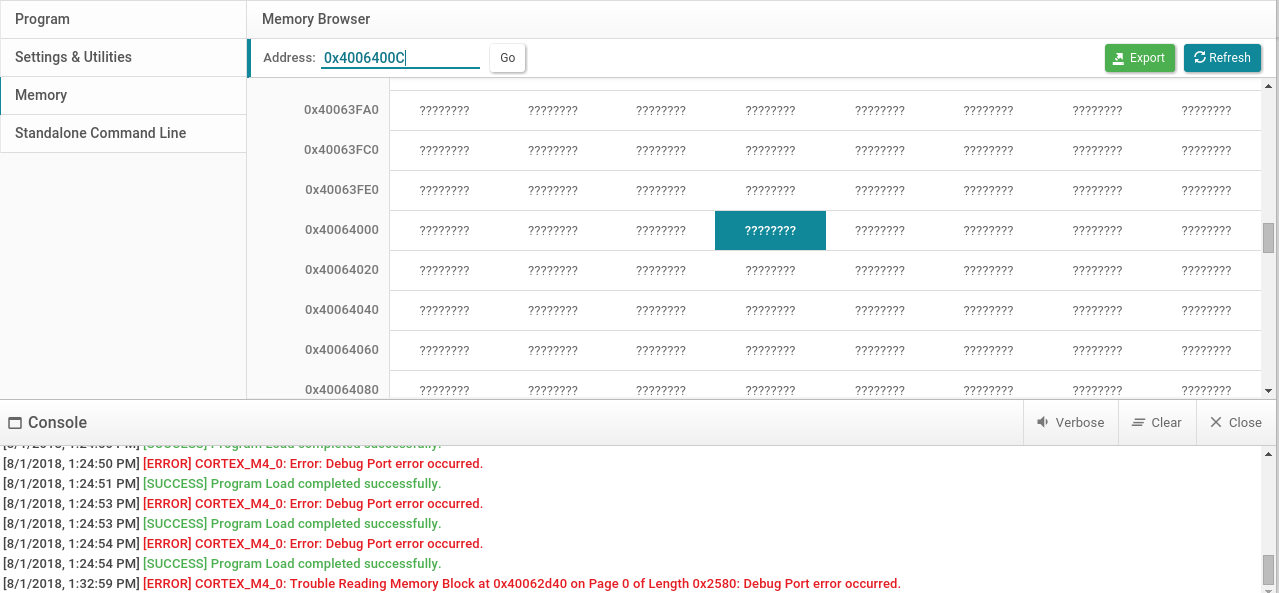
And when I try to verify the image using the "Verify Image" button, it says it  cannot load the file that has been selected.

which is extremely weird, since I am 100% sure the file is located in that directory and exist.

Does someone have a clue why UniFlash is behaving this way?

With kind regards,

Youri.

  • Hello,
    I've seen this error before... and it was usually due to some target initialization issue. Is this with a custom board? And do you get a similar issue when trying to load with the CCS IDE?

    Thanks
    ki
  • Dear Ki-Soo Lee,

    I have modified the assembly file because when I posted it yesterday there was a typo in it.

    The current source code can be viewed below.

    	.thumb
        .syntax unified
    
    #define GPIO_PORT_CGC_R     0x400FE608
    
    #define GPIO_PORTN0_DATA_R  0x40064004
    #define GPIO_PORTN_DIR_R    0x40064400
    #define GPIO_PORTN_DEN_R    0x4006451C
    
        .section .text
        	.org 0
    	.weak	main
    	.type	main, %function
    	.global main
    main:
    
        ldr R11, =GPIO_PORT_CGC_R
        ldr R10, [R11]
        MOV	R9,	 #0x1000
        ORR R10, R10, R9
        STR R10, [R11]
    
        ldr R11, =GPIO_PORTN_DIR_R
        ldr R10, [R11]
        ORR R10, #3
        STR R10, [r11]
    
        ldr R11, =GPIO_PORTN_DEN_R
        ldr R10, [R11]
        ORR R10, #3
        STR R10, [R11]
    
    	ldr R11, =GPIO_PORTN0_DATA_R
        ldr R10, [R11]
        ORR R10, #3
        STR R10, [R11]
    
        NOP
        NOP


    	.align
    	.end
    

    I have set up a project in Code Composer Studio and selected the GNU compiler.

    When I flash the code the only output I get is

    "CORTEX_M4_0: GEL Output:
    Memory Map Initialization Complete"

    And it seems there is no effect on the EK-TM4C1294XL. However, when I unplug the USB and plug it in again, the program is working!

    So to test my assembly program, I need to flash it using Code Composer Studio, then unplug it and then plug it in again.

    To answer your question, I have bought the EK-TM4C1294XL new as a kit, which can be seen in the 2 images below.

    Code Composer Studio is not flawless, but it flashes after all ^.^

    Could the issue with UniFlash be caused because I used the GNU assembler with my source code only, and no other files

    like the _startup_ccs_gcc_c?

  • It could be an issue with UniFlash. What exact version of UniFlash are you using? Can you also provide the out file you are trying to flash? You can share your out file privately if you do not want to post public (start a private conversation with me).

    Thanks
    ki
  • Dear Ki-Soo Lee,

    Thank you for your quick reply. In the screenshot below you can view details about my version of UniFlash (keep in mind that I am using the GNU/Linux OS)

    The a.out file is the assembled file from the source code that I sent earlier today.

    Since the .out extension is not allowed to be uploaded on the forums, I will try a to send it through a PM.

  • Thanks for the file. I tried loading it via CCS. I get various Debug Port errors and such when I try running and halting. Your program is odd, everything is loaded to address 0x0 and that is the entry point. I'm not sure if this is will work.

    Xhendos said:

    Could the issue with UniFlash be caused because I used the GNU assembler with my source code only, and no other files

    like the _startup_ccs_gcc_c?

    This might be the case. I am going to move this thread to the TM4C forum. They can confirm if what you are doing is allowed.

    Thanks

    ki

  • Dear Ki-Soo Lee,

    Thank you very much for all your time and effort you have put into my issue.
    I hope someone on the TM4C can tell me how they assemble a .out file
    and can explain what is wrong with my source code (if any errors or things that I miss)

    With kind regards,
    Youri.
  • I don't see the stack pointer and reset vector defined in your code. These two are required for the code to work. We normally don't support assembly level debug. Please use TivaWare or at least C code for your software development. Below is a link that introduces ARM assembly coding by University of Georgia. The lecture was created for Keil. The stack pointer and reset vector requirements are the same. You will need to adapt to the GNU coding.

    www.cs.uregina.ca/.../lecture.html
  • Hi Charles,

    Again much thanks for your 'terrific' assistance in aiding the T.I. rep (and my crüe)  w.r.t. - 'HW Over-sampling.'  

    Poster here would surely benefit from a read of,  Joseph Yiu's excellent book:   'The Definitive Guide to the  ARM Cortex M3/M4.'    Several chapters are 'heavy' in Assembly Code - and the 'key MCU Registers' (just as you've noted here) - are nicely  illustrated - even emphasized...

  • Hi cb1,

      Thanks for your suggestion. I wish I had this book too. :-)

      Someone nice enough to post this article titled 'TI Stellaris ARM Cortex-M4F Assembly Tutorial' will benefit the poster too, A simple example but nevertheless covers the stack pointer and reset vector. It is also written for GCC assembler.

  • First of all, thank you everyone who replied to this thread after it has been moved to the TM4C section. Every single comment has been helpful.

    was right. The stack pointer and reset vector must be defined so when the microcontroller boots up it checks location 0x4 and either execute or jump from there. Your link was helpful as it gave me insight in how this issue would be achieved using the GNU compiler toolchain.

    Thank you very much for your reference. I have the books from Jonathan W. Valvano, but they assume you have set up an environment and leaves a lot of essential assembly away.

    I have bought your suggestion and will read it when it arrives.

    The code that assembles and runs without problems is here, in case anyone is stuck in the future.

        .equ STACK_TOP, 0x20008000                                                                                                        
        .equ GPIO_PORT_CGC_R,   0x400FE608
        .equ GPIO_PORTN0_DATA_R,    0x40064004
        .equ GPIO_PORTN_DIR_R,  0x40064400
        .equ GPIO_PORTN_DEN_R,  0x4006451C
            
        .thumb
        .syntax unified
    
        .section .text
            .org 0
        .weak   start
        .type   start, %function
        .global _start
    
    _start:
        .word STACK_TOP, start
    
    start:
    
        ldr R11, =GPIO_PORT_CGC_R
        ldr R10, [R11]
        MOV R9,  #0x1000
        ORR R10, R10, R9
        STR R10, [R11]
    
        ldr R11, =GPIO_PORTN_DIR_R
        ldr R10, [R11]
        ORR R10, #3
        STR R10, [r11]
    
        ldr R11, =GPIO_PORTN_DEN_R
        ldr R10, [R11]
        ORR R10, #3
        STR R10, [R11]
    
        ldr R11, =GPIO_PORTN0_DATA_R
        ldr R10, [R11]
        ORR R10, #3
        STR R10, [R11]
    
        .align
        .end
    

  • Such quick purchase reveals 'high motivation.'      Surely vendor agents - and this 'outsider' are pleased to 'Note your success.'     (there will be 'No Living'  w/Charles now (having received TWO Awards - w/in a single thread) - at least for the next few days...)

    In light of your 'commitment to ASM' - may it be asked,  'Why?'    You certainly realize that modern C compilers (even vendor supplied, limited versions) have 'narrowed the gap' between 'C' and 'ASM.'    

    Long past studies revealed a 'huge DELTA' in (both:)

    • Speed of Development
    • Freedom from coding errors

    always & only - in VAST favor of  'C.'     As a small, Tech Biz Owner - we strive to, 'Arrive to Market EARLY - when Profit Margins ARE HIGHEST - and even a small firm may, 'Gain a Crucial (even lasting - if we are lucky) 'Foot-hold.'  

    ASM usage - instead - unless very tightly restricted & strategically directed - condemns  proponents to 'LATE ARRIVAL' - which yields (most always)  vastly SHRUNKEN (or zero) Profits!    And - usually 'exhausted staff' due to the far increased complexity/effort - which ASM always imposes!

    Note too - if further 'ammo' is (at all) required - this Semi-Vendor - and ALL OTHERS - provide enhanced (often exclusive) SUPPORT - but for 'C' alone.     The 'ASM' train - most surely  - has 'Left the Station' ... destination unknown - yet surely  downhill...