This thread has been locked.

If you have a related question, please click the "Ask a related question" button in the top right corner. The newly created question will be automatically linked to this question.

TM4C1294KCPDT: Struggling with radiated emissions

Part Number: TM4C1294KCPDT

Hello

I have done a small Ethernet Option Module where we use TM4C1294KCPDT as a UART to Ethernet gateway.

Unfortunately, we are struggling with Radiated Emission. In this case  625MHz

It seems to be harmonics of 125MHz, where the 5th harmonic ( 625MHz) is very dominant and the level is too high

Maybe TI has some experience with troubleshooting this emission problem?

  • Hi Kenka,

      I'm not an EMC/EMI expert. it is not possible to pinpoint a specific area by just reading the schematic that caused high emission. With that said, I have some comments and questions. 

      - Does the board work in functional mode aside the high radiated emission?

      - Are you running the Ethernet to UART firmware when conducting the radiation test?

      -  What is the number of the PCB layers used?  Generally , a 2-layer board should not be used for a Ethernet design. Please refer to the  TM4C129system design guideline at https://www.ti.com/lit/pdf/spma056. I will suggest you go through the guideline and search the EMC throughout the document. 

      - Does you board have good ground plane?

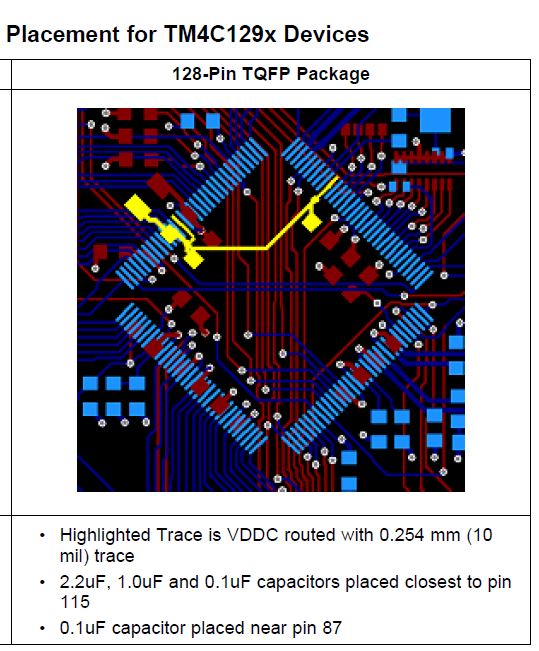
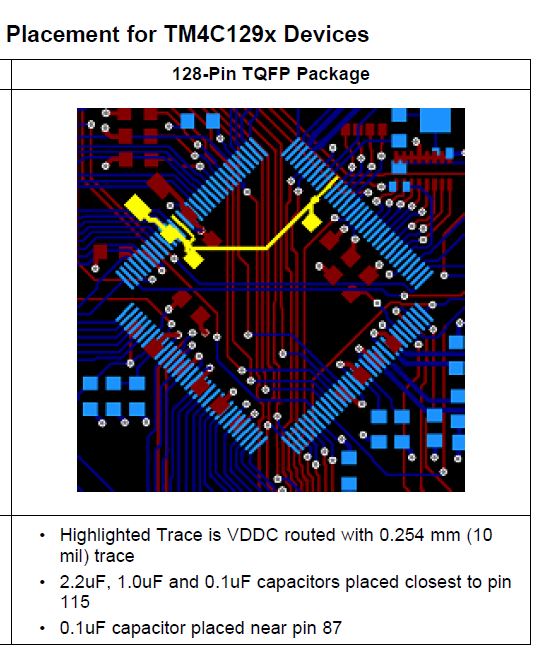
      - Where are the decoupling capacitors for VDD placed? A bulk capacitor must be placed as close as possible to the MCU. I see a 10uF bulk in your design. I hope the 0.1uF decoupling caps are also placed near to the VDD pins. Power supply noise suppression is important for good EMC. 

      - Looking at the VDDC on your schematic, I only see a 3.3uF shared by both VDDC pins. See below recommendation from the guideline and the footnote in the diagram. 

    "The CLDO capacitance is the sum of the capacitor values on the VDDC pins. The recommended VDDC
    capacitor solution, taking tolerance into account, consists of two or more 10%-tolerance ceramic chip
    capacitors totaling 3.3μF to 3.4μF (examples are, one each of 3.3μF and 0.1μF capacitors or one each
    2.2μF, 1.0μF and 0.1μF)."


    - Look like you use a RJ45 with built in magnetic. Is this a correct understanding? The magnetics is supposed to protect against faults and transients, including rejection of common mode signals between the transceiver IC and the cable. These signals can be due to electromagnetic interference (EMI), either from noise picked up by the cable or from slight impedance mismatches. A reputable vendor of the RJ45 with built-in magnetic is important as well. 

  • Hi Kenka,

      I'm not an EMC/EMI expert. it is not possible to pinpoint a specific area by just reading the schematic that caused high emission. With that said, I have some comments and questions. 

      - Does the board work in functional mode aside the high radiated emission?

      - Are you running the Ethernet to UART firmware when conducting the radiation test?

      -  What is the number of the PCB layers used?  Generally , a 2-layer board should not be used for a Ethernet design. Please refer to the  TM4C129system design guideline at https://www.ti.com/lit/pdf/spma056. I will suggest you go through the guideline and search the EMC throughout the document. 

      - Does you board have good ground plane?

      - Where are the decoupling capacitors for VDD placed? A bulk capacitor must be placed as close as possible to the MCU. I see a 10uF bulk in your design. I hope the 0.1uF decoupling caps are also placed near to the VDD pins. Power supply noise suppression is important for good EMC. 

      - Looking at the VDDC on your schematic, I only see a 3.3uF shared by both VDDC pins. See below recommendation from the guideline and the footnote in the diagram. 

    "The CLDO capacitance is the sum of the capacitor values on the VDDC pins. The recommended VDDC
    capacitor solution, taking tolerance into account, consists of two or more 10%-tolerance ceramic chip
    capacitors totaling 3.3μF to 3.4μF (examples are, one each of 3.3μF and 0.1μF capacitors or one each
    2.2μF, 1.0μF and 0.1μF)."


    - Look like you use a RJ45 with built in magnetic. Is this a correct understanding? The magnetics is supposed to protect against faults and transients, including rejection of common mode signals between the transceiver IC and the cable. These signals can be due to electromagnetic interference (EMI), either from noise picked up by the cable or from slight impedance mismatches. A reputable vendor of the RJ45 with built-in magnetic is important as well. 

  • Hi Charles

    I appreciate your reply and will take a closer look at the details.

    For now I can say:

    The PCB is 4 layer and with solid plane in both the two center layer.

    RJ45 connector with build in magnetic type WÜRTH 7499010003A.

    The decuple cap is placed around the IC. I will try to work with the value of this.

  • Hi Torben,

      Thanks for the update. I can't really comment if and any radiation can be attributed to the choice of your RJ45 connector magnetic. Please make sure the RJ45 has proper chassis ground connection and your board has a good chassis ground construction as illustrated in the system design guideline. I don't see them in your schematic. I'm not sure what else I'm able to suggest as I'm really not an expert on the EMC/EMI generation and containment.