This thread has been locked.

If you have a related question, please click the "Ask a related question" button in the top right corner. The newly created question will be automatically linked to this question.

TMS570LC4357: When does RAM17 Diagnostic signal an error to ESM?

Part Number: TMS570LC4357

Hello Hercules Support-Team,

How to run the "RAM17 - Redundant Address Decode Self-Test" diagnostic is described in Section 8.2.6 of the Technical reference Manual. If my understanding is correct a ESM 2.7 error is singaled if the self-test finds an error. If the self-test passes without finding a fault, no error is signaled to esm.

But when I checked the implementation in the SafeTI Diagnostic Library, I saw that, after the self-test passes an ESM error gets cleared and the nERROR pin is reset.

(Q1) Why is the error beeing cleared, after the test passes, although the Technical Reference Manual states: "No error bit will be set if no error is detected in the diagnostic test." ?

(Q2) What reaction is to be expected, if the diagnostic passes?

Thank you and best regards,

  • Hello Max,

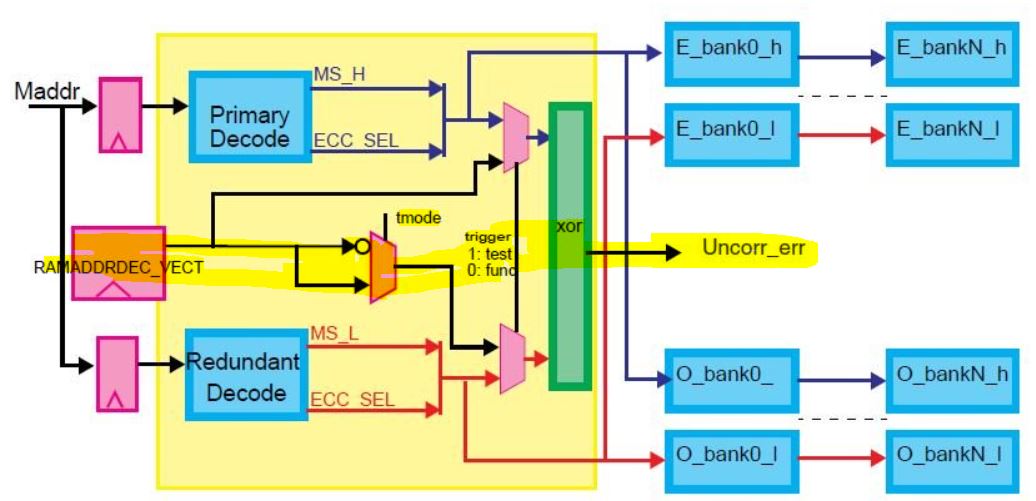
    Below is a diagram to illustrate the redundant decode. The address coming from the bus master (i.e. CPU or DMA) passes through two different address decoders. The decoder's job is to decode the incoming address and generate the chip select to the intended memory bank which stores the data the bus master wants to retrieve. The outputs of the two decoders are compared to each other. Basically this is what the redundant address decode does.

    The wrapper also supports test schemes to check the functionality of the comparator block (highlighted). The test scheme is realized by configuring the RAMTEST register of L2RAMW. After TEST is enabled by writing 0xA to the RAMTEST register's Test enable field and a valid test mode is selected, the test is triggered by writing on to the trigger field of the RAMTEST register. Once the test logic receives a trigger the stimulus provided in the ADDRVECT register is passed on to the comparator block and checked according to the test mode employed.

    For Equality test: This test forces same value into the two inputs of the XOR comparator. The expected output of the comparator is all zero’s. If the comparator output is non-zero then it signals one of the bitwise XOR component has defect.

    For In-Equality test: This test forces opposite value into the two inputs of the XOR comparator. The expected output of the comparator is all one’s. If the  comparator output is not all one’s then it signals one of the bitwise XOR component has defect.

    You are correct. There is no error generated if the test passes, and no need to clear the error flags.

  • Hello QJ,

    Thank you for the quick answer. This helped alot.