This thread has been locked.

If you have a related question, please click the "Ask a related question" button in the top right corner. The newly created question will be automatically linked to this question.

TMS320F28P650DK: Enabling and Disabling Converter

Part Number: TMS320F28P650DK
Other Parts Discussed in Thread: SYSCONFIG

Hi,

What is the recommended meathod in setting up the code to enable or disable the converter? From either the choice of manual control or during a faoult condition. Is there a function that diables the PWMs or is there a recommended meathod to do that?

  • Hi Mike,

    Can you comment on which TI reference design or solution are you asking about so I can loop in the proper expert?

    Best Regards,

    Delaney 

  • Hi Delaney,

    I'm not asking about a specific TI design per say. I'm designing a converter that I would like to manually enable/disable the PWMs. Wondering if there are any examples out there or any recommended methods out there that I can do.  One of my converters is a multiphase buck if that helps

  • Hi Mike,

    Thank you for the information, I have looped in the expert.

    Best Regards,

    Delaney

  • Hi Mike,

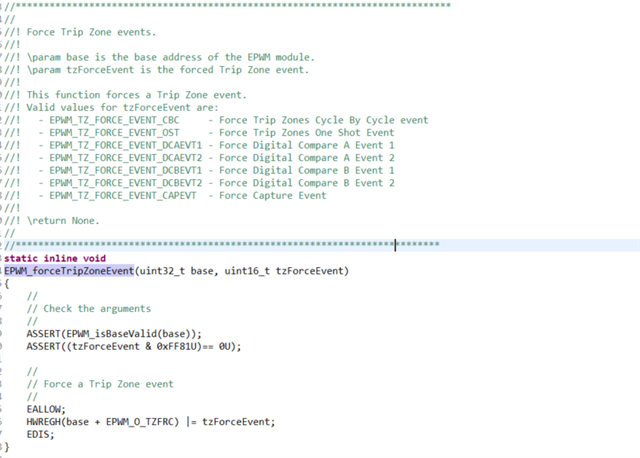
    In software, you can disable the PWM in software by using the EPWM_forceTripZoneEvent function and then enabling the PWM again using the EPWM_clearTripZoneFlag. You can also use CMPSS to detect any fault conditions such as overvoltage or overcurrent and then the CMPSS will issue an automatic trip to the PWMs to disable them while the fault condition is in place

    Regards,

    Peter

  • Thank you Delaney.

    Hi Peter,

    So on one converter, I want both PWMA and PWMB to go low in the event of me disabling the converter or fault condition. On the second converter, I want PWMA to to be low and PWMB to be high in the event of me disabling the converter or fault condition. If I use the EPWM_forceTripZoneEvent, do I have that kind of control? How would I set that up?

    Do I use the TZA and TZB event in SysConfig for these scenarios? And if i call the EPWM_forceTripZoneEvent function, will it trip based on what i set for each PWM in SysConfig?

    Which value should I put for tzForceEvent based on what I'm trying to do?


    Also, when I clear the trip zone event, would I have to reset the any of the EPWM settings or will it go back to what it was before the trip event?

  • Hi Peter,

    Just following up on this

  • Hi Mike,

    The trip condition applies to both A and B and makes them the same trip state (in most cases both LOW state). If they have to be different, then you could also use the EPWM_setActionQualifierContSWForceAction function to set the state of the EPWM. This function gives you the granularity to configure the state of a specific PWM channel. If you are using Active High with the deadband module then you only need to set the source PWM (usually channel A) since the other channel is derived from the source channel, otherwise you would set both PWM channels manually.

    The function EPWM_clearTripZoneFlag will set the trip bit similar to if a trip signal were coming from the CMPSS module. Thus whatever trip condition you have configured in the TZ module will take effect. So yes, if you are using SysConfig for the initialization, you can set the PWM tripped state options using the portion you screenshotted.

    Note that you can't have a separate PWM trip state for CMPSS trip vs. software trip, but you could reconfigure the trip state before you call the EPWM_clearTripZoneFlag, call the function, then reconfigure the trip states to the original states.

    For both of these approaches, you don't need to reconfigure any EPWM registers when coming back from the trip

    Regards,

    Peter