What is the RMS noise level of the A to D converter on the Piccolo processors
This thread has been locked.
If you have a related question, please click the "Ask a related question" button in the top right corner. The newly created question will be automatically linked to this question.
What is the RMS noise level of the A to D converter on the Piccolo processors
Hi Keith,
We don't have raw data for the histogram.
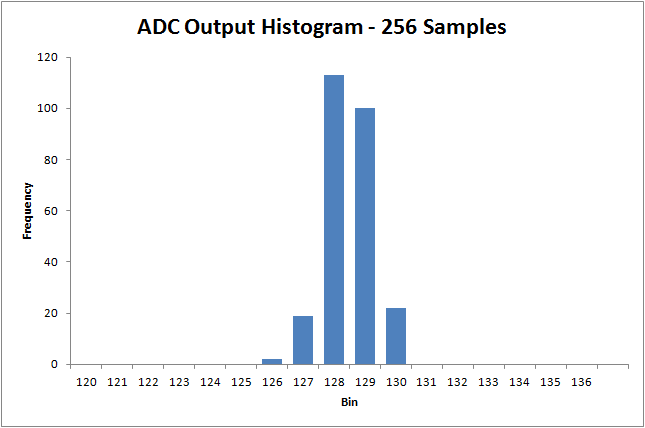
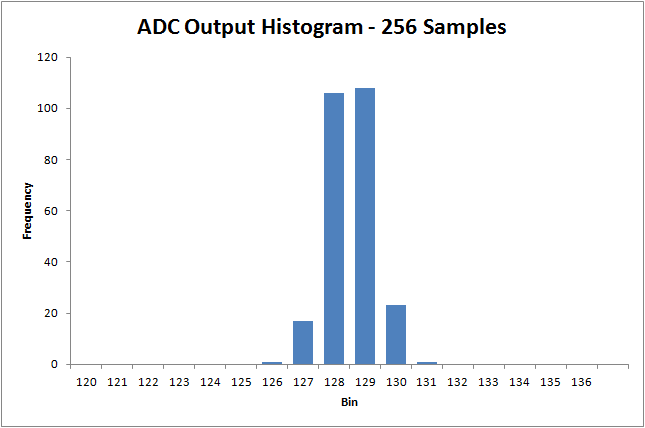
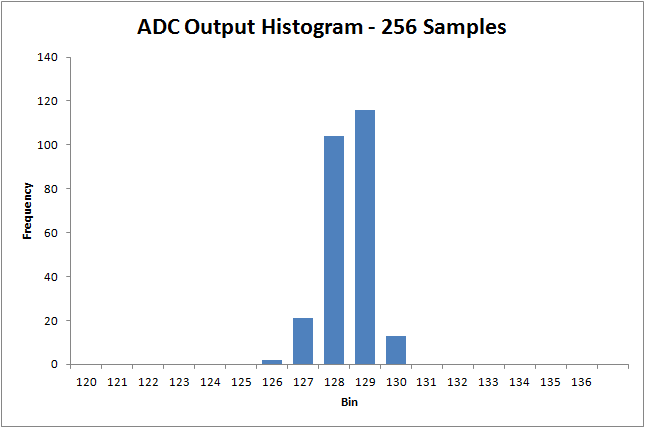
Interestingly, even with a Gaussian noise source on the input, the output may not look quite Gaussian due to the DNL of the ADC. Here are 3 simulated graphs with randomly generated Gaussian noise with center code = 128, noise STDEV = 0.7, and no DNL errors - these look pretty Gaussian:
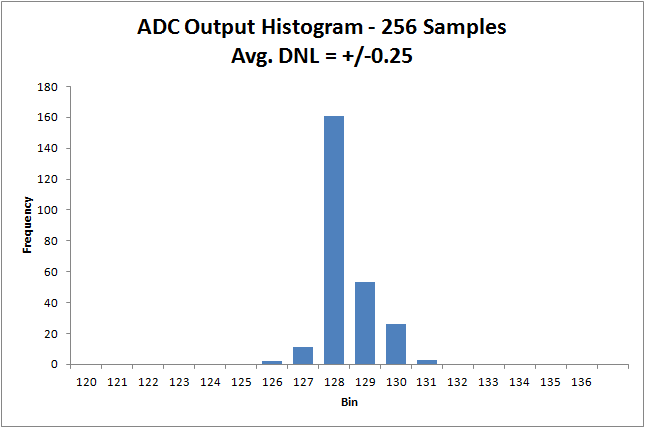
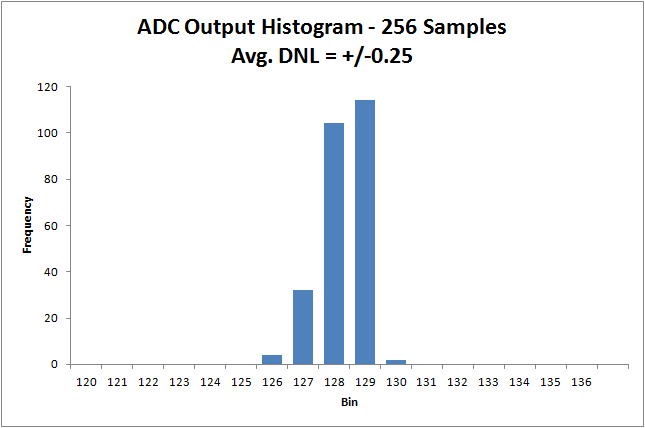
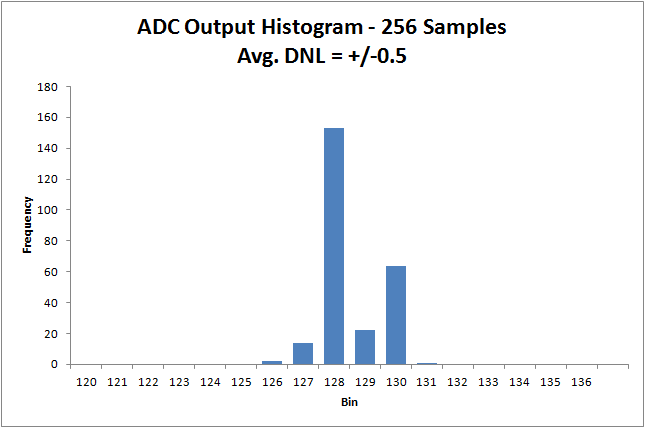
However, when we add some simulated random DNL errors, the graphs may looks quite a bit less Gaussian, even though the input noise is in fact Gaussian:
(Note that the DNL in this case is the average DNL, not the Min/Max DNL...these distortions wouldn't occur throughout the whole transfer function for a normal ADC, only at some worst case spots)
All of this is to say that I don't think a snapshot of the input histogram is all that useful; you are much better off working with the SNR, as this captures the noise across the full ADC range.
Hi Keith,
If I back calculate, I get 1.347 LSBs. Some notes:
-When adding the noise sources, we need to add the noise power, not the RMS values directly (hence SNR = 10log() instead of 20log())
-SNR is typically characterized with a sine input, so the signal part of the ratio has an RMS of (2^N)/sqrt(8) instead of the (2^N)/sqrt(12) for a ramp that covers the full range.