


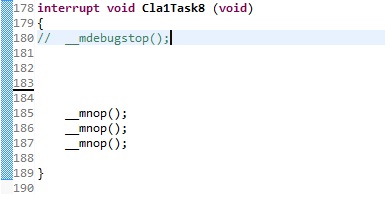
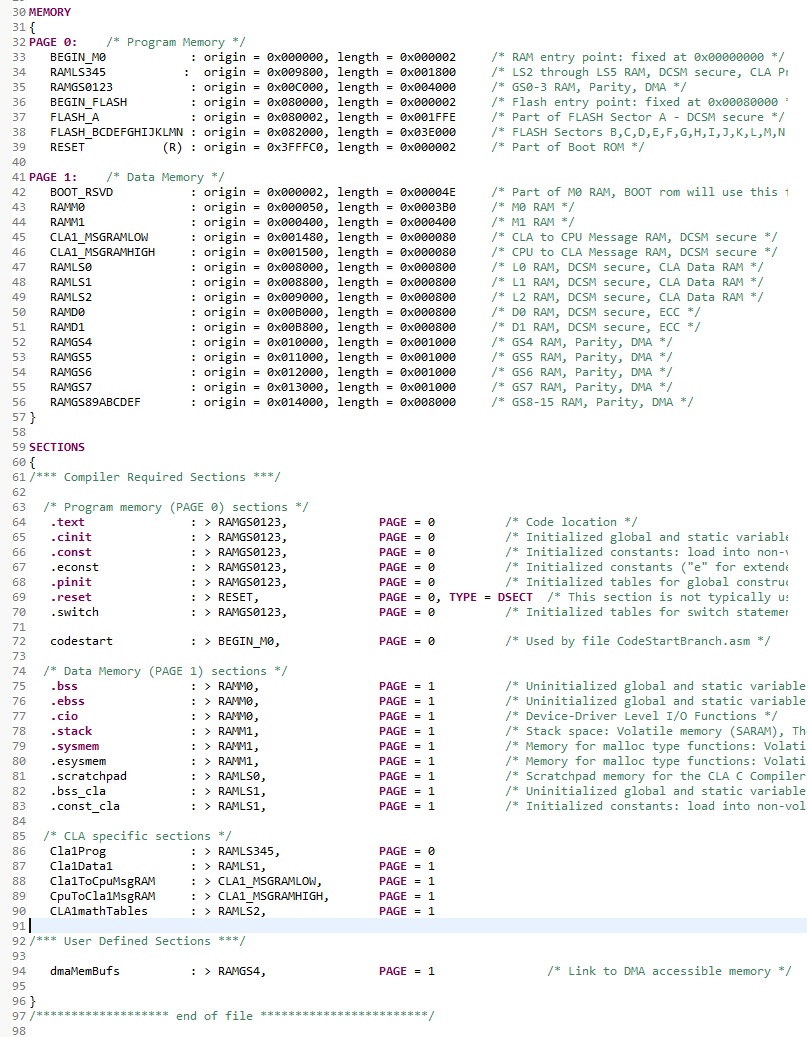
I've been successfully working with the CLA for a number of weeks as I learn more about the 320F28377D. After several weeks of smooth CLA operation, my code became suspended during debugging on a software trigger of task 8 in a CLA initialization routine. Just prior to this issue, I had been editing a significant portion of the CLA code as well as changing CLA program memory allocation in the linker file. This problem shows up every time I run the code on the CPU as the CLA initialization routine is waiting on the MIRUN bit to clear (see attached code screenshot). However, the code behaves as expected when I connect to the CLA target and step through the CLA code as possible with the mdebugstop() function. I never ran into this issue until today.
The 2837xD technical reference on Cla1Regs.MIRUN indicates "the bit is automatically cleared when the task competes and the respective interrupt is fed to the peripheral interrupt expansion (PIE) block of the device." (page 769).
I found one post (https://e2e.ti.com/support/microcontrollers/c2000/f/171/t/386841) on the e2e community. The symptoms of this user's problems are similar to mine but his results are no applicable as I'm running directly in ram and staying connected to my debugger. Maybe it is a problem with the code not fully loaded before enabling global interrupts (such as in https://e2e.ti.com/support/microcontrollers/c2000/f/171/t/534791) but I'm not sure how to verify. I thought my stripped down example version would alleviate this too.
Any help will be greatly appreciated. Screenshots are provided.
Thanks,
Ryan

#include "main.h"                        // Main include file


/**********************************************************************
* Function: Cla_Config()
*
* Description: Initializes CLA for the F28x7x
**********************************************************************/
void Cla_Config(void)
{
    extern uint32_t Cla1funcsRunStart, Cla1funcsLoadStart, Cla1funcsLoadSize;
    EALLOW;

//0 = clock turned off, 1= clock is turned on
    CpuSysRegs.PCLKCR0.bit.CLA1 = 1;		// turn on CLA1 clock

//--- Local Shared RAM Master Selector - local memory shared
    MemCfgRegs.LSxMSEL.bit.MSEL_LS0 = 1;		// 0=memory dedicated to CPU	1=memory shared between CPU & CLA
    MemCfgRegs.LSxMSEL.bit.MSEL_LS1 = 1;		// 0=memory dedicated to CPU	1=memory shared between CPU & CLA
    MemCfgRegs.LSxMSEL.bit.MSEL_LS2 = 1;		// 0=memory dedicated to CPU	1=memory shared between CPU & CLA
    MemCfgRegs.LSxMSEL.bit.MSEL_LS3 = 1;		// 0=memory dedicated to CPU	1=memory shared between CPU & CLA
    MemCfgRegs.LSxMSEL.bit.MSEL_LS4 = 1;		// 0=memory dedicated to CPU	1=memory shared between CPU & CLA
    MemCfgRegs.LSxMSEL.bit.MSEL_LS5 = 1;		// 0=memory dedicated to CPU	1=memory shared between CPU & CLA

//--- Memory Configuration - CLA Data Memory and CLA Program Memory Select
//    Ensure Linker file has memory mapped accordingly
    MemCfgRegs.LSxCLAPGM.bit.CLAPGM_LS0 = 0;    // 0=CLA data memory    1=CLA program memory
    MemCfgRegs.LSxCLAPGM.bit.CLAPGM_LS1 = 0;    // 0=CLA data memory    1=CLA program memory
    MemCfgRegs.LSxCLAPGM.bit.CLAPGM_LS2 = 0;    // 0=CLA data memory    1=CLA program memory
    MemCfgRegs.LSxCLAPGM.bit.CLAPGM_LS3 = 0;    // 0=CLA data memory    1=CLA program memory
    MemCfgRegs.LSxCLAPGM.bit.CLAPGM_LS4 = 1;    // 0=CLA data memory    1=CLA program memory
    MemCfgRegs.LSxCLAPGM.bit.CLAPGM_LS5 = 1;    // 0=CLA data memory    1=CLA program memory

 //--- Memory write and fetch protection
    MemCfgRegs.LSxACCPROT0.bit.CPUWRPROT_LS0 = 0; 	//0=CPU writes allowed	1=CPU writes blocked
    MemCfgRegs.LSxACCPROT0.bit.FETCHPROT_LS0 = 0;	//0=CPU Fetch allowed	1=CPU Fetch blocked
    MemCfgRegs.LSxACCPROT0.bit.CPUWRPROT_LS1 = 0; 	//0=CPU writes allowed	1=CPU writes blocked
    MemCfgRegs.LSxACCPROT0.bit.FETCHPROT_LS1 = 0;	//0=CPU Fetch allowed	1=CPU Fetch blocked
    MemCfgRegs.LSxACCPROT0.bit.CPUWRPROT_LS2 = 0; 	//0=CPU writes allowed	1=CPU writes blocked
    MemCfgRegs.LSxACCPROT0.bit.FETCHPROT_LS2 = 0;	//0=CPU Fetch allowed	1=CPU Fetch blocked
    MemCfgRegs.LSxACCPROT0.bit.CPUWRPROT_LS3 = 0; 	//0=CPU writes allowed	1=CPU writes blocked
    MemCfgRegs.LSxACCPROT0.bit.FETCHPROT_LS3 = 0;	//0=CPU Fetch allowed	1=CPU Fetch blocked
    MemCfgRegs.LSxACCPROT1.bit.CPUWRPROT_LS4 = 0; 	//0=CPU writes allowed	1=CPU writes blocked
    MemCfgRegs.LSxACCPROT1.bit.FETCHPROT_LS4 = 0;	//0=CPU Fetch allowed	1=CPU Fetch blocked
    MemCfgRegs.LSxACCPROT1.bit.CPUWRPROT_LS5 = 0; 	//0=CPU writes allowed	1=CPU writes blocked
    MemCfgRegs.LSxACCPROT1.bit.FETCHPROT_LS5 = 0;	//0=CPU Fetch allowed	1=CPU Fetch blocked

//--- Initialize CLA task interrupt vectors
//    On Type-1 CLAs the MVECT registers accept full 16-bit task addresses as
//    opposed to offsets used on older Type-0 CLAs.

	Cla1Regs.MVECT1 = (uint16_t)(&Cla1Task1);
	Cla1Regs.MVECT2 = (uint16_t)(&Cla1Task2);
	Cla1Regs.MVECT3 = (uint16_t)(&Cla1Task3);
	Cla1Regs.MVECT4 = (uint16_t)(&Cla1Task4);
	Cla1Regs.MVECT5 = (uint16_t)(&Cla1Task5);
	Cla1Regs.MVECT6 = (uint16_t)(&Cla1Task6);
	Cla1Regs.MVECT7 = (uint16_t)(&Cla1Task7);
	Cla1Regs.MVECT8 = (uint16_t)(&Cla1Task8);

//--- Select Task interrupt source                     /******** TRIGGER SOURCE FOR EACH TASK (unlisted numbers are reserved) ********/
    DmaClaSrcSelRegs.CLA1TASKSRCSEL1.bit.TASK1 = 0;    // 0=none       8=ADCBINT3  16=ADCDINT1  32=XINT4     42=EPWM7INT   70=TINT2     78=ECAP4INT   95=SD1INT     114=SPIRXINTC
    DmaClaSrcSelRegs.CLA1TASKSRCSEL1.bit.TASK2 = 0;    // 1=ADCAINT1   9=ADCBINT4  17=ADCDINT2  33=XINT5     43=EPWM8INT   71=MXEVTA    79=ECAP5INT   96=SD2INT
    DmaClaSrcSelRegs.CLA1TASKSRCSEL1.bit.TASK3 = 0;    // 2=ADCAINT2  10=ADCBEVT   18=ADCDINT3  36=EPWM1INT  44=EPWM9INT   72=MREVTA    80=ECAP6INT  107=UPP1INT
    DmaClaSrcSelRegs.CLA1TASKSRCSEL1.bit.TASK4 = 0;    // 3=ADCAINT3  11=ADCCINT1  19=ADCDINT4  37=EPWM2INT  45=EPWM10INT  73=MXEVTB    83=EQEP1INT  109=SPITXINTA
    DmaClaSrcSelRegs.CLA1TASKSRCSEL2.bit.TASK5 = 0;    // 4=ADCAINT4  12=ADCCINT2  20=ADCDEVT   38=EPWM3INT  46=EPWM11INT  74=MREVTB    84=EQEP2INT  110=SPIRXINTA
    DmaClaSrcSelRegs.CLA1TASKSRCSEL2.bit.TASK6 = 0;    // 5=ADCAEVT   13=ADCCINT3  29=XINT1     39=EPWM4INT  47=EPWM12INT  75=ECAP1INT  85=EQEP3INT  111=SPITXINTB
    DmaClaSrcSelRegs.CLA1TASKSRCSEL2.bit.TASK7 = 0;    // 6=ADCBINT1  14=ADCCINT4  30=XINT2     40=EPWM5INT  48=TINT0      76=ECAP2INT  87=HRCAP1INT 112=SPIRXINTB
    DmaClaSrcSelRegs.CLA1TASKSRCSEL2.bit.TASK8 = 0;    // 7=ADCBINT2  15=ADCCEVT   31=XINT3     41=EPWM6INT  69=TINT1      77=ECAP3INT  88=HRCAP2INT 113=SPITXINTC

//--- CLA1TASKSRCSELx register lock control
    DmaClaSrcSelRegs.CLA1TASKSRCSELLOCK.bit.CLA1TASKSRCSEL1 = 0;     // Write a 1 to lock (cannot be cleared once set)
    DmaClaSrcSelRegs.CLA1TASKSRCSELLOCK.bit.CLA1TASKSRCSEL2 = 0;     // Write a 1 to lock (cannot be cleared once set)

//--- Enable use software to start a task (IACK)
    Cla1Regs.MCTL.bit.IACKE = 1;        // Enable IACKE to start task using software

//--- Force one-time initialization Task 8 - zero delay buffer
    Cla1Regs.MIER.all = 0x0080;            // Enable CLA interrupt 8
    asm("  IACK  #0x0080");                // IACK - CLA task force instruction
    asm("  RPT #3 || NOP");                // Wait at least 4 cycles
    while(Cla1Regs.MIRUN.bit.INT8 == 1);   // Loop until task completes


//--- Enable CLA task interrupts
    Cla1Regs.MIER.all = 0x0061;        // Enable CLA interrupt 1, 6, & 7 (and disable interrupt 8)

    EDIS;                      			// Disable EALLOW protected register access

//--- Enable the CLA interrupt
    PieCtrlRegs.PIEIER11.bit.INTx1 = 1;    // Enable CLA Task1 in PIE group #11
    IER |= 0x0400;                         // Enable INT11 in IER to enable PIE group 11

} // end of InitCla()

