This thread has been locked.

If you have a related question, please click the "Ask a related question" button in the top right corner. The newly created question will be automatically linked to this question.

CCS/TMS320F28069M: Corrupted signal

Part Number: TMS320F28069M

Tool/software: Code Composer Studio

Hi Everyone!

This is Mike, I'm trying to sample a square signal, I found something about a similar problem here.

https://e2e.ti.com/support/microcontrollers/c2000/f/171/t/391833

But I think something else I'm not doing it well. 

Can anybody suggest something?

Best Regards

Mike
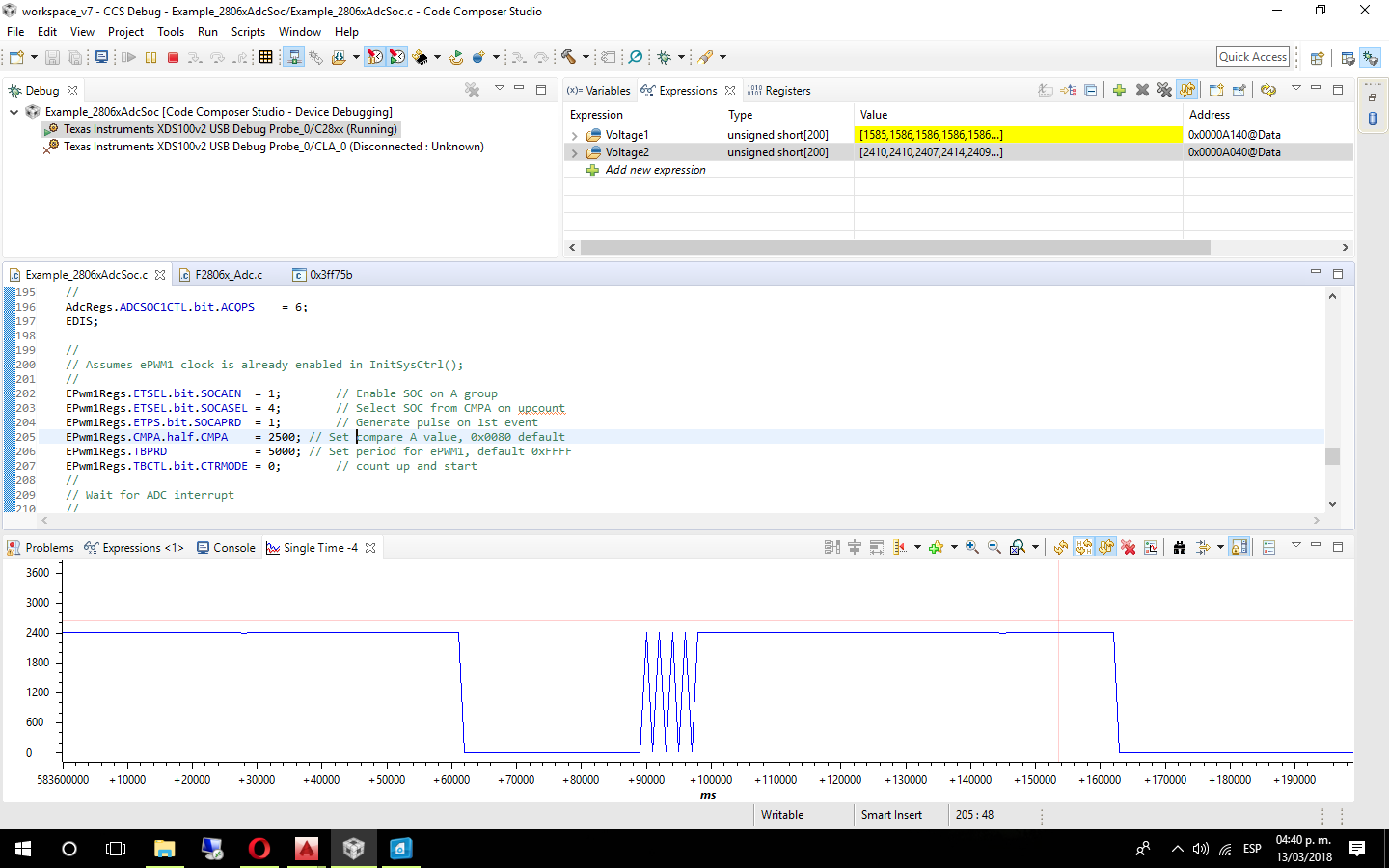
  • See errata (www.ti.com/.../sprz342) on "ADC: Initial Conversion".
    Perhaps you should sample two samples per trigger and take only the second one.
  • I just noticed that your screenshot shows that the MCU is not halted. Per e2e.ti.com/.../1383934
    try halting the MCU and hit refresh to get the data when no new samples are being written.
  • Mike,

    You did not provide a lot of details, but I am guessing that this example worked before you changed the period and compare values. Notice that it looks like you are seeing the problem at the end of the buffer. When changing these values you might also need to also increase the size of the buffer that you are graphing. Remember, that you are graphing a circular buffer and this needs to be large enough and a multiple of the waveform. Also, the setting for the graph window (Acquisition Buffer Size and Display Data Size) need to match the buffer size so that the graph will not scroll. This is only a graph window and not an oscilloscope (i.e. no trigger). We have a similar exercise in the following workshop:

    processors.wiki.ti.com/.../C2000_Archived_Workshops

    See lab exercise 7. For a square wave you will need to change the duty cycle from 25% to 50% (in Lab.h). This lab code might be easier to understand - give it a try.

    Please let me know if this solves your problem. Also, please use the green "Verified Answer" button if your example code is now working.

    - Ken
  • Thanks quark , Thanks Ken Schachter !

    Thanks both of you guys for the fastest answers.

    I was thinking it was an oscilloscope and that was my fault, I understood better the way it works. Thanks a lot

    Best Regards

    Mike