This thread has been locked.

If you have a related question, please click the "Ask a related question" button in the top right corner. The newly created question will be automatically linked to this question.

TMS320F28377S: HRPWM produces shorts

Part Number: TMS320F28377S
Other Parts Discussed in Thread: C2000WARE, TXB0106

Hi,

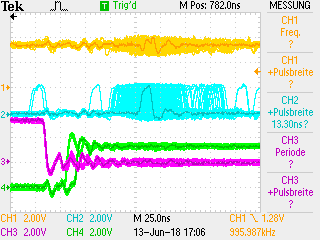
enclosed you find a project that produces extra pulses on the EPWM7B output (blue), that together with EPWM7A (yellow) will generate a short circuit in the power transistors (both high active on). The measurements were made with the 28377S launchpad.

hrpwm_prdupdown_sfo_cpu01.zip

The project is a modified version of C:\ti\c2000\C2000Ware_1_00_03_00\device_support\f2837xs\examples\cpu1\hrpwm_prdupdown_sfo_v8.

The main difference is, that EPWMB is controlled by dead band registers.

Can you reprodue that? Can you explain that?

Thanks and regards,

Frank


CH1: EPWM7A, CH2: EPWM7B, CH3: EPWM8A, CH4: EPWM8B (Launchpad 28377S J4 pin 40 to 37)

  • Hi Frank,

    I haven't looked through the project yet but just want to check this one thing. Are you using high resolution on both xA and xB outputs? If yes, please note that CMPBHR is used for hi-res portion on the xB outputs. This is true even if you use DB to generate xB output from xA. 

    x7B on 2nd and 3rd scope captures looks terrible. Could there be some coupling on your board when the power stage is powered up? Do you see the same behavior if you run the code without power stage powered up i.e. with only the control power?

    Thanks.

    Hrishi

  • Hi Hrishi,

    the PWM settings are derived from a well working project without HRPWM. No need to write to CMPB(HR), since EPWMB is derived from EPWMA + DB settings.

    I tested again, and I cannot see any influence of CMPB.

    Also no difference if HRCNFG.EDGEMODEB = 0 (disabled).

    The test is run with the launchpad alone (see photo below), so there is no power stage where pulses may come from. The ground connections may not be perfect, so you see some crosstalk.

    All three captures show different zooms of the same situation, but the first was shot without display persistance, so you see only one instance of the wrong pulses. EPWM7B (blue) should look like EPWM8B (magenta).

    Please have a look at the project for the details. In CCS, you can write to the variables below to test several settings. Define _LAUNCHXL_F28377S to get the right frequency.

    Thanks,

    Frank

    float   hrperiod = 50.2;
    float   hrnull = 25.0;
    float   hrduty = 15.5;
    int     hrdead = 5;

  • Hi Frank,

    It's not 28377S, but Launchpad, solved here:

    e2e.ti.com/.../625620

    Edward
  • Hi Edward,

    you got it. It is really the floating EQEP1I (pin 3 of the QEP A connector via the TXB0106) that causes the pulses. Also explains why the sh.. does not happen on EPWM8B. Also tested with my own hardware: all OK with EPWM7A.

    Thank you a lot,

    Frank