This thread has been locked.

If you have a related question, please click the "Ask a related question" button in the top right corner. The newly created question will be automatically linked to this question.

CM Ethernet issue (lwip)

Other Parts Discussed in Thread: C2000WARE

Hello all.

I think I am seing a similar issue like this:

https://e2e.ti.com/support/microcontrollers/c2000/f/171/t/891250

I am creating a lwip UDP server, and at the same time I am pinging the  device. Everything seems to work, however, in some situations (not always) an ICMP packet is lost, and then all the traffic (both UDP and ICMP) is delayed, until slowly, it falls appart and stops working.

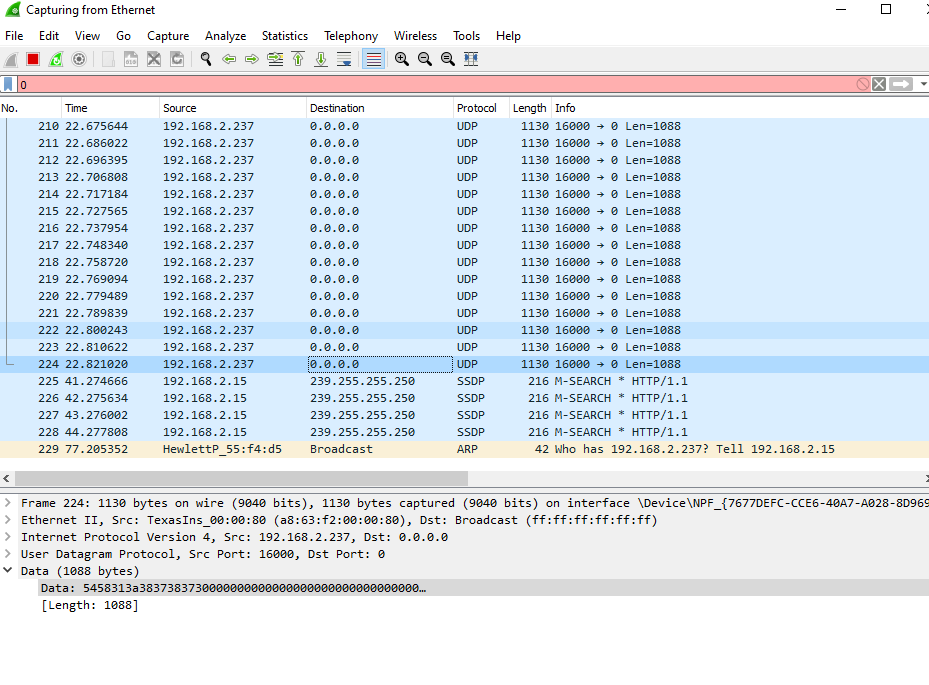
To illustrate, I post a capture:

As you can see, to every ping request number N, there is a reply to N-1. It happens the same to UDP packets. Many times, there is a ping reply, when a UDP is sent as well.

IS it possible to debug it?

  • Hi,

    Thanks for explaining the scenario. 

    PAk said:
    IS it possible to debug it?
    Yes you can definitely debug it.  

    PAk said:
    is delayed, until slowly, it falls appart and stops working.

    When this happens, what happens in the application on F2838x side. Are the packets received at driver check Ethernet_rxInterruptCount if it's incrementing or not?

    If it shows increment, then it is at stack/upper layer level.

    Then check lwip_stats to look at which layer is not receiving or acknowledging. The statistics at different layers link,IP,TCP/UDP , ICMP should throw some light on where the packets are getting dropped. 

    There is no direct solution to such problems, it just needs some level of debug since we did not encounter such scenarios during our webserver example.  

    Regards,

    Sudharsanan

  • Sudharsanan said:

    When this happens, what happens in the application on F2838x side. Are the packets received at driver check Ethernet_rxInterruptCount if it's incrementing or not?

    If it shows increment, then it is at stack/upper layer level.

    When it stops Ethernet_rxInterruptCount does not increase. Surprisingly, the program keeps running and even I can set breakpoints, and the main loop works as always.

    It seems something with Ethernet / Lwip memory problem. HEre are the CM ETH variables,as you can see it fails after many packets.

    Do you mind if I send you my code for debugging?

  • 521177 14
    R PC 0x0000000B 0x00210FCC
    R SP 0x0000000B 0x1FFFD030
    R LR 0x0000000B 0x00210FD1
    R xPSR 0x0000000B 0x61000000
    R R0 0x0000000B 0x00000258
    R R1 0x0000000B 0x00000000
    R R2 0x0000000B 0x00000000
    R R3 0x0000000B 0x20008EF4
    R R4 0x0000000B 0x00000000
    R R5 0x0000000B 0x20011290
    R R6 0x0000000B 0x0000D23C
    R R7 0x0000000B 0x400FD000
    R R8 0x0000000B 0x20011288
    R R9 0x0000000B 0x200112A0
    R R10 0x0000000B 0x2001129E
    R R11 0x0000000B 0x20011286
    R R12 0x0000000B 0x3000046A
    R R13 0x0000000B 0x1FFFD030
    R R14 0x0000000B 0x00210FD1
    R MSP 0x0000000B 0x1FFFD030
    R PSP 0x0000000B 0x00000000
    R DSP 0x0000000B 0x00000000
    R CTRL_FAULT_BASE_PRI 0x0000000B 0x00000000
    R AES_AES_KEY2_6 0x0000000B 0x00000000
    R AES_AES_KEY2_7 0x0000000B 0x00000000
    R AES_AES_KEY2_4 0x0000000B 0x00000000
    R AES_AES_KEY2_5 0x0000000B 0x00000000
    R AES_AES_KEY2_2 0x0000000B 0x00000000
    R AES_AES_KEY2_3 0x0000000B 0x00000000
    R AES_AES_KEY2_0 0x0000000B 0x00000000
    R AES_AES_KEY2_1 0x0000000B 0x00000000
    R AES_AES_KEY1_6 0x0000000B 0x00000000
    R AES_AES_KEY1_7 0x0000000B 0x00000000
    R AES_AES_KEY1_4 0x0000000B 0x00000000
    R AES_AES_KEY1_5 0x0000000B 0x00000000
    R AES_AES_KEY1_2 0x0000000B 0x00000000
    R AES_AES_KEY1_3 0x0000000B 0x00000000
    R AES_AES_KEY1_0 0x0000000B 0x00000000
    R AES_AES_KEY1_1 0x0000000B 0x00000000
    R AES_AES_IV_IN_OUT_0 0x0000000B 0x00000000
    R AES_AES_IV_IN_OUT_1 0x0000000B 0x00000000
    R AES_AES_IV_IN_OUT_2 0x0000000B 0x00000000
    R AES_AES_IV_IN_OUT_3 0x0000000B 0x00000000
    R AES_AES_CTRL 0x0000000B 0x80000000
    R AES_AES_C_LENGTH_0 0x0000000B 0x00000000
    R AES_AES_C_LENGTH_1 0x0000000B 0x00000000
    R AES_AES_AUTH_LENGTH 0x0000000B 0x00000000
    R AES_AES_DATA_IN_OUT_0 0x0000000B 0x00000000
    R AES_AES_DATA_IN_OUT_1 0x0000000B 0x00000000
    R AES_AES_DATA_IN_OUT_2 0x0000000B 0x00000000
    R AES_AES_DATA_IN_OUT_3 0x0000000B 0x00000000
    R AES_AES_TAG_OUT_0 0x0000000B 0x00000000
    R AES_AES_TAG_OUT_1 0x0000000B 0x00000000
    R AES_AES_TAG_OUT_2 0x0000000B 0x00000000
    R AES_AES_TAG_OUT_3 0x0000000B 0x00000000
    R AES_AES_REV 0x0000000B 0x40000B02
    R AES_AES_SYSCONFIG 0x0000000B 0x00000001
    R AES_AES_SYSSTATUS 0x0000000B 0x00000001
    R AES_AES_IRQSTATUS 0x0000000B 0x00000000
    R AES_AES_IRQENABLE 0x0000000B 0x00000000
    R AES_AES_DIRTY_BITS 0x0000000B 0x00000001
    R AES_SS_AESDMAINTEN 0x0000000B 0x00000000
    R AES_SS_AESDMASTATUS 0x0000000B 0x00000000
    R AES_SS_AESDMASTATUSCLR 0x0000000B 0x00000000
    R CANA_CAN_CTL 0x0000000B 0x00000000
    R CANA_CAN_ES 0x0000000B 0x00000000
    R CANA_CAN_ERRC 0x0000000B 0x00000000
    R CANA_CAN_BTR 0x0000000B 0x00000000
    R CANA_CAN_INT 0x0000000B 0x00000000
    R CANA_CAN_TEST 0x0000000B 0x00000000
    R CANA_CAN_PERR 0x0000000B 0x00000000
    R CANA_CAN_RAM_INIT 0x0000000B 0x00000000
    R CANA_CAN_GLB_INT_EN 0x0000000B 0x00000000
    R CANA_CAN_GLB_INT_FLG 0x0000000B 0x00000000
    R CANA_CAN_GLB_INT_CLR 0x0000000B 0x00000000
    R CANA_CAN_ABOTR 0x0000000B 0x00000000
    R CANA_CAN_TXRQ_X 0x0000000B 0x00000000
    R CANA_CAN_TXRQ_21 0x0000000B 0x00000000
    R CANA_CAN_NDAT_X 0x0000000B 0x00000000
    R CANA_CAN_NDAT_21 0x0000000B 0x00000000
    R CANA_CAN_IPEN_X 0x0000000B 0x00000000
    R CANA_CAN_IPEN_21 0x0000000B 0x00000000
    R CANA_CAN_MVAL_X 0x0000000B 0x00000000
    R CANA_CAN_MVAL_21 0x0000000B 0x00000000
    R CANA_CAN_IP_MUX21 0x0000000B 0x00000000
    R CANA_CAN_IF1CMD 0x0000000B 0x00000000
    R CANA_CAN_IF1MSK 0x0000000B 0x00000000
    R CANA_CAN_IF1ARB 0x0000000B 0x00000000
    R CANA_CAN_IF1MCTL 0x0000000B 0x00000000
    R CANA_CAN_IF1DATA 0x0000000B 0x00000000
    R CANA_CAN_IF1DATB 0x0000000B 0x00000000
    R CANA_CAN_IF2CMD 0x0000000B 0x00000000
    R CANA_CAN_IF2MSK 0x0000000B 0x00000000
    R CANA_CAN_IF2ARB 0x0000000B 0x00000000
    R CANA_CAN_IF2MCTL 0x0000000B 0x00000000
    R CANA_CAN_IF2DATA 0x0000000B 0x00000000
    R CANA_CAN_IF2DATB 0x0000000B 0x00000000
    R CANA_CAN_IF3OBS 0x0000000B 0x00000000
    R CANA_CAN_IF3MSK 0x0000000B 0x00000000
    R CANA_CAN_IF3ARB 0x0000000B 0x00000000
    R CANA_CAN_IF3MCTL 0x0000000B 0x00000000
    R CANA_CAN_IF3DATA 0x0000000B 0x00000000
    R CANA_CAN_IF3DATB 0x0000000B 0x00000000
    R CANA_CAN_IF3UPD 0x0000000B 0x00000000
    R CANB_CAN_CTL 0x0000000B 0x00000000
    R CANB_CAN_ES 0x0000000B 0x00000000
    R CANB_CAN_ERRC 0x0000000B 0x00000000
    R CANB_CAN_BTR 0x0000000B 0x00000000
    R CANB_CAN_INT 0x0000000B 0x00000000
    R CANB_CAN_TEST 0x0000000B 0x00000000
    R CANB_CAN_PERR 0x0000000B 0x00000000
    R CANB_CAN_RAM_INIT 0x0000000B 0x00000000
    R CANB_CAN_GLB_INT_EN 0x0000000B 0x00000000
    R CANB_CAN_GLB_INT_FLG 0x0000000B 0x00000000
    R CANB_CAN_GLB_INT_CLR 0x0000000B 0x00000000
    R CANB_CAN_ABOTR 0x0000000B 0x00000000
    R CANB_CAN_TXRQ_X 0x0000000B 0x00000000
    R CANB_CAN_TXRQ_21 0x0000000B 0x00000000
    R CANB_CAN_NDAT_X 0x0000000B 0x00000000
    R CANB_CAN_NDAT_21 0x0000000B 0x00000000
    R CANB_CAN_IPEN_X 0x0000000B 0x00000000
    R CANB_CAN_IPEN_21 0x0000000B 0x00000000
    R CANB_CAN_MVAL_X 0x0000000B 0x00000000
    R CANB_CAN_MVAL_21 0x0000000B 0x00000000
    R CANB_CAN_IP_MUX21 0x0000000B 0x00000000
    R CANB_CAN_IF1CMD 0x0000000B 0x00000000
    R CANB_CAN_IF1MSK 0x0000000B 0x00000000
    R CANB_CAN_IF1ARB 0x0000000B 0x00000000
    R CANB_CAN_IF1MCTL 0x0000000B 0x00000000
    R CANB_CAN_IF1DATA 0x0000000B 0x00000000
    R CANB_CAN_IF1DATB 0x0000000B 0x00000000
    R CANB_CAN_IF2CMD 0x0000000B 0x00000000
    R CANB_CAN_IF2MSK 0x0000000B 0x00000000
    R CANB_CAN_IF2ARB 0x0000000B 0x00000000
    R CANB_CAN_IF2MCTL 0x0000000B 0x00000000
    R CANB_CAN_IF2DATA 0x0000000B 0x00000000
    R CANB_CAN_IF2DATB 0x0000000B 0x00000000
    R CANB_CAN_IF3OBS 0x0000000B 0x00000000
    R CANB_CAN_IF3MSK 0x0000000B 0x00000000
    R CANB_CAN_IF3ARB 0x0000000B 0x00000000
    R CANB_CAN_IF3MCTL 0x0000000B 0x00000000
    R CANB_CAN_IF3DATA 0x0000000B 0x00000000
    R CANB_CAN_IF3DATB 0x0000000B 0x00000000
    R CANB_CAN_IF3UPD 0x0000000B 0x00000000
    R ERRORLOG_UCERRFLG 0x0000000B 0x00000000
    R ERRORLOG_UCERRSET 0x0000000B 0x00000000
    R ERRORLOG_UCERRCLR 0x0000000B 0x00000000
    R ERRORLOG_UCM4EADDR 0x0000000B 0x00000000
    R ERRORLOG_UCEMACEADDR 0x0000000B 0x00000000
    R ERRORLOG_UCuDMAEADDR 0x0000000B 0x00000000
    R ERRORLOG_UCEtherCATMEMREADDR 0x0000000B 0x00000000
    R ERRORLOG_UCEMACMEMREADDR 0x0000000B 0x00000000
    R ERRORLOG_BUSFAULTFLG 0x0000000B 0x00000000
    R ERRORLOG_BUSFAULTCLR 0x0000000B 0x00000000
    R ERRORLOG_M4BUSFAULTADDR 0x0000000B 0x00000000
    R ERRORLOG_uDMABUSFAULTADDR 0x0000000B 0x00000000
    R ERRORLOG_EMACBUSFAULTADDR 0x0000000B 0x00000000
    R ERRORLOG_CERRFLG 0x0000000B 0x00000000
    R ERRORLOG_CERRSET 0x0000000B 0x00000000
    R ERRORLOG_CERRCLR 0x0000000B 0x00000000
    R ERRORLOG_CM4EADDR 0x0000000B 0x00000000
    R ERRORLOG_CEMACEADDR 0x0000000B 0x00000000
    R ERRORLOG_CuDMAEADDR 0x0000000B 0x00000000
    R ERRORLOG_CERRCNT 0x0000000B 0x00000000
    R ERRORLOG_CERRTHRES 0x0000000B 0x00000000
    R ERRORLOG_CEINTFLG 0x0000000B 0x00000000
    R ERRORLOG_CEINTSET 0x0000000B 0x00000000
    R ERRORLOG_CEINTCLR 0x0000000B 0x00000000
    R ERRORLOG_CEINTEN 0x0000000B 0x00000000
    R DcsmCommonRegs_FLSEM 0x0000000B 0x00000000
    R DcsmCommonRegs_SECTSTAT1 0x0000000B 0x0FFFFFFF
    R DcsmCommonRegs_SECTSTAT2 0x0000000B 0x0FFFFFFF
    R DcsmCommonRegs_SECTSTAT3 0x0000000B 0x0FFFFFFF
    R DcsmCommonRegs_RAMSTAT1 0x0000000B 0x000FFFFF
    R DcsmCommonRegs_RAMSTAT2 0x0000000B 0xFFFFFF0F
    R DcsmCommonRegs_RAMSTAT3 0x0000000B 0x000FFFFF
    R DcsmCommonRegs_SECERRSTAT 0x0000000B 0x00000000
    R DcsmCommonRegs_SECERRCLR 0x0000000B 0x00000000
    R DcsmCommonRegs_SECERRFRC 0x0000000B 0x00000000
    R DcsmZ1Regs_Z1_LINKPOINTER 0x0000000B 0xFFFFFFFF
    R DcsmZ1Regs_Z1_OTPSECLOCK 0x0000000B 0x00000FF0
    R DcsmZ1Regs_Z1_JLM_ENABLE 0x0000000B 0x0000000F
    R DcsmZ1Regs_Z1_LINKPOINTERERR 0x0000000B 0x00000000
    R DcsmZ1Regs_Z1_GPREG1 0x0000000B 0xFFFFFFFF
    R DcsmZ1Regs_Z1_GPREG2 0x0000000B 0xFFFFFFFF
    R DcsmZ1Regs_Z1_GPREG3 0x0000000B 0xFFFFFFFF
    R DcsmZ1Regs_Z1_GPREG4 0x0000000B 0xFFFFFFFF
    R DcsmZ1Regs_Z1_CSMKEY0 0x0000000B 0x00000000
    R DcsmZ1Regs_Z1_CSMKEY1 0x0000000B 0x00000000
    R DcsmZ1Regs_Z1_CSMKEY2 0x0000000B 0x00000000
    R DcsmZ1Regs_Z1_CSMKEY3 0x0000000B 0x00000000
    R DcsmZ1Regs_Z1_CR 0x0000000B 0x0060000F
    R DcsmZ1Regs_Z1_GRABSECT1R 0x0000000B 0x0FFFFFFF
    R DcsmZ1Regs_Z1_GRABSECT2R 0x0000000B 0x0FFFFFFF
    R DcsmZ1Regs_Z1_GRABSECT3R 0x0000000B 0x0FFFFFFF
    R DcsmZ1Regs_Z1_GRABRAM1R 0x0000000B 0x000FFFFF
    R DcsmZ1Regs_Z1_GRABRAM2R 0x0000000B 0xFFFFFF0F
    R DcsmZ1Regs_Z1_GRABRAM3R 0x0000000B 0x000FFFFF
    R DcsmZ1Regs_Z1_EXEONLYSECT1R 0x0000000B 0x3FFF3FFF
    R DcsmZ1Regs_Z1_EXEONLYSECT2R 0x0000000B 0x00003FFF
    R DcsmZ1Regs_Z1_EXEONLYRAM1R 0x0000000B 0xFFC303FF
    R DcsmZ1Regs_Z1_JTAGKEY0 0x0000000B 0x00000000
    R DcsmZ1Regs_Z1_JTAGKEY1 0x0000000B 0x00000000
    R DcsmZ1Regs_Z1_JTAGKEY2 0x0000000B 0x00000000
    R DcsmZ1Regs_Z1_JTAGKEY3 0x0000000B 0x00000000
    R DcsmZ1Regs_Z1_CMACKEY0 0x0000000B 0x00000000
    R DcsmZ1Regs_Z1_CMACKEY1 0x0000000B 0x00000000
    R DcsmZ1Regs_Z1_CMACKEY2 0x0000000B 0x00000000
    R DcsmZ1Regs_Z1_CMACKEY3 0x0000000B 0x00000000
    R DcsmZ2Regs_Z2_LINKPOINTER 0x0000000B 0xFFFFFFFF
    R DcsmZ2Regs_Z2_OTPSECLOCK 0x0000000B 0x00000FF0
    R DcsmZ2Regs_Z2_LINKPOINTERERR 0x0000000B 0x00000000
    R DcsmZ2Regs_Z2_GPREG1 0x0000000B 0xFFFFFFFF
    R DcsmZ2Regs_Z2_GPREG2 0x0000000B 0xFFFFFFFF
    R DcsmZ2Regs_Z2_GPREG3 0x0000000B 0xFFFFFFFF
    R DcsmZ2Regs_Z2_GPREG4 0x0000000B 0xFFFFFFFF
    R DcsmZ2Regs_Z2_CSMKEY0 0x0000000B 0x00000000
    R DcsmZ2Regs_Z2_CSMKEY1 0x0000000B 0x00000000
    R DcsmZ2Regs_Z2_CSMKEY2 0x0000000B 0x00000000
    R DcsmZ2Regs_Z2_CSMKEY3 0x0000000B 0x00000000
    R DcsmZ2Regs_Z2_CR 0x0000000B 0x0060000F
    R DcsmZ2Regs_Z2_GRABSECT1R 0x0000000B 0x0FFFFFFF
    R DcsmZ2Regs_Z2_GRABSECT2R 0x0000000B 0x0FFFFFFF
    R DcsmZ2Regs_Z2_GRABSECT3R 0x0000000B 0x0FFFFFFF
    R DcsmZ2Regs_Z2_GRABRAM1R 0x0000000B 0x000FFFFF
    R DcsmZ2Regs_Z2_GRABRAM2R 0x0000000B 0xFFFFFF0F
    R DcsmZ2Regs_Z2_GRABRAM3R 0x0000000B 0x000FFFFF
    R DcsmZ2Regs_Z2_EXEONLYSECT1R 0x0000000B 0x3FFF3FFF
    R DcsmZ2Regs_Z2_EXEONLYSECT2R 0x0000000B 0x00003FFF
    R DcsmZ2Regs_Z2_EXEONLYRAM1R 0x0000000B 0xFFC303FF
    R DIAGERRORLOG_DIAGERRFLG 0x0000000B 0x00000000
    R DIAGERRORLOG_DIAGERRCLR 0x0000000B 0x00000000
    R DIAGERRORLOG_DIAGERRADDR 0x0000000B 0x00000000
    R CSFR_MMSR 0x0000000D 0x00
    R CSFR_BFSR 0x0000000D 0x00
    R CSFR_UFSR 0x0000000F 0x0000
    R ESCSS_ESCSS_IPREVNUM 0x0000000B 0x00000000
    R ESCSS_ESCSS_INTR_RIS 0x0000000B 0x00000000
    R ESCSS_ESCSS_INTR_MASK 0x0000000B 0x00000000
    R ESCSS_ESCSS_INTR_MIS 0x0000000B 0x00000000
    R ESCSS_ESCSS_INTR_CLR 0x0000000B 0x00000000
    R ESCSS_ESCSS_INTR_SET 0x0000000B 0x00000000
    R ESCSS_ESCSS_LATCH_SEL 0x0000000B 0x00000000
    R ESCSS_ESCSS_ACCESS_CTRL 0x0000000B 0x00000000
    R ESCSS_ESCSS_GPIN_DAT 0x0000000B 0x00000000
    R ESCSS_ESCSS_GPIN_PIPE 0x0000000B 0x00000000
    R ESCSS_ESCSS_GPIN_GRP_CAP_SEL 0x0000000B 0x00000000
    R ESCSS_ESCSS_GPOUT_DAT 0x0000000B 0x00000000
    R ESCSS_ESCSS_GPOUT_PIPE 0x0000000B 0x00000000
    R ESCSS_ESCSS_GPOUT_GRP_CAP_SEL 0x0000000B 0x00000000
    R ESCSS_ESCSS_MEM_TEST 0x0000000B 0x00000000
    R ESCSS_ESCSS_RESET_DEST_CONFIG 0x0000000B 0x00000000
    R ESCSS_ESCSS_SYNC0_CONFIG 0x0000000B 0x00000000
    R ESCSS_ESCSS_SYNC1_CONFIG 0x0000000B 0x00000000
    R ESCSSCONFIG_ESCSS_CONFIG_LOCK 0x0000000B 0x00000000
    R ESCSSCONFIG_ESCSS_MISC_IO_CONFIG 0x0000000B 0x00000000
    R ESCSSCONFIG_ESCSS_PHY_IO_CONFIG 0x0000000B 0x00000000
    R ESCSSCONFIG_ESCSS_SYNC_IO_CONFIG 0x0000000B 0x00000000
    R ESCSSCONFIG_ESCSS_LATCH_IO_CONFIG 0x0000000B 0x00000000
    R ESCSSCONFIG_ESCSS_GPIN_SEL 0x0000000B 0x00000000
    R ESCSSCONFIG_ESCSS_GPIN_IOPAD_SEL 0x0000000B 0x00000000
    R ESCSSCONFIG_ESCSS_GPOUT_SEL 0x0000000B 0x00000000
    R ESCSSCONFIG_ESCSS_GPOUT_IOPAD_SEL 0x0000000B 0x00000000
    R ESCSSCONFIG_ESCSS_LED_CONFIG 0x0000000B 0x00000000
    R ESCSSCONFIG_ESCSS_MISC_CONFIG 0x0000000B 0x00000000
    R ETHERNET_MAC_Configuration 0x0000000B 0x0000A003
    R ETHERNET_MAC_Ext_Configuration 0x0000000B 0x00000000
    R ETHERNET_MAC_Packet_Filter 0x0000000B 0x00000000
    R ETHERNET_MAC_Watchdog_Timeout 0x0000000B 0x00000000
    R ETHERNET_MAC_Hash_Table_Reg0 0x0000000B 0x00000000
    R ETHERNET_MAC_Hash_Table_Reg1 0x0000000B 0x00000000
    R ETHERNET_MAC_VLAN_Tag_Ctrl 0x0000000B 0x00000000
    R ETHERNET_MAC_VLAN_Tag_Data 0x0000000B 0x00000000
    R ETHERNET_MAC_VLAN_Hash_Table 0x0000000B 0x00000000
    R ETHERNET_MAC_VLAN_Incl 0x0000000B 0x00000000
    R ETHERNET_MAC_Inner_VLAN_Incl 0x0000000B 0x00000000
    R ETHERNET_MAC_Q0_Tx_Flow_Ctrl 0x0000000B 0x00000000
    R ETHERNET_MAC_Rx_Flow_Ctrl 0x0000000B 0x00000000
    R ETHERNET_MAC_RxQ_Ctrl4 0x0000000B 0x00000000
    R ETHERNET_MAC_RxQ_Ctrl0 0x0000000B 0x0000000A
    R ETHERNET_MAC_RxQ_Ctrl1 0x0000000B 0x00000000
    R ETHERNET_MAC_RxQ_Ctrl2 0x0000000B 0x00000000
    R ETHERNET_MAC_Interrupt_Status 0x0000000B 0x00000000
    R ETHERNET_MAC_Interrupt_Enable 0x0000000B 0x00000000
    R ETHERNET_MAC_Rx_Tx_Status 0x0000000B 0x00000000
    R ETHERNET_MAC_PMT_Control_Status 0x0000000B 0x03000000
    R ETHERNET_MAC_RWK_Packet_Filter 0x0000000B 0x00000000
    R ETHERNET_MAC_LPI_Control_Status 0x0000000B 0x00000000
    R ETHERNET_MAC_LPI_Timers_Control 0x0000000B 0x03E80000
    R ETHERNET_MAC_LPI_Entry_Timer 0x0000000B 0x00000000
    R ETHERNET_MAC_1US_Tic_Counter 0x0000000B 0x00000063
    R ETHERNET_MAC_Version 0x0000000B 0x00000050
    R ETHERNET_MAC_Debug 0x0000000B 0x00000000
    R ETHERNET_MAC_HW_Feature0 0x0000000B 0x0E1D73F5
    R ETHERNET_MAC_HW_Feature1 0x0000000B 0x218E3965
    R ETHERNET_MAC_HW_Feature2 0x0000000B 0x22041041
    R ETHERNET_MAC_HW_Feature3 0x0000000B 0x00320031
    R ETHERNET_MAC_MDIO_Address 0x0000000B 0x0001080C
    R ETHERNET_MAC_MDIO_Data 0x0000000B 0x0000FFFF
    R ETHERNET_MAC_ARP_Address 0x0000000B 0x00000000
    R ETHERNET_MAC_CSR_SW_Ctrl 0x0000000B 0x00000000
    R ETHERNET_MAC_Ext_Cfg1 0x0000000B 0x00000002
    R ETHERNET_MAC_Address0_High 0x0000000B 0x80008000
    R ETHERNET_MAC_Address0_Low 0x0000000B 0x00F263A8
    R ETHERNET_MAC_Address1_High 0x0000000B 0x0000FFFF
    R ETHERNET_MAC_Address1_Low 0x0000000B 0xFFFFFFFF
    R ETHERNET_MAC_Address2_High 0x0000000B 0x0000FFFF
    R ETHERNET_MAC_Address2_Low 0x0000000B 0xFFFFFFFF
    R ETHERNET_MAC_Address3_High 0x0000000B 0x0000FFFF
    R ETHERNET_MAC_Address3_Low 0x0000000B 0xFFFFFFFF
    R ETHERNET_MAC_Address4_High 0x0000000B 0x0000FFFF
    R ETHERNET_MAC_Address4_Low 0x0000000B 0xFFFFFFFF
    R ETHERNET_MAC_Address5_High 0x0000000B 0x0000FFFF
    R ETHERNET_MAC_Address5_Low 0x0000000B 0xFFFFFFFF
    R ETHERNET_MAC_Address6_High 0x0000000B 0x0000FFFF
    R ETHERNET_MAC_Address6_Low 0x0000000B 0xFFFFFFFF
    R ETHERNET_MAC_Address7_High 0x0000000B 0x0000FFFF
    R ETHERNET_MAC_Address7_Low 0x0000000B 0xFFFFFFFF
    R ETHERNET_MMC_Control 0x0000000B 0x00000000
    R ETHERNET_MMC_Rx_Interrupt 0x0000000B 0x00000000
    R ETHERNET_MMC_Tx_Interrupt 0x0000000B 0x00000000
    R ETHERNET_MMC_Rx_Interrupt_Mask 0x0000000B 0x00000000
    R ETHERNET_MMC_Tx_Interrupt_Mask 0x0000000B 0x00000000
    R ETHERNET_Tx_Octet_Count_Good_Bad 0x0000000B 0x039A9FC8
    R ETHERNET_Tx_Packet_Count_Good_Bad 0x0000000B 0x0000D244
    R ETHERNET_Tx_Broadcast_Packets_Good 0x0000000B 0x00000190
    R ETHERNET_Tx_Multicast_Packets_Good 0x0000000B 0x00000000
    R ETHERNET_Tx_64Octets_Packets_Good_Bad 0x0000000B 0x00000018
    R ETHERNET_Tx_65To127Octets_Packets_Good_Bad 0x0000000B 0x00000209
    R ETHERNET_Tx_128To255Octets_Packets_Good_Bad 0x0000000B 0x00000000
    R ETHERNET_Tx_256To511Octets_Packets_Good_Bad 0x0000000B 0x00000000
    R ETHERNET_Tx_512To1023Octets_Packets_Good_Bad 0x0000000B 0x00000000
    R ETHERNET_Tx_1024ToMaxOctets_Packets_Good_Bad 0x0000000B 0x0000D023
    R ETHERNET_Tx_Unicast_Packets_Good_Bad 0x0000000B 0x0000D0B4
    R ETHERNET_Tx_Multicast_Packets_Good_Bad 0x0000000B 0x00000000
    R ETHERNET_Tx_Broadcast_Packets_Good_Bad 0x0000000B 0x00000190
    R ETHERNET_Tx_Underflow_Error_Packets 0x0000000B 0x00000000
    R ETHERNET_Tx_Single_Collision_Good_Packets 0x0000000B 0x00000000
    R ETHERNET_Tx_Multiple_Collision_Good_Packets 0x0000000B 0x00000000
    R ETHERNET_Tx_Deferred_Packets 0x0000000B 0x00000000
    R ETHERNET_Tx_Late_Collision_Packets 0x0000000B 0x00000000
    R ETHERNET_Tx_Excessive_Collision_Packets 0x0000000B 0x00000000
    R ETHERNET_Tx_Carrier_Error_Packets 0x0000000B 0x00000000
    R ETHERNET_Tx_Octet_Count_Good 0x0000000B 0x039A9FC8
    R ETHERNET_Tx_Packet_Count_Good 0x0000000B 0x0000D244
    R ETHERNET_Tx_Excessive_Deferral_Error 0x0000000B 0x00000000
    R ETHERNET_Tx_Pause_Packets 0x0000000B 0x00000000
    R ETHERNET_Tx_VLAN_Packets_Good 0x0000000B 0x00000000
    R ETHERNET_Tx_OSize_Packets_Good 0x0000000B 0x00000000
    R ETHERNET_Rx_Packets_Count_Good_Bad 0x0000000B 0x00000A8E
    R ETHERNET_Rx_Octet_Count_Good_Bad 0x0000000B 0x0002D594
    R ETHERNET_Rx_Octet_Count_Good 0x0000000B 0x0002D594
    R ETHERNET_Rx_Broadcast_Packets_Good 0x0000000B 0x000000BE
    R ETHERNET_Rx_Multicast_Packets_Good 0x0000000B 0x00000000
    R ETHERNET_Rx_CRC_Error_Packets 0x0000000B 0x00000000
    R ETHERNET_Rx_Alignment_Error_Packets 0x0000000B 0x00000000
    R ETHERNET_Rx_Runt_Error_Packets 0x0000000B 0x00000000
    R ETHERNET_Rx_Jabber_Error_Packets 0x0000000B 0x00000000
    R ETHERNET_Rx_Undersize_Packets_Good 0x0000000B 0x00000000
    R ETHERNET_Rx_Oversize_Packets_Good 0x0000000B 0x00000000
    R ETHERNET_Rx_64Octets_Packets_Good_Bad 0x0000000B 0x000007F7
    R ETHERNET_Rx_65To127Octets_Packets_Good_Bad 0x0000000B 0x00000293
    R ETHERNET_Rx_128To255Octets_Packets_Good_Bad 0x0000000B 0x00000004
    R ETHERNET_Rx_256To511Octets_Packets_Good_Bad 0x0000000B 0x00000000
    R ETHERNET_Rx_512To1023Octets_Packets_Good_Bad 0x0000000B 0x00000000
    R ETHERNET_Rx_1024ToMaxOctets_Packets_Good_Bad 0x0000000B 0x00000000
    R ETHERNET_Rx_Unicast_Packets_Good 0x0000000B 0x000009D0
    R ETHERNET_Rx_Length_Error_Packets 0x0000000B 0x00000000
    R ETHERNET_Rx_Out_Of_Range_Type_Packets 0x0000000B 0x00000000
    R ETHERNET_Rx_Pause_Packets 0x0000000B 0x00000000
    R ETHERNET_Rx_FIFO_Overflow_Packets 0x0000000B 0x00000479
    R ETHERNET_Rx_VLAN_Packets_Good_Bad 0x0000000B 0x00000000
    R ETHERNET_Rx_Watchdog_Error_Packets 0x0000000B 0x00000000
    R ETHERNET_Rx_Receive_Error_Packets 0x0000000B 0x00000000
    R ETHERNET_Rx_Control_Packets_Good 0x0000000B 0x00000000
    R ETHERNET_Tx_LPI_USEC_Cntr 0x0000000B 0x00000000
    R ETHERNET_Tx_LPI_Tran_Cntr 0x0000000B 0x00000000
    R ETHERNET_Rx_LPI_USEC_Cntr 0x0000000B 0x00000000
    R ETHERNET_Rx_LPI_Tran_Cntr 0x0000000B 0x00000000
    R ETHERNET_MMC_IPC_Rx_Interrupt_Mask 0x0000000B 0x00000000
    R ETHERNET_MMC_IPC_Rx_Interrupt 0x0000000B 0x00000000
    R ETHERNET_RxIPv4_Good_Packets 0x0000000B 0x00000A42
    R ETHERNET_RxIPv4_Header_Error_Packets 0x0000000B 0x00000000
    R ETHERNET_RxIPv4_No_Payload_Packets 0x0000000B 0x00000000
    R ETHERNET_RxIPv4_Fragmented_Packets 0x0000000B 0x00000000
    R ETHERNET_RxIPv4_UDP_Checksum_Disabled_Packets 0x0000000B 0x00000000
    R ETHERNET_RxIPv6_Good_Packets 0x0000000B 0x00000000
    R ETHERNET_RxIPv6_Header_Error_Packets 0x0000000B 0x00000000
    R ETHERNET_RxIPv6_No_Payload_Packets 0x0000000B 0x00000000
    R ETHERNET_RxUDP_Good_Packets 0x0000000B 0x00000836
    R ETHERNET_RxUDP_Error_Packets 0x0000000B 0x00000000
    R ETHERNET_RxTCP_Good_Packets 0x0000000B 0x00000000
    R ETHERNET_RxTCP_Error_Packets 0x0000000B 0x00000000
    R ETHERNET_RxICMP_Good_Packets 0x0000000B 0x0000020C
    R ETHERNET_RxICMP_Error_Packets 0x0000000B 0x00000000
    R ETHERNET_RxIPv4_Good_Octets 0x0000000B 0x0001961F
    R ETHERNET_RxIPv4_Header_Error_Octets 0x0000000B 0x00000000
    R ETHERNET_RxIPv4_No_Payload_Octets 0x0000000B 0x00000000
    R ETHERNET_RxIPv4_Fragmented_Octets 0x0000000B 0x00000000
    R ETHERNET_RxIPv4_UDP_Checksum_Disable_Octets 0x0000000B 0x00000000
    R ETHERNET_RxIPv6_Good_Octets 0x0000000B 0x00000000
    R ETHERNET_RxIPv6_Header_Error_Octets 0x0000000B 0x00000000
    R ETHERNET_RxIPv6_No_Payload_Octets 0x0000000B 0x00000000
    R ETHERNET_RxUDP_Good_Octets 0x0000000B 0x00007717
    R ETHERNET_RxUDP_Error_Octets 0x0000000B 0x00000000
    R ETHERNET_RxTCP_Good_Octets 0x0000000B 0x00000000
    R ETHERNET_RxTCP_Error_Octets 0x0000000B 0x00000000
    R ETHERNET_RxICMP_Good_Octets 0x0000000B 0x000051E0
    R ETHERNET_RxICMP_Error_Octets 0x0000000B 0x00000000
    R ETHERNET_MAC_L3_L4_Control0 0x0000000B 0x00000000
    R ETHERNET_MAC_Layer4_Address0 0x0000000B 0x00000000
    R ETHERNET_MAC_Layer3_Addr0_Reg0 0x0000000B 0x00000000
    R ETHERNET_MAC_Layer3_Addr1_Reg0 0x0000000B 0x00000000
    R ETHERNET_MAC_Layer3_Addr2_Reg0 0x0000000B 0x00000000
    R ETHERNET_MAC_Layer3_Addr3_Reg0 0x0000000B 0x00000000
    R ETHERNET_MAC_L3_L4_Control1 0x0000000B 0x00000000
    R ETHERNET_MAC_Layer4_Address1 0x0000000B 0x00000000
    R ETHERNET_MAC_Layer3_Addr0_Reg1 0x0000000B 0x00000000
    R ETHERNET_MAC_Layer3_Addr1_Reg1 0x0000000B 0x00000000
    R ETHERNET_MAC_Layer3_Addr2_Reg1 0x0000000B 0x00000000
    R ETHERNET_MAC_Layer3_Addr3_Reg1 0x0000000B 0x00000000
    R ETHERNET_MAC_L3_L4_Control2 0x0000000B 0x00000000
    R ETHERNET_MAC_Layer4_Address2 0x0000000B 0x00000000
    R ETHERNET_MAC_Layer3_Addr0_Reg2 0x0000000B 0x00000000
    R ETHERNET_MAC_Layer3_Addr1_Reg2 0x0000000B 0x00000000
    R ETHERNET_MAC_Layer3_Addr2_Reg2 0x0000000B 0x00000000
    R ETHERNET_MAC_Layer3_Addr3_Reg2 0x0000000B 0x00000000
    R ETHERNET_MAC_L3_L4_Control3 0x0000000B 0x00000000
    R ETHERNET_MAC_Layer4_Address3 0x0000000B 0x00000000
    R ETHERNET_MAC_Layer3_Addr0_Reg3 0x0000000B 0x00000000
    R ETHERNET_MAC_Layer3_Addr1_Reg3 0x0000000B 0x00000000
    R ETHERNET_MAC_Layer3_Addr2_Reg3 0x0000000B 0x00000000
    R ETHERNET_MAC_Layer3_Addr3_Reg3 0x0000000B 0x00000000
    R ETHERNET_MAC_Timestamp_Control 0x0000000B 0x00002000
    R ETHERNET_MAC_Sub_Second_Increment 0x0000000B 0x00000000
    R ETHERNET_MAC_System_Time_Seconds 0x0000000B 0x00000000
    R ETHERNET_MAC_System_Time_Nanoseconds 0x0000000B 0x00000000
    R ETHERNET_MAC_System_Time_Seconds_Update 0x0000000B 0x00000000
    R ETHERNET_MAC_System_Time_Nanoseconds_Update 0x0000000B 0x00000000
    R ETHERNET_MAC_Timestamp_Addend 0x0000000B 0x00000000
    R ETHERNET_MAC_System_Time_Higher_Word_Seconds 0x0000000B 0x00000000
    R ETHERNET_MAC_Timestamp_Status 0x0000000B 0x00000000
    R ETHERNET_MAC_Tx_Timestamp_Status_Nanoseconds 0x0000000B 0x00000000
    R ETHERNET_MAC_Tx_Timestamp_Status_Seconds 0x0000000B 0x00000000
    R ETHERNET_MAC_Auxiliary_Control 0x0000000B 0x00000000
    R ETHERNET_MAC_Auxiliary_Timestamp_Nanoseconds 0x0000000B 0x00000000
    R ETHERNET_MAC_Auxiliary_Timestamp_Seconds 0x0000000B 0x00000000
    R ETHERNET_MAC_Timestamp_Ingress_Asym_Corr 0x0000000B 0x00000000
    R ETHERNET_MAC_Timestamp_Egress_Asym_Corr 0x0000000B 0x00000000
    R ETHERNET_MAC_Timestamp_Ingress_Corr_Nanosecond 0x0000000B 0x00000000
    R ETHERNET_MAC_Timestamp_Egress_Corr_Nanosecond 0x0000000B 0x00000000
    R ETHERNET_MAC_Timestamp_Ingress_Corr_Subnanosec 0x0000000B 0x00000000
    R ETHERNET_MAC_Timestamp_Egress_Corr_Subnanosec 0x0000000B 0x00000000
    R ETHERNET_MAC_PPS_Control 0x0000000B 0x00000000
    R ETHERNET_MAC_PPS0_Target_Time_Seconds 0x0000000B 0x00000000
    R ETHERNET_MAC_PPS0_Target_Time_Nanoseconds 0x0000000B 0x00000000
    R ETHERNET_MAC_PPS0_Interval 0x0000000B 0x00000000
    R ETHERNET_MAC_PPS0_Width 0x0000000B 0x00000000
    R ETHERNET_MAC_PPS1_Target_Time_Seconds 0x0000000B 0x00000000
    R ETHERNET_MAC_PPS1_Target_Time_Nanoseconds 0x0000000B 0x00000000
    R ETHERNET_MAC_PPS1_Interval 0x0000000B 0x00000000
    R ETHERNET_MAC_PPS1_Width 0x0000000B 0x00000000
    R ETHERNET_MAC_PTO_Control 0x0000000B 0x00000000
    R ETHERNET_MAC_Source_Port_Identity0 0x0000000B 0x00000000
    R ETHERNET_MAC_Source_Port_Identity1 0x0000000B 0x00000000
    R ETHERNET_MAC_Source_Port_Identity2 0x0000000B 0x00000000
    R ETHERNET_MAC_Log_Message_Interval 0x0000000B 0x00000000
    R ETHERNETSS_ETHERNETSS_IPREVNUM 0x0000000B 0x00000000
    R ETHERNETSS_ETHERNETSS_CTRLSTS 0x0000000B 0x00000100
    R ETHERNETSS_ETHERNETSS_PTPTSTRIGSEL0 0x0000000B 0x00000000
    R ETHERNETSS_ETHERNETSS_PTPTSTRIGSEL1 0x0000000B 0x00000000
    R ETHERNETSS_ETHERNETSS_PTPTSSWTRIG0 0x0000000B 0x00000000
    R ETHERNETSS_ETHERNETSS_PTPTSSWTRIG1 0x0000000B 0x00000000
    R ETHERNETSS_ETHERNETSS_PTPPPSR0 0x0000000B 0x00000000
    R ETHERNETSS_ETHERNETSS_PTPPPSR1 0x0000000B 0x00000000
    R ETHERNETSS_ETHERNETSS_PTP_TSRL 0x0000000B 0x00000000
    R ETHERNETSS_ETHERNETSS_PTP_TSRH 0x0000000B 0x00000000
    R ETHERNETSS_ETHERNETSS_PTP_TSWL 0x0000000B 0x00000000
    R ETHERNETSS_ETHERNETSS_PTP_TSWH 0x0000000B 0x00000000
    R ETHERNETSS_ETHERNETSS_REVMII_CTRL 0x0000000B 0x00000000
    R FLASHCTRL_FRDCNTL 0x0000000B 0x00000200
    R FLASHCTRL_FBAC 0x0000000B 0x0000000F
    R FLASHCTRL_FBFALLBACK 0x0000000B 0x00000003
    R FLASHCTRL_FBPRDY 0x0000000B 0x00008001
    R FLASHCTRL_FPAC1 0x0000000B 0x061A0001
    R FLASHCTRL_FMSTAT 0x0000000B 0x00000000
    R FLASHCTRL_FRD_INTF_CTRL_LOCK 0x0000000B 0xA5A5A5A5
    R FLASHCTRL_FRD_INTF_CTRL 0x0000000B 0x00000003
    R FLASHECC_ECC_ENABLE 0x0000000B 0x0000000A
    R FLASHECC_SINGLE_ERR_ADDR_LOW 0x0000000B 0x00000000
    R FLASHECC_SINGLE_ERR_ADDR_HIGH 0x0000000B 0x00000000
    R FLASHECC_UNC_ERR_ADDR_LOW 0x0000000B 0x00000000
    R FLASHECC_UNC_ERR_ADDR_HIGH 0x0000000B 0x00000000
    R FLASHECC_ERR_STATUS 0x0000000B 0x00000000
    R FLASHECC_ERR_POS 0x0000000B 0x00000000
    R FLASHECC_ERR_STATUS_CLR 0x0000000B 0x00000000
    R FLASHECC_ERR_CNT 0x0000000B 0x00000000
    R FLASHECC_ERR_THRESHOLD 0x0000000B 0x00000000
    R FLASHECC_ERR_INTFLG 0x0000000B 0x00000000
    R FLASHECC_ERR_INTCLR 0x0000000B 0x00000000
    R FLASHECC_FDATAH_TEST 0x0000000B 0x00000000
    R FLASHECC_FDATAL_TEST 0x0000000B 0x00000000
    R FLASHECC_FADDR_TEST 0x0000000B 0x00000000
    R FLASHECC_FECC_TEST 0x0000000B 0x00000000
    R FLASHECC_FECC_CTRL 0x0000000B 0x00000000
    R FLASHECC_FOUTH_TEST 0x0000000B 0x00000000
    R FLASHECC_FOUTL_TEST 0x0000000B 0x00000000
    R FLASHECC_FECC_STATUS 0x0000000B 0x00000000
    R FLASHECC_FLASH_ECC_REGS_LOCK 0x0000000B 0xA5A5A5A5
    R GCRC_CRCCTRL 0x0000000B 0x00000220
    R GCRC_CRCPOLY 0x0000000B 0x04C11DB7
    R GCRC_CRCDATAMASK 0x0000000B 0x00000000
    R GCRC_CRCDATAIN 0x0000000B 0x00000000
    R GCRC_CRCDATAOUT 0x0000000B 0x00000000
    R GCRC_CRCDATATRANS 0x0000000B 0x00000000
    R GPIODATA_GPADAT 0x0000000B 0x0FFFFFAB
    R GPIODATA_GPASET 0x0000000B 0x00000000
    R GPIODATA_GPACLEAR 0x0000000B 0x00000000
    R GPIODATA_GPATOGGLE 0x0000000B 0x00000000
    R GPIODATA_GPBDAT 0x0000000B 0xFFFFEFFB
    R GPIODATA_GPBSET 0x0000000B 0x00000000
    R GPIODATA_GPBCLEAR 0x0000000B 0x00000000
    R GPIODATA_GPBTOGGLE 0x0000000B 0x00000000
    R GPIODATA_GPCDAT 0x0000000B 0xFFFFF7FF
    R GPIODATA_GPCSET 0x0000000B 0x00000000
    R GPIODATA_GPCCLEAR 0x0000000B 0x00000000
    R GPIODATA_GPCTOGGLE 0x0000000B 0x00000000
    R GPIODATA_GPDDAT 0x0000000B 0xE2B09DFF
    R GPIODATA_GPDSET 0x0000000B 0x00000000
    R GPIODATA_GPDCLEAR 0x0000000B 0x00000000
    R GPIODATA_GPDTOGGLE 0x0000000B 0x00000000
    R GPIODATA_GPEDAT 0x0000000B 0xFFFFFFDF
    R GPIODATA_GPESET 0x0000000B 0x00000000
    R GPIODATA_GPECLEAR 0x0000000B 0x00000000
    R GPIODATA_GPETOGGLE 0x0000000B 0x00000000
    R GPIODATA_GPFDAT 0x0000000B 0x000001FF
    R GPIODATA_GPFSET 0x0000000B 0x00000000
    R GPIODATA_GPFCLEAR 0x0000000B 0x00000000
    R GPIODATA_GPFTOGGLE 0x0000000B 0x00000000
    R GPIODATAREAD_GPADAT_R 0x0000000B 0x00000000
    R GPIODATAREAD_GPBDAT_R 0x0000000B 0x00000000
    R GPIODATAREAD_GPCDAT_R 0x0000000B 0x00000000
    R GPIODATAREAD_GPDDAT_R 0x0000000B 0x00801000
    R GPIODATAREAD_GPEDAT_R 0x0000000B 0x00000000
    R GPIODATAREAD_GPFDAT_R 0x0000000B 0x00000000
    R GPIODATAREAD_GPGDAT_R 0x0000000B 0x00000000
    R GPIODATAREAD_GPHDAT_R 0x0000000B 0x00000000
    R I2C0_I2CMSA 0x0000000B 0x00000000
    R I2C0_I2CMCS 0x0000000B 0x00000020
    R I2C0_I2CMDR 0x0000000B 0x00000000
    R I2C0_I2CMTPR 0x0000000B 0x00010001
    R I2C0_I2CMIMR 0x0000000B 0x00000000
    R I2C0_I2CMRIS 0x0000000B 0x00000000
    R I2C0_I2CMMIS 0x0000000B 0x00000000
    R I2C0_I2CMICR 0x0000000B 0x00000000
    R I2C0_I2CMCR 0x0000000B 0x00000000
    R I2C0_I2CMCLKOCNT 0x0000000B 0x00000000
    R I2C0_I2CMBMON 0x0000000B 0x00000003
    R I2C0_I2CMBLEN 0x0000000B 0x00000000
    R I2C0_I2CMBCNT 0x0000000B 0x00000000
    R I2C0_I2CSOAR 0x0000000B 0x00000000
    R I2C0_I2CSCSR 0x0000000B 0x00000000
    R I2C0_I2CSDR 0x0000000B 0x00000000
    R I2C0_I2CSIMR 0x0000000B 0x00000000
    R I2C0_I2CSRIS 0x0000000B 0x00000000
    R I2C0_I2CSMIS 0x0000000B 0x00000000
    R I2C0_I2CSICR 0x0000000B 0x00000000
    R I2C0_I2CSOAR2 0x0000000B 0x00000000
    R I2C0_I2CSACKCTL 0x0000000B 0x00000000
    R I2C0_I2CFIFODATARX 0x0000000B 0x00000048
    R I2C0_I2CFIFOCTL 0x0000000B 0x00040004
    R I2C0_I2CFIFOSTATUS 0x0000000B 0x00010005
    R I2C0_I2CPP 0x0000000B 0x00000001
    R I2C0_I2CPC 0x0000000B 0x00000001
    R IPCCMTOCPU1_CMTOCPU1IPCACK 0x0000000B 0x00000000
    R IPCCMTOCPU1_CPU1TOCMIPCSTS 0x0000000B 0x00000000
    R IPCCMTOCPU1_CMTOCPU1IPCSET 0x0000000B 0x00000000
    R IPCCMTOCPU1_CMTOCPU1IPCCLR 0x0000000B 0x00000000
    R IPCCMTOCPU1_CMTOCPU1IPCFLG 0x0000000B 0x00000000
    R IPCCMTOCPU1_IPCCOUNTERL 0x0000000B 0xF58FE147
    R IPCCMTOCPU1_IPCCOUNTERH 0x0000000B 0x00000099
    R IPCCMTOCPU1_CPU1TOCMIPCRECVCOM 0x0000000B 0x00001001
    R IPCCMTOCPU1_CPU1TOCMIPCRECVADDR 0x0000000B 0x00000000
    R IPCCMTOCPU1_CPU1TOCMIPCRECVDATA 0x0000000B 0x00000440
    R IPCCMTOCPU1_CMTOCPU1IPCREPLY 0x0000000B 0x00005555
    R IPCCMTOCPU1_CMTOCPU1IPCSENDCOM 0x0000000B 0x00001001
    R IPCCMTOCPU1_CMTOCPU1IPCSENDADDR 0x0000000B 0x00000000
    R IPCCMTOCPU1_CMTOCPU1IPCSENDDATA 0x0000000B 0x00000002
    R IPCCMTOCPU1_CPU1TOCMIPCREPLY 0x0000000B 0x00005555
    R IPCCMTOCPU1_CMTOCPU1IPCBOOTSTS 0x0000000B 0x80001002
    R IPCCMTOCPU1_CPU1TOCMIPCBOOTMODE 0x0000000B 0x5A007D03
    R IPCCMTOCPU1_PUMPREQUEST 0x0000000B 0x00000000
    R IPCCMTOCPU2_CMTOCPU2IPCACK 0x0000000B 0x00000000
    R IPCCMTOCPU2_CPU2TOCMIPCSTS 0x0000000B 0x00000000
    R IPCCMTOCPU2_CMTOCPU2IPCSET 0x0000000B 0x00000000
    R IPCCMTOCPU2_CMTOCPU2IPCCLR 0x0000000B 0x00000000
    R IPCCMTOCPU2_CMTOCPU2IPCFLG 0x0000000B 0x00000000
    R IPCCMTOCPU2_IPCCOUNTERL 0x0000000B 0xECD0704D
    R IPCCMTOCPU2_IPCCOUNTERH 0x0000000B 0x00000099
    R IPCCMTOCPU2_CPU2TOCMIPCRECVCOM 0x0000000B 0x00000000
    R IPCCMTOCPU2_CPU2TOCMIPCRECVADDR 0x0000000B 0x00000000
    R IPCCMTOCPU2_CPU2TOCMIPCRECVDATA 0x0000000B 0x00000000
    R IPCCMTOCPU2_CMTOCPU2IPCREPLY 0x0000000B 0x00000000
    R IPCCMTOCPU2_CMTOCPU2IPCSENDCOM 0x0000000B 0x00000000
    R IPCCMTOCPU2_CMTOCPU2IPCSENDADDR 0x0000000B 0x00000000
    R IPCCMTOCPU2_CMTOCPU2IPCSENDDATA 0x0000000B 0x00000000
    R IPCCMTOCPU2_CPU2TOCMIPCREPLY 0x0000000B 0x00000000
    R MCANSS_MCANSS_PID 0x0000000B 0x68E03901
    R MCANSS_MCANSS_CTRL 0x0000000B 0x00000008
    R MCANSS_MCANSS_STAT 0x0000000B 0x00000006
    R MCANSS_MCANSS_ICS 0x0000000B 0x00000000
    R MCANSS_MCANSS_IRS 0x0000000B 0x00000000
    R MCANSS_MCANSS_IECS 0x0000000B 0x00000000
    R MCANSS_MCANSS_IE 0x0000000B 0x00000000
    R MCANSS_MCANSS_IES 0x0000000B 0x00000000
    R MCANSS_MCANSS_EOI 0x0000000B 0x00000000
    R MCANSS_MCANSS_EXT_TS_PRESCALER 0x0000000B 0x00000000
    R MCANSS_MCANSS_EXT_TS_UNSERVICED_INTR_CNTR 0x0000000B 0x00000000
    R MCAN_MCAN_CREL 0x0000000B 0x32270530
    R MCAN_MCAN_ENDN 0x0000000B 0x87654321
    R MCAN_MCAN_DBTP 0x0000000B 0x00000A33
    R MCAN_MCAN_TEST 0x0000000B 0x00000000
    R MCAN_MCAN_RWD 0x0000000B 0x00000000
    R MCAN_MCAN_CCCR 0x0000000B 0x00000001
    R MCAN_MCAN_NBTP 0x0000000B 0x06000A03
    R MCAN_MCAN_TSCC 0x0000000B 0x00000000
    R MCAN_MCAN_TSCV 0x0000000B 0x00000000
    R MCAN_MCAN_TOCC 0x0000000B 0xFFFF0000
    R MCAN_MCAN_TOCV 0x0000000B 0x0000FFFF
    R MCAN_MCAN_ECR 0x0000000B 0x00000000
    R MCAN_MCAN_PSR 0x0000000B 0x00000707
    R MCAN_MCAN_TDCR 0x0000000B 0x00000000
    R MCAN_MCAN_IR 0x0000000B 0x00000000
    R MCAN_MCAN_IE 0x0000000B 0x00000000
    R MCAN_MCAN_ILS 0x0000000B 0x00000000
    R MCAN_MCAN_ILE 0x0000000B 0x00000000
    R MCAN_MCAN_GFC 0x0000000B 0x00000000
    R MCAN_MCAN_SIDFC 0x0000000B 0x00000000
    R MCAN_MCAN_XIDFC 0x0000000B 0x00000000
    R MCAN_MCAN_XIDAM 0x0000000B 0x1FFFFFFF
    R MCAN_MCAN_HPMS 0x0000000B 0x00000000
    R MCAN_MCAN_NDAT1 0x0000000B 0x00000000
    R MCAN_MCAN_NDAT2 0x0000000B 0x00000000
    R MCAN_MCAN_RXF0C 0x0000000B 0x00000000
    R MCAN_MCAN_RXF0S 0x0000000B 0x00000000
    R MCAN_MCAN_RXF0A 0x0000000B 0x00000000
    R MCAN_MCAN_RXBC 0x0000000B 0x00000000
    R MCAN_MCAN_RXF1C 0x0000000B 0x00000000
    R MCAN_MCAN_RXF1S 0x0000000B 0x00000000
    R MCAN_MCAN_RXF1A 0x0000000B 0x00000000
    R MCAN_MCAN_RXESC 0x0000000B 0x00000000
    R MCAN_MCAN_TXBC 0x0000000B 0x00000000
    R MCAN_MCAN_TXFQS 0x0000000B 0x00000000
    R MCAN_MCAN_TXESC 0x0000000B 0x00000000
    R MCAN_MCAN_TXBRP 0x0000000B 0x00000000
    R MCAN_MCAN_TXBAR 0x0000000B 0x00000000
    R MCAN_MCAN_TXBCR 0x0000000B 0x00000000
    R MCAN_MCAN_TXBTO 0x0000000B 0x00000000
    R MCAN_MCAN_TXBCF 0x0000000B 0x00000000
    R MCAN_MCAN_TXBTIE 0x0000000B 0x00000000
    R MCAN_MCAN_TXBCIE 0x0000000B 0x00000000
    R MCAN_MCAN_TXEFC 0x0000000B 0x00000000
    R MCAN_MCAN_TXEFS 0x0000000B 0x00000000
    R MCAN_MCAN_TXEFA 0x0000000B 0x00000000
    R MCANERR_MCANERR_REV 0x0000000B 0x66A0E200
    R MCANERR_MCANERR_VECTOR 0x0000000B 0x00000000
    R MCANERR_MCANERR_STAT 0x0000000B 0x00000002
    R MCANERR_MCANERR_WRAP_REV 0x0000000B 0x00000000
    R MCANERR_MCANERR_CTRL 0x0000000B 0x00000000
    R MCANERR_MCANERR_ERR_CTRL1 0x0000000B 0x00000000
    R MCANERR_MCANERR_ERR_CTRL2 0x0000000B 0x00000000
    R MCANERR_MCANERR_ERR_STAT1 0x0000000B 0x00000000
    R MCANERR_MCANERR_ERR_STAT2 0x0000000B 0x00000000
    R MCANERR_MCANERR_ERR_STAT3 0x0000000B 0x00000000
    R MCANERR_MCANERR_SEC_EOI 0x0000000B 0x00000000
    R MCANERR_MCANERR_SEC_STATUS 0x0000000B 0x00000000
    R MCANERR_MCANERR_SEC_ENABLE_SET 0x0000000B 0x00000000
    R MCANERR_MCANERR_SEC_ENABLE_CLR 0x0000000B 0x00000000
    R MCANERR_MCANERR_DED_EOI 0x0000000B 0x00000000
    R MCANERR_MCANERR_DED_STATUS 0x0000000B 0x00000000
    R MCANERR_MCANERR_DED_ENABLE_SET 0x0000000B 0x00000000
    R MCANERR_MCANERR_DED_ENABLE_CLR 0x0000000B 0x00000000
    R MCANERR_MCANERR_AGGR_ENABLE_SET 0x0000000B 0x00000000
    R MCANERR_MCANERR_AGGR_ENABLE_CLR 0x0000000B 0x00000000
    R MCANERR_MCANERR_AGGR_STATUS_SET 0x0000000B 0x00000000
    R MCANERR_MCANERR_AGGR_STATUS_CLR 0x0000000B 0x00000000
    R MEMINITANDTEST_CxLOCK 0x0000000B 0x00000000
    R MEMINITANDTEST_CxTEST 0x0000000B 0x00000000
    R MEMINITANDTEST_CxINIT 0x0000000B 0x00000000
    R MEMINITANDTEST_CxINITDONE 0x0000000B 0x00000000
    R MEMINITANDTEST_CMMSGxLOCK 0x0000000B 0x00000000
    R MEMINITANDTEST_CMMSGxTEST 0x0000000B 0x00000000
    R MEMINITANDTEST_CMMSGxINIT 0x0000000B 0x00000000
    R MEMINITANDTEST_CMMSGxINITDONE 0x0000000B 0x00000000
    R MEMINITANDTEST_SxGROUP1_LOCK 0x0000000B 0x00000000
    R MEMINITANDTEST_SxGROUP1_TEST 0x0000000B 0x00000000
    R MEMINITANDTEST_SxGROUP1_INIT 0x0000000B 0x00000000
    R MEMINITANDTEST_SxGROUP1_INITDONE 0x0000000B 0x00000000
    R MEMINITANDTEST_ROM_LOCK 0x0000000B 0x00000000
    R MEMINITANDTEST_ROM_TEST 0x0000000B 0x00000000
    R MEMINITANDTEST_ROM_FORCE_ERROR 0x0000000B 0x00000000
    R MEMINITANDTEST_PERI_MEM_TEST_LOCK 0x0000000B 0x00000000
    R MEMINITANDTEST_PERI_MEM_TEST_CONTROL 0x0000000B 0x00000000
    R MPU_MPU_TYPE 0x0000000B 0x00000800
    R MPU_MPU_CTRL 0x0000000B 0x00000000
    R MPU_MPU_RNR 0x0000000B 0x00000000
    R MPU_MPU_RBAR 0x0000000B 0x00000000
    R MPU_MPU_RASR 0x0000000B 0x00000000
    R MPU_MPU_RBAR_A1 0x0000000B 0x00000000
    R MPU_MPU_RASR_A1 0x0000000B 0x00000000
    R MPU_MPU_RBAR_A2 0x0000000B 0x00000000
    R MPU_MPU_RASR_A2 0x0000000B 0x00000000
    R MPU_MPU_RBAR_A3 0x0000000B 0x00000000
    R MPU_MPU_RASR_A3 0x0000000B 0x00000000
    R NMI_CMNMICFG 0x0000000B 0x00000001
    R NMI_CMNMIFLG 0x0000000B 0x00000000
    R NMI_CMNMIFLGCLR 0x0000000B 0x00000000
    R NMI_CMNMIFLGFRC 0x0000000B 0x00000000
    R NMI_CMNMIWDCNT 0x0000000B 0x00000000
    R NMI_CMNMIWDPRD 0x0000000B 0x0000FFFF
    R NMI_CMNMISHDWFLG 0x0000000B 0x00000000
    R NVIC_NVIC_ISER0 0x0000000B 0x20014000
    R NVIC_NVIC_ISER1 0x0000000B 0x00000000
    R NVIC_NVIC_ICER0 0x0000000B 0x20014000
    R NVIC_NVIC_ICER1 0x0000000B 0x00000000
    R NVIC_NVIC_ISPR0 0x0000000B 0x00002000
    R NVIC_NVIC_ISPR1 0x0000000B 0x00000000
    R NVIC_NVIC_ISPR2 0x0000000B 0x00000000
    R NVIC_NVIC_ICPR0 0x0000000B 0x00002000
    R NVIC_NVIC_ICPR1 0x0000000B 0x00000000
    R NVIC_NVIC_IABR0 0x0000000B 0x00000000
    R NVIC_NVIC_IABR1 0x0000000B 0x00000000
    R NVIC_NVIC_IPR0 0x0000000B 0x00000000
    R NVIC_NVIC_IPR1 0x0000000B 0x00000000
    R NVIC_NVIC_IPR2 0x0000000B 0x00000000
    R NVIC_NVIC_IPR3 0x0000000B 0x00000000
    R NVIC_NVIC_IPR4 0x0000000B 0x00000000
    R NVIC_NVIC_IPR5 0x0000000B 0x00000000
    R NVIC_NVIC_IPR6 0x0000000B 0x00000000
    R NVIC_NVIC_IPR7 0x0000000B 0x00000000
    R NVIC_NVIC_IPR8 0x0000000B 0x00000000
    R NVIC_NVIC_IPR9 0x0000000B 0x00000000
    R NVIC_NVIC_IPR10 0x0000000B 0x00000000
    R NVIC_NVIC_IPR11 0x0000000B 0x00000000
    R NVIC_NVIC_IPR12 0x0000000B 0x00000000
    R NVIC_NVIC_IPR13 0x0000000B 0x00000000
    R NVIC_NVIC_IPR14 0x0000000B 0x00000000
    R NVIC_NVIC_IPR15 0x0000000B 0x00000000
    R NVIC_STIR 0x0000000B 0x00000000
    R SSI0_SSICR0 0x0000000B 0x00000000
    R SSI0_SSICR1 0x0000000B 0x00000000
    R SSI0_SSIDR 0x0000000B 0x00000000
    R SSI0_SSISR 0x0000000B 0x00000003
    R SSI0_SSICPSR 0x0000000B 0x00000000
    R SSI0_SSIIM 0x0000000B 0x00000000
    R SSI0_SSIRIS 0x0000000B 0x00000008
    R SSI0_SSIMIS 0x0000000B 0x00000000
    R SSI0_SSIICR 0x0000000B 0x00000000
    R SSI0_SSIDMACTL 0x0000000B 0x00000000
    R SSI0_SSIPV 0x0000000B 0x00000000
    R SSI0_SSIPP 0x0000000B 0x00000009
    R SSI0_SSIPC 0x0000000B 0x00000000
    R SSI0_SSIPeriphID4 0x0000000B 0x00000000
    R SSI0_SSIPeriphID5 0x0000000B 0x00000000
    R SSI0_SSIPeriphID6 0x0000000B 0x00000000
    R SSI0_SSIPeriphID7 0x0000000B 0x00000000
    R SSI0_SSIPeriphID0 0x0000000B 0x00000022
    R SSI0_SSIPeriphID1 0x0000000B 0x00000000
    R SSI0_SSIPeriphID2 0x0000000B 0x00000018
    R SSI0_SSIPeriphID3 0x0000000B 0x00000001
    R SSI0_SSIPCellID0 0x0000000B 0x0000000D
    R SSI0_SSIPCellID1 0x0000000B 0x000000F0
    R SSI0_SSIPCellID2 0x0000000B 0x00000005
    R SSI0_SSIPCellID3 0x0000000B 0x000000B1
    R CMSYSCTL_CMPCLKCR0 0x0000000B 0x00001111
    R CMSYSCTL_CMPCLKCR1 0x0000000B 0x00000135
    R CMSYSCTL_CMPCLKCR2 0x0000000B 0x00000157
    R CMSYSCTL_CMSOFTPRESET0 0x0000000B 0x00000000
    R CMSYSCTL_CMSOFTPRESET1 0x0000000B 0x00000004
    R CMSYSCTL_CMSOFTPRESET2 0x0000000B 0x00000000
    R CMSYSCTL_CMCLKSTOPREQ0 0x0000000B 0x00000000
    R CMSYSCTL_CMCLKSTOPREQ1 0x0000000B 0x00000000
    R CMSYSCTL_CMCLKSTOPREQ2 0x0000000B 0x00000000
    R CMSYSCTL_CMCLKSTOPACK0 0x0000000B 0x00000000
    R CMSYSCTL_CMCLKSTOPACK1 0x0000000B 0x00000000
    R CMSYSCTL_CMCLKSTOPACK2 0x0000000B 0x00000000
    R CMSYSCTL_MCANWAKESTATUS 0x0000000B 0x00000000
    R CMSYSCTL_MCANWAKESTATUSCLR 0x0000000B 0x00000000
    R CMSYSCTL_CMECATCTL 0x0000000B 0x00000000
    R CMSYSCTL_PALLOCATESTS 0x0000000B 0x00000010
    R CMSYSCTL_CMRESCCLR 0x0000000B 0x00000000
    R CMSYSCTL_CMRESC 0x0000000B 0x00000112
    R CMSYSCTL_CMSYSCTLLOCK 0x0000000B 0x00000000
    R SCB_ACTLR 0x0000000B 0x00000000
    R SCB_CPUID 0x0000000B 0x410FC241
    R SCB_ICSR 0x0000000B 0x00400000
    R SCB_VTOR 0x0000000B 0x20011400
    R SCB_AIRCR 0x0000000B 0xFA050000
    R SCB_SCR 0x0000000B 0x00000000
    R SCB_CCR 0x0000000B 0x00000200
    R SCB_SHPR1 0x0000000B 0x00000000
    R SCB_SHPR2 0x0000000B 0x00000000
    R SCB_SHPR3 0x0000000B 0x00000000
    R SCB_SHCSRS 0x0000000B 0x00000000
    R SCB_CFSR 0x0000000B 0x00000000
    R SCB_HFSR 0x0000000B 0x00000000
    R SCB_MMFAR 0x0000000B 0x20011286
    R SCB_BFAR 0x0000000B 0x20011286
    R SCB_AFSR 0x0000000B 0x00000000
    R SYSTICK_SYST_CSR 0x0000000B 0x00010007
    R SYSTICK_SYST_RVR 0x0000000B 0x00E4E1BF
    R SYSTICK_SYST_CVR 0x0000000B 0x008557DC
    R SYSTICK_SYST_CALIB 0x0000000B 0x80000000
    R TIMER0_TIM 0x0000000B 0x0000B514
    R TIMER0_PRD 0x0000000B 0x0000FFFF
    R TIMER0_TCR 0x0000000B 0x00008001
    R TIMER0_TPR 0x0000000B 0x00000000
    R TIMER1_TIM 0x0000000B 0x000058BD
    R TIMER1_PRD 0x0000000B 0x0000FFFF
    R TIMER1_TCR 0x0000000B 0x00008001
    R TIMER1_TPR 0x0000000B 0x00000000
    R TIMER2_TIM 0x0000000B 0x000015B1
    R TIMER2_PRD 0x0000000B 0x0000FFFF
    R TIMER2_TCR 0x0000000B 0x00008001
    R TIMER2_TPR 0x0000000B 0x00000000
    R UART0_UARTECR 0x0000000B 0x00000000
    R UDMA_DMASTAT 0x0000000B 0x001F0000
    R UDMA_DMACFG 0x0000000B 0x00000000
    R UDMA_DMACTLBASE 0x0000000B 0x00000000
    R UDMA_DMAALTBASE 0x0000000B 0x00000200
    R UDMA_DMASWREQ 0x0000000B 0x00000000
    R UDMA_DMAUSEBURSTSET 0x0000000B 0x00000000
    R UDMA_DMAUSEBURSTCLR 0x0000000B 0x00000000
    R UDMA_DMAREQMASKSET 0x0000000B 0x00000000
    R UDMA_DMAREQMASKCLR 0x0000000B 0x00000000
    R UDMA_DMAENASET 0x0000000B 0x00000000
    R UDMA_DMAENACLR 0x0000000B 0x00000000
    R UDMA_DMAALTSET 0x0000000B 0x00000000
    R UDMA_DMAALTCLR 0x0000000B 0x00000000
    R UDMA_DMAPRIOSET 0x0000000B 0x00000000
    R UDMA_DMAPRIOCLR 0x0000000B 0x00000000
    R UDMA_DMAERRCLR 0x0000000B 0x00000000
    R UDMA_DMACHMAP0 0x0000000B 0x00000000
    R UDMA_DMACHMAP1 0x0000000B 0x00000000
    R UDMA_DMACHMAP2 0x0000000B 0x00000000
    R UDMA_DMACHMAP3 0x0000000B 0x00000000
    R UDMA_DMAPeriphID4 0x0000000B 0x00000004
    R UDMA_DMAPeriphID0 0x0000000B 0x00000030
    R UDMA_DMAPeriphID1 0x0000000B 0x000000B2
    R UDMA_DMAPeriphID2 0x0000000B 0x0000000B
    R UDMA_DMAPeriphID3 0x0000000B 0x00000000
    R UDMA_DMAPCellID0 0x0000000B 0x0000000D
    R UDMA_DMAPCellID1 0x0000000B 0x000000F0
    R UDMA_DMAPCellID2 0x0000000B 0x00000005
    R UDMA_DMAPCellID3 0x0000000B 0x000000B1
    R WDT_SCSR 0x0000000B 0x00000003
    R WDT_WDCNTR 0x0000000B 0x00000000
    R WDT_WDKEY 0x0000000B 0x00000040
    R WDT_WDCR 0x0000000B 0x00000040
    R WDT_WDWCR 0x0000000B 0x00000000
    

    I attach the CM Registers in case it is needed

    One interesting thing about this error, is that only RX channel is broken, sonce if I debug the program, and force the variables value to send same packets, the device sends it and they are watched on the Network.

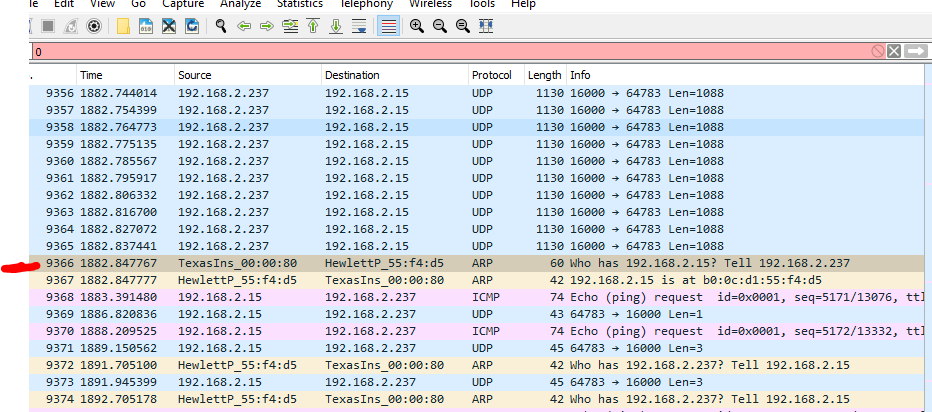
    However,  I cannot even ping the device, because the ARP is not answered, it seems  like it had dissapeared from the network:

    I was able too to capture an ARP request just before the error and lose of communication from TI device, probably it is an ARP related error.

    Thank you

  • It seems a constant error, but I don't know why it happens. I tried to disable LWIP_ARP, since I am using a static network, but f2838xif_init throws an error about it.

    So probably it is happening to the TCP server, only it is not tested enough.

    I am suspecting about f2838xif.c  

    Regards

  • I am not sure if there is a problem in f2838xif.c since the Ethernet Rx interrupt count did not increase post the issue, the hardware/driver should receive the packets before it hits f2838xif.c. 

    Also it is strange that F2838x stack is asking to 192.168.2.237 which is not found in the network at all. Please debug on those lines if what is making it query to 192.168.2.237.

    Regards,

    Sudharsanan

  • Hello  and thank you for your answer.

    Sudharsanan said:
    I am not sure if there is a problem in f2838xif.c since the Ethernet Rx interrupt count did not increase post the issue, the hardware/driver should receive the packets before it hits f2838xif.c. 

    Your observation is right, since Ethernet_receiveISR is not triggered anymore. But the reason why, I think it lies on the f2838xif.c mem management. Have you checked the registers?

    Sudharsanan said:
    Also it is strange that F2838x stack is asking to 192.168.2.237 which is not found in the network at all. Please debug on those lines if what is making it query to 192.168.2.237.

    Actually it is the other way around, F2838x CM is 192.168.2.237 and 192.168.2.15 is an application on the PC. It is sending data, and suddenly a Broadcast ARP is sent and the communications is lost.

    Once the F28388D launches de ARP request, network is lost, hence the PC is throwing ARPs too.

    I can share the programs with you.

  • Hello  

    I could provide yoy with the test for testing.

    would you be able to test it? I think it is important.

    Regards

  • Hi, 

    can you check where the control is stuck? Don't know how you suspect memory management.

    When the issue happens can you observe what Rx Statistics registers (0x400c0800 and beyond show)? Does it show an increase in the number of packets as you do more pings? 

    Regards,

    Sudharsanan

  • Hello.

    Once the error is triggered, the RxStatistics get frozen. No counter is incremented any more. I am worried. Is this a HW issue?

    It happens when many packets (around 40) are received in very little time.

    It seems a buffer is filled but not served, the RxStatistics won't increment any more with new packets (neither ping nor udp requests).

  • Could it be realted to this issue?

    How could I avoid RX FIFO overflow?

  • I have discovered after the Error the Rx variables increase with Broadcast packets, but no with packets destined to its current address!!!

    Besides RX_FIFO_Overflow_packets counter keeps growing.

    How can that be?

  • I once fixed a bug related to rx-overflow. I do not know if TI have done a similar fix yet, or if this is based on the same code. Might be worth to see this post:

  • Exactly!!!  Thank you Christian.

    I think I am seeing the same issue as you. In fact, I have downloaded and tested with UDP Unicorn and I see the same erratical behavior on the F28388D.

    Some years ago I implmented the same code in a Tivaware ARM M4 device,which is working fine. 

    Could you share the code to mange and clean the Rx FIFO Overflow?

    BR

  • Hi PAk,

    The main things I did were to include the following clause within lwIPEthernetIntHandler(void):

        // Handle receive error or FIFO overrun
        if  ( (ulStatus & (ETH_INT_RXOF|ETH_INT_RXER) ) != 0 )
        {
         unsigned long ethReceiveControl = HWREG(ETH_BASE + MAC_O_RCTL);
         // Disable receiver
         ethReceiveControl &= ~(MAC_RCTL_RXEN);
         HWREG(ETH_BASE + MAC_O_RCTL) = ethReceiveControl;
         // Clear receive FIFO
         HWREG(ETH_BASE + MAC_O_RCTL) |= MAC_RCTL_RSTFIFO;
         HWREG(ETH_BASE + MAC_O_RCTL) |= MAC_RCTL_RSTFIFO;
         // Enable receiver
         ethReceiveControl = HWREG(ETH_BASE + MAC_O_RCTL);
         ethReceiveControl &= ~(MAC_RCTL_RSTFIFO);
         ethReceiveControl |= MAC_RCTL_RXEN;
         HWREG(ETH_BASE + MAC_O_RCTL) = ethReceiveControl;
         return;
        }

    I also did a more careful check of receive length within concertoif_receive(struct netif *netif):

        p = NULL;
        if ( (len >= 46) && (len <= 1504) )
        {
         /* We allocate a pbuf chain of pbufs from the pool. */
         p = pbuf_alloc(PBUF_RAW, len, PBUF_POOL);
        }

    Have not seen crashes after these fixed. But it would be appropriate that someone from TI takes a look at the problem and includes similar, or better, fixes in their examples.

  • Interesting and clever approach.

    Now I need to port this Concerto Code to the F28388xif.c functions, so I suppose registers will change. Do you mind to share where are the definitions of ETH_BASE (and other)  registers?

    On the other hand, how did you defined:

    • ulStatus on lwIPEthernetIntHandler?
    • len on concertoif_receive function?

    I agree with you, TI should take a close look to this issue.

    Thank you again Christian.

  • Hello again, I would like to receive some feedback from TI and this issue. 

    It seems it is happenning to otheer users as well.

    Regards

  • Ok, this is clearly a library/mem issue.

    I have tested, the default TCP/IP example, which is provided by TI. Booting from flash.

    I launch a ping command (since the HHTP server is not working from flash yet ), and I launch the program  suggested: UDP Unicorn.

    It has the same effect, the RX FIFO is overloaded, the RX freezes, and then the applications fails.

    Again, I am demostrating this is a library port issue, probably with memory or access, so I request TI to help fix the issue.

    I don't want to sound demanding, but this is taking too long for such a serious issue.

    Thank you.

  • Hi,

    Sorry for the delay.

    Let us not jump into conclusions here before debugging further. We are talking of two different Hardware and two different stack versions, Interface layer, Low level drivers . 

    Please have in mind that in general the design of these kind of RTOS less software may be loading the Processor more, the entire packet processing will happen in ISR context, when we end up overflowing it could also be a symptom of packets coming in at a rate more than the stack can handle(without RTOS). 

    To isolate this further,

     1. can you please increase the interpacket delay further and see if it helps? 

     2. Also the lesser the packet size is worser will be the throughput, it will throttle the packets more. can you also increase the packet size may be set it to around 1.5K and see if it helps. 

    Please look into these vectors and let us know your observations.

    Regards,

    Sudharsanan

  • Thank you for your answer Sudharsanan

    I quickly answer to your questions:

    1. Increasing the interpacket delay helps.  In fact, this is the temporary solution we have adopted since July to test the device while connected only to a PC. However in a real network with real traffic, the device is unusable because of this error.


    2. Size does not matter, even only ARP packets can take down the ethernet port. On our application we are using packets from 1.2K to only a few bytes, and it happens no matter the size.

    About your RTOS appreciation, we have exactly the same application and code running on top of a Tivaware ARM M4 device using the Lwip stack, with no issues. That is why we are pretty sure the port to the F28388D is a clear suspect.

    Have you checked these posts?

    e2e.ti.com/.../3467876

  • Hi,

    PAk said:
    Increasing the interpacket delay helps.  In fact, this is the temporary solution we have adopted since July to test the device while connected only to a PC. However in a real network with real traffic, the device is unusable because of this error.

    Thanks for this input. What is the inter packet delay at which your system is supposed to work? 

    Practically if it is choking the stack, are you fine missing the requests if we do a recovery to handle further.  

    I shall file a ticket for tracking down this request and fix it.  

    PAk said:
    Have you checked these posts?

    Thanks for the links to you and Christian. I did have a check but this Ethernet controller is different than the one referenced in the thread, hence have to be handled differently.

    Regards,

    Sudharsanan

  • Thank you Sudharsanan

    Sudharsanan said:

    Practically if it is choking the stack, are you fine missing the requests if we do a recovery to handle further.  

    I shall file a ticket for tracking down this request and fix it.  

    Yes, we are fine missing requests. We prefer to throw and lose data, rather than brick the device.

    Sudharsanan said:

    Thanks for the links to you and Christian. I did have a check but this Ethernet controller is different than the one referenced in the thread, hence have to be handled differently.

    Sure it is different, but the issue seems to be similar and probably the solution. Just trying to help.

    Best regards

  • Hello @, for this issue. 

    Would you mind to specify a timeline for the solution? We are lauching some demo with clients and I need to use Ethernet to connect to their system.

    Thank you

    Regards

  • Hi,

    We tried to recreate with the HTTP webserver example. it is working fine with UDP Unicorn with 10ms Inter packet delay without any issue. Can you please share us the step to recreate the issue.

    We won't be able to specify a timeline, without recreating and analyzing the issue. 

    Regards,

    Sudharsanan 

  • Hello Sudharsanan.

    One quick question, have you booted from flash?

  • Hello,

    No. we are using CCS for loading FLASH and running our application. 

    Regards,

    Sudharsanan

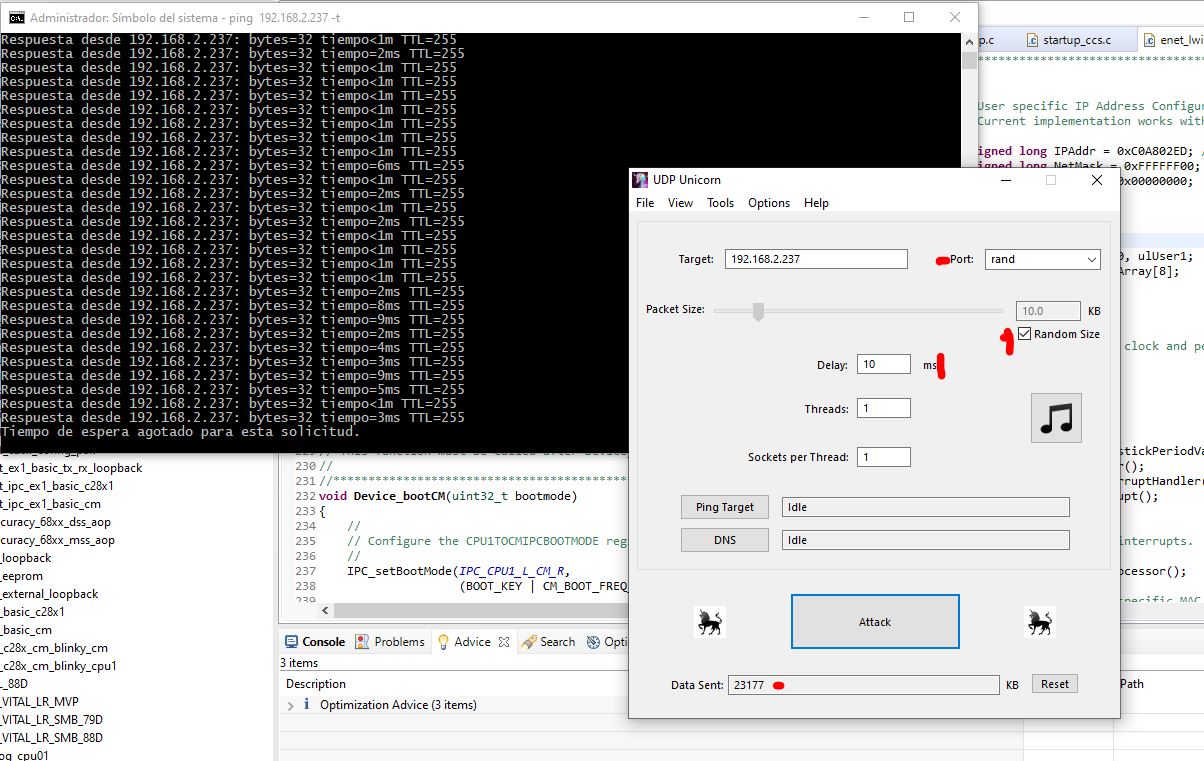
  • Sudharsanan said:
    No. we are using CCS for loading FLASH and running our application. 

    You need to boot from FLASH, as in a real environment. I see most of the issues not checked on the F28388D come from not testing with this setup.

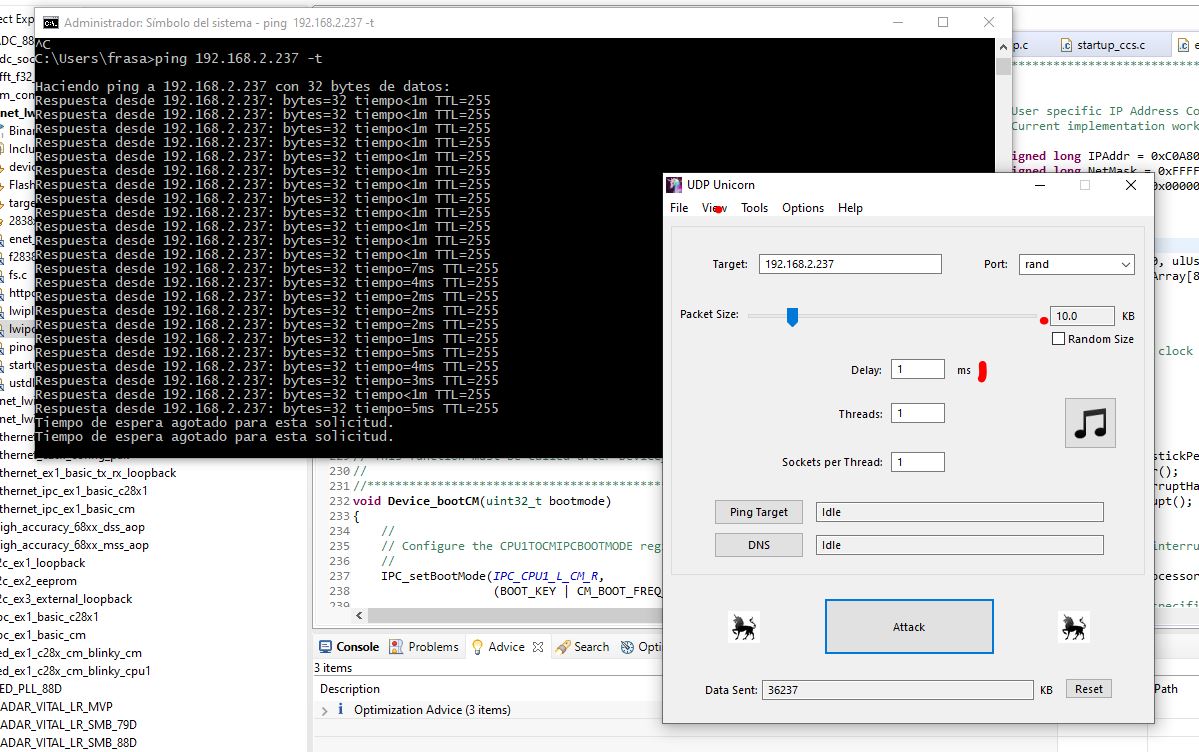
    We have used the default http example from FLASH, only changing the ip address to connect it to our network. The IP of the F28388D device is 192.168.2.237.

    Ping to "192.168.2.237 -t" from cmd console.

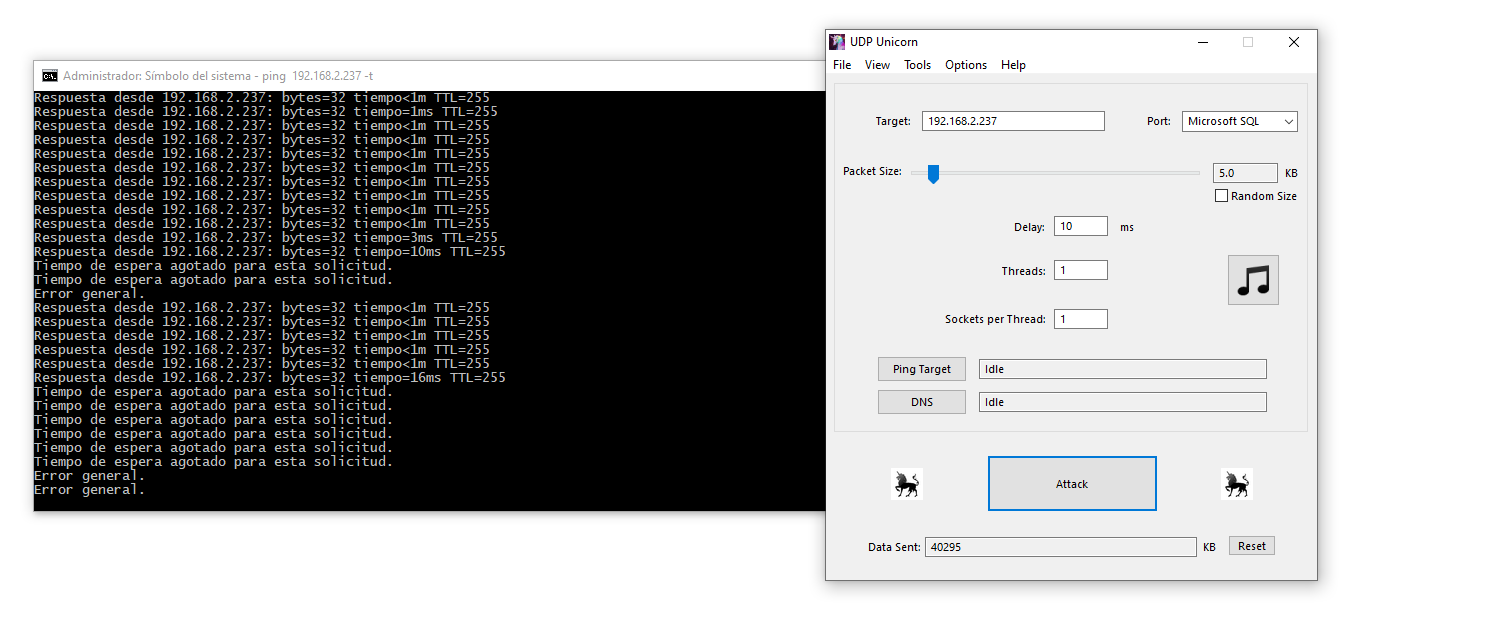
    We have replicated the issue easily and quickly with these two configurations in UDPUnicorn (there are many more which take more time!!):

    • 10kB packets at 1ms

    • 10ms and Random Size

    Regards

  • BTW, stop the UDPUnicorn Attack and resume once in a while (like 10 seconds) since, because of the upd sending, ARP packets are responded. But if these UDP packets stop, the ARP are never answered on the F28388D again.

  • Hello

    I would like to know if you have tested it booting from flash.

    This is the last issue we need to solve before releasing our device into the market.

    Regards

  • Hi,

    We could recreate a similar scenario that with lower Interpacket delay between packets it gets stuck in a FaultHandler. Is it something similar that you are seeing at your end? Where is the control stuck at when the issue happens? Can you post Call stack at the point when the issue happens?

    We could not get the standalone execution though, but definitely have noted your feedback to improve our testing going forward. 

    Regards,

    Sudharsanan

  • Yes, I see the Faulthandler when it is launched sometimes with JTAG. However, booting from FLASH, which is the real scenario for 99% of devices, the C28X and CM programs run degraded (without RX), until the CM program dies.

    Let me ask you, why couldn't you get the standalone execution? It is simply load it and test it.

  • How are you doing Standalone execution? If I understand correctly, the standalone execution will not work,since the RAM (containing the Webserver content) will not be initialized in the flow. It will work only with JTAG based loading right?

    Regards,

    Sudharsanan

  • With the TCP example it works as long as you don't call the http server from a web browser. Once you do it it will hang up.

    On the other hand, we have another program using a UDP server implementation which happens to work from Flash well,  until it freezes.

  • Hello.

    Could we have any feedback or time frame to expect the solution?

    Regards

  • Hello.

    Could we get an answer about this? I need to provide with a time  frame to our clients.

    PAk said:

    Could we have any feedback or time frame to expect the solution?

    Regards

  • Hello, could we get any feedback?

    Thank you

  • Hi,

    Sorry for the delay. I was out of office for an emergency. We have not yet root caused the issue. We just see one Hard fault with existing Webserver application at lower IPD at times. We could not root cause yet with that scenario. We shall continue our debugs this week and keep you posted. 

    Regards,

    Sudharsanan

  • Hi PAk,

    We have run some tests from our side to debug the issue. We have updated the port layer and Initialization of CM. I am attaching the updated files. Please try your application with these files and see if it works.

    Thanks,

    Yashwant

    //###########################################################################
    //
    // FILE:   f2838xif.c
    //
    // TITLE:  F2838x interface port file.
    //
    //###########################################################################
    // $TI Release: $
    // $Release Date: $
    // $Copyright: $
    //###########################################################################
    
    /**
     * Copyright (c) 2001-2004 Swedish Institute of Computer Science.
     * All rights reserved.
     *
     * Redistribution and use in source and binary forms, with or without modification,
     * are permitted provided that the following conditions are met:
     *
     * 1. Redistributions of source code must retain the above copyright notice,
     *    this list of conditions and the following disclaimer.
     * 2. Redistributions in binary form must reproduce the above copyright notice,
     *    this list of conditions and the following disclaimer in the documentation
     *    and/or other materials provided with the distribution.
     * 3. The name of the author may not be used to endorse or promote products
     *    derived from this software without specific prior written permission.
     *
     * THIS SOFTWARE IS PROVIDED BY THE AUTHOR ``AS IS'' AND ANY EXPRESS OR IMPLIED
     * WARRANTIES, INCLUDING, BUT NOT LIMITED TO, THE IMPLIED WARRANTIES OF
     * MERCHANTABILITY AND FITNESS FOR A PARTICULAR PURPOSE ARE DISCLAIMED. IN NO EVENT
     * SHALL THE AUTHOR BE LIABLE FOR ANY DIRECT, INDIRECT, INCIDENTAL, SPECIAL,
     * EXEMPLARY, OR CONSEQUENTIAL DAMAGES (INCLUDING, BUT NOT LIMITED TO, PROCUREMENT
     * OF SUBSTITUTE GOODS OR SERVICES; LOSS OF USE, DATA, OR PROFITS; OR BUSINESS
     * INTERRUPTION) HOWEVER CAUSED AND ON ANY THEORY OF LIABILITY, WHETHER IN
     * CONTRACT, STRICT LIABILITY, OR TORT (INCLUDING NEGLIGENCE OR OTHERWISE) ARISING
     * IN ANY WAY OUT OF THE USE OF THIS SOFTWARE, EVEN IF ADVISED OF THE POSSIBILITY
     * OF SUCH DAMAGE.
     *
     * This file is part of the lwIP TCP/IP stack.
     *
     * Author: Adam Dunkels <adam@sics.se>
     *
     */
    
    /**
     * Copyright (c) 2018 Texas Instruments Incorporated
     *
     * This file is dervied from the ``ethernetif.c'' skeleton Ethernet network
     * interface driver for lwIP.
     *
     */
    
    #include <string.h>
    /**
     * lwIP specific header files
     */
    #include "lwip/opt.h"
    #include "lwip/def.h"
    #include "lwip/mem.h"
    #include "lwip/pbuf.h"
    #include "lwip/sys.h"
    #include <lwip/stats.h>
    #include <lwip/snmp.h>
    #include "netif/etharp.h"
    #include "netif/ppp/pppoe.h"
    #include "netif/f2838xif.h"
    
    /**
     * f2838x device specific header files
     */
    #include "inc/hw_emac.h"
    #include "inc/hw_ints.h"
    #include "inc/hw_memmap.h"
    #include "inc/hw_types.h"
    #include "driverlib_cm/ethernet.h"
    #include "driverlib_cm/interrupt.h"
    #include "driverlib_cm/sysctl.h"
    
    #include "utils/lwiplib.h"
    /**
     * Sanity Check:  This interface driver will NOT work if the following defines
     * are incorrect.
     *
     */
    #if (PBUF_LINK_HLEN != 16)
    #error "PBUF_LINK_HLEN must be 16 for this interface driver!"
    #endif
    #if (ETH_PAD_SIZE != 0)
    #error "ETH_PAD_SIZE must be 0 for this interface driver!"
    #endif
    #if (!SYS_LIGHTWEIGHT_PROT)
    #error "SYS_LIGHTWEIGHT_PROT must be enabled for this interface driver!"
    #endif
    
    /**
     * Number of pbufs supported in low-level tx/rx pbuf queue.
     *
     */
    #ifndef F2838X_NUM_PBUF_QUEUE
    #define F2838X_NUM_PBUF_QUEUE    20
    #endif
    
    #define EMAC_BASE                   0x400C0000U //EMAC
    #define EMAC_SS_BASE                0x400C2000U //EMACSS
    
    /* Define those to better describe your network interface. */
    #define IFNAME0 't'
    #define IFNAME1 'i'
    
    /* Helper struct to hold a queue of pbufs for transmit and receive. */
    struct pbufq
    {
        struct pbuf *pbuf[F2838X_NUM_PBUF_QUEUE];
        unsigned long qwrite;
        unsigned long qread;
        unsigned long overflow;
    };
    
    /* Helper macros for accessing pbuf queues. */
    #define PBUF_QUEUE_EMPTY(q) \
        (((q)->qwrite == (q)->qread) ? true : false)
    
    #define PBUF_QUEUE_FULL(q) \
        ((((((q)->qwrite + 1) % F2838X_NUM_PBUF_QUEUE)) == (q)->qread) ? \
        true : false )
    
    /**
     * Helper struct to hold private data used to operate your ethernet interface.
     * Keeping the ethernet address of the MAC in this struct is not necessary
     * as it is already kept in the struct netif.
     * But this is only an example, anyway...
     */
    struct f2838xif
    {
        struct eth_addr *ethaddr;
        /* Add whatever per-interface state that is needed here. */
        struct pbufq txq;
        Ethernet_Pkt_Desc *pktDesc;
    };
    
    /**
     * A structure used to keep track of driver state and error counts.
     */
    typedef struct {
        uint32_t ui32TXCount;
        uint32_t ui32TXCopyCount;
        uint32_t ui32TXCopyFailCount;
        uint32_t ui32TXNoDescCount;
        uint32_t ui32TXBufQueuedCount;
        uint32_t ui32TXBufFreedCount;
        uint32_t ui32RXBufReadCount;
        uint32_t ui32RXPacketReadCount;
        uint32_t ui32RXPacketErrCount;
        uint32_t ui32RXPacketCBErrCount;
        uint32_t ui32RXNoBufCount;
    }
    tDriverStats;
    
    tDriverStats g_sDriverStats = {0};
    
    #define DRIVER_STATS_INC(x) do{ g_sDriverStats.ui32##x++; } while(0)
    #define DRIVER_STATS_DEC(x) do{ g_sDriverStats.ui32##x--; } while(0)
    #define DRIVER_STATS_ADD(x, inc) do{ g_sDriverStats.ui32##x += inc; } while(0)
    #define DRIVER_STATS_SUB(x, dec) do{ g_sDriverStats.ui32##x -= dec; } while(0)
    
    /*
     * Creating a queue that maps an ethernet packet descriptor with
     * the corresponding pbuf. It is useful to free up the allocated pbuf memory
     * after the packet has been sent.
     */
    #ifndef F2838X_INTERFACE_NUM_PKT_DESC_QUEUE
    #define F2838X_INTERFACE_NUM_PKT_DESC_QUEUE    20
    #endif
    
    /**
     * Global variable for this interface's private data.  Needed to allow
     * the interrupt handlers access to this information outside of the
     * context of the lwIP netif.
     *
     */
    static struct f2838xif f2838xif_data;
    
    Ethernet_Handle emac_handle;
    
    /**
     * A macro which determines whether a pointer is within the SRAM address
     * space and, hence, points to a buffer that the Ethernet MAC can directly
     * DMA from.
     */
    #define PTR_SAFE_FOR_EMAC_DMA(ptr) (((uint32_t)(ptr) >= 0x2000800) &&   \
                                        ((uint32_t)(ptr) < 0x2000FFFF))
    
    /**
     * In this function, the hardware should be initialized.
     * Called from f2838xif_init().
     *
     * @param netif the already initialized lwip network interface structure
     *        for this ethernetif
     */
    static void
    f2838xif_hwinit(struct netif *netif)
    {
        uint32_t mac_low,mac_high;
        uint8_t *pucTemp;
    
        /* set MAC hardware address length */
        netif->hwaddr_len = ETHARP_HWADDR_LEN;
    
        /* set MAC address */
        Ethernet_getMACAddr(EMAC_BASE, 0, &mac_high, &mac_low);
    
        pucTemp = (uint8_t *)&mac_low;
        netif->hwaddr[0] = pucTemp[0];
        netif->hwaddr[1] = pucTemp[1];
        netif->hwaddr[2] = pucTemp[2];
        netif->hwaddr[3] = pucTemp[3];
    
        pucTemp = (uint8_t *)&mac_high;
        netif->hwaddr[4] = pucTemp[0];
        netif->hwaddr[5] = pucTemp[1];
    
        /* maximum transfer unit */
        netif->mtu = 1500;
    
        /* device capabilities */
        /* don't set NETIF_FLAG_ETHARP if this device is not an ethernet one */
        netif->flags = NETIF_FLAG_BROADCAST | NETIF_FLAG_ETHARP | NETIF_FLAG_LINK_UP | NETIF_FLAG_IGMP;
    }
    
    /**
     * This function should do the actual transmission of the packet. The packet is
     * contained in the pbuf that is passed to the function. This pbuf might be
     * chained.
     *
     * @param netif the lwip network interface structure for this ethernetif
     * @param p the MAC packet to send (e.g. IP packet including MAC addresses and type)
     * @return ERR_OK if the packet could be sent
     *         an err_t value if the packet couldn't be sent
     * @note This function MUST be called with interrupts disabled or with the
     *       F2838x Ethernet transmit fifo protected.
     */
    static err_t
    f2838xif_transmit(struct netif *netif, struct pbuf *p)
    {
        struct pbuf *q;
    
        /* No of pbufs (if chained)*/
        int n=0;
        int i=0;
        Ethernet_Pkt_Desc *pktDescOrigPtr, *pktDescPtr;
    
        /* ENTER CRITICAL SECTION
         * This is to protect the forming of packetc descriptor chain using pbufs
         * passed to the function.
         */
        Interrupt_disable(INT_EMAC_TX0);
        Interrupt_disable(INT_EMAC_RX0);
    
        /*
         * Make sure we still have a valid buffer (it may have been copied)
         */
        if(!p)
        {
            LINK_STATS_INC(link.memerr);
    
            /* EXIT CRITICAL SECTION */
            Interrupt_enable(INT_EMAC_TX0);
            Interrupt_enable(INT_EMAC_RX0);
    
            return(ERR_MEM);
        }
    
        /*
         * Count the number of the pbufs in the chain that we are passed with.
         */
        for(q = p; q != NULL; q = q->next)
                n++;
    
        /*
         * Get the head of the packet descriptor chain that will be passed to
         * the driver for sending.
         */
        pktDescOrigPtr = mem_malloc(sizeof(Ethernet_Pkt_Desc));
        if(pktDescOrigPtr == NULL)
        {
            __asm("   bkpt #0");
        }
    
        /*
         * Go over the pbufs present in the chain and allot a packet descriptor for
         * each pbuf. The descriptors will also be chained in the same order as
         * pbufs before passing the head of the chain to the driver.
         */
        for(q = p, pktDescPtr = pktDescOrigPtr; // Initialization
            q != NULL; // Condition evaluation
            q = q->next, pktDescPtr = pktDescPtr->nextPacketDesc) // Manipulation
        {
            /*
             * Initializing this data structure, otherwise garbage values will
             * result in rogue results while running.
             */
            memset(pktDescPtr,0,sizeof(Ethernet_Pkt_Desc));
    
            pktDescPtr->dataOffset = 0;
            pktDescPtr->dataBuffer = q->payload;
            pktDescPtr->pktChannel = ETHERNET_DMA_CHANNEL_NUM_0;
            pktDescPtr->pktLength = q->tot_len;
            pktDescPtr->bufferLength = q->len;
            pktDescPtr->validLength = q->len;
    
    
              if(i==0)
              {
                    if(n!=1)
                    {
                        /*
                         * Prepare the next ethernet packet descriptor holder if
                         * there is a pbuf next in the chain.
                         */
                        pktDescPtr->nextPacketDesc =
                                mem_malloc(sizeof(Ethernet_Pkt_Desc));
                        if(pktDescPtr->nextPacketDesc == NULL)
                            {
                                __asm("   bkpt #0");
                            }
                        pktDescPtr->flags = ETHERNET_PKT_FLAG_SOP ;
                    }
                    else
                    {
                        pktDescPtr->nextPacketDesc = 0;
                        pktDescPtr->flags = ETHERNET_PKT_FLAG_SOP |
                                            ETHERNET_PKT_FLAG_EOP;
                    }
              }
              else
              {
                  if(q->next != NULL)
                  {
                      /*
                       * Prepare the next ethernet packet descriptor holder if
                       * there is a pbuf next in the chain.
                       */
                      pktDescPtr->nextPacketDesc =
                              mem_malloc(sizeof(Ethernet_Pkt_Desc));
                      if(pktDescPtr->nextPacketDesc == NULL)
                          {
                              __asm("   bkpt #0");
                          }
                      pktDescPtr->flags = 0;
                  }
                  else
                  {
                      pktDescPtr->nextPacketDesc = 0;
                      pktDescPtr->flags = ETHERNET_PKT_FLAG_EOP;
                  }
              }
    
              i++;
        }
    
        /* EXIT CRITICAL SECTION */
        Interrupt_enable(INT_EMAC_TX0);
        Interrupt_enable(INT_EMAC_RX0);
    
        /*
         * Hand over the packet descriptor to the driver.
         */
        pktDescOrigPtr->numPktFrags = n;
        Ethernet_sendPacket(emac_handle,pktDescOrigPtr);
    
        LINK_STATS_INC(link.xmit);
    
        return(ERR_OK);
    }
    
    /**
     * This function will process all transmit descriptors and free pbufs attached
     * to any that have been transmitted since we last checked.
     *
     * This function is called only from the Ethernet interrupt handler.
     *
     * @param netif the lwip network interface structure for this ethernetif
     * @return None.
     */
    int descriptorFreeErr=0;
    static void
    f2838xif_process_transmit(struct netif *netif, Ethernet_Pkt_Desc *pPacket)
    {
        Ethernet_Pkt_Desc *pktDescPtr, *pktDescPtrShadow;
    
        /*
         * Free the packet descriptor memory.
         */
        if (pPacket == 0)
            return;
    
        pktDescPtr = pPacket;
    
        do
        {
            pktDescPtrShadow = pktDescPtr->nextPacketDesc;
            mem_free(pktDescPtr);
            pktDescPtr = pktDescPtrShadow;
        }
        while(pktDescPtr != 0);
    
    }
    
    /**
     * This function with either place the packet into the F2838x transmit fifo,
     * or will place the packet in the interface PBUF Queue for subsequent
     * transmission when the transmitter becomes idle.
     *
     * @param netif the lwip network interface structure for this ethernetif
     * @param p the MAC packet to send (e.g. IP packet including MAC addresses and type)
     * @return ERR_OK if the packet could be sent
     *         an err_t value if the packet couldn't be sent
     *
     */
    
    static err_t
    f2838xif_output(struct netif *netif, struct pbuf *p)
    {
        f2838xif_transmit(netif, p);
    
        return ERR_OK;
    }
    
    /**
     * This function will read a single packet from the F2838x ethernet
     * interface, if available, and return a pointer to a pbuf.  The timestamp
     * of the packet will be placed into the pbuf structure.
     *
     * @param netif the lwip network interface structure for this ethernetif
     * @return pointer to pbuf packet if available, NULL otherswise.
     */
    Ethernet_Pkt_Desc*
    f2838xif_receive( struct netif *netif, Ethernet_Pkt_Desc *pPacket )
    {
        struct pbuf *p;
    
    #if LWIP_PTPD
        u32_t time_s, time_ns;
        /* Get the current timestamp if PTPD is enabled */
        lwIPHostGetTime(&time_s, &time_ns);
    #endif
    
        p = pbuf_alloc(PBUF_RAW, sizeof(struct pbuf), PBUF_POOL);
        if(p)
        {
            p->payload = pPacket->dataBuffer;
    
            p->len = pPacket->pktLength;
            p->tot_len = p->len;
    
        #if LWIP_PTPD
            /* Place the timestamp in the PBUF */
            p->time_s = time_s;
            p->time_ns = time_ns;
        #endif
    
            if(ethernet_input(p, netif)!=ERR_OK)
            {
                /* drop the packet */
                LWIP_DEBUGF(NETIF_DEBUG, ("f2838xif_input: input error\n"));
    
                /* Adjust the link statistics */
                LINK_STATS_INC(link.memerr);
                LINK_STATS_INC(link.drop);
            }
            pbuf_free(p);
            p = NULL;
    
        }
        if(pPacket->dataBuffer != NULL)
                memp_free(MEMP_PBUF_POOL, pPacket->dataBuffer);
        if(pPacket != NULL)
            mem_free(pPacket);
    
    
        Ethernet_Pkt_Desc *newPacket = mem_calloc(1, sizeof(Ethernet_Pkt_Desc));
    
        if(newPacket)
           newPacket->dataBuffer = memp_malloc(MEMP_PBUF_POOL);
    
        LINK_STATS_INC(link.recv);
        return(newPacket);
    }
    
    Ethernet_Pkt_Desc *f2838xif_newbuffcallback(void)
    {
        Ethernet_Pkt_Desc *newPacket = mem_calloc(1, sizeof(Ethernet_Pkt_Desc));
    
        if(newPacket)
        {
            newPacket->dataBuffer= memp_malloc(MEMP_PBUF_POOL);
        }
        return newPacket;
    }
    
    /**
     * Should be called at the beginning of the program to set up the
     * network interface. It calls the function f2838xif_hwinit() to do the
     * actual setup of the hardware.
     * This function should be passed as a parameter to netif_add().
     *
     * @param netif the lwip network interface structure for this ethernetif
     * @return ERR_OK if the loopif is initialized
     *         ERR_MEM if private data couldn't be allocated
     *         any other err_t on error
     */
    err_t
    f2838xif_init(struct netif *netif)
    {
        LWIP_ASSERT("netif != NULL", (netif != NULL));
    
    #if LWIP_NETIF_HOSTNAME
        /* Initialize interface hostname */
        netif->hostname = "lwip";
    #endif /* LWIP_NETIF_HOSTNAME */
    
        /*
         * Initialize the snmp variables and counters inside the struct netif.
         * The last argument should be replaced with your link speed, in units
         * of bits per second.
         */
        NETIF_INIT_SNMP(netif, snmp_ifType_ethernet_csmacd, 1000000);
    
        netif->state = &f2838xif_data;
        netif->name[0] = IFNAME0;
        netif->name[1] = IFNAME1;
    
        /* We directly use etharp_output() here to save a function call.
         * You can instead declare your own function an call etharp_output()
         * from it if you have to do some checks before sending (e.g. if link
         * is available...) */
        netif->output = etharp_output;
        netif->linkoutput = f2838xif_output;
    
        f2838xif_data.ethaddr = (struct eth_addr *)&(netif->hwaddr[0]);
        f2838xif_data.txq.qread = f2838xif_data.txq.qwrite = 0;
        f2838xif_data.txq.overflow = 0;
    
        /* initialize the hardware */
        f2838xif_hwinit(netif);
    
        return ERR_OK;
    }
    
    /**
     * Process tx and rx packets at the low-level interrupt.
     *
     * Should be called from the F2838x Ethernet Interrupt Handler.  This
     * function will read packets from the F2838x Ethernet fifo and place them
     * into a pbuf queue.  If the transmitter is idle and there is at least one packet
     * on the transmit queue, it will place it in the transmit fifo and start the
     * transmitter.
     *
     */
    
    Ethernet_Pkt_Desc*
    f2838xif_interrupt(struct netif *netif, Ethernet_Pkt_Desc *pPacket)
    {
        Ethernet_Pkt_Desc *sPacket = NULL;
        /**
         * Based on the flags we get from pPacket, we should decide whether
         * to trasnmit or receive. Currently, it works for only incoming
         * ICMP ping requests.
         */
    
        /* ENTER CRITICAL SECTION
         * This is to protect the forming of packetc descriptor chain using pbufs
         * passed to the function.
         */
        Interrupt_disable(INT_EMAC_TX0);
        Interrupt_disable(INT_EMAC_RX0);
    
        if(pPacket->flags & ETHERNET_INTERRUPT_FLAG_RECEIVE)
            sPacket = f2838xif_receive(netif, pPacket);
    
        if(pPacket->flags & ETHERNET_INTERRUPT_FLAG_TRANSMIT)
            f2838xif_process_transmit(netif, pPacket);
    
        /* EXIT CRITICAL SECTION */
    
        Interrupt_enable(INT_EMAC_TX0);
        Interrupt_enable(INT_EMAC_RX0);
    
        return (sPacket);
    }
    

    //###########################################################################
    //
    // FILE:   startup_ccs.c
    //
    // TITLE:  startup file for f2838x device.
    //
    //###########################################################################
    // $TI Release: $
    // $Release Date: $
    // $Copyright: $
    //###########################################################################
    
    //*****************************************************************************
    //
    // Forward declaration of the default fault handlers.
    //
    //*****************************************************************************
    void ResetISR(void);
    static void NmiSR(void);
    static void FaultISR(void);
    static void IntDefaultHandler(void);
    
    //*****************************************************************************
    //
    // External declaration for the reset handler that is to be called when the
    // processor is started
    //
    //*****************************************************************************
    extern void _c_int00(void);
    
    //*****************************************************************************
    //
    // Linker variable that marks the top of the stack.
    //
    //*****************************************************************************
    extern unsigned long __STACK_END;
    
    //*****************************************************************************
    //
    // External declarations for the interrupt handlers used by the application.
    //
    //*****************************************************************************
    extern void lwIPEthernetIntHandler(void);
    extern void SysTickIntHandler(void);
    
    //*****************************************************************************
    //
    // The vector table.  Note that the proper constructs must be placed on this to
    // ensure that it ends up at physical address 0x0000.0000 or at the start of
    // the program if located at a start address other than 0.
    //
    //*****************************************************************************
    #pragma DATA_ALIGN(vectorTableFlash, 1024)
    #pragma DATA_SECTION(vectorTableFlash, ".vftable")
    
    void (* const vectorTableFlash[])(void) =
    {
        (void (*)(void))((unsigned long)&__STACK_END),
                                                // The initial stack pointer
        ResetISR,                               // The reset handler
        NmiSR,                                  // The NMI handler
        FaultISR,                               // The hard fault handler
        IntDefaultHandler,                      // The MPU fault handler
        IntDefaultHandler,                      // The bus fault handler
        IntDefaultHandler,                      // The usage fault handler
        0,                                      // Reserved
        0,                                      // Reserved
        0,                                      // Reserved
        0,                                      // Reserved
        IntDefaultHandler,                      // SVCall handler
        IntDefaultHandler,                      // Debug monitor handler
        0,                                      // Reserved
        IntDefaultHandler,                      // The PendSV handler
        SysTickIntHandler,                      // The SysTick handler
        IntDefaultHandler,                      // GPIO Port A
        IntDefaultHandler,                      // GPIO Port B
        IntDefaultHandler,                      // GPIO Port C
        IntDefaultHandler,                      // GPIO Port D
        IntDefaultHandler,                      // GPIO Port E
        IntDefaultHandler,                      // UART0 Rx and Tx
        IntDefaultHandler,                      // UART1 Rx and Tx
        IntDefaultHandler,                      // SSI0 Rx and Tx
        IntDefaultHandler,                      // I2C0 Master and Slave
        IntDefaultHandler,                      // PWM Fault
        IntDefaultHandler,                      // PWM Generator 0
        IntDefaultHandler,                      // PWM Generator 1
        IntDefaultHandler,                      // PWM Generator 2
        IntDefaultHandler,                      // Quadrature Encoder 0
        IntDefaultHandler,                      // ADC Sequence 0
        IntDefaultHandler,                      // ADC Sequence 1
        IntDefaultHandler,                      // ADC Sequence 2
        IntDefaultHandler,                      // ADC Sequence 3
        IntDefaultHandler,                      // Watchdog timer
        IntDefaultHandler,                      // Timer 0 subtimer A
        IntDefaultHandler,                      // Timer 0 subtimer B
        IntDefaultHandler,                      // Timer 1 subtimer A
        IntDefaultHandler,                      // Timer 1 subtimer B
        IntDefaultHandler,                      // Timer 2 subtimer A
        IntDefaultHandler,                      // Timer 2 subtimer B
        IntDefaultHandler,                      // Analog Comparator 0
        IntDefaultHandler,                      // Analog Comparator 1
        IntDefaultHandler,                      // Analog Comparator 2
        IntDefaultHandler,                      // System Control (PLL, OSC, BO)
        IntDefaultHandler,                      // FLASH Control
        IntDefaultHandler,                      // GPIO Port F
        IntDefaultHandler,                      // GPIO Port G
        IntDefaultHandler,                      // GPIO Port H
        IntDefaultHandler,                      // UART2 Rx and Tx
        IntDefaultHandler,                      // SSI1 Rx and Tx
        IntDefaultHandler,                      // Timer 3 subtimer A
        IntDefaultHandler,                      // Timer 3 subtimer B
        IntDefaultHandler,                      // I2C1 Master and Slave
        IntDefaultHandler,                      // Quadrature Encoder 1
        IntDefaultHandler,                      // CAN0
        IntDefaultHandler,                      // CAN1
        IntDefaultHandler,                      // CAN2
        lwIPEthernetIntHandler,                 // Ethernet
        IntDefaultHandler,                      // Hibernate
        IntDefaultHandler,                      // USB0
        IntDefaultHandler,                      // PWM Generator 3
        IntDefaultHandler,                      // uDMA Software Transfer
        IntDefaultHandler,                      // uDMA Error
        IntDefaultHandler,                      // ADC1 Sequence 0
        IntDefaultHandler,                      // ADC1 Sequence 1
        IntDefaultHandler,                      // ADC1 Sequence 2
        IntDefaultHandler,                      // ADC1 Sequence 3
        IntDefaultHandler,                      // I2S0
        IntDefaultHandler,                      // External Bus Interface 0
        IntDefaultHandler                       // GPIO Port J
    };
    
    //*****************************************************************************
    //
    // This is the code that gets called when the processor first starts execution
    // following a reset event.  Only the absolutely necessary set is performed,
    // after which the application supplied entry() routine is called.  Any fancy
    // actions (such as making decisions based on the reset cause register, and
    // resetting the bits in that register) are left solely in the hands of the
    // application.
    //
    //*****************************************************************************
    #pragma CODE_SECTION(ResetISR, ".resetisr")
    void
    ResetISR(void)
    {
        // Jump to the CCS C Initialization Routine.
        __asm("    .global _c_int00\n"
              "    b.w     _c_int00");
    }
    
    
    //*****************************************************************************
    //
    // This is the code that gets called when the processor receives a NMI.  This
    // simply enters an infinite loop, preserving the system state for examination
    // by a debugger.
    //
    //*****************************************************************************
    static void
    NmiSR(void)
    {
        //
        // Enter an infinite loop.
        //
        while(1)
        {
        }
    }
    
    //*****************************************************************************
    //
    // This is the code that gets called when the processor receives a fault
    // interrupt.  This simply enters an infinite loop, preserving the system state
    // for examination by a debugger.
    //
    //*****************************************************************************
    static void
    FaultISR(void)
    {
        //
        // Enter an infinite loop.
        //
        while(1);
    }
    
    //*****************************************************************************
    //
    // This is the code that gets called when the processor receives an unexpected
    // interrupt.  This simply enters an infinite loop, preserving the system state
    // for examination by a debugger.
    //
    //*****************************************************************************
    static void
    IntDefaultHandler(void)
    {
        //
        // Go into an infinite loop.
        //
        while(1)
        {
        }
    }
    
    
    //###########################################################################
    //
    // FILE:   enet_lwip.c
    //
    // TITLE:  lwIP based Ethernet Example.
    //
    //###########################################################################
    // $TI Release: $
    // $Release Date: $
    // $Copyright: $
    //###########################################################################
    
    #include <string.h>
    
    #include "inc/hw_ints.h"
    #include "inc/hw_memmap.h"
    #include "inc/hw_nvic.h"
    #include "inc/hw_types.h"
    #include "inc/hw_sysctl.h"
    #include "inc/hw_emac.h"
    
    #include "driverlib_cm/ethernet.h"
    #include "driverlib_cm/gpio.h"
    #include "driverlib_cm/interrupt.h"
    
    #include "driverlib_cm/sysctl.h"
    #include "driverlib_cm/systick.h"
    #include "driverlib_cm/flash.h"
    
    #include "utils/lwiplib.h"
    #include "board_drivers/pinout.h"
    
    #include "lwip/apps/httpd.h"
    //*****************************************************************************
    //
    //! \addtogroup master_example_list
    //! <h1>Ethernet with lwIP (enet_lwip)</h1>
    //!
    //! This example application demonstrates the operation of the F2838x
    //! microcontroller Ethernet controller using the lwIP TCP/IP Stack. Once
    //! programmed, the device sits endlessly waiting for ICMP ping requests. It
    //! has a static IP address. To ping the device, the sender has to be in the
    //! same network. The stack also supports ARP.
    //!
    //! For additional details on lwIP, refer to the lwIP web page at:
    //! http://savannah.nongnu.org/projects/lwip/
    //
    //*****************************************************************************
    
    // These are defined by the linker (see device linker command file)
    //extern unsigned long RamfuncsLoadStart;
    //extern unsigned long RamfuncsLoadSize;
    //extern unsigned long RamfuncsRunStart;
    
    //*****************************************************************************
    //
    // Driver specific initialization code and macro.
    //
    //*****************************************************************************
    #ifdef _FLASH
    
    extern uint16_t RamfuncsLoadStart;
    extern uint16_t RamfuncsLoadEnd;
    extern uint16_t RamfuncsLoadSize;
    extern uint16_t RamfuncsRunStart;
    extern uint16_t RamfuncsRunEnd;
    extern uint16_t RamfuncsRunSize;
    
    #define DEVICE_FLASH_WAITSTATES 2
    
    #endif
    
    #define ETHERNET_NO_OF_RX_PACKETS   8U
    #define ETHERNET_MAX_PACKET_LENGTH 500
    #define NUM_PACKET_DESC_RX_APPLICATION 8
    
    Ethernet_Handle emac_handle;
    Ethernet_InitConfig *pInitCfg;
    uint32_t Ethernet_numRxCallbackCustom = 0;
    uint32_t releaseTxCount = 0;
    
    uint32_t systickPeriodValue = 15000000;
    Ethernet_Pkt_Desc  pktDescriptorRXCustom[NUM_PACKET_DESC_RX_APPLICATION];
    extern uint32_t Ethernet_numGetPacketBufferCallback;
    extern Ethernet_Device Ethernet_device_struct;
    uint8_t Ethernet_rxBuffer[ETHERNET_NO_OF_RX_PACKETS *
                              ETHERNET_MAX_PACKET_LENGTH];
    
    extern Ethernet_Pkt_Desc*
    lwIPEthernetIntHandler(Ethernet_Pkt_Desc *pPacket);
    void CM_init(void)
    {
        //
        // Disable the watchdog
        //
        SysCtl_disableWatchdog();
    
    #ifdef _FLASH
        //
        // Copy time critical code and flash setup code to RAM. This includes the
        // following functions: InitFlash();
        //
        // The RamfuncsLoadStart, RamfuncsLoadSize, and RamfuncsRunStart symbols
        // are created by the linker. Refer to the device .cmd file.
        //
        memcpy(&RamfuncsRunStart, &RamfuncsLoadStart, (size_t)&RamfuncsLoadSize);
    
        //
        // Call Flash Initialization to setup flash waitstates. This function must
        // reside in RAM.
        //
        Flash_initModule(FLASH0CTRL_BASE, FLASH0ECC_BASE, DEVICE_FLASH_WAITSTATES);
    #endif
    
        //
        // Turn on all peripherals
        //
        //CM_enableAllPeripherals();
    
        //
        // Sets the NVIC vector table offset address.
        //
    #ifdef _FLASH
        Interrupt_setVectorTableOffset((uint32_t)vectorTableFlash);
    #else
        Interrupt_setVectorTableOffset((uint32_t)vectorTableRAM);
    #endif
    
    }
    //*****************************************************************************
    //
    // HTTP Webserver related callbacks and definitions.
    //
    //*****************************************************************************
    //
    // Currently, this implemented as a pointer to function which is called when
    // corresponding query is received by the HTTP webserver daemon. When more
    // features are needed to be added, it should be implemented as a separate
    // interface.
    //
    void httpLEDToggle(void);
    void(*ledtoggleFuncPtr)(void) = &httpLEDToggle;
    
    //*****************************************************************************
    //
    // The interrupt handler for the SysTick interrupt.
    //
    //*****************************************************************************
    void
    SysTickIntHandler(void)
    {
        //Interrupt_disable(INT_EMAC_TX0);
        //Interrupt_disable(INT_EMAC_RX0);
        //
        // Call the lwIP timer handler.
        //
        lwIPTimer(systickPeriodValue);
        //Interrupt_enable(INT_EMAC_TX0);
        //Interrupt_enable(INT_EMAC_RX0);
    }
    
    //*****************************************************************************
    //
    //  This function is a callback function called by the example to
    //  get a Packet Buffer. Has to return a ETHERNET_Pkt_Desc Structure.
    //  Rewrite this API for custom use case.
    //
    //*****************************************************************************
    Ethernet_Pkt_Desc* Ethernet_getPacketBufferCustom(void)
    {
        //
        // Get the next packet descriptor from the descriptor pool
        //
        uint32_t shortIndex = (Ethernet_numGetPacketBufferCallback + 3)
                    % NUM_PACKET_DESC_RX_APPLICATION;
    
        //
        // Increment the book-keeping pointer which acts as a head pointer
        // to the circular array of packet descriptor pool.
        //
        Ethernet_numGetPacketBufferCallback++;
    
        //
        // Update buffer length information to the newly procured packet
        // descriptor.
        //
        pktDescriptorRXCustom[shortIndex].bufferLength =
                                      ETHERNET_MAX_PACKET_LENGTH;
    
        //
        // Update the receive buffer address in the packer descriptor.
        //
        pktDescriptorRXCustom[shortIndex].dataBuffer =
                                          &Ethernet_device_struct.rxBuffer [ \
                   (ETHERNET_MAX_PACKET_LENGTH*Ethernet_device_struct.rxBuffIndex)];
    
        //
        // Update the receive buffer pool index.
        //
        Ethernet_device_struct.rxBuffIndex += 1U;
        Ethernet_device_struct.rxBuffIndex  = \
        (Ethernet_device_struct.rxBuffIndex%ETHERNET_NO_OF_RX_PACKETS);
    
        //
        // Receive buffer is usable from Address 0
        //
        pktDescriptorRXCustom[shortIndex].dataOffset = 0U;
    
        //
        // Return this new descriptor to the driver.
        //
        return (&(pktDescriptorRXCustom[shortIndex]));
    }
    
    //*****************************************************************************
    //
    //  This is a hook function and called by the driver when it receives a
    //  packet. Application is expected to replenish the buffer after consuming it.
    //  Has to return a ETHERNET_Pkt_Desc Structure.
    //  Rewrite this API for custom use case.
    //
    //*****************************************************************************
    Ethernet_Pkt_Desc* Ethernet_receivePacketCallbackCustom(
            Ethernet_Handle handleApplication,
            Ethernet_Pkt_Desc *pPacket)
    {
        //
        // Book-keeping to maintain number of callbacks received.
        //
    #ifdef ETHERNET_DEBUG
        Ethernet_numRxCallbackCustom++;
    #endif
    
        //
        // This is a placeholder for Application specific handling
        // We are replenishing the buffer received with another buffer
        //
        return lwIPEthernetIntHandler(pPacket);
    }
    
    void Ethernet_releaseTxPacketBufferCustom(
            Ethernet_Handle handleApplication,
            Ethernet_Pkt_Desc *pPacket)
    {
        //
        // Once the packet is sent, reuse the packet memory to avoid
        // memory leaks. Call this interrupt handler function which will take care
        // of freeing the memory used by the packet descriptor.
        //
        lwIPEthernetIntHandler(pPacket);
    
        //
        // Increment the book-keeping counter.
        //
    #ifdef ETHERNET_DEBUG
        releaseTxCount++;
    #endif
    }
    
    void
    Ethernet_init(const unsigned char *mac)
    {
        Ethernet_InitInterfaceConfig initInterfaceConfig;
        uint32_t macLower;
        uint32_t macHigher;
        uint8_t *temp;
    
        initInterfaceConfig.ssbase = EMAC_SS_BASE;
        initInterfaceConfig.enet_base = EMAC_BASE;
        initInterfaceConfig.phyMode = ETHERNET_SS_PHY_INTF_SEL_MII;
    
        //
        // Assign SoC specific functions for Enabling,Disabling interrupts
        // and for enabling the Peripheral at system level
        //
        initInterfaceConfig.ptrPlatformInterruptDisable =
                                                        &Platform_disableInterrupt;
        initInterfaceConfig.ptrPlatformInterruptEnable =
                                                         &Platform_enableInterrupt;
        initInterfaceConfig.ptrPlatformPeripheralEnable =
                                                        &Platform_enablePeripheral;
        initInterfaceConfig.ptrPlatformPeripheralReset =
                                                         &Platform_resetPeripheral;
    
        //
        // Assign the peripheral number at the SoC
        //
        initInterfaceConfig.peripheralNum = SYSCTL_PERIPH_CLK_ENET;
    
        //
        // Assign the default SoC specific interrupt numbers of Ethernet interrupts
        //
        initInterfaceConfig.interruptNum[0] = INT_EMAC;
        initInterfaceConfig.interruptNum[1] = INT_EMAC_TX0;
        initInterfaceConfig.interruptNum[2] = INT_EMAC_TX1;
        initInterfaceConfig.interruptNum[3] = INT_EMAC_RX0;
        initInterfaceConfig.interruptNum[4] = INT_EMAC_RX1;
    
        pInitCfg = Ethernet_initInterface(initInterfaceConfig);
    
        Ethernet_getInitConfig(pInitCfg);
        pInitCfg->dmaMode.InterruptMode = ETHERNET_DMA_MODE_INTM_MODE2;
    
        //
        // Assign the callbacks for Getting packet buffer when needed
        // Releasing the TxPacketBuffer on Transmit interrupt callbacks
        // Receive packet callback on Receive packet completion interrupt
        //
        pInitCfg->pfcbRxPacket = &Ethernet_receivePacketCallbackCustom;
        pInitCfg->pfcbGetPacket = &Ethernet_getPacketBufferCustom;
        pInitCfg->pfcbFreePacket = &Ethernet_releaseTxPacketBufferCustom;
    
        //
        //Assign the Buffer to be used by the Low level driver for receiving
        //Packets. This should be accessible by the Ethernet DMA
        //
        pInitCfg->rxBuffer = Ethernet_rxBuffer;
    
        //
        // The Application handle is not used by this application
        // Hence using a dummy value of 1
        //
        Ethernet_getHandle((Ethernet_Handle)1, pInitCfg , &emac_handle);
    
        //
        //Do global Interrupt Enable
        //
        (void)Interrupt_enableInProcessor();
    
        //
        //Assign default ISRs
        //
        Interrupt_registerHandler(INT_EMAC_TX0, Ethernet_transmitISR);
        Interrupt_registerHandler(INT_EMAC_RX0, Ethernet_receiveISR);
    
        //
        //Enable the default interrupt handlers
        //
        Interrupt_enable(INT_EMAC_TX0);
        Interrupt_enable(INT_EMAC_RX0);
    
        //
        // Convert the mac address string into the 32/16 split variables format
        // that is required by the driver to program into hardware registers.
        // Note: This step is done after the Ethernet_getHandle function because
        //       a dummy MAC address is programmed in that function.
        //
        temp = (uint8_t *)&macLower;
        temp[0] = mac[0];
        temp[1] = mac[1];
        temp[2] = mac[2];
        temp[3] = mac[3];
    
        temp = (uint8_t *)&macHigher;
        temp[0] = mac[4];
        temp[1] = mac[5];
    
        //
        // Program the unicast mac address.
        //
        Ethernet_setMACAddr(EMAC_BASE,
                            0,
                            macHigher,
                            macLower,
                            ETHERNET_CHANNEL_0);
    }
    
    
    //*****************************************************************************
    //
    // This example demonstrates the use of the Ethernet Controller.
    //
    //*****************************************************************************
    int
    main(void)
    {
        unsigned long ulUser0, ulUser1;
        unsigned char pucMACArray[8];
    
        //
        // User specific IP Address Configuration.
        // Current implementation works with Static IP address only.
        //
        unsigned long IPAddr = 0xC0A80004;
        unsigned long NetMask = 0xFFFFFF00;
        unsigned long GWAddr = 0x00000000;
        CM_init();
        SYSTICK_setPeriod(systickPeriodValue);
        SYSTICK_enableCounter();
        SYSTICK_registerInterruptHandler(SysTickIntHandler);
        SYSTICK_enableInterrupt();
    
        //
        // Enable processor interrupts.
        //
        Interrupt_enableInProcessor();
            
        // Set user/company specific MAC octets
        // (for this code we are using A8-63-F2-00-00-80)
        // 0x00 MACOCT3 MACOCT2 MACOCT1
        ulUser0 = 0x00F263A8;
    
        // 0x00 MACOCT6 MACOCT5 MACOCT4
        ulUser1 = 0x00800000;
    
        //
        // Convert the 24/24 split MAC address from NV ram into a 32/16 split MAC
        // address needed to program the hardware registers, then program the MAC
        // address into the Ethernet Controller registers.
        //
        pucMACArray[0] = ((ulUser0 >>  0) & 0xff);
        pucMACArray[1] = ((ulUser0 >>  8) & 0xff);
        pucMACArray[2] = ((ulUser0 >> 16) & 0xff);
        pucMACArray[3] = ((ulUser1 >>  0) & 0xff);
        pucMACArray[4] = ((ulUser1 >>  8) & 0xff);
        pucMACArray[5] = ((ulUser1 >> 16) & 0xff);
    
        //
        // Initialize ethernet module.
        //
        Ethernet_init(pucMACArray);
    
        //
        // Initialze the lwIP library, using DHCP.
        //
        lwIPInit(0, pucMACArray, IPAddr, NetMask, GWAddr, IPADDR_USE_STATIC);
    
        //
        // Initialize the HTTP webserver daemon.
        //
        httpd_init();
    
        //
        // Loop forever. All the work is done in interrupt handlers.
        //
        while(1);
    }
    
    //*****************************************************************************
    //
    // Called by lwIP Library. Toggles the led when a command is received by the
    // HTTP webserver.
    //
    //*****************************************************************************
    void httpLEDToggle(void)
    {
        //
        // Toggle the LED D1 on the control card.
        //
        GPIO_togglePin(DEVICE_GPIO_PIN_LED1);
    }
    
    
    //*****************************************************************************
    //
    // Called by lwIP Library. Could be used for periodic custom tasks.
    //
    //*****************************************************************************
    void lwIPHostTimerHandler(void)
    {
    
    }
    

  • I have made the changes and it fails even more than before, even without  using UDP unicorn, just pinging!!!!

    Have you tested the code?

    From your code, besides the CM_init() update from flash, the only changes I see are the Interrup_enable calls ans some  __asm("   bkpt #0"); when pktDescPtr is null.

    Could you explain to us what are you doing? 

  • I have made the changes and it fails even more than before, even without  using UDP unicorn, just pinging!!!!

    Have you tested the code?

    From your code, besides the CM_init() update from flash, the only changes I see are the Interrupt_enable calls and some  __asm("   bkpt #0"); when pktDescPtr is null.

    Could you explain to us what are you doing?  We do not see any substantial change to solve the issue. 

    It seens you have not been testing your proposal enough. This is very time consuming for us, and we are only getting delays. 

  • Hi,

    Of course we did test the code while releasing.

    We recreated a scenario where the Hard fault was occuring when the inter packet delay was lower between pings. We root caused it to Hardfault in MEMP layer

    we introduced doing null pointer check in the interface layer. Secondly the Interrupt Enable and disables were having a bug which does not disable interrupts properly when it was being serviced. Those two are addressed in the change that Yashwant shared yesterday.

    With that we did not see a Hard fault occuring in the application for pings upto 10ms .

    Now after your response we did further stress tests to get to Inter packet delays < 10 ms. we do not see an Abort but observing something similar to what you shared earlier that the FIFO Overflow is happening(while the code is  in while(1) not hitting abort). We do not see Receive ISR being called. We will root cause this further and explore a recovery from this scenario. 

    Regards,

    Sudharsanan

  • Sudharsanan said:

    With that we did not see a Hard fault occuring in the application for pings upto 10ms .

    Excuse me , but from your words, you only test it at 10 ms pings at max rate, so not a full test. What could happen at 1ms, and with 5 frames at 2 ms. all together? What you have already done at 10ms is not a test, but  a simple launch, not a real world test.

    Sudharsanan said:
    Now after your response we did further stress tests to get to Inter packet delays < 10 ms. we do not see an Abort but observing something similar to what you shared earlier that the FIFO Overflow is happening(while the code is  in while(1) not hitting abort). We do not see Receive ISR being called.

    We are  stating this problem since August, so for us it seems you just started to work on this issue 45 days later. 

    Please, would you provide us a real time frame for this issue? We are at commercial state with our product.

    Thank you

  • Hello.

    Could we get a expected time frame for this issue? It is really important for us.

    Thank you

  • Hi,

    Our LWIP webserver example was provided to demonstrate the capability of Ethernet to behave like a webserver. We did not test it with real time traffic with the lwip stack and the interface layer. The Low level driver ethernet.c has been tested with such back to back packet tests, but not with this Webserver example and the stack. 

    From Mid September as per your shared test case scenario we recreated something similar at our end.

    Please find attached the modified files which is working fine for our non standalone (with jtag) scenario. We didn’t see the fault occurring / fifo overflow condition happening for interpacket gap of 1ms using UDP Unicorn while running web server application. We here drop the packets if fifo overflow or buffer not available occurs and it will recover from it. So after fifo overflow you may not get reply for some ping request packets (After some packets it will start giving reply). 

    Summary of the changes:

    1)     Interrupt Numbers updated in lwip interface layer (f2838xif.c).

    2)     CM initialization step added (enet_lwip.c , startup_ccs.c).

    3)     Generic Interrupt handler added to handle receive buffer Unavailable and Fifo overflow condition. Few helper functions added for the same (enet_lwip.c).

    4)     Buffer handling modified in receive function of lwip interface layer (f2838xif.c) .

    Please let us know if this helps at your end.

    Thanks,

    Yashwant enet.zip

  • Ok, there is some kind of "progress" here.

    Using it booting from FLASH , the program kind of resists until 5ms/4ms. Here, the pings are lost and some of them are responded. However, for us there is not such recovery. Eventually the program dies, so anything else is needed yet.


    On the other hand, from 3ms to 1ms, the problem persits and the program dies directly. So the issue is still there:


    It seems you are on the right path but it is not solved yet.

    I have one question for you:

    Yashwant Temburu1 said:
    which is working fine for our non standalone (with jtag) scenario. We didn’t see the fault occurring / fifo overflow condition happening for interpacket gap of 1ms using UDP Unicorn while running web server application

    Why don't you test it booting from flash as required instead of jtag? We need you to test it in the same scenario we are having the problem, not another different.

    Thank you

  • Can you please be more specific of what is happening when you stop getting reply when using 1ms interpacket delay (Where is the program stopping). This is definitely not due to fault.

    I suspect that the MAC Management counters have reached the end value.

    Can you try to add the following lines of code to enet_lwip.c file Ethernet_init function.

    HWREG(Ethernet_device_struct.baseAddresses.enet_base + ETHERNET_O_MMC_RX_INTERRUPT_MASK) = 0xFFFFFFFF;

    HWREG(Ethernet_device_struct.baseAddresses.enet_base + ETHERNET_O_MMC_IPC_RX_INTERRUPT_MASK) = 0xFFFFFFFF;

    Add the above lines after Ethernet_enableMTLInterrupt();

    Please let us know if this works.

    Thanks,

    Yashwant Kumar

  • Yashwant Temburu1 said:
    Can you please be more specific of what is happening when you stop getting reply when using 1ms interpacket delay (Where is the program stopping). This is definitely not due to fault.

    I already posted about this in this same thread. HAve you read it completely?:

    Please read this and following posts.

    Yashwant Temburu1 said:

    I suspect that the MAC Management counters have reached the end value.

    Can you try to add the following lines of code to enet_lwip.c file Ethernet_init function.

    HWREG(Ethernet_device_struct.baseAddresses.enet_base + ETHERNET_O_MMC_RX_INTERRUPT_MASK) = 0xFFFFFFFF;

    HWREG(Ethernet_device_struct.baseAddresses.enet_base + ETHERNET_O_MMC_IPC_RX_INTERRUPT_MASK) = 0xFFFFFFFF;

    I have tried. There seems to be some light improvement, but with 1ms and 1kB packets, if we stop UDPUnicorn the pinging stops. Ping continues as long as there are UDP packets.

    On the other hand, UDP unicorn at 1ms and Random Size, the program stops responding.

    Yashwant Temburu1 said:
    Please let us know if this works.

    Please could you check this issue and proposed solution?

    Maybe you can adapt the solution provided by  to this family:

    //The main things I did were to include the following clause within lwIPEthernetIntHandler(void):
    
        // Handle receive error or FIFO overrun
        if  ( (ulStatus & (ETH_INT_RXOF|ETH_INT_RXER) ) != 0 )
        {
         unsigned long ethReceiveControl = HWREG(ETH_BASE + MAC_O_RCTL);
         // Disable receiver
         ethReceiveControl &= ~(MAC_RCTL_RXEN);
         HWREG(ETH_BASE + MAC_O_RCTL) = ethReceiveControl;
         // Clear receive FIFO
         HWREG(ETH_BASE + MAC_O_RCTL) |= MAC_RCTL_RSTFIFO;
         HWREG(ETH_BASE + MAC_O_RCTL) |= MAC_RCTL_RSTFIFO;
         // Enable receiver
         ethReceiveControl = HWREG(ETH_BASE + MAC_O_RCTL);
         ethReceiveControl &= ~(MAC_RCTL_RSTFIFO);
         ethReceiveControl |= MAC_RCTL_RXEN;
         HWREG(ETH_BASE + MAC_O_RCTL) = ethReceiveControl;
         return;
        }
    
    //I also did a more careful check of receive length within concertoif_receive(struct netif *netif):
    
        p = NULL;
        if ( (len >= 46) && (len <= 1504) )
        {
         /* We allocate a pbuf chain of pbufs from the pool. */
         p = pbuf_alloc(PBUF_RAW, len, PBUF_POOL);
        }
    
    //Have not seen crashes after these fixed. But it would be appropriate that someone from TI takes a look at the problem and includes similar, or better, fixes in //their examples.

  • Some errors and bugs on the startup_css.c and f2838xif.c files were found in private, but the software with UDP is not still stable.

    Let's check this and then we could confim issue resolved.

  • Hello.

    Still with issue on UDP and memory.

  • PAk said:

    Hello.

    Still with issue on UDP and memory.

    There are still issues with Ethernet solution and TI library.

    Could we get some feedback?

    Thank you

  • PAk,

    With the latest TCP application files provided we are not facing any issues. Regarding the UDP without your complete application we will not be able to recreate the problem. 

    Thanks,

    Yashwant