This thread has been locked.

If you have a related question, please click the "Ask a related question" button in the top right corner. The newly created question will be automatically linked to this question.

MSP430FR2676: Question for Gain and Offset

Part Number: MSP430FR2676

Hi,

I got question from my customer for CapTIvate mechanism.
According to description in below page, there is an "Offset Subtraction stage" inside CapTIvate peripheral.
https://software-dl.ti.com/msp430/msp430_public_sw/mcu/msp430/CapTIvate_Design_Center/latest/exports/docs/users_guide/html/CapTIvate_Technology_Guide_html/markdown/ch_technology.html#signal-conditioning-sensitivity-related-functions

And the block subtract a fixed amount of charge during each charge transfer.
My customer is using mutual buttons and as described in other section of the technology guide, the sensor capacitance will be reduced when the touch occurs.
Then the customer wonders there might be cases the subtracted results are less than zero.
Are such cases really happened?

I found below more description about the mechanism.
https://software-dl.ti.com/msp430/msp430_public_sw/mcu/msp430/CapTIvate_Design_Center/latest/exports/docs/users_guide/html/CapTIvate_Technology_Guide_html/markdown/Conversion_Count_And_Gain.html

It seems the Offset block controls the number of charge transfer is equal to "Conversion Count" value.
And "Conversion Count" must be an equal to or larger than "Conversion Gain".
Then "Conversion Gain" is the number of charge transfer before offset subtraction.
Above mechanism is applied for both untouched situation and touched situation?
If so, offset subtraction value varies untouched case and touched case?

Or offset subtraction value is determined at calibration stage (i.e. untouched situation)
and the same value is used for touched case?
If so, it seems there is the case the offset subtraction result is less than zero.

Please clarify.

Thanks and regards,
Koichiro Tashiro

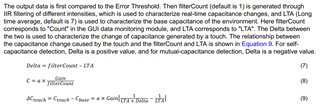
  • About offset, it is not fixed. It is dynamic changed according to the set of Gain and Conversion count. For the relationship between Conversion Count and Gain you can see this: Filtercount is Conversion Count

    Customer can test it by themselves, that the the Offset level is not fixed.

  • Eason,

    Can you answer to below question from customer?

    Then the customer wonders there might be cases the subtracted results are less than zero.
    Are such cases really happened?


    Do you mean Offset value is dynamically changed so the subtracted results are always larger than zero?

    Thanks and regards,
    Koichiro Tashiro

  • The conversion result will be close to the setting of Conversion Count. It represent the charge and conversion times. Actually, it should be at least one charge and sample times to tell the system that the detection is finished.

    Offset is fixed, after calling the calibration function. So it will not dynamic change.

  • Eason,

    Do you mean the answer to below question is "No"?
    The subtracted results (= Conversion Count) is minimum one. 

    Then the customer wonders there might be cases the subtracted results are less than zero.
    Are such cases really happened?


    Thanks and regards,
    Koichiro Tashiro

  • Yes.

    so the logic is that, first it will use Fine gain and Coarse gain to make the Count just large that Conversion count. The gain is change from large number to small number.

    Then it use offset to make the Count just large than the Conversion count. The Offset is change from large number to small number.

    At last the Count should be a little slightly large than the Conversion count. 

    Hope it can answer your question.

**Attention** This is a public forum