Part Number: MSP430F2274
Hello,
Does TI have any information on the expected rise-time/fall-time for MSP430 pins? This information would help me a lot with a noise analysis I am doing.
Thanks!
This thread has been locked.
If you have a related question, please click the "Ask a related question" button in the top right corner. The newly created question will be automatically linked to this question.
Part Number: MSP430F2274
Hello,
Does TI have any information on the expected rise-time/fall-time for MSP430 pins? This information would help me a lot with a noise analysis I am doing.
Thanks!
You mean GPIO output? You can only get the drive strength and IO capcitor value from the datasheet.
Do you think the IO voltage hcange will be a noise source?
Hi Eason,
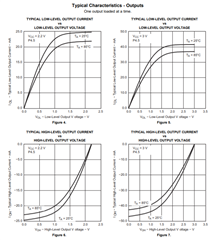
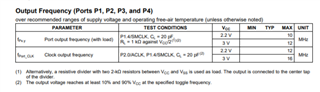
Yes, the GPIO outputs, as well as outputs driven by timer modules, PWM modules, UART modules, SPI modules, clock buffers, etc. Where do you see the drive strength detailed on the MSP430F2274 datasheet? Would the drive strength determine the rise/fall time even if the load was high impedance and low capacitance?
I don't necessarily think the voltage change will be a significant noise source, but I am interested in analyzing it and comparing my predictions to what I measure.
Hi Eason,
Thanks for the information, I've used the Typical Output Characteristics before when driving outputs that needed 10mA or more, but is it possible to estimate the rise or fall time using those graphs and tables? Otherwise, do you know of any whitepapers that analyze this information on any MSP430 microcontrollers?
Thanks
I think you can use these data and the test result based on real MSP430.
Sorry we don't have more data internal for this MSP430.
**Attention** This is a public forum