Tool/software:
Hi,
I need to know what should i choose between crystal/Ceramic Resonator for USS Module and how each would affect my performance?
What are the risks involved in each if i consider either of the one.
This thread has been locked.
If you have a related question, please click the "Ask a related question" button in the top right corner. The newly created question will be automatically linked to this question.
Tool/software:
Hi,
I need to know what should i choose between crystal/Ceramic Resonator for USS Module and how each would affect my performance?
What are the risks involved in each if i consider either of the one.
Hi, for USS, if you are using battery, that's related to USS application.
And in TI's design, it uses resonator because power consumption.
Will my delta TOF be effected or phase shift in UPS or DNS amplitude etc
USS module use its own clock circuit, not direct feed USS module the resonator's analog signal.
There is not much impact to USS performance, key point is power consumption.
If you got your resonator's part number, you can get reference from its datasheet, and refer to the spec and calculate the ageing spec whether meets your requirement.
Such as it's 10 year long product, and in 10th year, whether the accuracy meets your requirement.
From USS side, there is no requirement to clock source accuracy, but the accuracy offset in long term will influence the measurement result.
So, please choose a better accuracy clock source depending on your requirement and datasheet.
As you have stated accuracy offset in long term will influence the measurement result then how much error is allowed is there a range to it?

2.Also consider if 8 MHz frequency is Having tolerance or variation how much 80MHz will be impacted?
or 80MHz wont be affected at all over time.
Now, you are using a crystal with A% offset, that's OK, USS calibration will remove this A% offset error, so we got a ideally no error USS system.
But when 5 years passed, crystal's offset error change from A to B%, now USS system clock reference error is (A-B)%.
That's it.
how much error is allowed is there a range to it?
There is no standard for this.
Typically, a good quality crystal oscillator is OK. (Please refer to datasheet's spec.)
This is also depending on the production lifecycle.
Additional More point
1.My PLL output is proportional to oscillator clock or not?
2.If Yes, Then what is impact on delta TOF at zero flow due to change in clock offset.
3.Now how much jitter is allowed in PLL clock to maintain delta TOF, STD of <50ps as specification is not mentioned in datasheet.
4.If you could explain how jitter impacts my cross co relation.
So, change in 8 MHz Frequency will it impact 80MHz Frequency or it won't be affected by change.
All HFPLL's output is depending on its input, the 8MHz.
Any changed from 8MHz will impact the 80MHz.
1.My PLL output is proportional to oscillator clock or not?
PLL output follows external 8MHz.
2.If Yes, Then what is impact on delta TOF at zero flow due to change in clock offset.
Long term's clock offset will influence the calculation accuracy.
3.Now how much jitter is allowed in PLL clock to maintain delta TOF, STD of <50ps as specification is not mentioned in datasheet.
4.If you could explain how jitter impacts my cross co relation.
Not jitter, its clock source's long term offset error will impact to TOF's accuracy.
The tolerance depends on your design tolerance, any offset error will influence the final result,
but usually, there is a large margin between the accuracy requirements of product design and clock offset error.
There is no formula to measure this, it depends on your choice of external clock crystal.
The analysis of the clock offset results is currently still at the qualitative level.
Hi,
I have few more queries
1.Why Jitter is not important or not being considered ?

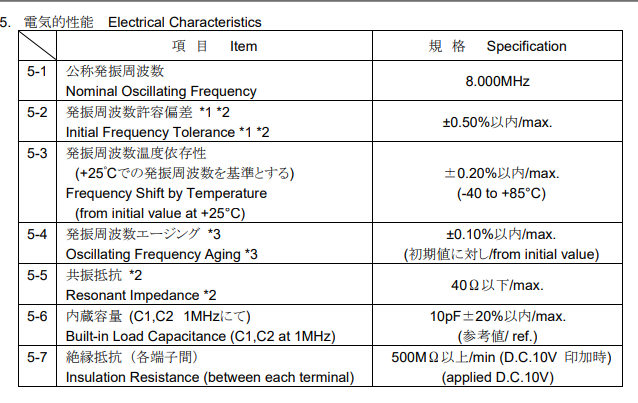
2.Above image is specs of my reasonator will it impact by TOF accuracy considering 10 year product life
3.Also will my accuracy for my Class 1 product at low and high flowrate will be impacted?
This is the crystal that 6043's EVM is using: 'ABM3-8.000MHZ-D2Y-T from 'Abracon Corporation as your reference.
1.Why Jitter is not important or not being considered ?
Random jitter is phase noise, doesn't have too much impact to accuracy in such kind of application (8MHz ~ 80MHz), frequency is very low.
Aging error is 0.1% max, but normally, the accuracy of civil meters is ~2%.
0.1% is not so much impact to 2%.
1.My Meter is Class 1 1% accuracy so aacording to you it wont cause any much impact for over 10years ?
Your Reasonator is 0.1% max, this choice is depending on your side.
2.Considering your answer Jitter Won't cause or wont have impact on accuracy.
Won't has large impact in such low frequency application.
**Attention** This is a public forum