This thread has been locked.

If you have a related question, please click the "Ask a related question" button in the top right corner. The newly created question will be automatically linked to this question.

TLV803E: TLV803EA26DBZR RESET pin is pulled LOW.

Part Number: TLV803E
Other Parts Discussed in Thread: TLV803

Hi

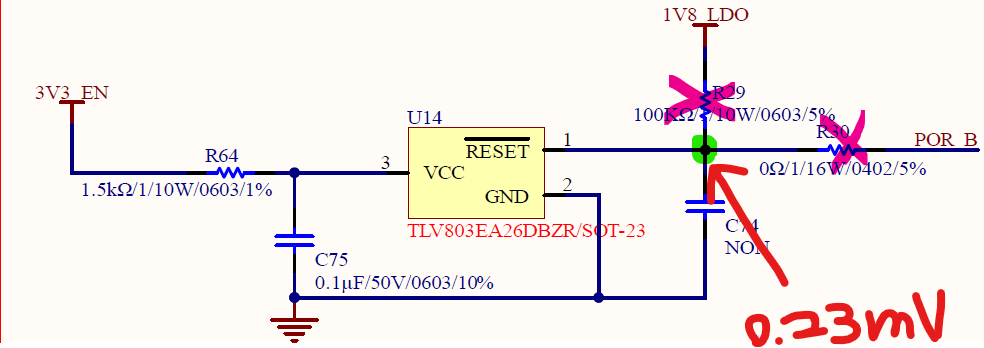
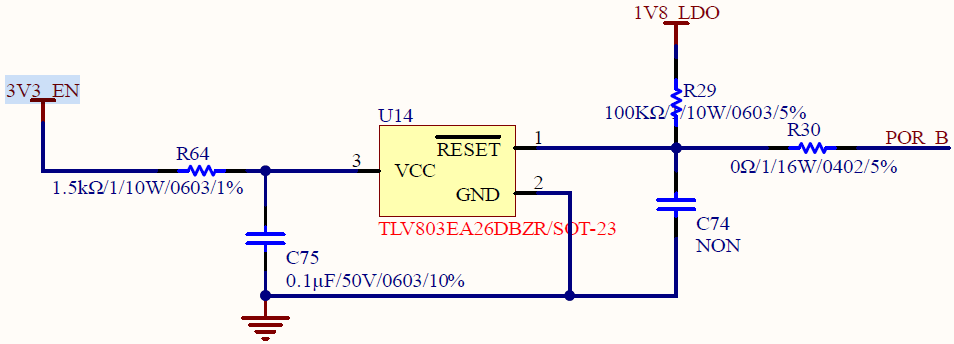
The circuit uses the TLV803EA26DBZR (U14) with its RESET pin pulled up to 1V8_LDO through resistor R29.
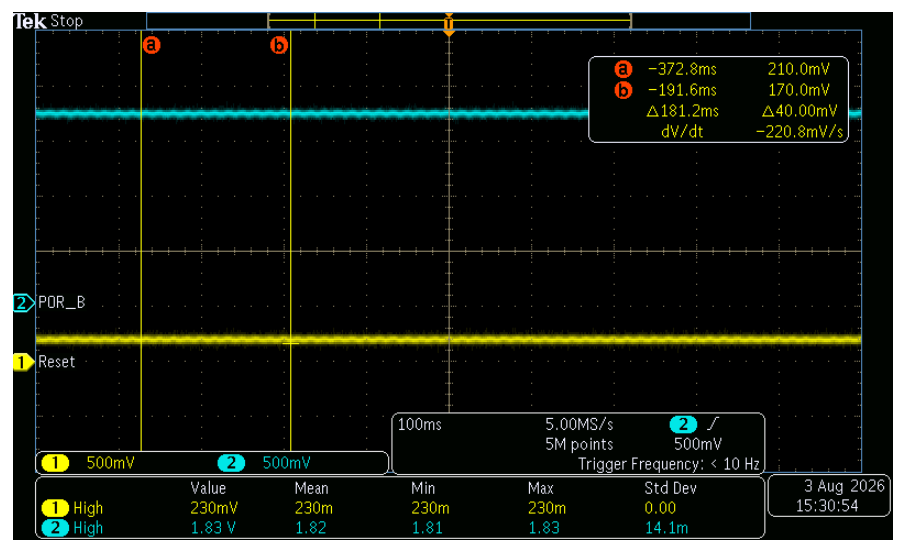
(1)When R30 is populated (0ohm): The POR_B voltage is pulled down to 0.23V, which matches the chip's typical low-level output voltage (V_OL).


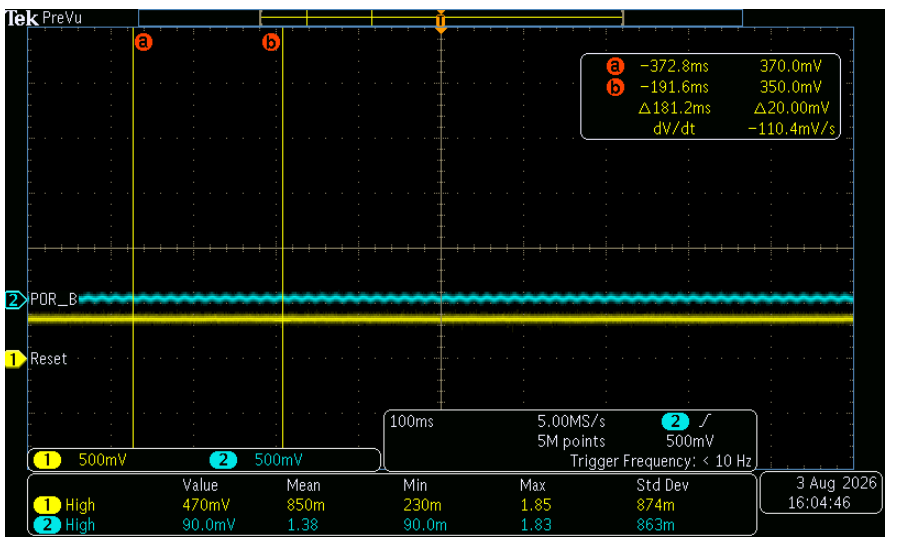
(2)When R30 is unpopulated (NC), The POR_B voltage returns to 1.8V.
stk tlv803.png

stk tlv803 wave.png

stk tlv803 nc.pngstk tlv803 nc wave.png


  • Hi,

    TLV803E has an open-drain output, so an external pull-up resistor is required for operation. In the second scope capture R29 appears to be removed, which will cause the output to go to an undefined state.

    Is the same behavior observed when R30 is removed but R29 is connected?

    A few additional questions about the schematic:

    • What is POR_B connected to?
    • What is the purpose of R64?
      • We typically do not recommend using a series resistor on the VDD pin of TLV803E as it can affect the threshold accuracy of the device

    Henry

  • Hi

    Is the same behavior observed when R30 is removed but R29 is connected? Yes, the phenomenon still persists.

    A few additional questions about the schematic:

    • What is POR_B connected to?  It connects to the MCU.
    • What is the purpose of R64? We replaced it with a 0-ohm resistor, but the defect still persists
    In short, as long as the pull-high potential is connected to the Reset Pin of the TLV803, the potential will be pulled low by the TLV803

  • Thank you for the clarification.

    Looking closer at the schematic, I believe that the pinout is incorrect for TLV803EA26DBZR in your schematic. Pin 1 is actually the GND pin and pin 2 is the RESET output.

    Are you able to test this device using the correct pin connections and verify that the circuit performs as expected?

    Henry

**Attention** This is a public forum