


Part Number: MSP430FR2355
Other Parts Discussed in Thread: MSP430FR5994
The MSP430FR2355 creates I2C two start conditions after initialisation, so the first byte I send to an ADC is corrupted:
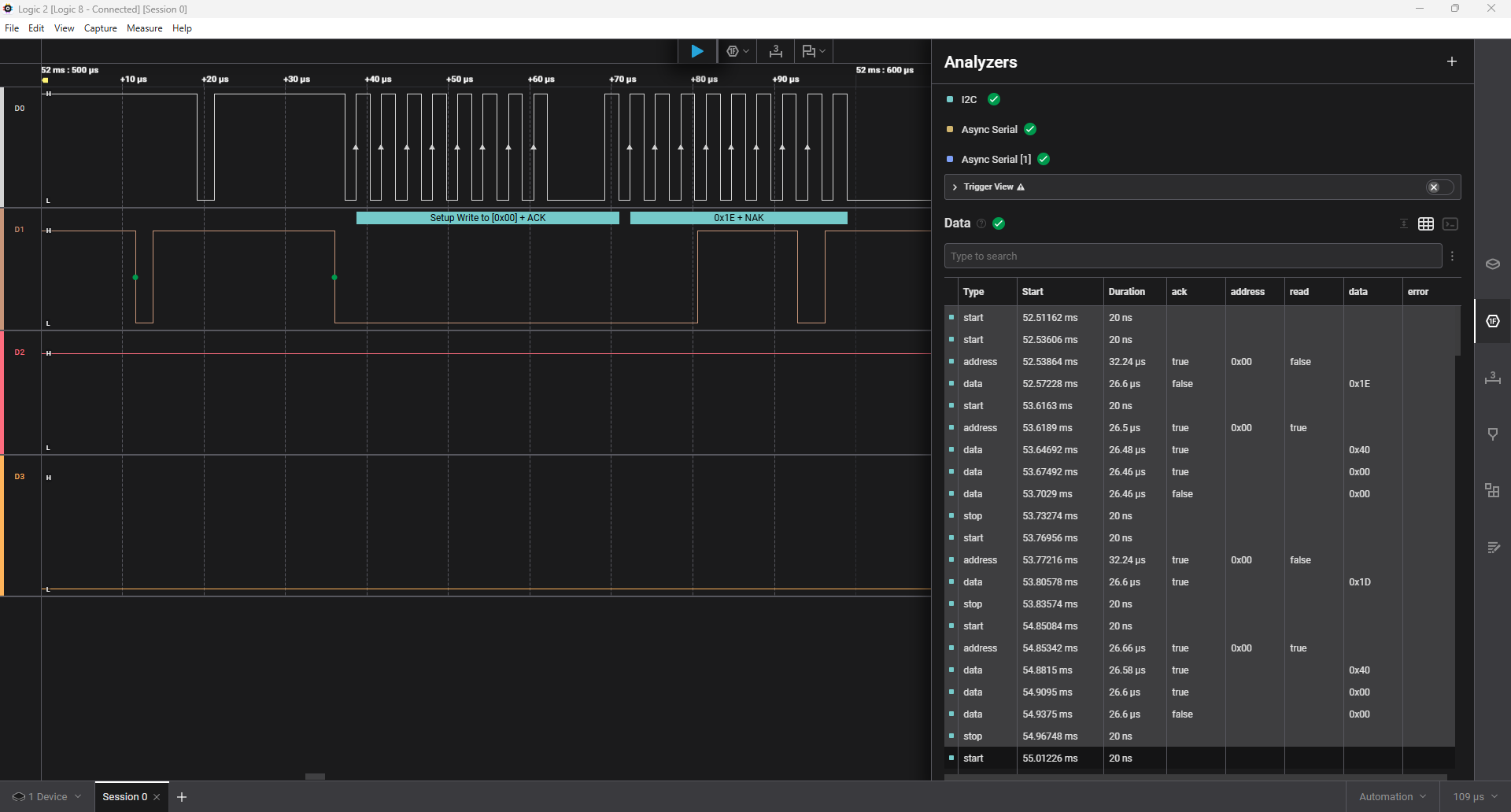
The Code:
bool zssc3224_init(void)
{
    uint32_t tmpInt = 0;
    float FRES;

    // Init I2C
    GPIO_setOutputHighOnPin(AFE_POW_PIN); // Power on
    delay_ms(POWER_ON_DELAY);

    initMasterI2C(AFE_USCI_BASE, ZSSC3224_ADDRESS, DATARATE400KHZ);

    GPIO_setAsPeripheralModuleFunctionOutputPin(AFE_SDA_PIN, AFE_PFX); // SDA
    GPIO_setAsPeripheralModuleFunctionOutputPin(AFE_SCL_PIN, AFE_PFX); // SCL

    enableI2C();

    // PMIN LSB
    if (!sendByteI2C(0x1E, true, true)) return (STATUS_FAIL);
    delay_ms(1);
    if (!receiveI2C(zssc3224_RxBuf,3)) return (STATUS_FAIL);
    if (!(zssc3224_checkState(zssc3224_RxBuf[0]) == STATUS_ZSSC_OK)) return STATUS_FAIL;
    tmpInt = 0;
    tmpInt = zssc3224_RxBuf[2];
    tmpInt <<= 8;
    tmpInt |= zssc3224_RxBuf[1];
    // PMIN MSB
    if (!sendByteI2C(0x1D, true, true)) return (STATUS_FAIL);
    delay_ms(1);
    if (!receiveI2C(zssc3224_RxBuf,3)) return (STATUS_FAIL);
    if (!(zssc3224_checkState(zssc3224_RxBuf[0]) == STATUS_ZSSC_OK)) return STATUS_FAIL;
    tmpInt <<= 8;
    tmpInt |= zssc3224_RxBuf[2];
    tmpInt <<= 8;
    tmpInt |= zssc3224_RxBuf[1];
    PMIN = int2float(tmpInt);
...
These are the I2C Routines
void initMasterI2C(uint16_t baseAddress, uint8_t slaveAddress, uint32_t datarate)
{
    I2C_USCI_BASE = baseAddress;
    HWREG16(I2C_USCI_BASE + OFS_UCBxCTLW0) = UCSWRST;

    HWREG16(I2C_USCI_BASE + OFS_UCBxCTLW1) &= ~UCASTP_3;
    HWREG16(I2C_USCI_BASE + OFS_UCBxCTLW1) |= 0;
    HWREG16(I2C_USCI_BASE + OFS_UCBxTBCNT) = 0;

    HWREG16(I2C_USCI_BASE + OFS_UCBxCTLW0) |= UCMST + UCMODE_3 + UCSYNC;
    HWREG16(I2C_USCI_BASE + OFS_UCBxCTLW0) |= (UCSSEL__SMCLK + UCSWRST);

    uint16_t clkDiv = (uint16_t)(CS_getSMCLK() / datarate);
    HWREG16(I2C_USCI_BASE + OFS_UCBxBRW) = clkDiv;

    HWREG16(I2C_USCI_BASE + OFS_UCBxI2CSA) = (slaveAddress);
    HWREG16(I2C_USCI_BASE + OFS_UCBxCTLW0) |= UCTR;
}

void enableI2C(void)
{
    HWREG16(I2C_USCI_BASE + OFS_UCBxCTLW0) &= ~(UCSWRST);
}

bool sendStartI2C(void)
{
    uint32_t timeout;

    HWREG16(I2C_USCI_BASE + OFS_UCBxCTLW0) |= UCTXSTT;

    timeout = I2C_TIMEOUT;

    while ((HWREG16(I2C_USCI_BASE + OFS_UCBxCTLW0) & UCTXSTT) && --timeout);

    if (timeout == 0) return (STATUS_FAIL); // Timeout

    return STATUS_SUCCESS;
}

bool sendStopI2C(void)
{
    uint32_t timeout;

    HWREG16(I2C_USCI_BASE + OFS_UCBxCTLW0) |= UCTXSTP;

    timeout = I2C_TIMEOUT;
    while ((HWREG16(I2C_USCI_BASE + OFS_UCBxCTLW0) & UCTXSTP) && --timeout);
    if (timeout == 0) return (STATUS_FAIL);

    return STATUS_SUCCESS;
}

bool sendByteI2C(uint8_t data, bool sendStart, bool sendStop)
{
    uint32_t timeout;

    uint16_t txieStatus = HWREG16(I2C_USCI_BASE + OFS_UCBxIE) & UCTXIE;
    HWREG16(I2C_USCI_BASE + OFS_UCBxIE) &= ~(UCTXIE);

    HWREG16(I2C_USCI_BASE + OFS_UCBxCTLW0) |= UCTR;

    if (sendStart)
    {
        if (!sendStartI2C()) return (STATUS_FAIL);
    }

    timeout = I2C_TIMEOUT;
    HWREG16(I2C_USCI_BASE + OFS_UCBxTXBUF) = data;
    while ((!(HWREG16(I2C_USCI_BASE + OFS_UCBxIFG) & UCTXIFG)) && --timeout);
    if (timeout == 0) return (STATUS_FAIL);

    if (sendStop)
    {
        if (!sendStopI2C()) return (STATUS_FAIL);
    }

    HWREG16(I2C_USCI_BASE + OFS_UCBxIFG) &= ~(UCTXIFG);
    HWREG16(I2C_USCI_BASE + OFS_UCBxIE) |= txieStatus;

    return (STATUS_SUCCESS);
}
What could be the problem. I used this code on a MSP430FR5994 a lot without problems

