This thread has been locked.

If you have a related question, please click the "Ask a related question" button in the top right corner. The newly created question will be automatically linked to this question.

Product Lifetime Test With MSP430

Hi.
I'm having such a big problem with a School Project, my professor wants us to do a Lifetime test of a product (It doesn't matter what kind of product).
The problem here is that I can't figure out what product should I test, our professor suggested a LED ON/OFF Cycle test, but I Think this test will need a lot of time in order to "Burn" the LED if it is possible, so I was thinking on doing the test of the Mechanical cycles for a Switch, but they have such a high lifetime(over a million cycles) so this will be another long time test.
Do you have any ideas of what kind of product could I Test?
I'm Using a MSP430 Launchpad, and any other mechanical/sensing devices that could be used for this project can be lent from where I work.
Thanks in Advance.

  • A solenoid can press a mechanical switch twice per second. Run this round-the-clock, it will be over a million in a week.
  • Carlos Ivan Orozco Hernandez said:
    our professor suggested a LED ON/OFF Cycle test, but I Think this test will need a lot of time in order to "Burn" the LED

    For artificially aging a LED you could run it under increased temperature, but I agree that this might not be the best idea for a test object. OCY's suggestion isn't that bad, I would also go for something like this. But the driving part must have a longer lifetime then the test object, of course, so choose your equipment according to this.

    This could also be a possible test:

    Build a relatively slow rotating wheel that presses a tactile switch (or more) over and over again and measure the bouncing of the button contacts. You could also run the test at the absolute maximum ratings in comparison to the recommended operating conditions. If you have a LaunchPad, you could measure the number of pulses the button generates when pressed (and released) once. You know the repetition time of the wheel so you also know when a new button press will occur. If your button is pressed every second, for example, then a slightly shorter time could be taken as timeout for knowing that the next pulse is the first of your next measurement. You could also add a hall-sensor that "resets" the counter before the button press appears. A hall sensor does not bounce. With this method you would be independent from a fixed timing interval and could dynamically speed up your cycle.

    This tactile switch has a life expectancy of 100,000 cycles.

    When pressing it every second, this would need slightly more than a day, so you could test many of them to compare the results.

    And you would have a nice test procedure. When you connect an oscilloscope to the contact as well, you can make the bouncing visible. But I haven't done such a test myself - it is just an idea, so I don't know about the results.

    Dennis

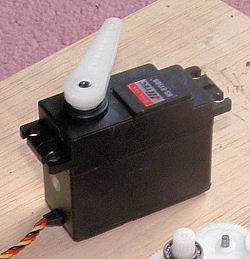
  • If you take a R/C servo and slightly modify it's electronics inside it becomes a continuously rotating arm which could press a switch with those "long arms":

    Dennis

  • While testing mechanical contacts, you shall run them at maximum specs - max voltage and max current at specified voltage. Only then your test will make sense.
    BTW much easier is to test contacts of relay - you don't need to build actuator because it is already there.
  • our professor suggested a LED ON/OFF Cycle test, but I Think this test will need a lot of time in order to "Burn" the LED

    See the Avago white paper Calculate Reliable LED Lifetime Performance in Optocouplers for how to stress a LED (briefly: use higher current and higher temperature).

    And you don't actually need to completely burn out the LED; you could say that failure is defined as less than 90% of the initial brightness.


    If you try to test a mechanical switch, it's likely that (the motor of) your robotic arm fails first. Well, just say you wanted to test that.

    Non-mechanical devices typcially do not wear out, unless you operate them way outside their specifications.

  • I Think i'll go with something Like this, I just need to find the correct actuator, because I Think the Prof. Would like to see the test at school, and i dont want to be there a whole day, Looking for a Fast Actuator and a mechanical switch with less life expectancy.

  • The LED suggestion isn’t that bad, you can blow a LED in a few seconds. If you apply a current at the maximum peak current, an uncooled (leaded) LED will reach his max Tj (~150 degC) in just a few seconds. You could apply a PWM signal with a long OFF time, 1-2 sec to cool down the LED and a short ON time, and measure so the maximal ON time to reach the maximum Tj.
    But you can also do this with a light bulb or a fuse.
  • Be innovative and do it in a totally different way.

    Review the social-media on the internet to find out what's in and what's out. Product-Life has almost nothing to do with Time-to-Failure of the product itself.

    Egg-headed engineers often look in the wrong direction. The Professor is testing you!

**Attention** This is a public forum