Other Parts Discussed in Thread: MSP430FR4133, MSP430WARE, MSP430G2231
Hello,
I am currently using a MSP430FR4133 and trying to use interrupts to interface with a wii nunchuck. I have referenced heavily from 2 different I2C examples provided from MSP430Ware (msp430fr413x_euscib0_i2c_10.c and msp430fr413x_euscib0_i2c_15.c) and reproduced the following code attached.
/* --COPYRIGHT--,BSD_EX
 * Copyright (c) 2014, Texas Instruments Incorporated
 * All rights reserved.
 *
 * Redistribution and use in source and binary forms, with or without
 * modification, are permitted provided that the following conditions
 * are met:
 *
 * *  Redistributions of source code must retain the above copyright
 *    notice, this list of conditions and the following disclaimer.
 *
 * *  Redistributions in binary form must reproduce the above copyright
 *    notice, this list of conditions and the following disclaimer in the
 *    documentation and/or other materials provided with the distribution.
 *
 * *  Neither the name of Texas Instruments Incorporated nor the names of
 *    its contributors may be used to endorse or promote products derived
 *    from this software without specific prior written permission.
 *
 * THIS SOFTWARE IS PROVIDED BY THE COPYRIGHT HOLDERS AND CONTRIBUTORS "AS IS"
 * AND ANY EXPRESS OR IMPLIED WARRANTIES, INCLUDING, BUT NOT LIMITED TO,
 * THE IMPLIED WARRANTIES OF MERCHANTABILITY AND FITNESS FOR A PARTICULAR
 * PURPOSE ARE DISCLAIMED. IN NO EVENT SHALL THE COPYRIGHT OWNER OR
 * CONTRIBUTORS BE LIABLE FOR ANY DIRECT, INDIRECT, INCIDENTAL, SPECIAL,
 * EXEMPLARY, OR CONSEQUENTIAL DAMAGES (INCLUDING, BUT NOT LIMITED TO,
 * PROCUREMENT OF SUBSTITUTE GOODS OR SERVICES; LOSS OF USE, DATA, OR PROFITS;
 * OR BUSINESS INTERRUPTION) HOWEVER CAUSED AND ON ANY THEORY OF LIABILITY,
 * WHETHER IN CONTRACT, STRICT LIABILITY, OR TORT (INCLUDING NEGLIGENCE OR
 * OTHERWISE) ARISING IN ANY WAY OUT OF THE USE OF THIS SOFTWARE,
 * EVEN IF ADVISED OF THE POSSIBILITY OF SUCH DAMAGE.
 *
 *******************************************************************************
 *
 *                       MSP430 CODE EXAMPLE DISCLAIMER
 *
 * MSP430 code examples are self-contained low-level programs that typically
 * demonstrate a single peripheral function or device feature in a highly
 * concise manner. For this the code may rely on the device's power-on default
 * register values and settings such as the clock configuration and care must
 * be taken when combining code from several examples to avoid potential side
 * effects. Also see www.ti.com/grace for a GUI- and www.ti.com/msp430ware
 * for an API functional library-approach to peripheral configuration.
 *
 * --/COPYRIGHT--*/
//******************************************************************************
//  MSP430FR413x Demo - Toggle P1.0 using software
//
//  Description: I2C interface with Wii Nunchuck
//  By default, FR413x select XT1 as FLL reference.
//  If XT1 is present, the PxSEL(XIN & XOUT) needs to configure.
//  If XT1 is absent, switch to select REFO as FLL reference automatically.
//  XT1 is considered to be absent in this example.
//  ACLK = default REFO ~32768Hz, MCLK = SMCLK = default DCODIV ~1MHz.
//
//                                /|\  /|\
//               Wii Nunchuck      10k  10k     MSP430FR4133
//                   slave         |    |        master
//             -----------------   |    |   -----------------
//            |              SDA|<-|----|->|P5.2/UCB0SDA     |
//            |                 |  |       |                 |
//            |                 |  |       |                 |
//            |              SCL|<-|------>|P5.3/UCB0SCL     |
//            |                 |          |             P1.0|--> LED
//
//   Jerry Leung
//   Texas Instruments Inc.
//   October 2016
//   Built with Code Composer Studio v6.1.3
//******************************************************************************
#include <msp430.h>

	// Slave address for wii nunchuck is 0x52
	// For black Wii nunchuck:
	//		Initializing 1st register: 0xF0 and 0x55
	//		Initializing 2nd register: 0xFB and 0x00
	// For white Wii nunchuck:
	//		Send 0x40, 0x00, followed by 0x00

unsigned char SlaveAddress = 0x52;						// Slave address of wii nunchuck
unsigned char TXData[]= {0xF0,0x55,0xFB,0x00};        	// Handshake TX data
volatile unsigned char nunchuck_data[6] = {0, 0, 0, 0, 0, 0};		// data from nunchuk
														// Declared volatile because there will be multiple
														// receive data as this operates
unsigned int counter = 0;

// Need to check if MSP430 has internal functions like end of array instead of having to hard code counters below
unsigned char TXByteCtr;								// Number of handshake bytes. Set at 4
unsigned char TXPointer;								// Position of TXData array. Start with TXData[0]
unsigned char RXByteCtr;								// Number of bytes of data from wii nunchuck. Set at 6
unsigned char RXPointer;								// Postion of nunchuck_data

void init()
{
	WDTCTL = WDTPW | WDTHOLD;               // Stop watchdog timer

    // Configure GPIO
    P1OUT &= ~BIT0;                         // Clear P1.0 output latch
    P1DIR |= BIT0;                          // For LED
    P5SEL0 |= BIT2 | BIT3;                  // I2C pins

    // Disable the GPIO power-on default high-impedance mode to activate
    // previously configured port settings
    PM5CTL0 &= ~LOCKLPM5;
}

void i2c_init()
{
    // Configure USCI_B0 for I2C mode
	// For TX
    UCB0CTLW0 |= UCSWRST;                   // put eUSCI_B in reset state
    UCB0CTLW0 |= UCMODE_3 | UCMST | UCSYNC; // I2C mode, Master mode, sync

    // For RX
    UCB0CTLW1 |= UCASTP_2;                  // Automatic stop generated after UCB0TBCNT is reached
    UCB0TBCNT = 0x0006;                     // number of bytes to be received  // Wii nunchuck receives 6 bytes of data

    UCB0BRW = 0x0008;                       // baudrate = SMCLK / 8
    UCB0CTLW0 &=~ UCSWRST;                  // Release eUSCI_B reset state

    UCB0IE |= UCTXIE0 | UCRXIE | UCNACKIE | UCBCNTIE; // Interrupt enables. Transmit | Receive | NACK | Byte Counter

}

void nunchuck_init()
{
    __delay_cycles(1);                   // Delay between transmissions
	UCB0I2CSA = SlaveAddress;				// Address of the slave device, wii nunchuk
	TXByteCtr = 4;							// Load TX byte counter
											// There are 4 bytes for handshake with a black wii nunchuck
	TXPointer = 0;							// Start by sending the 1st entry in the array
	while (UCB0CTLW0 & UCTXSTP);            // Ensure stop condition got sent
    UCB0CTLW0 |= UCTR | UCTXSTT;            // I2C TX, start condition
    __bis_SR_register(LPM0_bits | GIE);     // Enter LPM0 w/ interrupts. Remain in LPM0 until all data is TX'd
    										// Wait for transmit interrupt flag UCTXIFG0 to set
    										// which indicates that the transmit buffer UCBxTXBUF is empty
    										// Low power mode will exit after all bytes are transmitted
}

void nunchuck_read()
{
    __delay_cycles(1);                   // Delay between transmissions
    // Don't need to set the slave address again
    UCB0I2CSA = SlaveAddress;				// Address of the slave device, wii nunchuk
    UCB0IE &= ~UCTXIE0;						// Disable transmit interrupt
    UCB0IE |= UCRXIE | UCNACKIE | UCBCNTIE; // Interrupt enables. Receive | NACK | Byte Counter
	RXByteCtr = 6;							// Load RX byte counter
											// There are 6 bytes of data from wii nunchuck
    while (UCB0CTLW0 & UCTXSTP)
    {										// Ensure stop condition got sent
    	P1OUT ^= BIT0;                      // Toggle P1.0 using exclusive-OR;
    	_delay_cycles(1);
    }
//    while (UCB0CTL1 & UCTXSTP);            // Ensure stop condition got sent
    UCB0CTLW0 |= UCTXSTT;            		// I2C start condition, UCTR not set in order to receive
//    UCB0CTL1 |= UCTXSTT;            		// I2C start condition, UCTR not set in order to receive
    __bis_SR_register(LPM0_bits|GIE);   	// Enter LPM0 w/ interrupt
											// Wait for receive interrupt flag UCRXIFG0 to set
											// which indicates that a char is received and loaded
    										// into the receive buffer UCBxRXBUF
											// Low power mode will exit after all bytes are received
}

int main(void)
{

	init();
	i2c_init();
	nunchuck_init();

    while(1)
    {
    	nunchuck_read();					// Read data from nunchuck and store into nunchuck_data array
    	__delay_cycles(1);             	// Delay for 1000*(1/MCLK)=0.001s
    }
}

// Interrupt Handlers and service routines ISR
#if defined(__TI_COMPILER_VERSION__) || defined(__IAR_SYSTEMS_ICC__)
#pragma vector = USCI_B0_VECTOR
__interrupt void USCIB0_ISR(void)
#elif defined(__GNUC__)
void __attribute__ ((interrupt(USCI_B0_VECTOR))) USCIB0_ISR (void)
#else
#error Compiler not supported!
#endif
{
  switch(__even_in_range(UCB0IV, USCI_I2C_UCBIT9IFG))
  {
        case USCI_NONE:          break;               	// Vector 0: No interrupts break;
        case USCI_I2C_UCALIFG:   break;				  	// Vector 2: ALIFG
        case USCI_I2C_UCNACKIFG:					  	// Vector 4: NACKIFG
            UCB0CTL1 |= UCTXSTT;                      	// resend start if NACK, I2C start condition
          break;
        case USCI_I2C_UCSTTIFG:  break;               	// Vector 6: STTIFG break;
        case USCI_I2C_UCSTPIFG:  break;               	// Vector 8: STPIFG break;
        case USCI_I2C_UCRXIFG3:  break;               	// Vector 10: RXIFG3 break;
        case USCI_I2C_UCTXIFG3:  break;               	// Vector 14: TXIFG3 break;
        case USCI_I2C_UCRXIFG2:  break;               	// Vector 16: RXIFG2 break;
        case USCI_I2C_UCTXIFG2:  break;               	// Vector 18: TXIFG2 break;
        case USCI_I2C_UCRXIFG1:  break;               	// Vector 20: RXIFG1 break;
        case USCI_I2C_UCTXIFG1:  break;               	// Vector 22: TXIFG1 break;
        case USCI_I2C_UCRXIFG0:               			// Vector 24: RXIFG0
        if (RXPointer < RXByteCtr)						// Check if counter limit has reached
        	{
        	nunchuck_data[RXPointer] = UCB0RXBUF;       // Get RX data
        	RXPointer++;								// Increment RXPointer for the next incoming byte
        	}
        else											// Counter limit has reached and all data has been received
        {
        	RXPointer = 0;								// ResetRXPointer to prevent out of bounds memory access
        												// Probably not needed but just in case
            __bic_SR_register_on_exit(LPM0_bits); 		// Exit LPM0
        }
        	break;

        case USCI_I2C_UCTXIFG0:							// Vector 26: TXIFG0
        	// Transmit interrupt flag, TX buffer UCBxTXBUF is empty and next byte can be loaded
        if (TXPointer < TXByteCtr)                      // Check if counter limit has reached
           {
            UCB0TXBUF = TXData[TXPointer];            	// Load TX buffer
            TXPointer++;								// Increment TXPointer for the next data in the array
           }
        else											// Counter limit has reached and all data has been transmitted
           {
            TXPointer = 0;								// Reset TXPointer to prevent out of bounds memory access
            											// Probably not needed but just in case
        	UCB0CTLW0 |= UCTXSTP;                     	// I2C stop condition
            UCB0IFG &= ~UCTXIFG;                      	// Clear USCI_B0 TX int flag
            __bic_SR_register_on_exit(LPM0_bits);   // Exit LPM0 and disable interrupts
           }
          break;
        case USCI_I2C_UCBCNTIFG:						// Vector 28: BCNTIFG
        	// Btye counter interrupt. Flag is set when the byte counter value reaches the value
        	// defined in UCBxTBCNT (UCB0TBCNT) and UCASTPx = 01 or 10.
            P1OUT ^= BIT0;                        		// Toggle LED on P1.0
        	break;
        case USCI_I2C_UCCLTOIFG: break;               	// Vector 30: clock low timeout
        case USCI_I2C_UCBIT9IFG: break;               	// Vector 32: 9th bit
        default: break;
  }
}
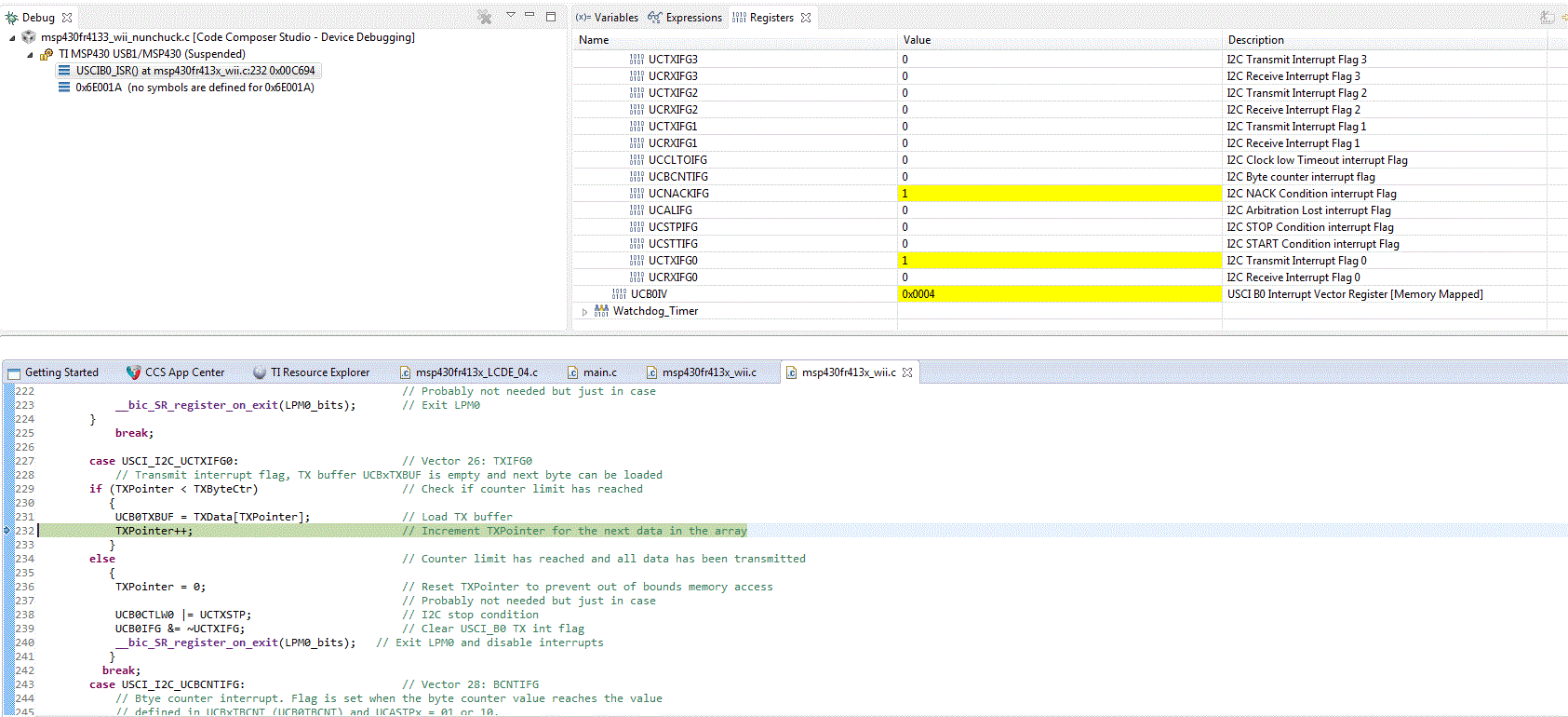
However, as I attempt to run the code, it seems to hang sometimes when I enter LPM0 during TX. Other times it gets through it but hangs as I attempt to read it. What I want to verify is whether or not this is a code issue or a hardware connection issue.
As I am running out of ideas, any help on this would be greatly appreciated.
Thanks and best regards,
Jerry Leung