This thread has been locked.

If you have a related question, please click the "Ask a related question" button in the top right corner. The newly created question will be automatically linked to this question.

RTOS/MSP432-RTOS: Tickless scheduler

Part Number: MSP432-RTOS
Other Parts Discussed in Thread: SYSBIOS

Tool/software: TI-RTOS

Hi,

I'm currently playing around with the MSP432 using simplelink_msp432_sdk_1_40_01_00 and want to get power usage a bit lower, so was hoping you could clarify a few things. I'm using the PowerMSP432_sleepPolicy but plan to switch to deepSleep later on, but I get the same behaviour with both policies. So, I register notifications fort PowerMSP432_AWAKE_SLEEP and PowerMSP432_ENTERING_SLEEP (and deepsleep variants when using deepsleep), then set a pin high when awake, and low when asleep. I then have a single task which is below:

void main_task(UArg arg0, UArg arg1) {
    while (1) {
        Task_sleep(Clock_tickPeriod * 10);
    }
}

I see my pin go high/low every ten seconds, as expected. However, if I monitor when the system clock ticks, I notice that I get a HWI every 1000 microseconds (as configured), or if I enable tick suppression I get a HWI about every 350ms. 

I'm using the timer that is automatically configured by the Clock module, which is presumably a 16-bit timer (TimerA?) with a period of 1000us. 

So I have a few questions:

  1. Can I increase the time between ticks (with tick suppression enabled) while also keeping a 1000 us period? i.e. I don't want to wakeup every 350ms. If so, how? If not could you explain the constraints? 
  2. If I have to change clock source to (e.g. RTC), would I have to implement tickless stuff myself? For example, would I need to determine when the next wakeup is due and schedule a wakeup accordingly? I would assume I could hook into the current tick suppression stuff, but advice would be much appreciated :)
  3. It's my understanding that LPM3 and LPM4 (DEEPSLEEP0 and DEEPSLEEP1) both disable internal timers, which according to the link below should prevent both periodic ticks and my 10 second wakeup. However, even when in LPM3 (using deepSleepPolicy), I still get my regular wakeups. Why is this? My tickSource is ti.sysbios.knl.Clock.TickSource_TIMER.

Thanks

  • Hi Campbell,

    The kernel's tickless mode does not work with the RTC or WDT. You would have to do it yourself.

    The confused where the 350ms interrupt rate is coming from. Do you have something scheduled to go off then?

    Todd
  • ToddMullanix said:
    Hi Campbell,

    The kernel's tickless mode does not work with the RTC or WDT. You would have to do it yourself.

    The confused where the 350ms interrupt rate is coming from. Do you have something scheduled to go off then?

    Todd

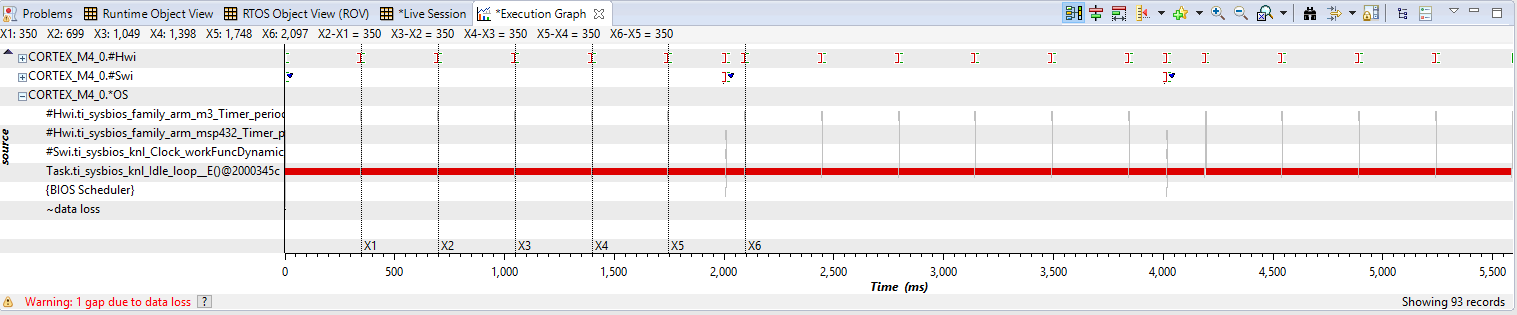
    Thanks for the reply. Yeah, I'm not sure what the 350ms is either, but I don't have any scheduled wakeups, and I don't have any interrupts enabled. If I enable execution analysis, I see that it's all related to the system timer / clock. I've included a screen shot below:

    Ignore the data loss, that was just due to me pausing in debugger at the start of main. But as you can see, every 350 ms I get a HWI for ti_sysbios_family_arm_m3_Timer_periodicStub__I, and every 2 seconds I get one for ti_sysbios_family_arm_msp432_Timer_periodicStub__E, which then runs its SWI (ti_sysbios_knl_Clock_workFuncDynamic__E). My sleep policy is PowerMSP432_sleepPolicy. I have disabled all of my tasks and my main function is below:

    int main()
    {
        /* Call driver init functions */
        Board_initGeneral();
        Board_initGPIO();
        Board_initSPI();
        Board_initUART();
    
        Power_setPolicy(PowerMSP432_sleepPolicy);
        Power_enablePolicy();
    
        BIOS_start();
    
        return 0;
    }

    I have also included my .cfg at the end of this post. Am I doing something silly here? Happy to get more data if needed.

    edit: I just tried a 100,000 us tick period and still notice the 350ms wakeups, I'm not familiar enough with TI-RTOS to say why...

    Thanks

    /*
     * Copyright (c) 2015-2016, Texas Instruments Incorporated
     * All rights reserved.
     *
     * Redistribution and use in source and binary forms, with or without
     * modification, are permitted provided that the following conditions
     * are met:
     *
     * *  Redistributions of source code must retain the above copyright
     *    notice, this list of conditions and the following disclaimer.
     *
     * *  Redistributions in binary form must reproduce the above copyright
     *    notice, this list of conditions and the following disclaimer in the
     *    documentation and/or other materials provided with the distribution.
     *
     * *  Neither the name of Texas Instruments Incorporated nor the names of
     *    its contributors may be used to endorse or promote products derived
     *    from this software without specific prior written permission.
     *
     * THIS SOFTWARE IS PROVIDED BY THE COPYRIGHT HOLDERS AND CONTRIBUTORS "AS IS"
     * AND ANY EXPRESS OR IMPLIED WARRANTIES, INCLUDING, BUT NOT LIMITED TO,
     * THE IMPLIED WARRANTIES OF MERCHANTABILITY AND FITNESS FOR A PARTICULAR
     * PURPOSE ARE DISCLAIMED. IN NO EVENT SHALL THE COPYRIGHT OWNER OR
     * CONTRIBUTORS BE LIABLE FOR ANY DIRECT, INDIRECT, INCIDENTAL, SPECIAL,
     * EXEMPLARY, OR CONSEQUENTIAL DAMAGES (INCLUDING, BUT NOT LIMITED TO,
     * PROCUREMENT OF SUBSTITUTE GOODS OR SERVICES; LOSS OF USE, DATA, OR PROFITS;
     * OR BUSINESS INTERRUPTION) HOWEVER CAUSED AND ON ANY THEORY OF LIABILITY,
     * WHETHER IN CONTRACT, STRICT LIABILITY, OR TORT (INCLUDING NEGLIGENCE OR
     * OTHERWISE) ARISING IN ANY WAY OUT OF THE USE OF THIS SOFTWARE,
     * EVEN IF ADVISED OF THE POSSIBILITY OF SUCH DAMAGE.
     */
    
    /* ================ Clock configuration ================ */
    var Clock = xdc.useModule('ti.sysbios.knl.Clock');
    var Memory = xdc.useModule('xdc.runtime.Memory');
    var SysStd = xdc.useModule('xdc.runtime.SysStd');
    var LoggingSetup = xdc.useModule('ti.uia.sysbios.LoggingSetup');
    var Diags = xdc.useModule('xdc.runtime.Diags');
    
    /*
     * Default value is family dependent. For example, Linux systems often only
     * support a minimum period of 10000 us and multiples of 10000 us.
     * TI platforms have a default of 1000 us.
     */
    Clock.tickPeriod = 1000;
    //Defaults.common$.namedModule = false;


    /* ================ Error configuration ================ */
    var Error = xdc.useModule('xdc.runtime.Error');
    /*
     * This function is called to handle all raised errors, but unlike
     * Error.raiseHook, this function is responsible for completely handling the
     * error with an appropriately initialized Error_Block.
     *
     * Pick one:
     *  - Error.policyDefault (default)
     *      Calls Error.raiseHook with an initialized Error_Block structure and logs
     *      the error using the module's logger.
     *  - Error.policySpin
     *      Simple alternative that traps on a while(1) loop for minimized target
     *      footprint.
     *      Using Error.policySpin, the Error.raiseHook will NOT called.
     */
    Error.policyFxn = Error.policyDefault;
    //Error.policyFxn = Error.policySpin;
    
    /*
     * If Error.policyFxn is set to Error.policyDefault, this function is called
     * whenever an error is raised by the Error module.
     *
     * Pick one:
     *  - Error.print (default)
     *      Errors are formatted and output via System_printf() for easier
     *      debugging.
     *  - null
     *      Errors are not formatted or logged. This option reduces code footprint.
     *  - non-null function
     *      Errors invoke custom user function. See the Error module documentation
     *      for more details.
     */
    Error.raiseHook = Error.print;
    //Error.raiseHook = null;
    //Error.raiseHook = "&myErrorFxn";
    
    /*
     * If Error.policyFxn is set to Error.policyDefault, this option applies to the
     * maximum number of times the Error.raiseHook function can be recursively
     * invoked. This option limits the possibility of an infinite recursion that
     * could lead to a stack overflow.
     * The default value is 16.
     */
    Error.maxDepth = 2;


    /* ================ Hwi configuration ================ */
    var halHwi = xdc.useModule('ti.sysbios.hal.Hwi');
    var m3Hwi = xdc.useModule('ti.sysbios.family.arm.m3.Hwi');
    /*
     * Checks for Hwi (system) stack overruns while in the Idle loop.
     *
     * Pick one:
     *  - true (default)
     *      Checks the top word for system stack overflows during the idle loop and
     *      raises an Error if one is detected.
     *  - false
     *      Disabling the runtime check improves runtime performance and yields a
     *      reduced flash footprint.
     */
    halHwi.checkStackFlag = true;
    //halHwi.checkStackFlag = false;
    
    /*
     * The following options alter the system's behavior when a hardware exception
     * is detected.
     *
     * Pick one:
     *  - Hwi.enableException = true
     *      This option causes the default m3Hwi.excHandlerFunc function to fully
     *      decode an exception and dump the registers to the system console.
     *      This option raises errors in the Error module and displays the
     *      exception in ROV.
     *  - Hwi.enableException = false
     *      This option reduces code footprint by not decoding or printing the
     *      exception to the system console.
     *      It however still raises errors in the Error module and displays the
     *      exception in ROV.
     *  - Hwi.excHandlerFunc = null
     *      This is the most aggressive option for code footprint savings; but it
     *      can difficult to debug exceptions. It reduces flash footprint by
     *      plugging in a default while(1) trap when exception occur. This option
     *      does not raise an error with the Error module.
     */
    m3Hwi.enableException = true;
    //m3Hwi.enableException = false;
    //m3Hwi.excHandlerFunc = null;
    
    /*
     * Enable hardware exception generation when dividing by zero.
     *
     * Pick one:
     *  - 0 (default)
     *      Disables hardware exceptions when dividing by zero
     *  - 1
     *      Enables hardware exceptions when dividing by zero
     */
    m3Hwi.nvicCCR.DIV_0_TRP = 0;
    //m3Hwi.nvicCCR.DIV_0_TRP = 1;
    
    /*
     * Enable hardware exception generation for invalid data alignment.
     *
     * Pick one:
     *  - 0 (default)
     *      Disables hardware exceptions for data alignment
     *  - 1
     *      Enables hardware exceptions for data alignment
     */
    m3Hwi.nvicCCR.UNALIGN_TRP = 0;
    //m3Hwi.nvicCCR.UNALIGN_TRP = 1;


    /* ================ Idle configuration ================ */
    var Idle = xdc.useModule('ti.sysbios.knl.Idle');
    /*
     * The Idle module is used to specify a list of functions to be called when no
     * other tasks are running in the system.
     *
     * Functions added here will be run continuously within the idle task.
     *
     * Function signature:
     *     Void func(Void);
     */
    //Idle.addFunc("&myIdleFunc");
    
    Idle.addFunc('&Power_idleFunc');  /* add the Power module's idle function */


    /* ================ Kernel (SYS/BIOS) configuration ================ */
    var BIOS = xdc.useModule('ti.sysbios.BIOS');
    /*
     * Enable asserts in the BIOS library.
     *
     * Pick one:
     *  - true (default)
     *      Enables asserts for debugging purposes.
     *  - false
     *      Disables asserts for a reduced code footprint and better performance.
     */
    //BIOS.assertsEnabled = true;
    BIOS.assertsEnabled = true;
    
    /*
     * A flag to determine if xdc.runtime sources are to be included in a custom
     * built BIOS library.
     *
     * Pick one:
     *  - false (default)
     *      The pre-built xdc.runtime library is provided by the respective target
     *      used to build the application.
     *  - true
     *      xdc.runtime library sources are to be included in the custom BIOS
     *      library. This option yields the most efficient library in both code
     *      footprint and runtime performance.
     */
    BIOS.includeXdcRuntime = true;
    //BIOS.includeXdcRuntime = true;
    
    /*
     * The SYS/BIOS runtime is provided in the form of a library that is linked
     * with the application. Several forms of this library are provided with the
     * SYS/BIOS product.
     *
     * Pick one:
     *   - BIOS.LibType_Custom
     *      Custom built library that is highly optimized for code footprint and
     *      runtime performance.
     *   - BIOS.LibType_Debug
     *      Custom built library that is non-optimized that can be used to
     *      single-step through APIs with a debugger.
     *
     */
    BIOS.libType = BIOS.LibType_Debug;
    //BIOS.libType = BIOS.LibType_Debug;
    
    /*
     * Runtime instance creation enable flag.
     *
     * Pick one:
     *   - true (default)
     *      Allows Mod_create() and Mod_delete() to be called at runtime which
     *      requires a default heap for dynamic memory allocation.
     *   - false
     *      Reduces code footprint by disallowing Mod_create() and Mod_delete() to
     *      be called at runtime. Object instances are constructed via
     *      Mod_construct() and destructed via Mod_destruct().
     */
    BIOS.runtimeCreatesEnabled = true;
    //BIOS.runtimeCreatesEnabled = false;
    
    /*
     * Enable logs in the BIOS library.
     *
     * Pick one:
     *  - true (default)
     *      Enables logs for debugging purposes.
     *  - false
     *      Disables logging for reduced code footprint and improved runtime
     *      performance.
     */
    //BIOS.logsEnabled = true;
    BIOS.logsEnabled = true;
    
    
    /* ================ Program configuration ================ */
    /*
     *  Setting Program.stack to 0 forces the stack size configuration to be done
     *  within the example's linker command file.
     */
    Program.stack = 0;
    
    
    /*
     * Uncomment to enable Semihosting for GNU targets to print to the CCS console.
     * Please read the following TIRTOS Wiki page for more information on Semihosting:
     * processors.wiki.ti.com/.../TI-RTOS_Examples_SemiHosting
     */
    
    if (Program.build.target.$name.match(/gnu/)) {
        //var SemiHost = xdc.useModule('ti.sysbios.rts.gnu.SemiHostSupport');
    }
    /* ================ Semaphore configuration ================ */
    var Semaphore = xdc.useModule('ti.sysbios.knl.Semaphore');
    /*
     * Enables global support for Task priority pend queuing.
     *
     * Pick one:
     *  - true (default)
     *      This allows pending tasks to be serviced based on their task priority.
     *  - false
     *      Pending tasks are services based on first in, first out basis.
     *
     *  When using BIOS in ROM:
     *      This option must be set to false.
     */
    //Semaphore.supportsPriority = true;
    Semaphore.supportsPriority = false;
    
    /*
     * Allows for the implicit posting of events through the semaphore,
     * disable for additional code saving.
     *
     * Pick one:
     *  - true
     *      This allows the Semaphore module to post semaphores and events
     *      simultaneously.
     *  - false (default)
     *      Events must be explicitly posted to unblock tasks.
     *
     */
    //Semaphore.supportsEvents = true;
    Semaphore.supportsEvents = false;


    /* ================ Swi configuration ================ */
    var Swi = xdc.useModule('ti.sysbios.knl.Swi');
    /*
     * A software interrupt is an object that encapsulates a function to be
     * executed and a priority. Software interrupts are prioritized, preempt tasks
     * and are preempted by hardware interrupt service routines.
     *
     * This module is included to allow Swi's in a users' application.
     */


    /* ================ System configuration ================ */
    var System = xdc.useModule('xdc.runtime.System');
    /*
     * The Abort handler is called when the system exits abnormally.
     *
     * Pick one:
     *  - System.abortStd (default)
     *      Call the ANSI C Standard 'abort()' to terminate the application.
     *  - System.abortSpin
     *      A lightweight abort function that loops indefinitely in a while(1) trap
     *      function.
     *  - A custom abort handler
     *      A user-defined function. See the System module documentation for
     *      details.
     */
    System.abortFxn = System.abortStd;
    //System.abortFxn = System.abortSpin;
    //System.abortFxn = "&myAbortSystem";
    
    /*
     * The Exit handler is called when the system exits normally.
     *
     * Pick one:
     *  - System.exitStd (default)
     *      Call the ANSI C Standard 'exit()' to terminate the application.
     *  - System.exitSpin
     *      A lightweight exit function that loops indefinitely in a while(1) trap
     *      function.
     *  - A custom exit function
     *      A user-defined function. See the System module documentation for
     *      details.
     */
    System.exitFxn = System.exitStd;
    //System.exitFxn = System.exitSpin;
    //System.exitFxn = "&myExitSystem";
    
    /*
     * Minimize exit handler array in the System module. The System module includes
     * an array of functions that are registered with System_atexit() which is
     * called by System_exit(). The default value is 8.
     */
    System.maxAtexitHandlers = 2;
    
    /*
     * The System.SupportProxy defines a low-level implementation of System
     * functions such as System_printf(), System_flush(), etc.
     *
     * Pick one pair:
     *  - SysMin
     *      This module maintains an internal configurable circular buffer that
     *      stores the output until System_flush() is called.
     *      The size of the circular buffer is set via SysMin.bufSize.
     *  - SysCallback
     *      SysCallback allows for user-defined implementations for System APIs.
     *      The SysCallback support proxy has a smaller code footprint and can be
     *      used to supply custom System_printf services.
     *      The default SysCallback functions point to stub functions. See the
     *      SysCallback module's documentation.
     */
    System.SupportProxy = SysStd;
    //var SysCallback = xdc.useModule('xdc.runtime.SysCallback');
    //System.SupportProxy = SysCallback;
    //SysCallback.abortFxn = "&myUserAbort";
    //SysCallback.exitFxn  = "&myUserExit";
    //SysCallback.flushFxn = "&myUserFlush";
    //SysCallback.putchFxn = "&myUserPutch";
    //SysCallback.readyFxn = "&myUserReady";


    /* ================ Task configuration ================ */
    var Task = xdc.useModule('ti.sysbios.knl.Task');
    /*
     * Check task stacks for overflow conditions.
     *
     * Pick one:
     *  - true (default)
     *      Enables runtime checks for task stack overflow conditions during
     *      context switching ("from" and "to")
     *  - false
     *      Disables runtime checks for task stack overflow conditions.
     */
    Task.checkStackFlag = true;
    //Task.checkStackFlag = false;
    
    /*
     * Set the default task stack size when creating tasks.
     *
     * The default is dependent on the device being used. Reducing the default stack
     * size yields greater memory savings.
     */
    Task.defaultStackSize = 1024;
    
    /*
     * Enables the idle task.
     *
     * Pick one:
     *  - true (default)
     *      Creates a task with priority of 0 which calls idle hook functions. This
     *      option must be set to true to gain power savings provided by the Power
     *      module.
     *  - false
     *      No idle task is created. This option consumes less memory as no
     *      additional default task stack is needed.
     *      To gain power savings by the Power module without having the idle task,
     *      add Idle.run as the Task.allBlockedFunc.
     */
    Task.enableIdleTask = true;
    //Task.enableIdleTask = false;
    //Task.allBlockedFunc = Idle.run;
    
    /*
     * If Task.enableIdleTask is set to true, this option sets the idle task's
     * stack size.
     *
     * Reducing the idle stack size yields greater memory savings.
     */
    Task.idleTaskStackSize = 1024;
    
    /*
     * Reduce the number of task priorities.
     * The default is 16.
     * Decreasing the number of task priorities yield memory savings.
     */
    Task.numPriorities = 16;


    /* ================ Text configuration ================ */
    var Text = xdc.useModule('xdc.runtime.Text');
    /*
     * These strings are placed in the .const section. Setting this parameter to
     * false will save space in the .const section. Error, Assert and Log messages
     * will print raw ids and args instead of a formatted message.
     *
     * Pick one:
     *  - true (default)
     *      This option loads test string into the .const for easier debugging.
     *  - false
     *      This option reduces the .const footprint.
     */
    Text.isLoaded = true;
    //Text.isLoaded = false;


    /* ================ Types configuration ================ */
    var Types = xdc.useModule('xdc.runtime.Types');
    BIOS.customCCOpts = "--endian=little -mv7M4 --abi=eabi --float_support=fpv4spd16 -q -ms  --program_level_compile -g";
    LoggingSetup.loggerType = LoggingSetup.LoggerType_MIN;
    Clock.tickMode = Clock.TickMode_DYNAMIC;
    LoggingSetup.loadLogging = false;
    LoggingSetup.sysbiosSwiLogging = true;
    LoggingSetup.sysbiosHwiLogging = true;
    LoggingSetup.countingAndGraphingLogging = true;
    LoggingSetup.sysbiosTaskLogging = true;
    LoggingSetup.benchmarkLogging = false;
    LoggingSetup.loadLoggerSize = 4096;
    

  • Hi Campbell,

    First of all...your reply was awesome! Perfect usage of the execution graph!

    We'll try to reproduce the issue and figure out what is going on.

    Todd
  • Hi Campbell,

    The M3 Timer (SysTick) is firing every 350ms because it has 24 bits before a roll-over occurs. We have the ISR run every 350ms (actually a little less than 350ms) to handle that roll-over (2^24 / 48MHz = 350ms). This timer is coming in to provide timestamps that we needed for the logging.

    You have a couple options to get rid of this
    1. Stop logging
    2. Configure the timestamp module to use a different timer.

    Unfortunately disabling timestamps in LoggingSetup (LoggingSetup.timestampSize = LoggingSetup.TimestampSize_NONE;) and not doing a useModule of the Timestamp in the .cfg file does not work. The timestamp module is still pulled in. I'm not sure if this is a viable solution anyway if the execution graph is needed.

    Please note on the MSP432, the MSP432 timer will still fire every 2 seconds even with tickless mode. (2^16 / 32768 = 2 seconds.

    Todd
  • Thanks Todd, that makes sense. I want to do stuff about every 5 minutes, so it's probably easiest to schedule a wakeup with the RTC and then shutdown and not worry about the 2 second tick :)

**Attention** This is a public forum