This thread has been locked.

If you have a related question, please click the "Ask a related question" button in the top right corner. The newly created question will be automatically linked to this question.

MSP430FR2633: FRAM data retention Issue

Part Number: MSP430FR2633


Hello Everyone,

I am working on MSP430FR2633 Capacitive touch Micro controller.

I have developed application for Capacitive touch buttons,Slider with our own designed board and it is working fine with the data retention using the FRAM technology.

ISSUE:

I am storing data of the capacitive touch button status in FRAM which is storing fine but when stored in more than one address for more than one button the behavior of microcontroller changes as suddenly the buttons go off when i touch some other button.

What might be the issue?

below is the method i am storing data .


#define FRAM_TEST_START1 0xCABB
#define FRAM_TEST_START2 0xCABC
#define FRAM_TEST_START3 0xCABD
#define FRAM_TEST_START4 0xCABE
#define FRAM_TEST_START5 0xCABF

Pointers to access the adress data

uint8_t  * stored_data1,* stored_data2,* stored_data3,* stored_data4,* stored_data5;

Writing data to the FRAM address

FRAMCtl_write8(Delay_set1,(uint8_t *) FRAM_TEST_START1,1);
delay_ms(1);

FRAMCtl_write8(Delay_set1,(uint8_t *) FRAM_TEST_START2,1);
delay_ms(1);

FRAMCtl_write8(Delay_set1,(uint8_t *) FRAM_TEST_START3,1);
delay_ms(1);

FRAMCtl_write8(Delay_set1,(uint8_t *) FRAM_TEST_START4,1);
delay_ms(1);

FRAMCtl_write8(Delay_set1,(uint8_t *) FRAM_TEST_START5,1);
delay_ms(1);

data access from the adrress

stored_data1 = (uint8_t *) FRAM_TEST_START1;
__delay_cycles(1000);
stored_data2 = (uint8_t *) FRAM_TEST_START2;
__delay_cycles(1000);
stored_data3 = (uint8_t *) FRAM_TEST_START3;
__delay_cycles(1000);
stored_data4 = (uint8_t *) FRAM_TEST_START4;
__delay_cycles(1000);
stored_data5 = (uint8_t *) FRAM_TEST_START5;
__delay_cycles(1000);

Thanks and Regards,

Sanath Rai

  • Hello Sanath,

    Thank you for your post. Are you running the CPU faster than 8MHz? If so, are you configuring the FRAM wait states properly?

    Regards,

    James

    MSP Customer Applications
  • Hello James,

    Thank you for the reply.

    CPU is not faster than 8Mhz. Its running at 32768Hz.

    Regards,

    Sanath Rai

  • Hello,

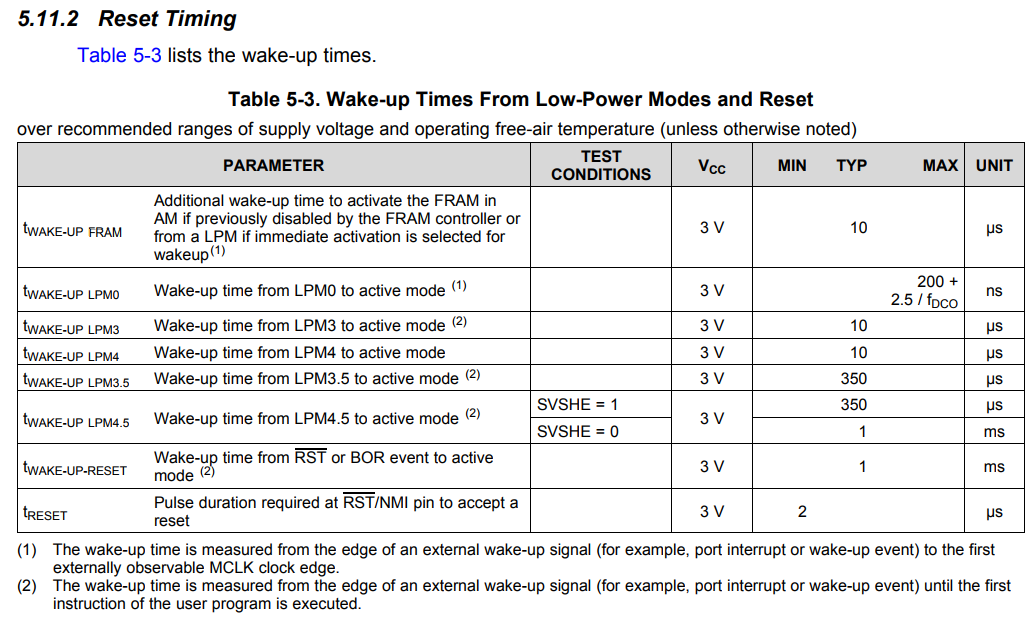
    Thanks for this information. Since you're running at 32.768kHz, are you waking up from a Low Power Mode (LPM) and immediately writing to FRAM? Table 5-3 in the datasheet mentions that an additional wake-up time of 10us is required to activate the FRAM in Active Mode (AM) when coming out of a LPM. Again, this is an additional wake-up time besides the wake-up time from the LPM to AM. Is this something that you're accounting for in your code?

    Regards,

    James

    MSP Customer Applications

  • Hello,

    Looking more closely at your code, I'm concerned that you're placing data in the Program FRAM instead of the Information FRAM. I would strongly recommend changing your start address from 0xCABB to 0x1800. Also, it's very important to pay attention to the FRAM Write Protection settings and recommendations.

    A good reference is our FRAM Write code example included below. As you can see in the FRAMWrite() function, the FRAM password is provided and the Information FRAM is unprotected at the beginning of the function. At the end, the FRAM password is provided again and the Information FRAM is protected again. The Program FRAM remains locked the entire time.

    msp430_fr243x_framwrite.c

    /* --COPYRIGHT--,BSD_EX
     * Copyright (c) 2014, Texas Instruments Incorporated
     * All rights reserved.
     *
     * Redistribution and use in source and binary forms, with or without
     * modification, are permitted provided that the following conditions
     * are met:
     *
     * *  Redistributions of source code must retain the above copyright
     *    notice, this list of conditions and the following disclaimer.
     *
     * *  Redistributions in binary form must reproduce the above copyright
     *    notice, this list of conditions and the following disclaimer in the
     *    documentation and/or other materials provided with the distribution.
     *
     * *  Neither the name of Texas Instruments Incorporated nor the names of
     *    its contributors may be used to endorse or promote products derived
     *    from this software without specific prior written permission.
     *
     * THIS SOFTWARE IS PROVIDED BY THE COPYRIGHT HOLDERS AND CONTRIBUTORS "AS IS"
     * AND ANY EXPRESS OR IMPLIED WARRANTIES, INCLUDING, BUT NOT LIMITED TO,
     * THE IMPLIED WARRANTIES OF MERCHANTABILITY AND FITNESS FOR A PARTICULAR
     * PURPOSE ARE DISCLAIMED. IN NO EVENT SHALL THE COPYRIGHT OWNER OR
     * CONTRIBUTORS BE LIABLE FOR ANY DIRECT, INDIRECT, INCIDENTAL, SPECIAL,
     * EXEMPLARY, OR CONSEQUENTIAL DAMAGES (INCLUDING, BUT NOT LIMITED TO,
     * PROCUREMENT OF SUBSTITUTE GOODS OR SERVICES; LOSS OF USE, DATA, OR PROFITS;
     * OR BUSINESS INTERRUPTION) HOWEVER CAUSED AND ON ANY THEORY OF LIABILITY,
     * WHETHER IN CONTRACT, STRICT LIABILITY, OR TORT (INCLUDING NEGLIGENCE OR
     * OTHERWISE) ARISING IN ANY WAY OUT OF THE USE OF THIS SOFTWARE,
     * EVEN IF ADVISED OF THE POSSIBILITY OF SUCH DAMAGE.
     *
     *******************************************************************************
     *
     *                       MSP430 CODE EXAMPLE DISCLAIMER
     *
     * MSP430 code examples are self-contained low-level programs that typically
     * demonstrate a single peripheral function or device feature in a highly
     * concise manner. For this the code may rely on the device's power-on default
     * register values and settings such as the clock configuration and care must
     * be taken when combining code from several examples to avoid potential side
     * effects. Also see www.ti.com/grace for a GUI- and www.ti.com/msp430ware
     * for an API functional library-approach to peripheral configuration.
     *
     * --/COPYRIGHT--*/
    //******************************************************************************
    //   MSP430FR243x Demo - Long word writes to FRAM
    //
    //   Description: Use long word write to write to 512 byte blocks of FRAM.
    //   Toggle LED after every 100 writes.
    //   NOTE: Running this example for extended periods will impact the FRAM
    //   endurance.
    //   ACLK = REFO, MCLK = SMCLK = default DCODIV = ~1MHz
    //
    //   It is recommended to disable interrupt while code is writing to main FRAM,
    //   because it is dangerous for running the interrupt services routine with 
    //   PFWP disabled.
    //   This code examples is using DFWP which wouldn't have dangerous. But it is 
    //   recommended to disable interrupt if user is using PFWP.
    //
    //           MSP430FR2433
    //         ---------------
    //     /|\|               |
    //      | |               |
    //      --|RST            |
    //        |               |
    //        |          P1.0 |---> LED
    //
    //   Ling Zhu
    //   Texas Instruments Inc.
    //   Feb 2015
    //   Built with IAR Embedded Workbench v6.20 & Code Composer Studio v6.0.1
    //******************************************************************************
    #include <msp430.h>
    
    void FRAMWrite(void);
    
    unsigned char count = 0;
    unsigned long *FRAM_write_ptr;
    unsigned long data;
    
    #define FRAM_TEST_START 0x1800
    
    
    int main(void)
    {
        WDTCTL = WDTPW | WDTHOLD;               // Stop watchdog timer
    
        P1OUT &= ~BIT0;                         // Clear P1.0 output latch for a defined power-on state
        P1DIR |= BIT0;                          // Set P1.0 to output directionOUT
    
        PM5CTL0 &= ~LOCKLPM5;                   // Disable the GPIO power-on default high-impedance mode
                                                // to activate previously configured port settings
        data = 0x11111111;                      // Initialize dummy data
    
        while(1)
        {
            data += 0x00010001;
            FRAM_write_ptr = (unsigned long *)FRAM_TEST_START;
            FRAMWrite();
            count++;
            if (count > 100)
            {
                P1OUT ^= 0x01;                  // Toggle LED to show 512 bytes
                count = 0;                      // have been written
                data = 0x11111111;
            }
        }
    }
    
    void FRAMWrite (void)
    {
        unsigned int i=0;
    
        SYSCFG0 = FRWPPW | PFWP;
        for (i = 0; i < 128; i++)
        {
            *FRAM_write_ptr++ = data;
        }
        SYSCFG0 = FRWPPW | PFWP | DFWP;
    }
    

    Regards,

    James

    MSP Customer Applications

  • Hello James,

    Thank you very much for that valuable information.

    I will make the necessary changes and check it out.

    thanks and Regards,

    Sanath Rai

**Attention** This is a public forum