This thread has been locked.

If you have a related question, please click the "Ask a related question" button in the top right corner. The newly created question will be automatically linked to this question.

MSP432E401Y: Debug Mode blocking

Part Number: MSP432E401Y


Tool/software: TI C/C++ Compiler

Hi,

Whenever I run my code in debug mode, it blocks because the System Peripheral isn't ready. However, if I just press reset on the board, it runs fine. Any help would be appreciated, thanks. 

    SysCtlPeripheralDisable(SYSCTL_PERIPH_CCM0);
    SysCtlPeripheralReset(SYSCTL_PERIPH_CCM0);
    SysCtlPeripheralEnable(SYSCTL_PERIPH_CCM0);
    //
    // Wait for the peipheral to be ready.
    //
    while(!SysCtlPeripheralReady(SYSCTL_PERIPH_CCM0))
    {
    }

  • Ryan,
    I missed seeing this yesterday. I will work to get you a response on Monday.

    Chris
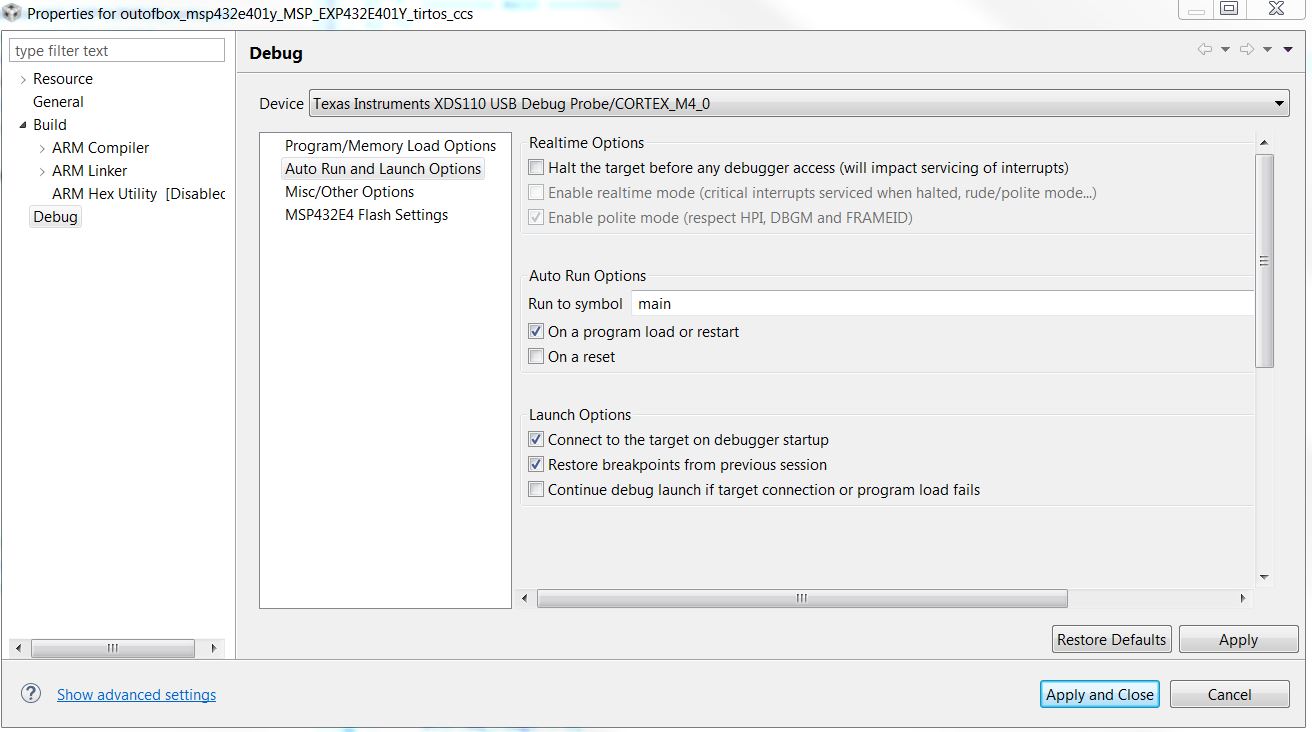
  • Thanks Chris. I also would like to know how to disable the breakpoint that occurs at the start of main() every time I run my code? I think that may be part of the problem as well.
  • Ryan,

       I am still unable to find a good answer to your first question.  Looking at the driverLib example it would seem that the first two instructions to  disable and reset are not required.  Can you please remove these two and simply enable the peripheral and wait for the ready status?

     To your second question you can move that breakpoint in ccs.

    Chris

  • Hi Chris,

    I tried to remove the disable and reset, but nothing changed. Occasionally it won't block at the while loop, however most of the time it does and the rest of the program cannot run. Any other insight you might be able to provide would be greatly appreciated. Thanks.

  • Ryan,

       I do not be able to recreate the issue.  Can you try the attached code with this project:  ?

    Thanks,
    Chris

    /* --COPYRIGHT--,BSD
     * Copyright (c) 2017, Texas Instruments Incorporated
     * All rights reserved.
     *
     * Redistribution and use in source and binary forms, with or without
     * modification, are permitted provided that the following conditions
     * are met:
     *
     * *  Redistributions of source code must retain the above copyright
     *    notice, this list of conditions and the following disclaimer.
     *
     * *  Redistributions in binary form must reproduce the above copyright
     *    notice, this list of conditions and the following disclaimer in the
     *    documentation and/or other materials provided with the distribution.
     *
     * *  Neither the name of Texas Instruments Incorporated nor the names of
     *    its contributors may be used to endorse or promote products derived
     *    from this software without specific prior written permission.
     *
     * THIS SOFTWARE IS PROVIDED BY THE COPYRIGHT HOLDERS AND CONTRIBUTORS "AS IS"
     * AND ANY EXPRESS OR IMPLIED WARRANTIES, INCLUDING, BUT NOT LIMITED TO,
     * THE IMPLIED WARRANTIES OF MERCHANTABILITY AND FITNESS FOR A PARTICULAR
     * PURPOSE ARE DISCLAIMED. IN NO EVENT SHALL THE COPYRIGHT OWNER OR
     * CONTRIBUTORS BE LIABLE FOR ANY DIRECT, INDIRECT, INCIDENTAL, SPECIAL,
     * EXEMPLARY, OR CONSEQUENTIAL DAMAGES (INCLUDING, BUT NOT LIMITED TO,
     * PROCUREMENT OF SUBSTITUTE GOODS OR SERVICES; LOSS OF USE, DATA, OR PROFITS;
     * OR BUSINESS INTERRUPTION) HOWEVER CAUSED AND ON ANY THEORY OF LIABILITY,
     * WHETHER IN CONTRACT, STRICT LIABILITY, OR TORT (INCLUDING NEGLIGENCE OR
     * OTHERWISE) ARISING IN ANY WAY OUT OF THE USE OF THIS SOFTWARE,
     * EVEN IF ADVISED OF THE POSSIBILITY OF SUCH DAMAGE.
     * --/COPYRIGHT--*/
    /******************************************************************************
     * MSP432E4 Example for Deep Sleep Mode entry and wakeup using GPIO
     *
     * Description: The application code puts the device in deep sleep mode with
     * clock enabled only for the GPIO in deep sleep mode and memory in standby.
     * During Active state (RUN Mode), the LED D1 is switched ON. When there is no
     * activity the device is put into deep sleep mode and LED D1 is switched OFF.
     * During Deep sleep the clock source if LFIOSC, the core voltage is reduced
     * to 0.9V and memory banks are put in low power state. When the user presses
     * USR_SW2 the device is woken up and the LED D1 switches ON.
     *
     *                MSP432E401Y
     *             ------------------
     *         /|\|                  |
     *          | |                  |
     *          --|RST            PJ1|<-- USR_SW2
     *            |                  |
     *            |               PN1|--> LED D1
     *            |                  |
     *            |                  |
     * Author: Amit Ashara
    *******************************************************************************/
    /* DriverLib Includes */
    #include <ti/devices/msp432e4/driverlib/driverlib.h>
    
    /* Standard Includes */
    #include <stdint.h>
    #include <stdbool.h>
    
    //volatile uint32_t setTimeOutCount;
    volatile uint32_t systemClock;
    volatile uint32_t ledState;
    
    
    void GPIOJ_IRQHandler(void)
    {
        uint32_t getIntStatus;
    
        /* Set the timeout counter to count down value */
    //    setTimeOutCount = systemClock/12;
    
        /* Get the interrupt status and clear the status bits */
        getIntStatus = MAP_GPIOIntStatus(GPIO_PORTJ_BASE, false);
        MAP_GPIOIntClear(GPIO_PORTJ_BASE, getIntStatus);
    
        /* Switch the LED ON */
        if(ledState)
        {
            MAP_GPIOPinWrite(GPIO_PORTN_BASE, GPIO_PIN_1, GPIO_PIN_1);
            ledState = 0;
        }
        else
        {
            ledState = 1;
            MAP_GPIOPinWrite(GPIO_PORTN_BASE, GPIO_PIN_1, 0);
        }
    }
    
    int main(void)
    {
    
        SysCtlPeripheralDisable(SYSCTL_PERIPH_CCM0);
        SysCtlPeripheralReset(SYSCTL_PERIPH_CCM0);
        SysCtlPeripheralEnable(SYSCTL_PERIPH_CCM0);
        //
        // Wait for the peipheral to be ready.
        //
        while(!SysCtlPeripheralReady(SYSCTL_PERIPH_CCM0))
        {
        }
    
        /* Configure the system clock for 120 MHz */
        systemClock = MAP_SysCtlClockFreqSet((SYSCTL_XTAL_25MHZ | SYSCTL_OSC_MAIN |
                                              SYSCTL_USE_PLL | SYSCTL_CFG_VCO_480),
                                              120000000);
    
    //    setTimeOutCount = systemClock/12;
        ledState = 1;
    
        /* Enable the clock to the GPIO Port N and wait for it to be ready */
        MAP_SysCtlPeripheralEnable(SYSCTL_PERIPH_GPION);
        while(!(SysCtlPeripheralReady(SYSCTL_PERIPH_GPION)))
        {
        }
    
        /* Configure the GPIO PN1 as output and switch D1 ON */
        MAP_GPIOPinTypeGPIOOutput(GPIO_PORTN_BASE, GPIO_PIN_1);
        MAP_GPIOPinWrite(GPIO_PORTN_BASE, GPIO_PIN_1, GPIO_PIN_1);
    
        /* Configure the GPIO PJ1 as input and enable interrupt on rising edge */
        MAP_SysCtlPeripheralEnable(SYSCTL_PERIPH_GPIOJ);
        while(!(SysCtlPeripheralReady(SYSCTL_PERIPH_GPIOJ)))
        {
        }
    
        MAP_GPIOPinTypeGPIOInput(GPIO_PORTJ_BASE, GPIO_PIN_1);
        GPIOJ->PUR |= GPIO_PIN_1;
    
        /* Configure Interrupt Generation by Port Pin PJ1 as falling edge */
        MAP_GPIOIntTypeSet(GPIO_PORTJ_BASE, GPIO_PIN_1, GPIO_FALLING_EDGE);
        MAP_GPIOIntEnable(GPIO_PORTJ_BASE, GPIO_INT_PIN_1);
        MAP_IntEnable(INT_GPIOJ);
    
    //    /* Configure GPIO Port N and J to remain active in Deep Sleep Mode */
    //    MAP_SysCtlPeripheralDeepSleepEnable(SYSCTL_PERIPH_GPION);
    //    MAP_SysCtlPeripheralDeepSleepEnable(SYSCTL_PERIPH_GPIOJ);
    //
    //    /* Configure the clocks to be auto gated in deep sleep mode */
    //    MAP_SysCtlPeripheralClockGating(true);
    //
    //    /* Configure SRAM and Flash to be in Low Power State */
    //    MAP_SysCtlDeepSleepPowerSet(SYSCTL_SRAM_LOW_POWER | SYSCTL_FLASH_LOW_POWER);
    //
    //    /* Configure the deep sleep clock as LFIOSC and power down the PIOSC */
    //    MAP_SysCtlDeepSleepClockConfigSet((SYSCTL_DSLP_OSC_INT30 |
    //            SYSCTL_DSLP_PIOSC_PD | SYSCTL_DSLP_MOSC_DPD), 1);
    //
    //    /* Configure the VDDC voltage to 0.9V. On the LaunchPad the user can check
    //     * TP12 for change of VDDC from 1.2V to 0.9V */
    //    MAP_SysCtlLDODeepSleepSet(SYSCTL_LDO_0_90V);
    
        while(1)
        {
            /* Count down to 0 */
    //        for(;setTimeOutCount > 0; setTimeOutCount--);
    
            /* Switch the LED OFF and go to deep sleep state. */
    //        MAP_GPIOPinWrite(GPIO_PORTN_BASE, GPIO_PIN_1, ~(GPIO_PIN_1));
    
    //        MAP_SysCtlDeepSleep();
        }
    }
    

  • Yes, that one works fine for me. It won't actually matter as long as I can get the date/time to work when I press reset, so as long as I can figure out how to do that, I will be fine. Thanks for the effort, I appreciate it. 

  • Ryan,
    Is this resolved? I do not follow the date/time comment in this context. Can you mark that as resolved and create a related thread about the date/time stamp you are trying to record at reset?
  • Unfortunately I have just started getting this issue when I reset the board as well. I am seeing if the Peripheral is ready in order to use the SHAMD5 module, is there any workaround or insight someone could give in order to help me out with this? It also sometimes will work, other times it will not. There isn't much else to go on unfortunately. Thanks for the help.

**Attention** This is a public forum