This thread has been locked.

If you have a related question, please click the "Ask a related question" button in the top right corner. The newly created question will be automatically linked to this question.

MSP430F5529: Selection of proper WiFi Module

Part Number: MSP430F5529
Other Parts Discussed in Thread: AFE4400, CC3100MOD, CC3120MOD, CC3200MOD, CC3220MOD, CC3200

We are under development of medical related product. In the product we are using MSP430F5529 MCU. Interfacing modules are AFE4400 , LCD 8x2 serial interface , one UART based module. Our product is IoT based product. So we want to use proper Wifi Module. So according to RAM and ROM of the MCU and other interfacing devices ie. AFE4400, LCD and UART based module which WiFi module will be useful to us. Which will not afferct the performance of AFE4400 and other module and MCU can handle all the process. 

As we have search CC3100MOD and CC3120MOD or any other module is better? Which will support to MCU? Please suggest.

  • Hi,

    thank you for reaching out.
    Please let me forward your request to our experts on WiFi as they can point you to the best fit with regards to WiFi.
    With regards to the performance of AFE4400 and MSP430F5529 it will be hard to evaluate this without knowing details of the application but there are certain aspects that you can take care of:
    1) Timings, such as frequency of the AFE4400
    2) Communication frequency (such as UART connection to WiFi module)
    3) Update rate from LCD module
    Those need all to be handled by the MCU so you need to make sure that all can be processed. Depending on the frequencies you'll need this shouldn't be a problem from MCU perspective but you'd need to investigate it.

    Best regards,
    Britta
  • Hello Yogesh,

    do you plan to use TI-RTOS?
    Is your device to be a battery powered tool?
  • No sir. We are not using TI-RTOS. Power to the device is via Adapter AC to DC. Our device is not battery powered.

    There is a LCD 8*2 Serial communication based. www.winstar.com.tw/.../8x2-lcd.html

    One UART based module which gives Hex values directly, AFE4400- SPI based and we choose CC3200MOD.

    As in the description of CC3200MOD given that: The Wi-Fi network processor subsystem features a Wi-Fi Internet-on-a-chip and contains an additional dedicated ARM MCU that completely off-loads the applications MCU.

    Our MCU is MSP430F5529. I have only doubt with AFE4400 module that both CC3200MOD and AFE4400 can work on MSP430F5529 without any affecting performance of AFE4400? Because in our product SPO2 and Pulse rate parameters are very important.
  • The updates on LCD 1-3 times per sec. when having LCD with its own controller with SPI / I2C would not affect your MCU performance.

    You develop a medical device. If TLS needed, consider CC3220MOD usage because of performance.

    What are your max rates of data streams for both CC and AFE connections?
    Both streams can be supported by DMA.

    I have not checked TI provided reference designs for a heart rate monitor and a pulse oximeter.
    Are any time domain or other CPU heavy processing required?
  • Yes sir AFE4400 is time domain but it is not that much required heavy process CPU. It gives no. of samples from IR LED and RED LED from that we are calculating SPO2 and PR. No. of samples are 2000 above. As in description of CC3200MOD , additional dedicated ARM MCU that completely offloads the host MCU.
  • 2 LEDs, 3 bytes, 3000 samples, 3 time per second, 11 bits per byte gives 594 kbps on 2 interfaces.
    Looks achievable.
    MSP4305529 8 KB RAM makes some concerns.
    Because of relatively small FIFOs / data buffers, timings and blockings on CC32x0 have to be very carefully checked.
    For example: RF calibration takes 25 ms.
  • I have no experience with CC32x0MOD but... it looks like you can implement your application inside of it. It has a number of serial interfaces even. Why do you also need an MSP430?
  • Hello,

    for this project I am not an architect, I do not know risks, etc.

    In my modest opinion, placing everything on CC32x0MOD means that the application should be driven by TI-RTOS.
    I have basic experience with CC3200 and TI-RTOS however I have never had performance demanding applications on that platform.
    TI-RTOS has very huge overhead when comparing it with driverlibs applications.
    For sure, Cortex M4F on CC32x0MOD major job is to deal with WiFi services.
    How much space and non blocking "flexibility" for other tasks?

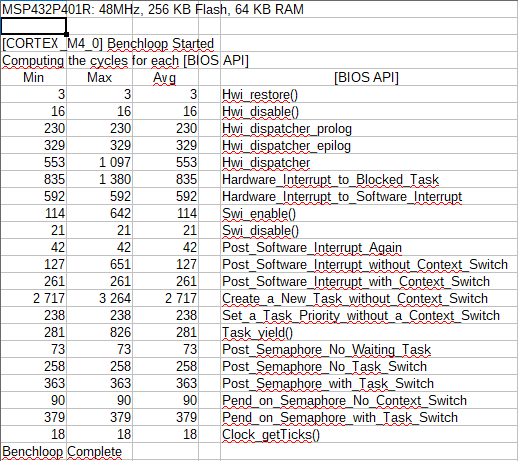
    Please, find below basic TI-RTOS interface performance on Cortex M4F architecture:

    Greg,, bright question!

  • From the datasheet:

    • CC3220MODx and CC3220MODAx SimpleLink Wi-Fi Wireless MCU System-on-Chip (SoC) Contains a Single Chip With Two Separate Execution Environments:
      • User Application Dedicated ARM® Cortex®-M4 MCU
      • Network Processor MCU to Run All Wi-Fi and Internet Logical Layers

    It sounds like you have almost free reign over that Cortex-M4 as the network processor is totally separate. While as I mentioned I don't have experience with this particular chip, I do have significant experience with CM4-based MCU's... and I would think that you could get away with doing everything bare metal, and avoid the RTOS performance hit entirely. Not to mention, the core runs at 80 MHz (much faster than MSP432). Eliminating the MSP432 as a go-between may relieve a significant bottleneck, not to mention simplifying the design. I would definitely explore the option if possible. After all, two Cortex-M4 cores and a dedicated network processor seems a bit overkill for this application! :)

  • It appears I misunderstood your post on my last read-through. You were not suggesting MSP432 as a replacement for the MSP430 in the OP, but rather for reference to illustrate the RTOS performance hit. Sorry for the confusion.

    In this case, the system would have one Cortex-M4, one dedicated network processor, and one MSP430 as a data hub. It sounds like the Cortex-M4 would be bored while the MSP430 would be pushed pretty hard. Not ideal.
  • Greg,

    <<< It sounds like you have almost free reign over that Cortex-M4 as the network processor is totally separate.
    You are right, however, according to my knowledge AES, DES, 3DES, SHA2, MD5, CRC and Checksum have to be done on an application core and this functions are CPU killers.
    <<< I would think that you could get away with doing everything bare metal, and avoid the RTOS performance hit entirely.
    Two years ago I did a few applications for CC3200. As I remember it is impossible to deal with CC320 simplelink API without TI-RTOS.
    <<< Not to mention, the core runs at 80 MHz (much faster than MSP432).
    67% performance increase is nothing when having to many unknowns.
    <<< Eliminating the MSP432 as a go-between may relieve a significant bottleneck, not to mention simplifying the design.
    I am sorry for a misleading information. I have provided MSP432 benchmarks because it use the same M4F as CC32x0.
    Yogesh architecture is based on MSP430FR5529.
    <<< not to mention simplifying the design.
    The goal to simplify a design is a reason we are talking to each other.
    We look for a similar objectives however we may understand project risks in a different way.
    <<< I would definitely explore the option if possible.
    Me too!
    Do you have an idea how to emulate a communication with AFE4400, emulation reliability and an influence on a performance?
    100-1000% error is acceptable if it goes in a right way.
    <<< After all, two Cortex-M4 cores and a dedicated network processor seems a bit overkill for this application! :)
    Yogesh architecture consist of MSP430FR5529 and CC32x0.
    I have never proposed MSP432P401R plus CC32x0.

    Lets focus on CC32x0 and AFE4400 emulation and its impact on performance.
    Our dialog should be moved to somewhere out of the topic:

    RE: MSP430F5529: Selection of proper WiFi Module

  • Fair enough. Regarding MSP430 vs MSP432, I realized shortly after I sent that message what you really meant. (Please see my last message where I address that.)
  • I my opinion your proposal is very good.
    Using non TI-RTOS hwi() to drive SPI/I2C would be no issue with performance.
    Does CC32x0MOD has required interfaces?

**Attention** This is a public forum