This thread has been locked.

If you have a related question, please click the "Ask a related question" button in the top right corner. The newly created question will be automatically linked to this question.

MSP432P401R: multiple triggering of DMA completion interrupt on UART transfer

Part Number: MSP432P401R


Hello,

I'm currently working on a setup with two MSP432.  I will shortly describe the overall setup which is the same for both MCUs:

- ISR with highest priority: running at 5kHz (trigger is ADC), reading ADC values and doing some control stuff (Control C-code is generated out of a Matlab modell)
- ISR with second priority: running at 100Hz (trigger is timer32), some statemachine tasks (statemachine C-code is generated out of a Matlab modell)
- ISR with third priority: DMA completion interrupt (after 4 transferes)

Both devices are communicating over their UART channels to exchange 4 bytes of data. I use the DMA for TX und RX to write the data from the tx-buffer to the TX register and read the values from the RX register and write it to the rx-buffer. During this communication one MSP acts as a Master and the other as a Slave. For testing the master should send "Ping" to the slave. After the slave receives "Ping" it sends back "Pong" as an answer. I trigger the start of the conversation by setting a parameter to 1 in the expression window of the Code Composer Studio (v7.4).

Now to my Problem:
When I comment out the control in the ISR with the highest priority everything is as expected. The slave receives "Ping" and sends back "Pong". I checked the content of the buffer after the conversation finished. However, when I uncomment the control I receive "000g". I used a port to toggle it everytime I enter the completion interrupt of the DMA and what I see is that in the case I get the wrong values the interrupt is called after every byte transfere. I don't see the correlation between multiple completion interrupts and some cpu calculation. Can anybody help me with this problem?

Thanks in advance.

Dominic  

  • Since the issue appears to be related to processing within an ISR, I would look for situations where you are preventing the CPU to service an interrupt because it is still in another ISR. Perhaps you can add port toggles for each ISR entry and exit to determine if an ISR is being serviced late.

    Regards,
    Chris
  • Hi Chris,

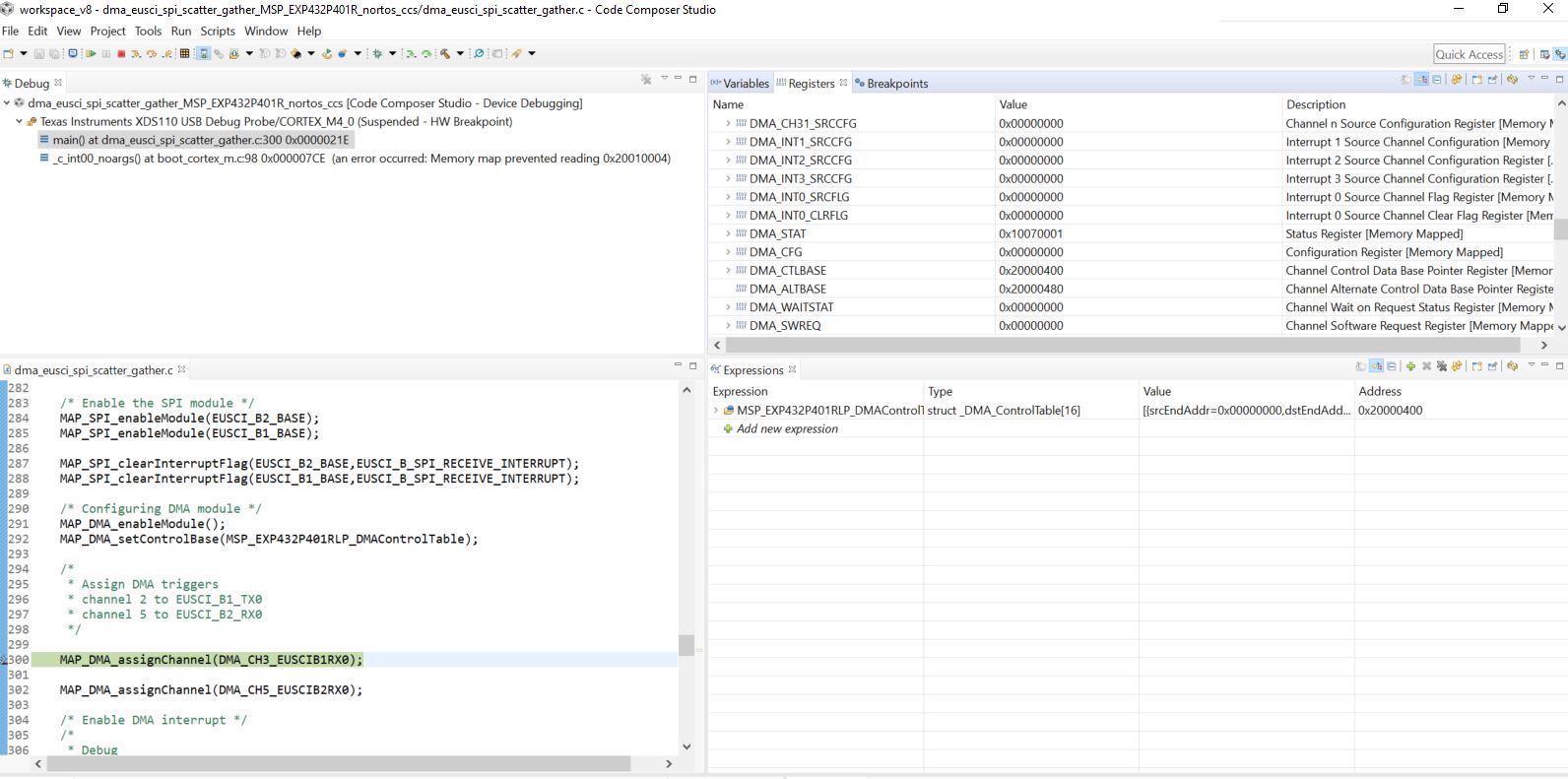
    I think I found the issue. It is not related to the ISR itself.It is about the setup of the DMA. I defined  a parameter for the "controlTable"  (static DMA_ControlTable MSP432_DMAControlTable[32]). The address of this parameter is 0x20000400. When I call the function MAP_DMA_setControlBase(MSP432_DMAControlTable) the address which is stored in the DMA_DMA_CTLBASE (0x4000F000) is 0x20000000 instead of 0x20000400 and at 0x20000000 another buffer is stored which changes its value in the ISR and changes the config of the DMA so that only one byte is transfered.

    I checked the reference manual. The descriptioni of the DMA_CTLBASE register is on page 661. There you can see that the first 4 bits are reserved. I would expect that in my case when I call MAP_DMA_setControlBase(MSP432_DMAControlTable) the value ind DMA_CTLBASE register should be 0x20000400 and not 0x20000000. Can you confirm that? If yes, can you guess why there is a wrong address written to the register?

    Thanks!

    Dominic

  • I was not able to confirm.

    Please find the modified example attached.

    /* --COPYRIGHT--,BSD,BSD
     * Copyright (c) 2017, Texas Instruments Incorporated
     * All rights reserved.
     *
     * Redistribution and use in source and binary forms, with or without
     * modification, are permitted provided that the following conditions
     * are met:
     *
     * *  Redistributions of source code must retain the above copyright
     *    notice, this list of conditions and the following disclaimer.
     *
     * *  Redistributions in binary form must reproduce the above copyright
     *    notice, this list of conditions and the following disclaimer in the
     *    documentation and/or other materials provided with the distribution.
     *
     * *  Neither the name of Texas Instruments Incorporated nor the names of
     *    its contributors may be used to endorse or promote products derived
     *    from this software without specific prior written permission.
     *
     * THIS SOFTWARE IS PROVIDED BY THE COPYRIGHT HOLDERS AND CONTRIBUTORS "AS IS"
     * AND ANY EXPRESS OR IMPLIED WARRANTIES, INCLUDING, BUT NOT LIMITED TO,
     * THE IMPLIED WARRANTIES OF MERCHANTABILITY AND FITNESS FOR A PARTICULAR
     * PURPOSE ARE DISCLAIMED. IN NO EVENT SHALL THE COPYRIGHT OWNER OR
     * CONTRIBUTORS BE LIABLE FOR ANY DIRECT, INDIRECT, INCIDENTAL, SPECIAL,
     * EXEMPLARY, OR CONSEQUENTIAL DAMAGES (INCLUDING, BUT NOT LIMITED TO,
     * PROCUREMENT OF SUBSTITUTE GOODS OR SERVICES; LOSS OF USE, DATA, OR PROFITS;
     * OR BUSINESS INTERRUPTION) HOWEVER CAUSED AND ON ANY THEORY OF LIABILITY,
     * WHETHER IN CONTRACT, STRICT LIABILITY, OR TORT (INCLUDING NEGLIGENCE OR
     * OTHERWISE) ARISING IN ANY WAY OUT OF THE USE OF THIS SOFTWARE,
     * EVEN IF ADVISED OF THE POSSIBILITY OF SUCH DAMAGE.
     * --/COPYRIGHT--*/
    /*******************************************************************************
     * MSP432 DMA - Scatter-Gather between eUSCIB2 memory and eUSCIB1
     *
     * Description: In this code example, two software initiated DMA transfers are
     * setup and executed.  The scatter-gather transfers initiated from software
     * perform two tasks.  The first task is to read three bytes from the eUSCIB2
     * SPI and the second task is to transmit two bytes from the eUSCIB1 SPI.
     * In addition to the SPI communication the tasks also manage the chip select
     * via the port registers.
     * During the first interrupt a simple computation is performed to transfer
     * the information read to the information transmitted.
     *
     *              MSP432P401
     *             ------------------
     *         /|\|                  |
     *          | |                  |
     *          --|RST           P3.0|--> CS
     *            |     P3.5(eUSCIB2)|--> CLK
     *            |              P3.6|--> SIMO
     *            |              P3.7|<-- SOMI
     *            |                  |
     *            |              P6.1|--> CS
     *            |     P6.3(eUSCIB1)|--> CLK
     *            |              P6.4|--> SIMO
     *            |              P6.5|<-- SOMI
     *
     ******************************************************************************/
    #include <stdint.h>
    #include <string.h>
    #include <stdbool.h>
    #include <ti/devices/msp432p4xx/driverlib/driverlib.h>
    #include <ti/devices/msp432p4xx/inc/msp.h>
    
    #define RX_TASKS    9
    #define TX_TASKS    7
    
    /* SPI Configuration Parameter */
    const eUSCI_SPI_MasterConfig spiMasterConfig_B2 =
    {
        EUSCI_B_SPI_CLOCKSOURCE_SMCLK, 3000000, 1000000,
        EUSCI_B_SPI_MSB_FIRST,
        EUSCI_B_SPI_PHASE_DATA_CAPTURED_ONFIRST_CHANGED_ON_NEXT,
        EUSCI_B_SPI_CLOCKPOLARITY_INACTIVITY_HIGH,
        EUSCI_B_SPI_3PIN
    };
    
    /* SPI Configuration Parameter */
    const eUSCI_SPI_MasterConfig spiMasterConfig_B1 =
    {
        EUSCI_B_SPI_CLOCKSOURCE_SMCLK, 3000000, 1000000,
        EUSCI_B_SPI_MSB_FIRST,
        EUSCI_B_SPI_PHASE_DATA_CAPTURED_ONFIRST_CHANGED_ON_NEXT,
        EUSCI_B_SPI_CLOCKPOLARITY_INACTIVITY_HIGH, EUSCI_B_SPI_3PIN
    };
    
    ///* DMA Control Table */
    //#if defined(__TI_COMPILER_VERSION__)
    //#pragma DATA_ALIGN(MSP_EXP432P401RLP_DMAControlTable, 1024)
    //#elif defined(__IAR_SYSTEMS_ICC__)
    //#pragma data_alignment=1024
    //#elif defined(__GNUC__)
    //__attribute__ ((aligned (1024)))
    //#elif defined(__CC_ARM)
    //__align(1024)
    //#endif
    //static DMA_ControlTable MSP_EXP432P401RLP_DMAControlTable[16];  // 8 primary and 8 alternate
    
    uint8_t outputLow = 0;
    uint8_t ADC_CS = BIT0;  /* P3.0 is Chip Select */
    uint8_t DAC_CS = BIT1;  /* P6.1 is Chip Select */
    uint8_t dummyTX = 0xa5;
    uint8_t dummyRX;
    uint8_t rxBuffer[300];
    uint8_t txBuffer[200];
    
    /* DMA Control Table */
    #if defined(__TI_COMPILER_VERSION__)
    #pragma DATA_ALIGN(MSP_EXP432P401RLP_DMAControlTable, 1024)
    #elif defined(__IAR_SYSTEMS_ICC__)
    #pragma data_alignment=1024
    #elif defined(__GNUC__)
    __attribute__ ((aligned (1024)))
    #elif defined(__CC_ARM)
    __align(1024)
    #endif
    static DMA_ControlTable MSP_EXP432P401RLP_DMAControlTable[16];  // 8 primary and 8 alternate
    
    
    /*
     * ADC_DMA Sequence: This sequence sets CS, reads data, and clears CS
     * The 'MEM' instructions are automatic while the 'PER' requires a
     * peripheral trigger, which is the EUSCI_B2_RX.  The trigger is configured
     * before the sequence is started.
     */
    DMA_ControlTable spiAdcDmaSeq[RX_TASKS] =
    {
        /* Task1, Dummy read RX buffer to clear IFG */
        DMA_TaskStructEntry(1, UDMA_SIZE_8,
                    UDMA_SRC_INC_NONE, &EUSCI_B2_SPI->RXBUF,
                    UDMA_DST_INC_NONE, &dummyRX,
                    UDMA_ARB_4, (UDMA_MODE_MEM_SCATTER_GATHER+UDMA_MODE_ALT_SELECT)),
        /* Task2, Clear Chip select */
        DMA_TaskStructEntry(1, UDMA_SIZE_8,
                    UDMA_SRC_INC_NONE, &outputLow,
                    UDMA_DST_INC_NONE, &P3->OUT,
                    UDMA_ARB_4, (UDMA_MODE_MEM_SCATTER_GATHER+UDMA_MODE_ALT_SELECT)),
        /* Task3, load TX buffer to initiate SPI */
        DMA_TaskStructEntry(1, UDMA_SIZE_8,
                    UDMA_SRC_INC_NONE, &dummyTX,
                    UDMA_DST_INC_NONE, &EUSCI_B2_SPI->TXBUF,
                    UDMA_ARB_4, (UDMA_MODE_PER_SCATTER_GATHER+UDMA_MODE_ALT_SELECT)),
        /* Task4, read RX buffer to clear IFG */
        DMA_TaskStructEntry(1, UDMA_SIZE_8,
                    UDMA_SRC_INC_NONE, &EUSCI_B2_SPI->RXBUF,
                    UDMA_DST_INC_NONE, &rxBuffer[0],
                    UDMA_ARB_4, (UDMA_MODE_MEM_SCATTER_GATHER+UDMA_MODE_ALT_SELECT)),
        /* Task5, load TX buffer to initiate SPI */
        DMA_TaskStructEntry(1, UDMA_SIZE_8,
                    UDMA_SRC_INC_NONE, &dummyTX,
                    UDMA_DST_INC_NONE, &EUSCI_B2_SPI->TXBUF,
                    UDMA_ARB_4, (UDMA_MODE_PER_SCATTER_GATHER+UDMA_MODE_ALT_SELECT)),
        /* Task6, read RX buffer to initiate SPI */
        DMA_TaskStructEntry(1, UDMA_SIZE_8,
                    UDMA_SRC_INC_NONE, &EUSCI_B2_SPI->RXBUF,
                    UDMA_DST_INC_NONE, &rxBuffer[1],
                    UDMA_ARB_4, (UDMA_MODE_MEM_SCATTER_GATHER+UDMA_MODE_ALT_SELECT)),
        /* Task7, load TX buffer to initiate SPI */
        DMA_TaskStructEntry(1, UDMA_SIZE_8,
                    UDMA_SRC_INC_NONE, &dummyTX,
                    UDMA_DST_INC_NONE, &EUSCI_B2_SPI->TXBUF,
                    UDMA_ARB_4, (UDMA_MODE_PER_SCATTER_GATHER+UDMA_MODE_ALT_SELECT)),
        /* Task8, read RX buffer to initiate SPI */
        DMA_TaskStructEntry(1, UDMA_SIZE_8,
                    UDMA_SRC_INC_NONE, &EUSCI_B2_SPI->RXBUF,
                    UDMA_DST_INC_NONE, &rxBuffer[2],
                    UDMA_ARB_4, (UDMA_MODE_MEM_SCATTER_GATHER+UDMA_MODE_ALT_SELECT)),
        /* Task 9, set GPIO, chip select */
        DMA_TaskStructEntry(1, UDMA_SIZE_8,
                    UDMA_SRC_INC_NONE, &ADC_CS,
                    UDMA_DST_INC_NONE, &P3->OUT,
                    UDMA_ARB_4, UDMA_MODE_BASIC)
    };
    
    /*
     * DAC_DMA Sequence: This sequence sets CS, reads data, and clears CS
     * The 'MEM' instructions are automatic while the 'PER' requires a
     * peripheral trigger, which is the EUSCI_B1_TX. The trigger is configured
     * before the sequence is started.
     */
    DMA_ControlTable spiDacDmaSeq[TX_TASKS] =
    {
        /* Task1, Dummy read RX buffer to clear IFG */
        DMA_TaskStructEntry(1, UDMA_SIZE_8,
                    UDMA_SRC_INC_NONE, &EUSCI_B1_SPI->RXBUF,
                    UDMA_DST_INC_NONE, &dummyRX,
                    UDMA_ARB_4, (UDMA_MODE_MEM_SCATTER_GATHER+UDMA_MODE_ALT_SELECT)),
        /* Task2, Clear Chip select P6.2 */
        DMA_TaskStructEntry(1, UDMA_SIZE_8,
                    UDMA_SRC_INC_NONE, &outputLow,
                    UDMA_DST_INC_NONE, &P6->OUT,
                    UDMA_ARB_4, (UDMA_MODE_MEM_SCATTER_GATHER+UDMA_MODE_ALT_SELECT)),
        /* Task3, load TX buffer to initiate SPI */
        DMA_TaskStructEntry(1, UDMA_SIZE_8,
                    UDMA_SRC_INC_NONE, &txBuffer[0],
                    UDMA_DST_INC_NONE, &EUSCI_B1_SPI->TXBUF,
                    UDMA_ARB_4, (UDMA_MODE_PER_SCATTER_GATHER+UDMA_MODE_ALT_SELECT)),
        /* Task4, Dummy read RX buffer to clear IFG, wait for RXIFG trigger */
        DMA_TaskStructEntry(1, UDMA_SIZE_8,
                    UDMA_SRC_INC_NONE, &EUSCI_B1_SPI->RXBUF,
                    UDMA_DST_INC_NONE, &dummyRX,
                    UDMA_ARB_4, (UDMA_MODE_MEM_SCATTER_GATHER+UDMA_MODE_ALT_SELECT)),
        /* Task 5, load TX buffer to initiate SPI */
        DMA_TaskStructEntry(1, UDMA_SIZE_8,
                    UDMA_SRC_INC_NONE, &txBuffer[1],
                    UDMA_DST_INC_NONE, &EUSCI_B1_SPI->TXBUF,
                    UDMA_ARB_4, (UDMA_MODE_PER_SCATTER_GATHER+UDMA_MODE_ALT_SELECT)),
        /*
         * Task 6, Dummy read RX buffer to clear IFG
         * This delay ensures that the chip select happens after the last byte is transmitted
         */
        DMA_TaskStructEntry(1, UDMA_SIZE_8,
                    UDMA_SRC_INC_NONE, &EUSCI_B1_SPI->RXBUF,
                    UDMA_DST_INC_NONE, &dummyRX,
                    UDMA_ARB_4, (UDMA_MODE_MEM_SCATTER_GATHER+UDMA_MODE_ALT_SELECT)),
        /* Task 7, set GPIO, chip select */
        DMA_TaskStructEntry(1, UDMA_SIZE_8,
                    UDMA_SRC_INC_NONE, &DAC_CS,
                    UDMA_DST_INC_NONE, &P6->OUT,
                    UDMA_ARB_4, UDMA_MODE_BASIC)
    };
    
    int main(void)
    {
        /* Halt watchdog timer */
        MAP_WDT_A_holdTimer();
        /*
         * Configuring P1.1 as an input and enabling interrupts
         */
        MAP_GPIO_setAsInputPinWithPullUpResistor(GPIO_PORT_P1, GPIO_PIN1);
        MAP_GPIO_clearInterruptFlag(GPIO_PORT_P1, GPIO_PIN1);
        MAP_GPIO_enableInterrupt(GPIO_PORT_P1, GPIO_PIN1);
        MAP_Interrupt_enableInterrupt(INT_PORT1);
    
        /*
         * DAC SPI
         * Configure CLK, MOSI & MISO for SPI0 (EUSCI_B1)
         * P6.3 UCB1CLK
         * P6.4 SIMO
         * P6.5 SOMI
         *
         */
        MAP_GPIO_setAsPeripheralModuleFunctionOutputPin(GPIO_PORT_P6,
                GPIO_PIN3 | GPIO_PIN4, GPIO_PRIMARY_MODULE_FUNCTION);
        MAP_GPIO_setAsPeripheralModuleFunctionInputPin(GPIO_PORT_P6,
                GPIO_PIN5, GPIO_PRIMARY_MODULE_FUNCTION);
        /*
         * ADC SPI
         * Configure CLK, MOSI & MISO for SPI0 (EUSCI_B2)
         * 3.5 CLK
         * 3.6 SIMO
         * 3.7 SOMI
         */
        MAP_GPIO_setAsPeripheralModuleFunctionOutputPin(GPIO_PORT_P3,
                GPIO_PIN5 | GPIO_PIN6, GPIO_PRIMARY_MODULE_FUNCTION);
        MAP_GPIO_setAsPeripheralModuleFunctionInputPin(GPIO_PORT_P3,
                GPIO_PIN7, GPIO_PRIMARY_MODULE_FUNCTION);
    
        /* Configure CS pin P3.0 */
        P3->OUT |= BIT0;
        P3->DIR |= BIT0;
        /* Configure CS pin P6.1 */
        P6->OUT |= BIT1;
        P6->DIR |= BIT1;
    
        /* Debug Port P1.0       */
        P1->DIR |= BIT0;
    
        /*
         * LDO, Vcore0 (default)
         * 24Mhz MCLK,
         * 3Mhz SMCLK
         */
    
        MAP_CS_setDCOCenteredFrequency(CS_DCO_FREQUENCY_24);
        MAP_CS_initClockSignal(CS_MCLK,CS_DCOCLK_SELECT,CS_CLOCK_DIVIDER_1);
        MAP_CS_initClockSignal(CS_SMCLK,CS_DCOCLK_SELECT,CS_CLOCK_DIVIDER_8);
    
        /* Configuring SPI module */
        MAP_SPI_initMaster(EUSCI_B2_BASE, &spiMasterConfig_B2);
        MAP_SPI_initMaster(EUSCI_B1_BASE, &spiMasterConfig_B1);
    
        /* Enable the SPI module */
        MAP_SPI_enableModule(EUSCI_B2_BASE);
        MAP_SPI_enableModule(EUSCI_B1_BASE);
    
        MAP_SPI_clearInterruptFlag(EUSCI_B2_BASE,EUSCI_B_SPI_RECEIVE_INTERRUPT);
        MAP_SPI_clearInterruptFlag(EUSCI_B1_BASE,EUSCI_B_SPI_RECEIVE_INTERRUPT);
    
        /* Configuring DMA module */
        MAP_DMA_enableModule();
        MAP_DMA_setControlBase(MSP_EXP432P401RLP_DMAControlTable);
    
        /*
         * Assign DMA triggers
         * channel 2 to EUSCI_B1_TX0
         * channel 5 to EUSCI_B2_RX0
         */
    
        MAP_DMA_assignChannel(DMA_CH3_EUSCIB1RX0);
    
        MAP_DMA_assignChannel(DMA_CH5_EUSCIB2RX0);
    
        /* Enable DMA interrupt */
        /*
         * Debug
         * Change to Channel1 eUSCI_B2_RX2
         */
        MAP_DMA_assignInterrupt(INT_DMA_INT1, 5);  /* Channel 5 is the ADC (RX) */
        MAP_DMA_assignInterrupt(INT_DMA_INT2, 3);  /* Channel 3 is the DAC (TX) */
    
        while(1)
        {
            MAP_PCM_gotoLPM0();
        }
    }
    
    /* Completion interrupt for DMA */
    void DMA_INT1_IRQHandler(void)
    {
        MAP_DMA_disableChannel(5);
        MAP_DMA_disableInterrupt(INT_DMA_INT1);
        MAP_Interrupt_disableInterrupt(INT_DMA_INT1);
        MAP_SPI_clearInterruptFlag(EUSCI_B2_BASE,EUSCI_B_IFG_RXIFG0);
        MAP_DMA_clearInterruptFlag(5);
        /*
         * Translate ADC data to DAC data
         * 0 -> MSB (transmit first)
         * 1 -> LSB (transmit second)
         */
        txBuffer[0] = (rxBuffer[0] & 0x3) << 6;
        txBuffer[0] |= (rxBuffer[1] & 0xFC) >> 2;
        txBuffer[1] = (rxBuffer[1] & 0x3) << 6;
        txBuffer[1] |= (rxBuffer[2] & 0xFC) >> 2;
    
        MAP_SPI_clearInterruptFlag(EUSCI_B1_BASE,EUSCI_B_SPI_RECEIVE_INTERRUPT);
        MAP_DMA_setChannelScatterGather(DMA_CH3_EUSCIB1RX0,TX_TASKS,(void*)&spiDacDmaSeq[0],0);
        MAP_DMA_clearInterruptFlag(DMA_CH3_EUSCIB1RX0 & 0x0F);
        /* Assigning/Enabling Interrupts */
        MAP_DMA_enableInterrupt(INT_DMA_INT2);
        MAP_Interrupt_enableInterrupt(INT_DMA_INT2);
        MAP_DMA_enableChannel(3);
        EUSCI_B1_SPI->IFG |= EUSCI_B_IFG_RXIFG0;
    }
    
    void DMA_INT2_IRQHandler(void)
    {
        MAP_DMA_disableChannel(3);
        MAP_DMA_disableInterrupt(INT_DMA_INT2);
        MAP_Interrupt_disableInterrupt(INT_DMA_INT2);
        MAP_SPI_clearInterruptFlag(EUSCI_B1_BASE,EUSCI_B_IFG_RXIFG0);
        MAP_DMA_clearInterruptFlag(3);
        P1->OUT ^= BIT0;
    }
    
    void PORT1_IRQHandler(void)
    {
        uint32_t status;
    
        status = MAP_GPIO_getEnabledInterruptStatus(GPIO_PORT_P1);
        MAP_GPIO_clearInterruptFlag(GPIO_PORT_P1, status);
    
        /* Toggling the output on the LED */
        if(status & GPIO_PIN1)
        {
            rxBuffer[0] = 0;
            rxBuffer[1] = 0;
            rxBuffer[2] = 0;
    
            txBuffer[0] = 0;
            txBuffer[1] = 0;
    
            /*
             * Start SPI read
             */
            while(status & GPIO_PIN1)
            {
                status = MAP_GPIO_getEnabledInterruptStatus(GPIO_PORT_P1);
                MAP_GPIO_clearInterruptFlag(GPIO_PORT_P1, status);
            }
            /*
             * Peripheral trigger.  Memory Scatter Gather
             */
            MAP_DMA_setChannelScatterGather(DMA_CH5_EUSCIB2RX0,RX_TASKS,(void*)&spiAdcDmaSeq[0],0);
            MAP_DMA_clearInterruptFlag(DMA_CH5_EUSCIB2RX0 & 0x0F);
    
            /* Assigning/Enabling Interrupts */
            MAP_DMA_enableInterrupt(INT_DMA_INT1);
            MAP_Interrupt_enableInterrupt(INT_DMA_INT1);
            MAP_DMA_enableChannel(5);
    
            /*
             * The DMA channel5 is set to trigger off of theEUSCIB0RX IFG.  This
             * did not really happen but is forced manually to start the
             * scatter-gather sequence.  Because the setting is 'memory'
             * scatter-gather all triggers (transitions) from primary to
             * auxiliary actions will be automatic.  The auxiliary action triggers
             * are defined in the task list.
             */
            EUSCI_B2_SPI->IFG |= EUSCI_B_IFG_RXIFG0;
        }
    }
    

    Regards,

    Chris

  • Hello Chris,

    thank you for your answer. Sorry for the late reply but I was quite busy the last month. I will have a look on your modified example tomorrow.

    Regards,
    Dominic
  • Dominic,
    Let me know if you have any further questions.

    Chris
  • Hello Chris,

    your example is working and also my code is working now although I didn't change anything on the software side. I got another hardware though. Maybe there was some issue with the old hardware. I will close the post and come back to you in case it will arise again. Thank you for your support!

    Regards,

    Dominic

**Attention** This is a public forum