This thread has been locked.

If you have a related question, please click the "Ask a related question" button in the top right corner. The newly created question will be automatically linked to this question.

MSP430F5510: SLAA514 : reference schematics

Part Number: MSP430F5510

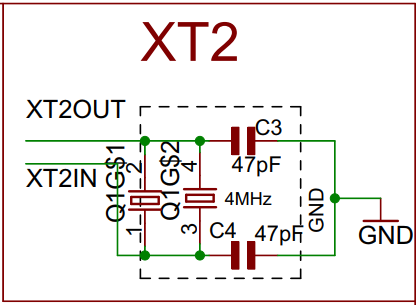
Could you clarify the value capacitor and Crystal oscillator frequency used in the schematic at page 15 of the application report SLAA514 ?

In my understanding they should be 4MHz and 47 pF, quite different of the value of Cl eff specified in the datasheet of MSP430 (SLAS645J page 27). The capacitor value that can accepts XT2 Input/Output (Cl eff) should be 15pF.

Regards

Adamo

  • Hello,

    tizzoni adamo said:
    Could you clarify the value capacitor and Crystal oscillator frequency used in the schematic at page 15 of the application report SLAA514 ?

    You're correct that the frequency is 4MHZ and the capacitors are 47pF.

    tizzoni adamo said:
    In my understanding they should be 4MHz and 47 pF, quite different of the value of Cl eff specified in the datasheet of MSP430 (SLAS645J page 27). The capacitor value that can accepts XT2 Input/Output (Cl eff) should be 15pF.

    I think you're referring to the XT1 section of the datasheet. The latest version is Revision K, and according to Footnote 1 under the table in Section 5.16 on page 29 of the MSP430F550x/F5510, the values of the load capacitances are specified by the crystal manufacturer. For XT2, the integrated effective load capacitance is only around 1pF.

    Regards,

    James

  • I'm using a quartz with 12pF of Cl, but sometime doesn't start to oscillate at 4MHz, XT2IN remains at DC level of 300mV and XT2OUT is zero. The packege used is RGC for MSP430F5510 device 

    The pad P5.4 and P5.5 are floating (refered to Crystal XT1 input), are there some external device issue to do to have the P5.2/XT2IN PAD in high impedence (SLAS645J, paragraph 6.11.6), in order to feed the XT2IN to Unified Clock System ?

  • tizzoni adamo said:

    I'm using a quartz with 12pF of Cl, but sometime doesn't start to oscillate at 4MHz, XT2IN remains at DC level of 300mV and XT2OUT is zero. The packege used is RGC for MSP430F5510 device 

    The pad P5.4 and P5.5 are floating (refered to Crystal XT1 input), are there some external device issue to do to have the P5.2/XT2IN PAD in high impedence (SLAS645J, paragraph 6.11.6), in order to feed the XT2IN to Unified Clock System ?

    I'm sorry, but I don't understand what you're asking. Also, this question seems to be different than your original question. For new questions, we recommend that you start a new thread. I don't know if you're confusing XT1 and XT2 or asking how to set up the pins to use XT1 or XT2. On the firmware side, have you referenced the code examples for this device yet?

    MSP430F55xx_UCS_08.c

    /* --COPYRIGHT--,BSD_EX
     * Copyright (c) 2012, Texas Instruments Incorporated
     * All rights reserved.
     *
     * Redistribution and use in source and binary forms, with or without
     * modification, are permitted provided that the following conditions
     * are met:
     *
     * *  Redistributions of source code must retain the above copyright
     *    notice, this list of conditions and the following disclaimer.
     *
     * *  Redistributions in binary form must reproduce the above copyright
     *    notice, this list of conditions and the following disclaimer in the
     *    documentation and/or other materials provided with the distribution.
     *
     * *  Neither the name of Texas Instruments Incorporated nor the names of
     *    its contributors may be used to endorse or promote products derived
     *    from this software without specific prior written permission.
     *
     * THIS SOFTWARE IS PROVIDED BY THE COPYRIGHT HOLDERS AND CONTRIBUTORS "AS IS"
     * AND ANY EXPRESS OR IMPLIED WARRANTIES, INCLUDING, BUT NOT LIMITED TO,
     * THE IMPLIED WARRANTIES OF MERCHANTABILITY AND FITNESS FOR A PARTICULAR
     * PURPOSE ARE DISCLAIMED. IN NO EVENT SHALL THE COPYRIGHT OWNER OR
     * CONTRIBUTORS BE LIABLE FOR ANY DIRECT, INDIRECT, INCIDENTAL, SPECIAL,
     * EXEMPLARY, OR CONSEQUENTIAL DAMAGES (INCLUDING, BUT NOT LIMITED TO,
     * PROCUREMENT OF SUBSTITUTE GOODS OR SERVICES; LOSS OF USE, DATA, OR PROFITS;
     * OR BUSINESS INTERRUPTION) HOWEVER CAUSED AND ON ANY THEORY OF LIABILITY,
     * WHETHER IN CONTRACT, STRICT LIABILITY, OR TORT (INCLUDING NEGLIGENCE OR
     * OTHERWISE) ARISING IN ANY WAY OUT OF THE USE OF THIS SOFTWARE,
     * EVEN IF ADVISED OF THE POSSIBILITY OF SUCH DAMAGE.
     *
     *******************************************************************************
     * 
     *                       MSP430 CODE EXAMPLE DISCLAIMER
     *
     * MSP430 code examples are self-contained low-level programs that typically
     * demonstrate a single peripheral function or device feature in a highly
     * concise manner. For this the code may rely on the device's power-on default
     * register values and settings such as the clock configuration and care must
     * be taken when combining code from several examples to avoid potential side
     * effects. Also see www.ti.com/grace for a GUI- and www.ti.com/msp430ware
     * for an API functional library-approach to peripheral configuration.
     *
     * --/COPYRIGHT--*/
    //******************************************************************************
    //  MSP430F552x Demo - XT2 sources MCLK & SMCLK
    //
    //  Description: This program demonstrates using XT2 to source MCLK. XT1 is not
    //  connected in this case.
    //
    //  By default, LFXT1 is requested by the following modules:
    //     - FLL
    //     - ACLK
    //  If LFXT1 is NOT used and if the user does not change the source modules,
    //  it causes the XT1xxOFIFG flag to be set because it is constantly looking
    //  for LFXT1. OFIFG, global oscillator fault flag, will always be set if LFXT1
    //  is set. Hence, it is important to ensure LFXT1 is no longer being sourced
    //  if LFXT1 is NOT used.
    //  MCLK = XT2
    //
    //               MSP430F552x
    //             -----------------
    //        /|\ |                 |
    //         |  |                 |
    //         ---|RST              |
    //            |            XT2IN|-
    //            |                 | HF XTAL (455kHz - 16MHz)
    //            |           XT2OUT|-
    //            |                 |
    //            |             P7.7|--> MCLK = XT2
    //            |             P2.2|--> SMCLK = XT2
    //
    //   Bhargavi Nisarga
    //   Texas Instruments Inc.
    //   April 2009
    //   Built with CCSv4 and IAR Embedded Workbench Version: 4.21
    //******************************************************************************
    
    #include <msp430.h>
    
    int main(void)
    {
      WDTCTL = WDTPW + WDTHOLD;                 // Stop watchdog timer
    
      P2DIR |= BIT2;                            // SMCLK set out to pins
      P2SEL |= BIT2;                            
      P7DIR |= BIT7;                            // MCLK set out to pins
      P7SEL |= BIT7;
      
      P5SEL |= BIT2+BIT3;                       // Port select XT2
    
      UCSCTL6 &= ~XT2OFF;                       // Enable XT2 
      UCSCTL3 |= SELREF_2;                      // FLLref = REFO
                                                // Since LFXT1 is not used,
                                                // sourcing FLL with LFXT1 can cause
                                                // XT1OFFG flag to set
      UCSCTL4 |= SELA_2;                        // ACLK=REFO,SMCLK=DCO,MCLK=DCO
    
      // Loop until XT1,XT2 & DCO stabilizes - in this case loop until XT2 settles
      do
      {
        UCSCTL7 &= ~(XT2OFFG + XT1LFOFFG + DCOFFG);
                                                // Clear XT2,XT1,DCO fault flags
        SFRIFG1 &= ~OFIFG;                      // Clear fault flags
      }while (SFRIFG1&OFIFG);                   // Test oscillator fault flag
    
      UCSCTL6 &= ~XT2DRIVE0;                    // Decrease XT2 Drive according to
                                                // expected frequency
      UCSCTL4 |= SELS_5 + SELM_5;               // SMCLK=MCLK=XT2
    
      while(1);                                 // Loop in place
    }

    Regards,

    James

**Attention** This is a public forum