This thread has been locked.

If you have a related question, please click the "Ask a related question" button in the top right corner. The newly created question will be automatically linked to this question.

MSP430FR6047: Velocity calculation using the USS lib algorithm results

Part Number: MSP430FR6047


Hello

For our product we need to calculate and output the velocity of the fluid in the pipe and the volume accordingly

The product should be generic for multiple pipes diameter sizes and wall thickness, so we plan to calculate the volume afterwards, according to the pipe selected.

The algorithm yield the following results: deltaTOF,  totalTOF_UPS  and  .totalTOF_DNS

Assuming the medium is water and the temperature is 25 degrees Celsius (1480 m/s) and the pipe diameter is 25 DN (33.7 mm)

The question is:

What is the best way to calculate the medium velocity? and volume afterwards.

Real world numbers as an example to the equation can really assist here

Thanks

  • Hello,

    I am forwarding this request over to an expert in the USS applications team. Thank you for your patience.

    Best regards,

    Matt

  • Hello dear customer,

    you were already on the right track... "real world" is the key. Pipes and fittings were categorized in the past with 1/2", 3/4", 1", 1 1/4" etc. Nowadays a metric measure is more fashionable. Here they call it DN15, DN20, DN25, DN32 but with pretty much the same dimensions. If you measure them you will find out that the inner diameter in most cases fits neither the "inch-scale" or "mm-scale". In the early days when the made plumbing pipes out of casted iron a DN25/1" had a nominal inner diameter of around 25mm. manufacturing improved, and less material is used where possible. What's left is just some nominal classes of pipes and connection to meters.

    If you purchase a meter look for the sensitivity.... typical meters with DN25 would have values between 100-200 ps/lph in its linear region.  At low rate things get non linear, also at high flow rates where the pressure drop across the meter gats out of the specified limits.

    If you build your own meter and have to calculate the sensitivity then use a simulator for flow dynamics. There are powerful one that are sold on the market. Free simulators are also available. Many universities use "OpenFoam" (I just mention it her without and particular recommendation). This simulators allow you to calculate shapes that differ from a straight pipe. Modern ultrasonic meters are not just straight pipes they feature elements like diffusors, jets, orifices and baffles. This allows to achieve high dynamic ranges of  ..R800/1000. Look also for ISBN 978-3-662-52917-1 the first 75 pages of this 800 pager are free. This gives you a rough idea.

    The simple, non simulative approach is to use the meter-pipe you have build and put an reference meter in series; the run a series of different flow rates. The results lead to a correction curve for your new meter. Repeat the whole thing for several temperatures then => done. (you've characterized your pipe). 

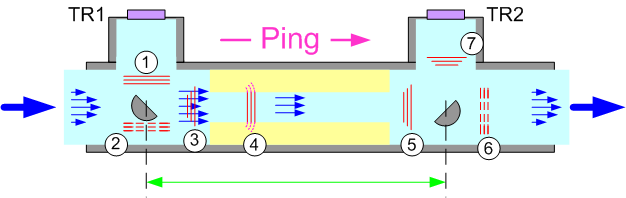
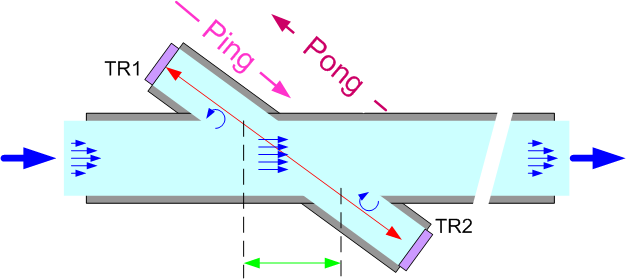
     I attached some drawings based on straight pipes; those are easier to calculate but feature lower sensitivity and lower dynamic range

    a) a two mirror system without orifice, notice the change of the stream profile between the mirrors

    b) the orifice (yellow) suppresses wall reflections and leads to a more linear behavior, at the cost of higher pressure drop

    c) a diagonal system; turbulences build at the intersection with the acoustic horns. Also the acoustic axis might get bent on high medium speeds...

    have fun

       Johann 

**Attention** This is a public forum