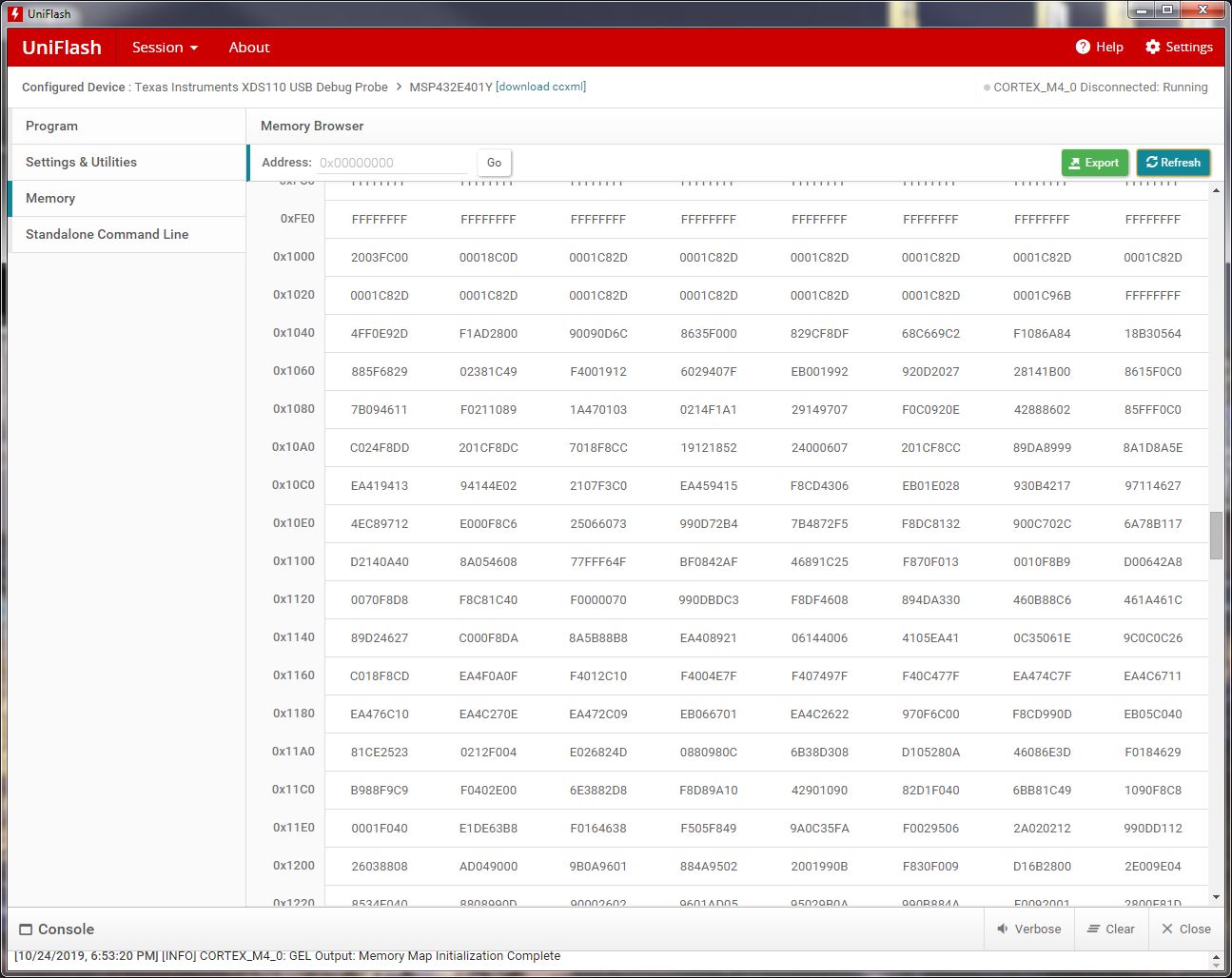
Other Parts Discussed in Thread: UNIFLASH
I'm still struggling with the EMAC bootloader functions on the MSP432E4.
I've now been successful in loading a custom firmware onto the device via emac bootloader. I can then even trigger another update request through receipt of the magic packet, and have the board initialize a tftp read request. However this is where things go sideways.
The board will then pull in the file but then bricks itself and can only be recovered by perfoming a mass erase to reprogram. I'm not really sure what may be causing the issue and am now at a loss.
Here is the software update task function that monitors for a successful receipt of magicpacket on UDP port 9. The getFirmwareUpdateSatus() function just returns a boolean value that is set by a monitor thread that checks for the magic packet. This all works, but I put it here as maybe there is something amiss with the sysClock variable.
void *_swUpdate(xdc_UArg sysClock)
{
    uint32_t m_sysClock = (uint32_t)sysClock;
    /* If the firmware request is not issued by the Host then blink the LED D1
     * On switch firmware request detect exit the blinking program and jump to
     * the flash boot loader. */
    GPIO_write(Board_GPIO_LED0, 1);
    while (!getFirmwareUpdateSatus())
//    while(1)
    {
        GPIO_toggle(Board_GPIO_LED0);
        Task_sleep(500);
    }

    /* Before passing control make sure that the LED is turned OFF. */
    GPIO_write(Board_GPIO_LED0, 0);
    Display_printf(display, 0, 0, "received MP, sysClock = %u\n",m_sysClock);
//    GPIOPinWrite(GPIO_PORTN_BASE, GPIO_PIN_1, 0x0);

    /* Pass control to whichever flavour of boot loader the board is configured
     * with. */
    SoftwareUpdateBegin(m_sysClock);

    /* The previous function never returns but we need to stick in a return
     * code here to keep the compiler from generating a warning. */
    return (0);
}
sysClock is passed as a Task argument and derived in the main function routine. Here is main so you can see where the systemClock is derived.
int main(void)
{
Task_Params params;
uint32_t getSystemClock;
/* Run from the PLL at 120 MHz. */
getSystemClock = MAP_SysCtlClockFreqSet((SYSCTL_XTAL_25MHZ |
SYSCTL_OSC_MAIN |
SYSCTL_USE_PLL |
SYSCTL_CFG_VCO_480),
120000000);
sem_init(&fwStatusSem, 0, 0);
sem_post(&fwStatusSem);
/* Call driver init functions */
Board_init();
GPIO_init();
Display_init();
display = Display_open(Display_Type_UART, NULL);
if (display == NULL) {
/* Failed to open display driver */
while(1);
}
//*
Task_Params_init(¶ms);
params.instance->name = "_swUpdate";
params.priority = 3;
params.stackSize = 2048;
params.arg0 = (xdc_UArg)getSystemClock;
swUpdateThread = Task_create((Task_FuncPtr)_swUpdate, ¶ms, NULL);
if (!swUpdateThread) {
// Error: could not create NDK stack thread
while(1);
}
//*/
ti_ndk_config_Global_startupFxn();
/* Start BIOS */
BIOS_start();
return (0);
}
Finally, the SoftwareUpdateBegin begin function disables the interrupts, kills the outstanding tasks, and disables the sysTick interrupts before calling the ROM_updaeEMAC function
void SoftwareUpdateBegin(uint32_t ui32SysClock)
{
    //
    // Disable all processor interrupts.  Instead of disabling them
    // one at a time (and possibly missing an interrupt if new sources
    // are added), a direct write to NVIC is done to disable all
    // peripheral interrupts.
    //
    Display_printf(display, 0, 0, "preparing update, sysClock = %u\n",ui32SysClock);
    Task_delete(&swUpdateThread);
    Task_delete(&ndkThread);


    NVIC->ICER[0] = 0xffffffff;
    NVIC->ICER[1] = 0xffffffff;
    NVIC->ICER[2] = 0xffffffff;
    NVIC->ICER[3] = 0xffffffff;

    //
    // Also disable the SysTick interrupt.
    //
    SysTickIntDisable();
    SysTickDisable();

    //
    // Return control to the boot loader.  This is a call to the SVC
    // handler in the flashed-based boot loader, or to the ROM if configured.
    //
#if ((defined ROM_UpdateEMAC) && !(defined USE_FLASH_BOOT_LOADER))
    ROM_UpdateEMAC(ui32SysClock);
#else
    (*((void (*)(void))(*(uint32_t *)0x2c)))();
#endif
}
in case it is helpful I've also included my linker cmd file, the resultant .map, and the system_msp432e401y.c and startup_msp432e401y_ccs.c files. The last two I pulled straight from the boot_emac_flash_app_magicpacket_update_MSP_EXP432E401Y_nortos_ccs example project without changes, so maybe there is something in there that is an issue.
Thanks for any help you can provide.
Patrick
/******************************************************************************
*
* Copyright (C) 2017 Texas Instruments Incorporated - http://www.ti.com/
*
* Redistribution and use in source and binary forms, with or without
* modification, are permitted provided that the following conditions
* are met:
*
*  Redistributions of source code must retain the above copyright
*  notice, this list of conditions and the following disclaimer.
*
*  Redistributions in binary form must reproduce the above copyright
*  notice, this list of conditions and the following disclaimer in the
*  documentation and/or other materials provided with the
*  distribution.
*
*  Neither the name of Texas Instruments Incorporated nor the names of
*  its contributors may be used to endorse or promote products derived
*  from this software without specific prior written permission.
*
* THIS SOFTWARE IS PROVIDED BY THE COPYRIGHT HOLDERS AND CONTRIBUTORS
* "AS IS" AND ANY EXPRESS OR IMPLIED WARRANTIES, INCLUDING, BUT NOT
* LIMITED TO, THE IMPLIED WARRANTIES OF MERCHANTABILITY AND FITNESS FOR
* A PARTICULAR PURPOSE ARE DISCLAIMED. IN NO EVENT SHALL THE COPYRIGHT
* OWNER OR CONTRIBUTORS BE LIABLE FOR ANY DIRECT, INDIRECT, INCIDENTAL,
* SPECIAL, EXEMPLARY, OR CONSEQUENTIAL DAMAGES (INCLUDING, BUT NOT
* LIMITED TO, PROCUREMENT OF SUBSTITUTE GOODS OR SERVICES; LOSS OF USE,
* DATA, OR PROFITS; OR BUSINESS INTERRUPTION) HOWEVER CAUSED AND ON ANY
* THEORY OF LIABILITY, WHETHER IN CONTRACT, STRICT LIABILITY, OR TORT
* (INCLUDING NEGLIGENCE OR OTHERWISE) ARISING IN ANY WAY OUT OF THE USE
* OF THIS SOFTWARE, EVEN IF ADVISED OF THE POSSIBILITY OF SUCH DAMAGE.
 ******************************************************************************/

#include <stdint.h>
#include "Board.h"
#include <ti/devices/msp432e4/inc/msp.h>

/*----------------------------------------------------------------------------
  Define clocks
 *----------------------------------------------------------------------------*/
#define __SYSTEM_CLOCK    (16000000ul)

/* Update frequency to match the crystal frequency on your board */
#define XTAL_FREQ         (25000000ul)

/*----------------------------------------------------------------------------
  Clock Variable definitions
 *----------------------------------------------------------------------------*/
uint32_t SystemCoreClock = __SYSTEM_CLOCK; /*!< System Clock Frequency (Core Clock)*/


/*----------------------------------------------------------------------------
  Clock functions
 *----------------------------------------------------------------------------*/
void SystemCoreClockUpdate (void)            /* Get Core Clock Frequency      */
{
    uint32_t getClockDivider;
    uint32_t getPLLMIntValue;
    uint32_t getPLLNValue;
    uint32_t getPLLQValue;

    /* Update the default System Clock value for MSP432E4x devices */
    SystemCoreClock = __SYSTEM_CLOCK;

    if((SYSCTL->RSCLKCFG & SYSCTL_RSCLKCFG_USEPLL) == SYSCTL_RSCLKCFG_USEPLL)
    {
        getClockDivider = (SYSCTL->RSCLKCFG & SYSCTL_RSCLKCFG_PSYSDIV_M) >> SYSCTL_RSCLKCFG_PSYSDIV_S;

        getPLLMIntValue = (SYSCTL->PLLFREQ0 & SYSCTL_PLLFREQ0_MINT_M) >> SYSCTL_PLLFREQ0_MINT_S;
        getPLLNValue = (SYSCTL->PLLFREQ1 & SYSCTL_PLLFREQ1_N_M) >> SYSCTL_PLLFREQ1_N_S;
        getPLLQValue = (SYSCTL->PLLFREQ1 & SYSCTL_PLLFREQ1_Q_M) >> SYSCTL_PLLFREQ1_Q_S;

        if((SYSCTL->RSCLKCFG & SYSCTL_RSCLKCFG_PLLSRC_M) == SYSCTL_RSCLKCFG_PLLSRC_PIOSC)
        {
            SystemCoreClock = (__SYSTEM_CLOCK * (getPLLMIntValue)) / ((getPLLNValue + 1) * (getPLLQValue + 1));
            SystemCoreClock = SystemCoreClock / (getClockDivider + 1);
        }
        else if((SYSCTL->RSCLKCFG & SYSCTL_RSCLKCFG_PLLSRC_M) == SYSCTL_RSCLKCFG_PLLSRC_MOSC)
        {
            SystemCoreClock = (XTAL_FREQ * (getPLLMIntValue)) / ((getPLLNValue + 1) * (getPLLQValue + 1));
            SystemCoreClock = SystemCoreClock / (getClockDivider + 1);
        }
    }
    else
    {
        getClockDivider = (SYSCTL->RSCLKCFG & SYSCTL_RSCLKCFG_OSYSDIV_M) >> SYSCTL_RSCLKCFG_OSYSDIV_S;

        if((SYSCTL->RSCLKCFG & SYSCTL_RSCLKCFG_OSCSRC_M) == SYSCTL_RSCLKCFG_OSCSRC_PIOSC)
        {
            SystemCoreClock = __SYSTEM_CLOCK / (getClockDivider + 1);
        }
        else if((SYSCTL->RSCLKCFG & SYSCTL_RSCLKCFG_OSCSRC_M) == SYSCTL_RSCLKCFG_OSCSRC_MOSC)
        {
            SystemCoreClock = XTAL_FREQ / (getClockDivider + 1);
        }
    }
}

/**
 * Initialize the system
 *
 * @param  none
 * @return none
 *
 * @brief  Setup the microcontroller system.
 *         Initialize the System.
 */
void SystemInit (void)
{
  #if (__FPU_USED == 1)
    SCB->CPACR |= ((3UL << 10*2) |                 /* set CP10 Full Access */
                   (3UL << 11*2)  );               /* set CP11 Full Access */
  #endif

#ifdef UNALIGNED_SUPPORT_DISABLE
  SCB->CCR |= SCB_CCR_UNALIGN_TRP_Msk;
#endif

  SystemCoreClock = __SYSTEM_CLOCK;

}
/******************************************************************************
*
* Copyright (C) 2017 Texas Instruments Incorporated - http://www.ti.com/
*
* Redistribution and use in source and binary forms, with or without
* modification, are permitted provided that the following conditions
* are met:
*
* Redistributions of source code must retain the above copyright
* notice, this list of conditions and the following disclaimer.
*
* Redistributions in binary form must reproduce the above copyright
* notice, this list of conditions and the following disclaimer in the
* documentation and/or other materials provided with the
* distribution.
*
* Neither the name of Texas Instruments Incorporated nor the names of
* its contributors may be used to endorse or promote products derived
* from this software without specific prior written permission.
*
* THIS SOFTWARE IS PROVIDED BY THE COPYRIGHT HOLDERS AND CONTRIBUTORS
* "AS IS" AND ANY EXPRESS OR IMPLIED WARRANTIES, INCLUDING, BUT NOT
* LIMITED TO, THE IMPLIED WARRANTIES OF MERCHANTABILITY AND FITNESS FOR
* A PARTICULAR PURPOSE ARE DISCLAIMED. IN NO EVENT SHALL THE COPYRIGHT
* OWNER OR CONTRIBUTORS BE LIABLE FOR ANY DIRECT, INDIRECT, INCIDENTAL,
* SPECIAL, EXEMPLARY, OR CONSEQUENTIAL DAMAGES (INCLUDING, BUT NOT
* LIMITED TO, PROCUREMENT OF SUBSTITUTE GOODS OR SERVICES; LOSS OF USE,
* DATA, OR PROFITS; OR BUSINESS INTERRUPTION) HOWEVER CAUSED AND ON ANY
* THEORY OF LIABILITY, WHETHER IN CONTRACT, STRICT LIABILITY, OR TORT
* (INCLUDING NEGLIGENCE OR OTHERWISE) ARISING IN ANY WAY OUT OF THE USE
* OF THIS SOFTWARE, EVEN IF ADVISED OF THE POSSIBILITY OF SUCH DAMAGE.
*
*****************************************************************************/
#include <stdint.h>
/* External declaration for the reset handler that is to be called when the */
/* processor is started */
extern void _c_int00(void);
/* External declaration for system initialization function */
extern void SystemInit(void);
/* Linker variable that marks the top of the stack. */
extern uint32_t __STACK_TOP;
/* Forward declaration of the default fault handlers. */
void Default_Handler (void) __attribute__((weak));
extern void Reset_Handler (void) __attribute__((weak));
/* Cortex-M4 Processor Exceptions */
extern void NMI_Handler (void) __attribute__((weak, alias("Default_Handler")));
extern void HardFault_Handler (void) __attribute__((weak, alias("Default_Handler")));
extern void MemManage_Handler (void) __attribute__((weak, alias("Default_Handler")));
extern void BusFault_Handler (void) __attribute__((weak, alias("Default_Handler")));
extern void UsageFault_Handler (void) __attribute__((weak, alias("Default_Handler")));
extern void SVC_Handler (void) __attribute__((weak, alias("Default_Handler")));
extern void DebugMon_Handler (void) __attribute__((weak, alias("Default_Handler")));
extern void PendSV_Handler (void) __attribute__((weak, alias("Default_Handler")));
extern void SysTick_Handler (void) __attribute__((weak, alias("Default_Handler")));
/* device specific interrupt handler */
extern void GPIOA_IRQHandler (void) __attribute__((weak, alias("Default_Handler")));
extern void GPIOB_IRQHandler (void) __attribute__((weak, alias("Default_Handler")));
extern void GPIOC_IRQHandler (void) __attribute__((weak, alias("Default_Handler")));
extern void GPIOD_IRQHandler (void) __attribute__((weak, alias("Default_Handler")));
extern void GPIOE_IRQHandler (void) __attribute__((weak, alias("Default_Handler")));
extern void UART0_IRQHandler (void) __attribute__((weak, alias("Default_Handler")));
extern void UART1_IRQHandler (void) __attribute__((weak, alias("Default_Handler")));
extern void SSI0_IRQHandler (void) __attribute__((weak, alias("Default_Handler")));
extern void I2C0_IRQHandler (void) __attribute__((weak, alias("Default_Handler")));
extern void PWM0_FAULT_IRQHandler (void) __attribute__((weak, alias("Default_Handler")));
extern void PWM0_0_IRQHandler (void) __attribute__((weak, alias("Default_Handler")));
extern void PWM0_1_IRQHandler (void) __attribute__((weak, alias("Default_Handler")));
extern void PWM0_2_IRQHandler (void) __attribute__((weak, alias("Default_Handler")));
extern void QEI0_IRQHandler (void) __attribute__((weak, alias("Default_Handler")));
extern void ADC0SS0_IRQHandler (void) __attribute__((weak, alias("Default_Handler")));
extern void ADC0SS1_IRQHandler (void) __attribute__((weak, alias("Default_Handler")));
extern void ADC0SS2_IRQHandler (void) __attribute__((weak, alias("Default_Handler")));
extern void ADC0SS3_IRQHandler (void) __attribute__((weak, alias("Default_Handler")));
extern void WATCHDOG_IRQHandler (void) __attribute__((weak, alias("Default_Handler")));
extern void TIMER0A_IRQHandler (void) __attribute__((weak, alias("Default_Handler")));
extern void TIMER0B_IRQHandler (void) __attribute__((weak, alias("Default_Handler")));
extern void TIMER1A_IRQHandler (void) __attribute__((weak, alias("Default_Handler")));
extern void TIMER1B_IRQHandler (void) __attribute__((weak, alias("Default_Handler")));
extern void TIMER2A_IRQHandler (void) __attribute__((weak, alias("Default_Handler")));
extern void TIMER2B_IRQHandler (void) __attribute__((weak, alias("Default_Handler")));
extern void COMP0_IRQHandler (void) __attribute__((weak, alias("Default_Handler")));
extern void COMP1_IRQHandler (void) __attribute__((weak, alias("Default_Handler")));
extern void COMP2_IRQHandler (void) __attribute__((weak, alias("Default_Handler")));
extern void SYSCTL_IRQHandler (void) __attribute__((weak, alias("Default_Handler")));
extern void FLASH_IRQHandler (void) __attribute__((weak, alias("Default_Handler")));
extern void GPIOF_IRQHandler (void) __attribute__((weak, alias("Default_Handler")));
extern void GPIOG_IRQHandler (void) __attribute__((weak, alias("Default_Handler")));
extern void GPIOH_IRQHandler (void) __attribute__((weak, alias("Default_Handler")));
extern void UART2_IRQHandler (void) __attribute__((weak, alias("Default_Handler")));
extern void SSI1_IRQHandler (void) __attribute__((weak, alias("Default_Handler")));
extern void TIMER3A_IRQHandler (void) __attribute__((weak, alias("Default_Handler")));
extern void TIMER3B_IRQHandler (void) __attribute__((weak, alias("Default_Handler")));
extern void I2C1_IRQHandler (void) __attribute__((weak, alias("Default_Handler")));
extern void CAN0_IRQHandler (void) __attribute__((weak, alias("Default_Handler")));
extern void CAN1_IRQHandler (void) __attribute__((weak, alias("Default_Handler")));
extern void EMAC0_IRQHandler (void) __attribute__((weak, alias("Default_Handler")));
extern void HIBERNATE_IRQHandler (void) __attribute__((weak, alias("Default_Handler")));
extern void USB0_IRQHandler (void) __attribute__((weak, alias("Default_Handler")));
extern void PWM0_3_IRQHandler (void) __attribute__((weak, alias("Default_Handler")));
extern void UDMA_IRQHandler (void) __attribute__((weak, alias("Default_Handler")));
extern void UDMAERR_IRQHandler (void) __attribute__((weak, alias("Default_Handler")));
extern void ADC1SS0_IRQHandler (void) __attribute__((weak, alias("Default_Handler")));
extern void ADC1SS1_IRQHandler (void) __attribute__((weak, alias("Default_Handler")));
extern void ADC1SS2_IRQHandler (void) __attribute__((weak, alias("Default_Handler")));
extern void ADC1SS3_IRQHandler (void) __attribute__((weak, alias("Default_Handler")));
extern void EPI0_IRQHandler (void) __attribute__((weak, alias("Default_Handler")));
extern void GPIOJ_IRQHandler (void) __attribute__((weak, alias("Default_Handler")));
extern void GPIOK_IRQHandler (void) __attribute__((weak, alias("Default_Handler")));
extern void GPIOL_IRQHandler (void) __attribute__((weak, alias("Default_Handler")));
extern void SSI2_IRQHandler (void) __attribute__((weak, alias("Default_Handler")));
extern void SSI3_IRQHandler (void) __attribute__((weak, alias("Default_Handler")));
extern void UART3_IRQHandler (void) __attribute__((weak, alias("Default_Handler")));
extern void UART4_IRQHandler (void) __attribute__((weak, alias("Default_Handler")));
extern void UART5_IRQHandler (void) __attribute__((weak, alias("Default_Handler")));
extern void UART6_IRQHandler (void) __attribute__((weak, alias("Default_Handler")));
extern void UART7_IRQHandler (void) __attribute__((weak, alias("Default_Handler")));
extern void I2C2_IRQHandler (void) __attribute__((weak, alias("Default_Handler")));
extern void I2C3_IRQHandler (void) __attribute__((weak, alias("Default_Handler")));
extern void TIMER4A_IRQHandler (void) __attribute__((weak, alias("Default_Handler")));
extern void TIMER4B_IRQHandler (void) __attribute__((weak, alias("Default_Handler")));
extern void TIMER5A_IRQHandler (void) __attribute__((weak, alias("Default_Handler")));
extern void TIMER5B_IRQHandler (void) __attribute__((weak, alias("Default_Handler")));
extern void SYSEXC_IRQHandler (void) __attribute__((weak, alias("Default_Handler")));
extern void I2C4_IRQHandler (void) __attribute__((weak, alias("Default_Handler")));
extern void I2C5_IRQHandler (void) __attribute__((weak, alias("Default_Handler")));
extern void GPIOM_IRQHandler (void) __attribute__((weak, alias("Default_Handler")));
extern void GPION_IRQHandler (void) __attribute__((weak, alias("Default_Handler")));
extern void TAMPER0_IRQHandler (void) __attribute__((weak, alias("Default_Handler")));
extern void GPIOP0_IRQHandler (void) __attribute__((weak, alias("Default_Handler")));
extern void GPIOP1_IRQHandler (void) __attribute__((weak, alias("Default_Handler")));
extern void GPIOP2_IRQHandler (void) __attribute__((weak, alias("Default_Handler")));
extern void GPIOP3_IRQHandler (void) __attribute__((weak, alias("Default_Handler")));
extern void GPIOP4_IRQHandler (void) __attribute__((weak, alias("Default_Handler")));
extern void GPIOP5_IRQHandler (void) __attribute__((weak, alias("Default_Handler")));
extern void GPIOP6_IRQHandler (void) __attribute__((weak, alias("Default_Handler")));
extern void GPIOP7_IRQHandler (void) __attribute__((weak, alias("Default_Handler")));
extern void GPIOQ0_IRQHandler (void) __attribute__((weak, alias("Default_Handler")));
extern void GPIOQ1_IRQHandler (void) __attribute__((weak, alias("Default_Handler")));
extern void GPIOQ2_IRQHandler (void) __attribute__((weak, alias("Default_Handler")));
extern void GPIOQ3_IRQHandler (void) __attribute__((weak, alias("Default_Handler")));
extern void GPIOQ4_IRQHandler (void) __attribute__((weak, alias("Default_Handler")));
extern void GPIOQ5_IRQHandler (void) __attribute__((weak, alias("Default_Handler")));
extern void GPIOQ6_IRQHandler (void) __attribute__((weak, alias("Default_Handler")));
extern void GPIOQ7_IRQHandler (void) __attribute__((weak, alias("Default_Handler")));
extern void SHA0_IRQHandler (void) __attribute__((weak, alias("Default_Handler")));
extern void AES0_IRQHandler (void) __attribute__((weak, alias("Default_Handler")));
extern void DES0_IRQHandler (void) __attribute__((weak, alias("Default_Handler")));
extern void TIMER6A_IRQHandler (void) __attribute__((weak, alias("Default_Handler")));
extern void TIMER6B_IRQHandler (void) __attribute__((weak, alias("Default_Handler")));
extern void TIMER7A_IRQHandler (void) __attribute__((weak, alias("Default_Handler")));
extern void TIMER7B_IRQHandler (void) __attribute__((weak, alias("Default_Handler")));
extern void I2C6_IRQHandler (void) __attribute__((weak, alias("Default_Handler")));
extern void I2C7_IRQHandler (void) __attribute__((weak, alias("Default_Handler")));
extern void I2C8_IRQHandler (void) __attribute__((weak, alias("Default_Handler")));
extern void I2C9_IRQHandler (void) __attribute__((weak, alias("Default_Handler")));
/* Interrupt vector table. Note that the proper constructs must be placed on this to */
/* ensure that it ends up at physical address 0x0000.0000 or at the start of */
/* the program if located at a start address other than 0. */
#pragma RETAIN(interruptVectors)
#pragma DATA_SECTION(interruptVectors, ".intvecs")
void (* const interruptVectors[])(void) =
{
(void (*)(void))((uint32_t)&__STACK_TOP),
/* The initial stack pointer */
Reset_Handler, /* The reset handler */
NMI_Handler, /* The NMI handler */
HardFault_Handler, /* The hard fault handler */
MemManage_Handler, /* The MPU fault handler */
BusFault_Handler, /* The bus fault handler */
UsageFault_Handler, /* The usage fault handler */
0, /* Reserved */
0, /* Reserved */
0, /* Reserved */
0, /* Reserved */
SVC_Handler, /* SVCall handler */
DebugMon_Handler, /* Debug monitor handler */
0, /* Reserved */
PendSV_Handler, /* The PendSV handler */
SysTick_Handler, /* The SysTick handler */
GPIOA_IRQHandler, /* GPIO Port A */
GPIOB_IRQHandler, /* GPIO Port B */
GPIOC_IRQHandler, /* GPIO Port C */
GPIOD_IRQHandler, /* GPIO Port D */
GPIOE_IRQHandler, /* GPIO Port E */
UART0_IRQHandler, /* UART0 Rx and Tx */
UART1_IRQHandler, /* UART1 Rx and Tx */
SSI0_IRQHandler, /* SSI0 Rx and Tx */
I2C0_IRQHandler, /* I2C0 Master and Slave */
PWM0_FAULT_IRQHandler, /* PWM Fault */
PWM0_0_IRQHandler, /* PWM Generator 0 */
PWM0_1_IRQHandler, /* PWM Generator 1 */
PWM0_2_IRQHandler, /* PWM Generator 2 */
QEI0_IRQHandler, /* Quadrature Encoder 0 */
ADC0SS0_IRQHandler, /* ADC Sequence 0 */
ADC0SS1_IRQHandler, /* ADC Sequence 1 */
ADC0SS2_IRQHandler, /* ADC Sequence 2 */
ADC0SS3_IRQHandler, /* ADC Sequence 3 */
WATCHDOG_IRQHandler, /* Watchdog timer */
TIMER0A_IRQHandler, /* Timer 0 subtimer A */
TIMER0B_IRQHandler, /* Timer 0 subtimer B */
TIMER1A_IRQHandler, /* Timer 1 subtimer A */
TIMER1B_IRQHandler, /* Timer 1 subtimer B */
TIMER2A_IRQHandler, /* Timer 2 subtimer A */
TIMER2B_IRQHandler, /* Timer 2 subtimer B */
COMP0_IRQHandler, /* Analog Comparator 0 */
COMP1_IRQHandler, /* Analog Comparator 1 */
COMP2_IRQHandler, /* Analog Comparator 2 */
SYSCTL_IRQHandler, /* System Control */
FLASH_IRQHandler, /* FLASH Control */
GPIOF_IRQHandler, /* GPIO Port F */
GPIOG_IRQHandler, /* GPIO Port G */
GPIOH_IRQHandler, /* GPIO Port H */
UART2_IRQHandler, /* UART2 Rx and Tx */
SSI1_IRQHandler, /* SSI1 Rx and Tx */
TIMER3A_IRQHandler, /* Timer 3 subtimer A */
TIMER3B_IRQHandler, /* Timer 3 subtimer B */
I2C1_IRQHandler, /* I2C1 Master and Slave */
CAN0_IRQHandler, /* CAN0 */
CAN1_IRQHandler, /* CAN1 */
EMAC0_IRQHandler, /* Ethernet */
HIBERNATE_IRQHandler, /* Hibernate */
USB0_IRQHandler, /* USB0 */
PWM0_3_IRQHandler, /* PWM Generator 3 */
UDMA_IRQHandler, /* uDMA Software Transfer */
UDMAERR_IRQHandler, /* uDMA Error */
ADC1SS0_IRQHandler, /* ADC1 Sequence 0 */
ADC1SS1_IRQHandler, /* ADC1 Sequence 1 */
ADC1SS2_IRQHandler, /* ADC1 Sequence 2 */
ADC1SS3_IRQHandler, /* ADC1 Sequence 3 */
EPI0_IRQHandler, /* External Bus Interface 0 */
GPIOJ_IRQHandler, /* GPIO Port J */
GPIOK_IRQHandler, /* GPIO Port K */
GPIOL_IRQHandler, /* GPIO Port L */
SSI2_IRQHandler, /* SSI2 Rx and Tx */
SSI3_IRQHandler, /* SSI3 Rx and Tx */
UART3_IRQHandler, /* UART3 Rx and Tx */
UART4_IRQHandler, /* UART4 Rx and Tx */
UART5_IRQHandler, /* UART5 Rx and Tx */
UART6_IRQHandler, /* UART6 Rx and Tx */
UART7_IRQHandler, /* UART7 Rx and Tx */
I2C2_IRQHandler, /* I2C2 Master and Slave */
I2C3_IRQHandler, /* I2C3 Master and Slave */
TIMER4A_IRQHandler, /* Timer 4 subtimer A */
TIMER4B_IRQHandler, /* Timer 4 subtimer B */
TIMER5A_IRQHandler, /* Timer 5 subtimer A */
TIMER5B_IRQHandler, /* Timer 5 subtimer B */
SYSEXC_IRQHandler, /* FPU */
0, /* Reserved */
0, /* Reserved */
I2C4_IRQHandler, /* I2C4 Master and Slave */
I2C5_IRQHandler, /* I2C5 Master and Slave */
GPIOM_IRQHandler, /* GPIO Port M */
GPION_IRQHandler, /* GPIO Port N */
0, /* Reserved */
TAMPER0_IRQHandler, /* Tamper */
GPIOP0_IRQHandler, /* GPIO Port P(Summary or P0)*/
GPIOP1_IRQHandler, /* GPIO Port P1 */
GPIOP2_IRQHandler, /* GPIO Port P2 */
GPIOP3_IRQHandler, /* GPIO Port P3 */
GPIOP4_IRQHandler, /* GPIO Port P4 */
GPIOP5_IRQHandler, /* GPIO Port P5 */
GPIOP6_IRQHandler, /* GPIO Port P6 */
GPIOP7_IRQHandler, /* GPIO Port P7 */
GPIOQ0_IRQHandler, /* GPIO Port Q(Summary or Q0)*/
GPIOQ1_IRQHandler, /* GPIO Port Q1 */
GPIOQ2_IRQHandler, /* GPIO Port Q2 */
GPIOQ3_IRQHandler, /* GPIO Port Q3 */
GPIOQ4_IRQHandler, /* GPIO Port Q4 */
GPIOQ5_IRQHandler, /* GPIO Port Q5 */
GPIOQ6_IRQHandler, /* GPIO Port Q6 */
GPIOQ7_IRQHandler, /* GPIO Port Q7 */
0, /* Reserved */
0, /* Reserved */
SHA0_IRQHandler, /* SHA/MD5 0 */
AES0_IRQHandler, /* AES 0 */
DES0_IRQHandler, /* DES3DES 0 */
0, /* Reserved */
TIMER6A_IRQHandler, /* Timer 6 subtimer A */
TIMER6B_IRQHandler, /* Timer 6 subtimer B */
TIMER7A_IRQHandler, /* Timer 7 subtimer A */
TIMER7B_IRQHandler, /* Timer 7 subtimer B */
I2C6_IRQHandler, /* I2C6 Master and Slave */
I2C7_IRQHandler, /* I2C7 Master and Slave */
0, /* Reserved */
0, /* Reserved */
0, /* Reserved */
0, /* Reserved */
0, /* Reserved */
I2C8_IRQHandler, /* I2C8 Master and Slave */
I2C9_IRQHandler, /* I2C9 Master and Slave */
0, /* Reserved */
0, /* Reserved */
0, /* Reserved */
};
/* Forward declaration of the default fault handlers. */
/* This is the code that gets called when the processor first starts execution */
/* following a reset event. Only the absolutely necessary set is performed, */
/* after which the application supplied entry() routine is called. Any fancy */
/* actions (such as making decisions based on the reset cause register, and */
/* resetting the bits in that register) are left solely in the hands of the */
/* application. */
void Reset_Handler(void)
{
SystemInit();
/* Jump to the CCS C Initialization Routine. */
__asm(" .global _c_int00\n"
" b.w _c_int00");
}
/* This is the code that gets called when the processor receives an unexpected */
/* interrupt. This simply enters an infinite loop, preserving the system state */
/* for examination by a debugger. */
void Default_Handler(void)
{
/* Fault trap exempt from ULP advisor */
#pragma diag_push
#pragma CHECK_ULP("-2.1")
/* Enter an infinite loop. */
while(1)
{
}
#pragma diag_pop
}
udpecho_MSP_EXP432E401Y_tirtos_ccs_bootload.map.txt
I couldn't upload the .cmd file, so here it is:
/*
 *  ======== MSP_EXP432E401Y.cmd ========
 *  Define the memory block start/length for the MSP_EXP432E401Y M4
 */
--stack_size=1024   /* C stack is also used for ISR stack */
--retain=Vectors

#define APP_BASE 	0x00004000
#define FLASH_BASE	0x00005000

HEAPSIZE = 0x20000;  /* Size of heap buffer used by HeapMem */

MEMORY
{
	DEFAULT (RX) : origin = APP_BASE, length = 0x00001000
    FLASH (RX) : origin = FLASH_BASE, length = 0x000FC000
    SRAM (RWX) : origin = 0x20000000, length = 0x00040000
}

/* Section allocation in memory */

SECTIONS
{
	.intvecs:   > APP_BASE
//	.intvecs:   > FLASH
	.resetVecs	> FLASH_BASE
    .text   :   > FLASH
    .const  :   > FLASH
    .cinit  :   > FLASH
    .pinit  :   > FLASH
    .init_array : > FLASH

    .vtable :   > 0x20000000
    .TI.ramfunc : {} load=FLASH, run=SRAM, table(BINIT)
    .data   :   > SRAM
    .bss    :   > SRAM
    .sysmem :   > SRAM

    /* Heap buffer used by HeapMem */
    .priheap   : {
        __primary_heap_start__ = .;
        . += HEAPSIZE;
        __primary_heap_end__ = .;
    } > SRAM align 8

    .stack  :   > SRAM (HIGH)
}

__STACK_TOP = __stack + 512;